Buying a home in England, Wales or Northern Ireland usually means buying one of two things. With a freehold you become the sole owner of both the building and the land it stands on, and there is no lease term, so your ownership has no set end date1. With a leasehold you own the property for a set number of years under a lease, but not the ground or the building it sits on, and whoever owns the freehold is your landlord1.
The split follows the property type. Most houses are sold freehold and most flats leasehold, and in England an estimated 94% of owner-occupied flats are leasehold against 71% of privately rented flats5. Around 30% of leasehold homes in England are houses, so leasehold houses exist, they are just the minority6.
What follows is what each tenure gives you, what a leasehold costs on top of a mortgage, how long a lease needs to be for a lender to accept it, and what happens as the years run down.
Freehold or leasehold: what you actually own
A freehold is the simplest form of ownership. In England, Wales and Northern Ireland it is a legal title proving ownership of a plot of land and all structures within it, and when you buy one you become the sole owner of both the building and the land it stands on1. There is no lease term, so ownership does not have a set end date, and no ground rent, service charges or permission fees apply. What replaces them is direct responsibility: you pay for any maintenance, repairs or upkeep yourself1.
A leasehold is different in kind, not just in cost. You have the right to live in the home for a set number of years specified on the lease, but you do not own the land it stands on1. The lease is a contract between you and the freeholder, and it sets out what you may and may not do. Because you are a tenant of the freeholder, you pay them ground rent, and disputes can be referred to them4.
There is a middle position. In some blocks of flats the leaseholders also share ownership of the building itself, known as a share of freehold, so you own the property leasehold plus a share of the freehold for the building1. It is not a full escape from leasehold mechanics: a mortgage lender may still need to assess the lease even though you own a share of the freehold2.
Shared ownership sits inside the leasehold world. Shared ownership properties are usually leasehold, meaning shared owners are leaseholders, and most shared ownership houses are leasehold too12. If you want the detail on that route, shared ownership in England covers how the lease and the rent work together.
Leases usually run 99 or 125 years, and the clock matters
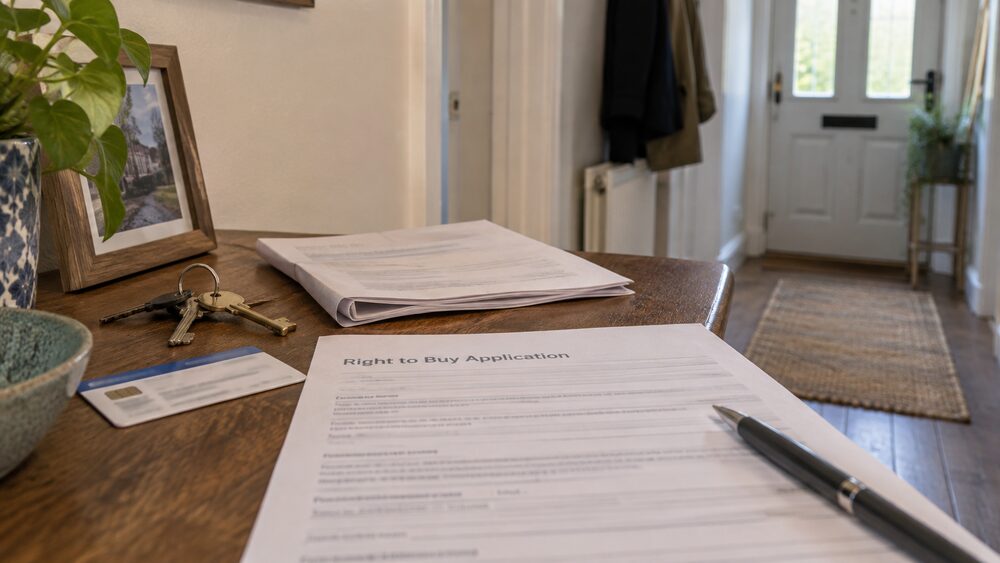
When a residential lease is first drawn up it usually lasts for up to 125 years, though leases of 99 years are common and it is possible to have one for up to 999 years1. Right to Buy leases are typically granted for 125 years14. The number on the lease is not fixed for life: it counts down from the day it was granted, so a 125-year lease sold after 15 years leaves the buyer a 110-year lease14.
That countdown is the single most important number in a leasehold purchase, because it drives both value and mortgageability. A lease with fewer than 80 years remaining can seriously affect both the value of your property and the amount it will command, and many mortgage providers will refuse to lend on a property with fewer than 80 years left1. One lender's guidance puts the difficulty at fewer than 80 years, another at fewer than 70, so the threshold is not identical everywhere8.
Ground rent, service charges and other leasehold costs
A leasehold usually carries two extra charges on top of the mortgage, paid monthly or every year: ground rent, which is rent for the ground your property sits on, and a service charge, which covers maintaining the building and grounds11. You may pay service charges and, depending on your lease, ground rent or other charges2. These can increase over time11.
The service charge is the one that varies most. When you own a leasehold flat you will usually pay a service charge to your landlord or management company to maintain any common areas of the building, and it is normally apportioned to the number of units1. Owner occupiers can face service charges too if the home was bought on a leasehold basis16. Leaseholders are also required by law to pay the freeholder's reasonable legal and own valuation costs when extending a lease17.
| Cost | What it covers | Who pays |
|---|---|---|
| Ground rent | Rent for the ground the property sits on11 | Leaseholders, where the lease provides for it |
| Service charge | Maintaining the building and common areas1 | Leaseholders, apportioned by unit |
| Maintenance and repairs | Upkeep of the building and land1 | Freeholders, directly |
| Conveyancing | Buying a leasehold costs around £300 more than a freehold18 | Buyer |
There is help in some circumstances. Owner-occupiers who are leaseholders may get help to pay service charges through the housing costs element of Universal Credit, subject to payment, liability and occupation conditions and provided neither they nor a partner has earned income19. If you own a leasehold property you may also be able to get help to pay some service charges and ground rent through a Support for Mortgage Interest loan20. Falling behind on these charges is treated as a debt in its own right, and service and ground charge arrears sets out what happens next.
What a lease can stop you doing
A lease is a set of rules as well as a title. There could be clauses written into the lease that affect what you can do, for example pets, subletting or changing the layout4. Leaseholders have to get permission from the freeholder to make certain alterations to the property, and you may need permission for some changes depending on the terms of your lease1. If you are a leaseholder and want to take in a lodger, you might also need permission from the freeholder21.
Shared ownership leases are tighter still. The standard shared ownership lease does not permit the leaseholder to sub-let or part with possession of the property in any other way until staircasing to 100% ownership22. In Wales the lease does not allow sub-letting at all, permitted only in exceptional circumstances for serving Armed Forces personnel with prior landlord approval, though lodgers are permitted23. If you are considering that, can you rent out a shared ownership home goes through the conditions.
Reform is changing the balance. The Leasehold and Freehold Reform Act 2024 introduced changes designed to give leaseholders more rights and change the process for extending a lease or buying a freehold2. The Act prohibits commissions from the placer or manager of insurance from being recovered from leaseholders through their service charge10. In its current form, later legislation would ban the use of leasehold for most new flats to make commonhold the default tenure, and new leasehold houses are being banned in England and Wales other than in exceptional circumstances, so every new house will be freehold from the outset1. Failure to comply with the restrictions on new leasehold houses could result in a fine ranging from £500 to £30,000 per infraction10.
Getting a mortgage: lenders check the lease length
For a freehold, there is no lease for the lender to assess, although other property checks still apply2. For a leasehold, lenders may consider the lease length, costs and terms before deciding whether to lend2. That is why the 80-year mark matters so much: it is not only about value, it is about whether a buyer can get a mortgage at all1.
Different lenders set their own rules. Equity release providers might want an unexpired term of at least 75 or 80 years25. One lifetime mortgage product requires the remaining term plus the age of the youngest borrower at completion to be at least 175 years26. Some lenders will ask for written confirmation from the freeholder or management company that all ground rent and service charges are paid and up to date before the mortgage offer is issued27.
Two other structures need checking. A mortgage lender may need to assess the lease even where you own a share of the freehold2. And with a flying freehold, where part of a property sits over land belonging to someone else, some lenders may need to check the ownership and legal arrangements before deciding whether to offer a mortgage2.
If you are working out what you can borrow, mortgages covers how lenders assess affordability, and buying a leasehold property deals with the specific checks a leasehold purchase triggers.
When a lease runs out: ownership returns to the freeholder
A lease is a wasting asset. When the lease ends, ownership returns to the freeholder unless the lease is extended, and once the lease expires the ownership of the home reverts to the owner of the land7. Once the lease runs out, ownership of the entire property reverts back to the freeholder1.
For a shared owner the outcome is harsher. If possession is ordered, the shared owner would lose their interest in the property and ownership would return in full to the landlord, and they would also lose any capital payment made when the lease was granted29. That is why shared ownership arrears is a serious situation rather than a payment hiccup.
In practice, very few leases are allowed to run to zero. The market expects a lease to be extended well before the 80-year mark, because a short lease is hard to sell and hard to mortgage1. The alternative routes are set out below.
Extending your lease or buying the freehold: recent reforms
If you hold a short lease you may be able to buy the freehold, or a share of the freehold with other flat owners, or extend the term of the lease30. The Leasehold and Freehold Reform Act 2024 reshaped all three routes2.
The headline change is length. The Act gives tenants of houses and flats the right to a 990-year lease extension, increasing the standard term from 90 years for flats and 50 years for houses, with ground rent reduced to a peppercorn, meaning zero financial value, on payment of a premium1. Leaseholders of flats and houses get the same right to extend as often as they wish, at zero ground rent, for a term of 990 years6. There is also a new right for leaseholders who already have very long leases, with over 150 years remaining, to buy out their ground rent10.
The two-year ownership rule is gone. Leaseholders no longer need to live in a property for two years before they can extend their lease or buy the freehold, and the requirement for a new leaseholder to have owned their house or flat for two years before benefiting was removed1. The change took effect from 31 January 202531.
Costs have moved too. Leaseholders extending their lease, buying their freehold or exercising their right to manage will no longer generally pay their freeholder's costs, with each party bearing their own10. The presumption for leaseholders to pay their freeholders' legal costs when challenging poor practice was scrapped9. The so-called marriage value, which makes it more expensive to extend leases when they are close to expiry, was removed9.
Other changes widen who can act. The non-residential limit preventing leaseholders in mixed-use buildings from buying their freehold or taking over management rose from 25% to 50% of floorspace9. Freehold homeowners on private and mixed tenure estates are to get the same rights of redress as leaseholders, including transparency over estate charges and the ability to challenge them at a tribunal, and freeholders who manage their property will be required to belong to a redress scheme9. Leaseholders are also to get greater transparency about service charges, with freeholders and managing agents required to issue bills in a standardised format1.
What you pay for an extension depends on the value of the property, the number of years left on the lease, the annual ground rent, the value of improvements paid by the leaseholder and the expected rate of return on investments17. On top of the premium you pay for the extra years, there are legal advice, a lease extension valuation report, the freeholder's reasonable legal and own valuation costs, and Land Registry fees17. Government consultations on valuation rates and on who pays the costs of the enfranchisement process were published in July 2026, closing in September and October 202631.
Scotland works differently
In Scotland, very few properties are sold as leaseholds, and land and property ownership is different from the rest of the UK1. There is not the same issue with leasehold properties, as very few homes are sold with this type of ownership24.
Lenders reflect that. Acceptable tenure is described as freehold or leasehold in England and Wales, or their Scottish equivalent, and Scottish properties must be absolute ownership or heritable32. Scotland's housing and tenancy laws can differ from the rest of Great Britain, which affects how rules work in practice21.
There is one quirk worth knowing if you own a share of the freehold in Scotland. The Financial Ombudsman Service can look at your complaint if all the freehold owners bring it together; otherwise it assesses the complaint as if you were a leaseholder34. Repossession law in Scotland is also different from the rest of the UK35.
If you are buying north of the border, buying a home in Scotland covers the process, and money in Scotland, Wales and Northern Ireland sets out where the rules diverge.
Sources35 cited
- Leasehold vs freehold Which?
- Freehold, leasehold and commonhold explained TSB
- Mortgage jargon buster StepChange
- Difference between freehold and leasehold HSBC UK
- Mortgages explained Saffron Building Society
- Leasehold and commonhold reform House of Commons Library
- Home buying and selling jargon HomeOwners Alliance
- Equity sharing nidirect
- Guide to the Leasehold and Freehold Reform Bill GOV.UK
- Leasehold and Freehold Reform Act 2024 legislation.gov.uk
- Difference between leasehold and freehold Yorkshire Building Society
- What is shared ownership? HSBC UK
- Why are shared ownership customers responsible for major structural works? National Housing Federation
- Your right to buy your home: a guide GOV.UK
- Leaseholder contribution caps GOV.UK
- Buying or owning a leasehold property GOV.UK
- Leasehold extension calculator HomeOwners Alliance
- Cost of buying house calculator HomeOwners Alliance
- Universal Credit housing costs element Turn2us
- Help with your rent or mortgage Independent Age
- Tenant deposits: protection mygov.scot
- Key information for shared owners of flats in England GOV.UK
- Shared ownership Wales buyers' guide Welsh Government
- Leasehold rent to be capped at £250 Which? News
- Interest Roll Up Lifetime Mortgage product summary Legal & General
- Application checklist Together Money
- Finding a home Leeds Building Society
- Jargon buster Progressive Building Society
- Can shared owners lose their investment if they do not pay rent? National Housing Federation
- Can I get equity release on a leasehold property? Equity Release Council
- Should you wait for cheaper lease extensions? Which? News
- Residential lending policy Newcastle Building Society
- Residential products and criteria The Mortgage Lender
- Multiple occupancy buildings insurance Financial Ombudsman Service
- Repossession GOV.UK



 MoneyHelperFree, impartial money and pensions guidance, set up by government
 Citizens AdviceFree advice on money, consumer and legal problems in England and Wales
 ShelterFree housing advice from a charity
 GOV.UKOfficial information on tax, benefits and government services
 Financial Ombudsman ServiceFree, independent help when a complaint about a firm is not put right