
Yes. On a shared ownership home in England or Northern Ireland, Stamp Duty Land Tax can be paid in one of two ways: as a single payment on the full market value of the property at the outset, or in stages, paying only on the share you are buying now and again each time you buy more1. The staged route is the one most shared owners use, because it keeps the initial bill down.
Yes. On a shared ownership home in England or Northern Ireland, Stamp Duty Land Tax can be paid in one of two ways: as a single payment on the full market value of the property at the outset, or in stages, paying only on the share you are buying now and again each time you buy more1. The staged route is the one most shared owners use, because it keeps the initial bill down.
The trade-off is that the staged route leaves tax to pay later. Each time you increase your share, a further charge can arise on the extra slice, so the total paid over the life of the purchase can end up higher than a single upfront payment on the whole value3. Which route suits depends on how much cash you have at completion and whether you expect to staircase.
The tax itself is not the same everywhere in the UK. Stamp Duty Land Tax applies in England and Northern Ireland only4. Scotland and Wales run their own property taxes, and the Right to Shared Ownership scheme is not available in Scotland, Wales or Northern Ireland at all5.
Yes: pay upfront on the full value or in stages on your share
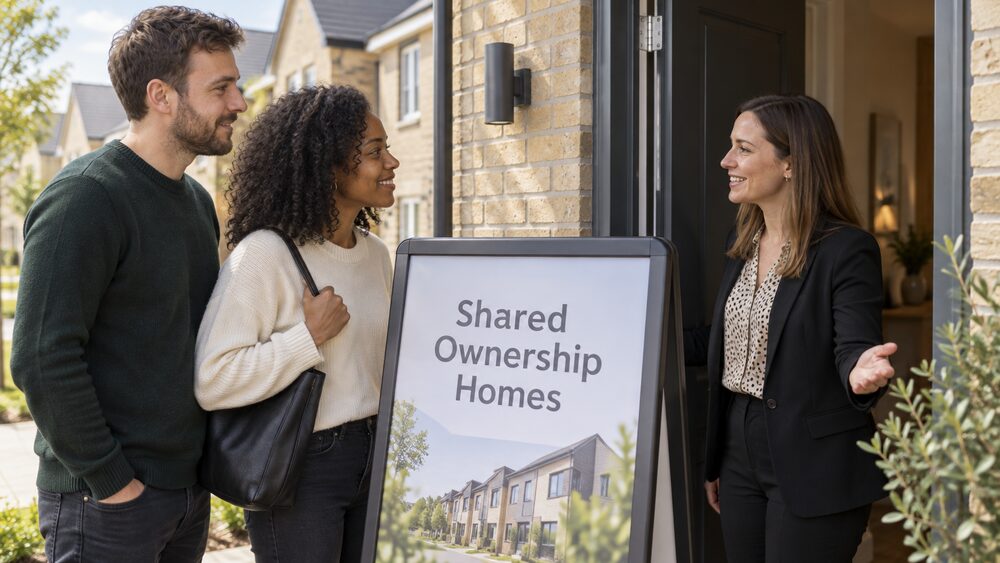
Shared ownership splits a purchase. You buy a share of the property, usually between 25% and 75%, and pay rent to a housing association on the rest9. Under the Right to Shared Ownership scheme the initial stake can be anywhere from 10% to 75% of full market value5. Because you are buying a legal interest in land, the purchase can trigger Stamp Duty Land Tax, and the scheme gives you a choice of two ways to pay1.
The first is to pay on the whole home. You settle the tax on the full market value at completion, pay more now, and do not pay again when you buy further shares1. The second is to pay in stages on your share. You pay tax based on the share you buy now, then more later if you increase your share above 80%2. The staged option is what makes shared ownership affordable at the point of purchase, because the tax bill is calculated on the slice you actually own rather than the whole property.
Whichever route you take, the tax is payable at the point of completion10. It is not spread over the life of the mortgage, and it is not paid monthly alongside the rent. Your conveyancer normally handles the return and the payment as part of the completion process.
How Stamp Duty is worked out: rates and bands on a main home
For an ordinary home purchase, Stamp Duty Land Tax is charged in bands on the portion of the price that falls within each band. The rates that apply depend on whether the purchase is a main residence or an additional dwelling, and on whether any relief applies.
The higher rates table for additional dwellings, set out in the legislation, charges 5% on the portion up to £125,000, 7% on the portion from £125,001 to £250,000, 10% on the portion from £250,001 to £925,000, 15% on the portion from £925,001 to £1,500,000, and 17% on anything above that11. Those are the rates for people who already own a property and are buying another.
For a shared ownership purchase, the calculation is done on the share you are buying, not the full value, if you choose the staged route. That is why the initial bill is usually small. On a modest share of a modest property, the chargeable amount can fall entirely within the lowest band or below the starting threshold.
The documents in this area do not agree on every figure. One independent guide gives the additional property band from £125,001 to £250,000 as 7%, while another part of the same guidance gives a different rate for the same band6. Where the sources conflict, both figures stand and the exact rate for your purchase should be confirmed with your conveyancer.
First-time buyer relief on a shared ownership home: up to £300,000 or £425,000
First-time buyer relief reduces the Stamp Duty bill for people buying their first home. The relief is not available on transactions over £500,000, and any value between £300,000 and £500,000 is taxed at 5%6. The cap matters for shared ownership because the relief is assessed against the property, so a home valued above the cap does not qualify even if the share you are buying is small.
There has been movement on the maximum purchase price for the relief. A parliamentary briefing records an increase in the maximum amount a first-time buyer can pay for a house and still be eligible, from £500,000 to £625,0004. That change is recorded in the briefing, and the £500,000 cap is the figure given in the current guidance6. Where the two differ, both are stated here and the position for a particular purchase should be checked.
The relief is tightly defined. The legislation requires that the purchaser, or each of the purchasers if there is more than one, is a first-time buyer who intends to occupy the purchased dwelling as their only or main residence12. That means joint buyers must both qualify. If you are buying with a partner and only one of you is a first-time buyer, the relief is not available on that purchase13.
Inheriting a property removes the entitlement. If you have ever inherited a property, or part of one, you are not considered a first-time buyer15, and the same rule is stated in guidance on the tax itself: if you have inherited property you will not be classed as a first-time buyer14.
Paying in stages: what happens when you staircase
Staircasing is the process of buying more shares in your shared ownership home over time, with the aim of eventually owning it outright16. Each time you buy a further share, you must pay Stamp Duty on that purchase. The choice you made at the outset determines how: either as a one-off lump sum based on the total market value of the property, or in stages as your share grows3.
The increments available depend on the scheme and when you bought. Under the Right to Shared Ownership scheme you can buy more shares in the future and pay less rent on the rest of the property5. A new national model for shared ownership allows new shared owners to buy additional shares in 1% increments for up to 15 years, with heavily reduced fees17. Older arrangements differ: in England, staircasing has typically been in 5% steps, or 1% a year for up to 15 years, with purchases of 5% or more requiring a valuation and an administration fee18. In Northern Ireland, Co-Ownership staircasing works in 5% steps with a subsidised valuation fee18.
The practical consequence is that the staged route creates a series of smaller tax events rather than one large one. Each staircase purchase is a separate transaction for tax purposes, and each one needs its own return if it is chargeable. That is why the staged route can cost more in total: you are paying tax on each slice as you buy it, and the administrative work repeats.
Upfront or in stages: how each choice plays out
The two routes suit different circumstances, and the difference is mostly about cash flow and certainty.
Paying upfront on the full value means a larger bill at completion, calculated on the whole property rather than your share. In exchange, no further Stamp Duty arises when you staircase, because the tax on the full value has already been settled1. For a buyer with the cash available and a firm intention to staircase to 100%, this removes a series of future tax events and the administration that goes with them.
Paying in stages means a smaller bill now, based on the share you are buying2. The cost is deferred rather than avoided, and it recurs each time you increase your share3. For a buyer whose priority is keeping the deposit and completion costs manageable, this spreads the tax across the life of the purchase. The total paid can be higher than the upfront route, because each staircase purchase is taxed separately.
There is a further consideration for anyone buying with help from someone who already owns a home. If a parent already owns a property and buys jointly with a child, the parent must pay second property stamp duty rates19, and the second property surcharge can run to thousands of pounds20. The surcharge on additional properties in England and Northern Ireland is 5%7. The rules on who is treated as holding a property interest are detailed, and they extend to cases involving settlements and bare trusts, where a parent can be treated as holding a dwelling interest on a child's behalf11.
| Route | What you pay at completion | What happens later |
|---|---|---|
| Upfront on full value | Tax on the whole property1 | No further tax when you staircase1 |
| In stages on your share | Tax on the share you buy now2 | Further tax on each extra share3 |
Returns, deadlines and late payment penalties
A Stamp Duty Land Tax return is required where you take over a property and pay money or take on a debt, such as a mortgage, for it21. Buying a leasehold property can also require a return, depending on how much you pay for the lease21. Shared ownership purchases are normally bought on a long leasehold basis, with the buyer registered at the Land Registry as legal owner of the registered title22.
The return must be filed on time, and using a representative does not shift the duty. Even if a solicitor or conveyancer sends the return, the taxpayer remains responsible for making sure it reaches HMRC on time and with the correct information8. HMRC charges a late filing penalty and interest if a Stamp Duty Land Tax return is not filed on time8.
In Scotland the equivalent tax is Land and Buildings Transaction Tax, and Revenue Scotland may charge penalties and interest if a return is not submitted or the tax is not paid on time23. First-time buyer relief exists in Scotland too, with a maximum amount of relief that can be claimed, illustrated in official guidance by a £250,000 purchase on which £1,500 of LBTT was due and the relief was capped at £60024.
Does Stamp Duty apply to shared ownership homes in Scotland or Wales?
Not in the same form. Stamp Duty Land Tax applies in England and Northern Ireland only4. Scotland has Land and Buildings Transaction Tax, and Wales has Land Transaction Tax, which replaced Stamp Duty Land Tax on residential and non-residential property and land interests from 1 April 201825. Each is run by its own revenue body, and each has its own rates, reliefs and filing rules.
The shared ownership landscape differs too. The Right to Shared Ownership scheme is England only and is not available in Scotland, Wales or Northern Ireland5. Scotland runs shared equity schemes instead, including Help to Buy (Scotland) successor arrangements and the Open Market Shared Equity scheme, where buyers pay for their share of the home's price along with other costs such as legal costs, registration fees and any stamp duty26. The First Homes Fund in Scotland offers up to £10,000 towards the cost of a property worth up to £300,00027. In Wales, Help to Buy - Wales is a shared equity loan scheme for homes up to £300,000, open to first-time buyers and home movers28. Northern Ireland has Co-Ownership rather than shared ownership in the English sense18.
If you are buying outside England and Northern Ireland, the tax that applies is the one for that nation, and the reliefs and deadlines are set by its own revenue body. The pages on Land and Buildings Transaction Tax and Land Transaction Tax set out how those work.
Do I pay Stamp Duty on the rent I pay to the housing association?
No. Stamp Duty Land Tax is charged on the acquisition of a property interest, not on rent. On a shared ownership home you buy a percentage share and pay rent on the remainder to a housing association9. Under the Right to Shared Ownership scheme, that means buying a percentage of the property and paying a reduced rent on the rest13. The tax attaches to the share purchase, not to the ongoing rent.
Rent is a separate cost, and it can be supported. If you have a shared ownership tenancy, your housing costs payment can include an amount for your rent29. That matters for anyone working out the true monthly cost of a shared ownership home, because the rent sits alongside the mortgage payment on the share you own.
The distinction also matters for staircasing. When you buy a further share, the rent on the remaining share falls, and a further tax charge can arise on the purchase. The rent and the tax are separate calculations, and neither is offset against the other.
Where to get help
Stamp Duty on a shared ownership purchase is worked out by your conveyancer as part of the completion process, and the return is normally filed by them. Because the choice between paying upfront and paying in stages affects both the bill now and the bills later, it is worth raising the question early, before exchange, so the figures can be built into your budget.
If you are buying in Scotland or Wales, the equivalent tax and its reliefs are handled under that nation's rules, and the same principle applies: the conveyancer calculates and files. Free, impartial guidance on buying a home and on the costs involved is available from MoneyHelper, and the pages on the costs of buying a house and Stamp Duty Land Tax set out the wider picture.
Sources29 cited
- Shared ownership mortgages NatWest, 2026-09-25
- What is Stamp Duty Land Tax? Experian, 2026
- Shared ownership mortgages Lloyds Bank, 2026-09-27
- Stamp Duty Land Tax: research briefing House of Commons Library, 2026-07-08
- Right to Shared Ownership GOV.UK, 2026-09-26
- Review of Land and Buildings Transaction Tax Scottish Government, 2026-03-25
- Deadline approaches for Making Tax Digital quarterly update GOV.UK, 2026-07-23
- How to send a Stamp Duty Land Tax return GOV.UK, 2026-06-26
- How much deposit do you need for a mortgage? Which?, 2026-04-02
- Home buying and selling jargon HomeOwners Alliance, 2026-07-31
- Stamp Duty Land Tax: higher rates for additional dwellings legislation.gov.uk, 2026
- Stamp Duty Land Tax: first-time buyer relief legislation.gov.uk, 2026
- Shared ownership National Housing Federation, 2026-09-26
- Buying your first home Furness Building Society, 2026-09-26
- First-time buyer mortgages Cumberland Building Society, 2026
- Mortgage jargon buster StepChange, 2026-09-25
- Evaluation of the Help to Buy scheme GOV.UK, 2026-07-08
- Shared ownership in Northern Ireland Co-Ownership, 2026-09-26
- How can parents help first-time buyers? Which?, 2025-12-16
- Guarantor mortgages Which?, 2026-04-02
- Check if you need to send a Stamp Duty Land Tax return GOV.UK, 2026-06-26
- Why is shared ownership considered ownership? National Housing Federation, 2026-09-26
- Land and Buildings Transaction Tax: residential property Revenue Scotland, 2026-09-26
- LBTT first-time buyer relief Revenue Scotland, 2025-11-19
- Land Transaction Tax statistics Welsh Government, 2026-09-28
- Open Market Shared Equity scheme: how to apply mygov.scot, 2026-03-17
- First Homes Fund Scottish Government, 2026-09-26
- Help to Buy home schemes Welsh Government, 2026
- Can I get Universal Credit housing costs element? Turn2us, 2026-02-25



 MoneyHelperFree, impartial money and pensions guidance, set up by government
 Citizens AdviceFree advice on money, consumer and legal problems in England and Wales
 ShelterFree housing advice from a charity
 GOV.UKOfficial information on tax, benefits and government services
 Financial Ombudsman ServiceFree, independent help when a complaint about a firm is not put right