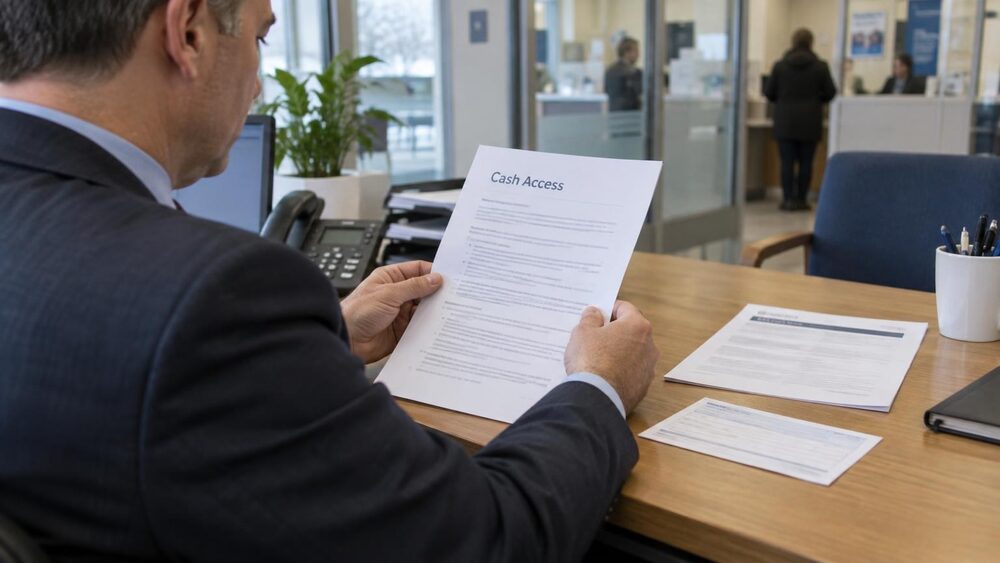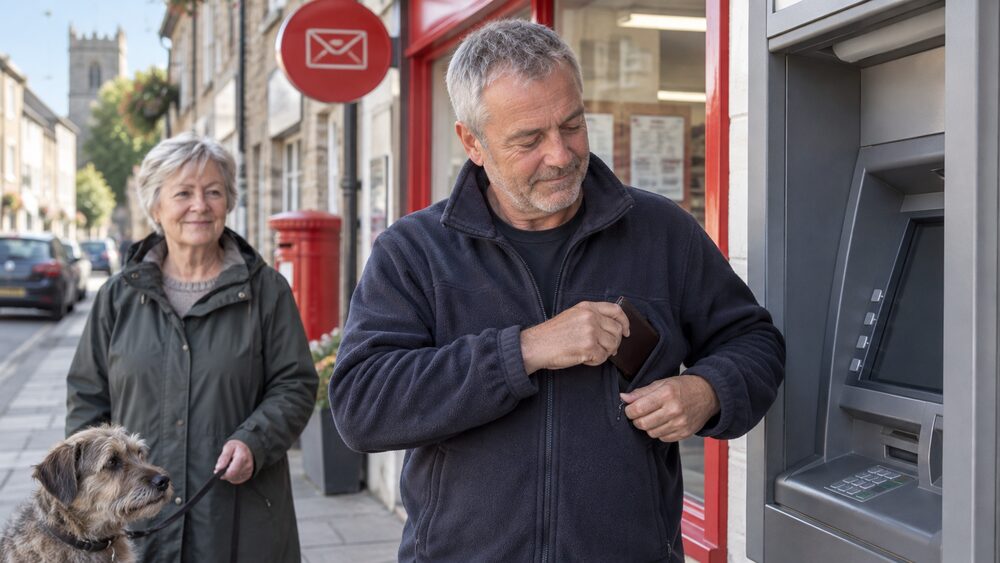
Getting hold of cash, and paying it in, still depends on a physical network: cash machines, Post Office counters, bank branches and the newer banking hubs. Most of that network is free to use if you have a current account, and rules now in force mean banks and building societies have to check that an area keeps adequate access to cash before they close a branch or machine. More than 95% of the UK population lives within the distances the Treasury has set for access to free cash1.
The rules matter because the network keeps shrinking. The number of bank branches and cash machines has been falling over the past decade as consumers increasingly use online banking and digital payments2. When a closure is planned, LINK, the ATM network run by banks, assesses the local area and can recommend replacements, including new cash machines or a banking hub2. As of 19 August 2025, 178 banking hubs had opened across the UK3.
This page explains where you can get cash and pay it in, how the free cash machine network is protected, what banking hubs do and do not do, what happens when a branch or machine closes near you, and how to ask LINK to review your own area.
Where you can get cash: free cash machines, Post Offices, banks and cashback
Most people get cash from a cash machine using their debit card. Some banks also let you cash a current account personal cheque or use your cash card at the Post Office, free of charge6. Post Office branches offer simple banking facilities, withdrawing and depositing cash and cheques, for customers of nearly all banks7, though exactly what you can do depends on who you bank with: withdrawing cash, paying in cheques, checking your balance or paying bills8.
If you do not have a bank account at all, there are other routes. People who cannot get a bank or building society account can collect a benefit or State Pension payment in cash at a Post Office through the Payment Exception Service9, using vouchers that can be swapped for cash at a Post Office or PayPoint outlet, often found in a corner shop, loaded onto a payment card or sent by email or text message10. Credit union current accounts usually let you pay in or take out cash at the credit union itself, alongside online, mobile or telephone banking11, and credit union members can also withdraw by cashing a cheque at a local Post Office, from a local credit union office, or by debit card at a cash machine where the credit union operates a current account12. In a crisis, a council may give you a barcode or PIN to get money from a cash machine, post office or PayPoint shop13.
To find your nearest options, the LINK Cash Locator Tool gives the location of ATMs, bank branches, post offices and banking hubs14. The dedicated pages on banking at the Post Office, paying cash and cheques into your account and whether cash machines are free to use cover each route in more detail.
Coverage: more than 95% of people live within reach of free cash
The Treasury has set the distances that count as reasonable access to cash. For predominantly urban areas the relevant distance is within 1 mile of where at least 95% of people live; for predominantly rural areas it is within 3 miles4. The Financial Conduct Authority publishes coverage data against those distances, and its 2025 second-half figures continue to show more than 95% of the UK population within them1.
The detail behind the headline shows how close the network still comes to most homes:
| Measure | Urban (within 1 mile) | Rural (within 3 miles) |
|---|---|---|
| Free cash withdrawal point | 99.6% of urban population | 98.1% of rural population1 |
| Free cash deposit point | 97.2% of urban population | 97.3% of rural population1 |
Withdrawal coverage counts any bank, building society, Post Office branch or any free ATM; deposit coverage counts designated banks and building societies providing personal current accounts and the Post Office, including mobile bank branches1. Earlier measurements tell a similar story: in 2021 the FCA estimated that 95.4% of the UK population was within 2km of a free cash access point and 99.7% within 5km15, and in 2022 a Scottish Affairs Committee report put free cash access within a mile and a quarter for 95.5% of the population, and within three miles for 98.3% of people in rural areas16.
Coverage is not the same as convenience. A distance that is manageable with a car can be a serious journey without one, and the figures are averages across whole local authorities. The rules described later in this page, which require banks to assess an area before closing a branch or machine, exist precisely because the averages can hide places where access is thin.
Free and paying cash machines: how LINK protects isolated ATMs
LINK is the network of cash machines that gives you access to your bank account from almost anywhere in the UK17. Technically, the LINK ATM system is the main network connecting UK card issuers and ATM providers, enabling cardholders to obtain cash from their bank accounts, with over 100 million LINK-enabled cards in circulation18. When you withdraw cash at an ATM belonging to your own bank or building society, the LINK system is not involved at all18.
Most UK cash machines are free to use because the bank that issued your card pays the ATM operator a fee, called the interchange fee, for each withdrawal. LINK sets higher fees for withdrawals from isolated and low-use ATMs, to make running them more attractive to ATM operators2. Under LINK's financial inclusion programme, it protects the interchange fee for any free-to-use ATM that is one kilometre or more away from the next nearest free-to-use ATM, with support also available to deprived areas that do not have a free ATM within a kilometre19. LINK announced a strengthened financial inclusion programme with the aim of ensuring that free-to-use ATMs are maintained across the UK and that all communities retain free access to cash18.
This protection is backed by regulation. The Payment Systems Regulator has issued Specific Direction 8, which requires LINK to do all it can to fulfil its commitment to maintain the broad geographic spread of free-to-use ATMs20, a direction designed to make sure LINK does all it can to keep that spread in place21. The regulator continues to oversee LINK, the ATM network, making sure people and businesses have access to cash across the UK22, and retains oversight of LINK as a designated payment system, working closely with the FCA in its oversight of LINK as a designated cash access coordination body22.
What banking hubs offer at the counter and on community banker days
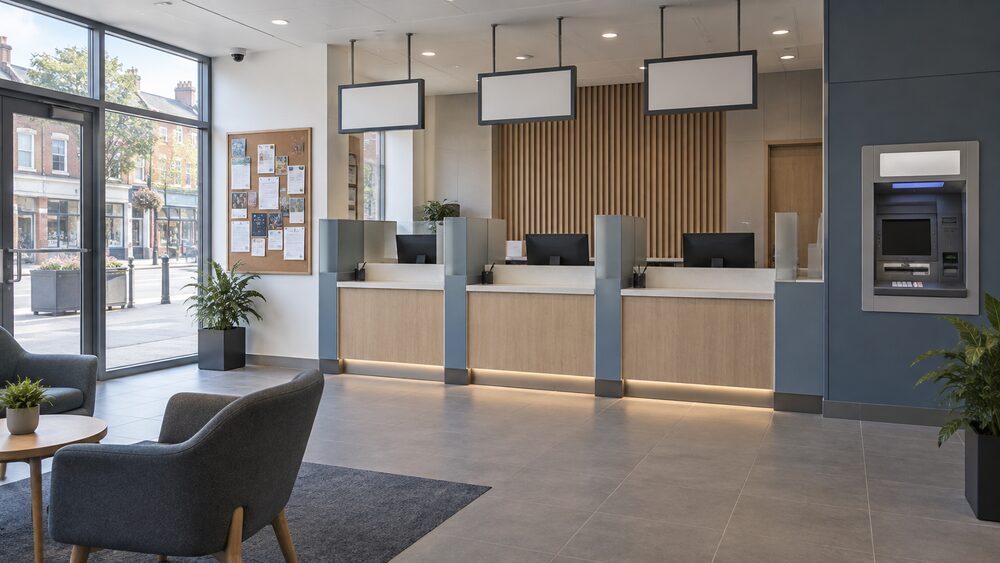
A banking hub is a shared counter for a whole town. Hubs are set up by LINK, after identifying areas where people need cash and banking services, and the Post Office is then brought in to run each site and provide cash services to the local community23. The counter services are run by Post Office staff, where personal and business customers of any bank signed up to the hub's services can do their everyday banking3.
At the counter you can pay cash in or take cash out, including coins, pay in cheques, pay bills and check your balance24. The counter service is accessible to customers of all participating banks, Monday to Friday 9.00am to 5.00pm, and is not restricted to your own bank's community banker day24.
On top of the shared counter, each participating bank sends a community banker to the hub on a designated day. Community bankers are available from Bank of Ireland, Barclays, Bank of Scotland, Danske Bank, Halifax, HSBC, Lloyds Bank, NatWest, Royal Bank of Scotland, Santander, TSB, Ulster Bank and Virgin Money23. A Danske Bank community banker, for example, is available at various banking hub locations on designated days to support both business and personal customers24. Community banker days are the place for conversations the counter cannot handle, such as opening products or sorting out a problem with your account.
Research into hubs in Northern Ireland in July 2026 gives a picture of how they are actually used. Among consumers who were customers of a bank operating in a hub, nearly two in five (39%) had used it25. Of those who had used it, withdrawing cash was the most common activity (59%), followed by paying a bill (48%) and depositing cash or a cheque (44%)25. Almost three-quarters (73%) of consumers who used a hub were satisfied with it, and around four in five (81%) of businesses that used one were satisfied25. Satisfaction with specific facilities was more mixed: 51% of consumer customers believed the cash withdrawal facility met their needs, 46% believed cash and cheque deposits met their needs, 45% believed bill payments met their needs, 43% believed access to a community banker met their needs, and 39% believed balance checking met their needs25.
Who can use a banking hub, and what to take with you
Any customer of a participating bank can use the counter, for personal or business banking, on any weekday24. You do not need to wait for your own bank's community banker day for counter services, though you do need that day if you want to speak to your own bank's staff about something beyond a basic transaction24.
What to take depends on what you are doing:
- Withdrawing cash or paying bills: your bank card and PIN, as you would at any counter.
- Paying in cash or cheques: your card, and the cheques made out to your account.
- Speaking to a community banker: anything relevant to the matter, and identification if you are opening or amending an account. Banks usually ask for ID such as a driving licence, passport, recent bills or official documents10.
- No passport or photocard driving licence: ask the bank what forms of ID it will accept before you try to open an account26. Most banks ask for a driving licence or passport, or a photo of these online, but other documents, such as letters from DWP, HMRC, JobCentre Plus, a local council, a GP, a social landlord, an employer or a college, may be accepted27.
Businesses are heavy users of hubs. A Treasury Committee report in 2024 noted that 80% of businesses had used their local hub since it opened, and 53% of firms said they saved time going to their nearest banking hub rather than having to travel further to a bank branch28. Among businesses in the 2026 Northern Ireland research, 97% were aware of the hub in their area, 45% had used it, and 68% had received a communication from their bank about the service25.
Paying in cash: deposit machines, hubs and monthly limits
Paying cash in is a separate service from taking it out, and it is covered by its own part of the coverage rules. The FCA's 2025 figures show 97.2% of the urban population and 97.3% of the rural population within the Treasury's distances of a free-to-use deposit point1. The rules require banks to provide access to both notes and coins, free of charge for consumers with personal current accounts5.
The routes for paying in cash include your own bank's deposit machines, Post Office counters, banking hub counters and multi-bank deposit ATMs. At a banking hub you can pay cash or cheques into your account, take out money and check your available balance23, though cash withdrawal and deposit limits apply24.
Limits are set by each bank and by the channel, and they have been tightening. From 21 September 2026, HSBC limits cash deposits at its deposit machines, Post Offices, banking hubs and multi-bank ATMs to £3,000 per day and £15,000 per calendar year, with larger deposits requiring an HSBC branch with counter service. Multi-bank cash deposit machines have their own limits, reported as £500 per day and £5,000 in a rolling 12-month period. These caps are anti-money-laundering measures rather than a withdrawal on service, but they mean that anyone handling large amounts of cash, such as a small business taking weekend takings to a hub, may find the channel closed to them part-way through the year.
The page on paying cash and cheques into your account covers the process, and cheque clearing times explains how long a paid-in cheque takes to become available.
Deposit limits: how much cash you can pay in each month and year
The headline limits worth knowing are the daily and annual caps described above: HSBC's £3,000 per day and £15,000 per calendar year from 21 September 2026 across deposit machines, Post Offices, banking hubs and multi-bank ATMs, and the multi-bank machines' reported £500 per day and £5,000 in a rolling 12-month period. Other banks set their own figures, so the exact cap depends on who you bank with and which channel you use.
Two things follow from how these limits work. First, they are cumulative across channels: a deposit at a hub and a deposit at a Post Office on the same day count together towards the daily cap. Second, the annual cap runs on the calendar year at HSBC, while the multi-bank machine limit rolls over 12 months, so the timing of large deposits affects how much headroom is left.
For most people paying in wages or small amounts of cash, the limits never bite. They matter mainly to cash businesses and to people who handle cash for someone else, such as a carer or a person with power of attorney. If a limit is reached, the remaining options are a branch with a counter service, or paying the cash in over several days within the caps.
When a bank branch or cash machine closes near you
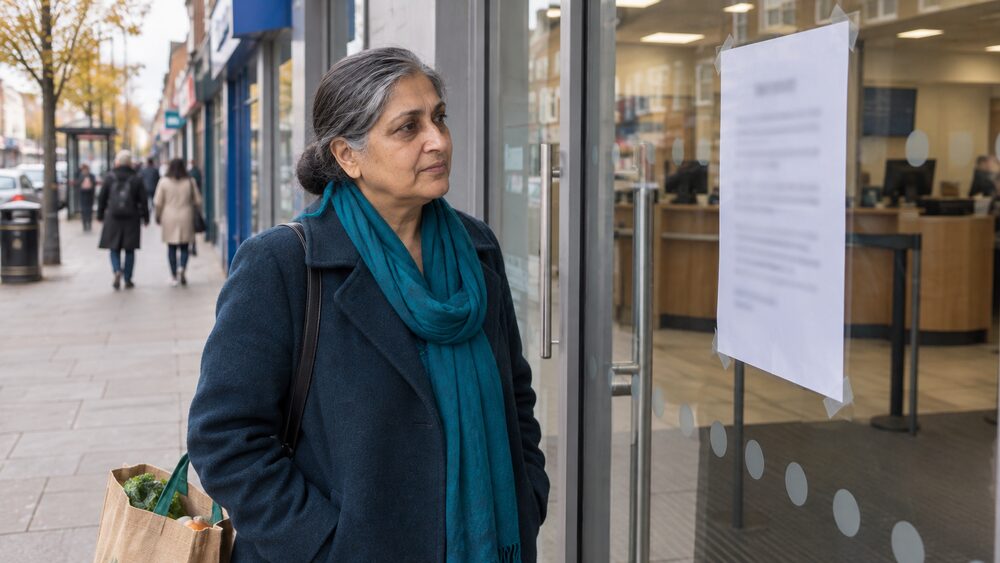
Banks must tell customers about a branch or ATM closure at least 12 weeks before it takes effect5. Under the FCA's access to cash rules, a firm closing a branch or cash machine must first assess whether the area will still have adequate access to cash, and if it will not, put alternatives in place, which can include a new ATM, a banking hub or a mobile branch5. Closures announced before the rules came into force are not subject to the new regime5.
The pressure is real. During April to June 2020, fewer than 12% of all UK branch locations and fewer than 12% of ATM sites closed, and in most local authorities between 0 and 1% of the population lost access to cash near their homes29. That episode showed how quickly local gaps can open even when the national picture looks stable. LINK has recommended 77 banking hubs as part of its response to identified gaps28, and 178 hubs had opened across the UK as of 19 August 20253.
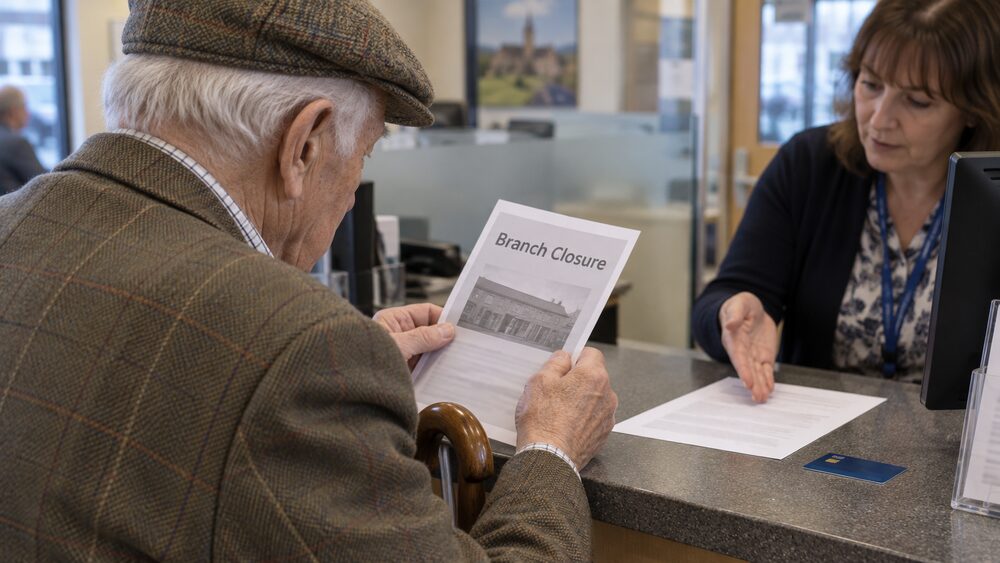
What a closure means for you depends on what is left. In one complaint the Financial Ombudsman Service looked at, a customer's local branch closed and the alternative branch in the next town, two miles away, was open30. The ombudsman's role in these complaints is limited: it can look at how the bank handled the closure, but it cannot order a branch to stay open. The pages on bank branch closures and what replaces them, how much notice a bank must give and the Access to Banking Standard set out the process and your options, including switching to a bank with a branch you can reach.
How to request an access to cash review from LINK
You do not have to wait for a bank to act. LINK runs access to cash reviews when banks plan closures, or if local residents ask for a review, and a review can result in new ATMs or banking hubs2. You can ask LINK to review your community's access to cash on its Request Access to Cash Review webpage31. If LINK finds that a planned closure would cause an unacceptably low level of access to cash, it can recommend new services be put in place32.
The process in order:
- Make the request. A resident, a group of residents or a community organisation contacts LINK through its Request Access to Cash Review webpage31. A bank planning a closure triggers the same assessment2.
- Notice period. Any closure the review relates to must have been communicated to customers at least 12 weeks before it takes effect5.
- Assessment. LINK looks at the local area's cash access, including branches, cash machines and Post Office services2.
- Finding. LINK judges whether the level of access would be unacceptably low32.
- Outcome. If it would, LINK can recommend a new cash machine or a banking hub for the area2.
There are limits to what a review can achieve. LINK will not consider whether an area requires a new cash solution if a bank or building society branch remains in the town, subject to exceptions, including where the branch is open for less than 12 hours a week, is cashless, or does not serve small businesses33. LINK also runs an ATM Community Request scheme and a Retail Centre policy alongside the review process34. An assessment may not be required where one is already ongoing or was completed within the preceding 12 months for substantially the same area and issues, where the requestor withdraws, where the closure is no longer happening, or where an ATM closes but one or more ATMs offering the same services remain at the same site4.
Where banking hubs stop: what they do not do
Banking hubs are everyday banking counters, not bank branches. The cash access arrangements behind them are limited to deposit and withdrawal facilities: they do not extend to wider banking services32. That means a hub is not the place to open a mortgage, dispute a transaction or apply for an overdraft, though your bank's community banker may be able to start those conversations on their designated day.
Hubs are also not Post Office branches. While they are operated by the Post Office, banking hubs are not regular Post Office branches, so services like posting letters and parcels, insurance products, travel money and identity services such as passports are not available in them23.
Two further boundaries are worth knowing. Neither the law nor the Treasury's statement sets any expectation that cash access services should be free for business customers, so business banking at a hub or Post Office may carry charges4. And the coverage map has gaps of its own kind: there are no mobile bank branches or mobile Post Office branches in London1, so the mobile services that fill rural gaps do not exist in the capital.
The comparison page on Post Office banking versus banking hubs sets the two side by side.
Staying safe at cash machines
Cash machines are a safe way to access your account and money, but there are steps to take to protect yourself35. The main ones:
- If a machine keeps your card, report it to your card provider immediately35. A retained card can mean a tampered machine or an attempted theft.
- Enter your PIN yourself. You cannot withdraw money from a cash machine using contactless; you need to enter your PIN36.
- Check the machine for anything attached to the card slot or the keypad before using it.
- Shield your PIN and be wary of anyone standing close or offering help.
- If the card was issued for the Payment Exception Service, call that service's helpline so the card can be blocked and a new one sent out10.
If money goes missing after using a machine, your bank's fraud rules apply: the page on unauthorised payments and your refund rights explains the position, and scams and fraud covers the wider warning signs.
Where to get help
If your area's cash access is poor, the first step is the LINK review process described above31. The Payment Systems Regulator, which oversees LINK and the ATM network, publishes consumer information on how it helps with access to cash problems37.
For complaints about how a bank handled a closure or a service problem, the Financial Ombudsman Service can look at the individual case, though it cannot keep a branch open30. Its service is free. The page on consumer protection in UK financial services explains how to complain and when the ombudsman can help.
If the underlying problem is not having an account at all, a basic bank account is available to people who cannot open a standard current account, and MoneyHelper explains what ID banks accept27. StepChange advises asking the bank what forms of ID it will accept before applying if you have no passport or photocard driving licence26. Free, impartial money help is available from MoneyHelper, and free debt advice from charities such as StepChange, if charges or lost access are part of a wider money problem.
Sources37 cited
- Access to cash coverage data UK 2025 H2 Financial Conduct Authority, 2025
- Access to banking services and cash House of Commons Library
- Is your local bank closing? Which?, 2025-08-19
- PS24/8: Access to cash policy Financial Conduct Authority, 2024-07
- PS24/8: Access to cash policy statement Financial Conduct Authority, 2024-07-24
- Getting a bank account Citizens Advice
- Ways to bank Consumer Council Northern Ireland
- Making the most of your bank account Independent Age
- What to do now your Post Office card account is closing MoneyHelper
- Choosing a bank account for your Universal Credit payment MoneyHelper
- Credit union current accounts MoneyHelper
- Credit unions factsheet Building Societies Association
- Crisis payments Shelter England, 2026-06-24
- Bank branch closures Consumer Council Northern Ireland
- UK's cash infrastructure consumer research Financial Conduct Authority, 2021
- Access to cash in Scotland report Scottish Affairs Committee, 2022-07-11
- When you make a payment Payment Systems Regulator
- CP18/2: draft Specific Direction 8 protected ATMs Payment Systems Regulator
- The UK's ATM network Payment Systems Regulator
- First annual review of Specific Direction 8 Payment Systems Regulator, 2020
- Second annual review of Specific Direction 8 Payment Systems Regulator, 2021
- Access to cash Payment Systems Regulator
- Banking hubs Post Office, 2026
- Banking hubs Danske Bank, 2026-09-25
- Impact of bank branch closure research report Consumer Council Northern Ireland, 2026-07
- Basic bank account StepChange
- Basic bank accounts MoneyHelper
- Access to financial services report Treasury Committee, 2024
- Access to cash during COVID-19: identifying and managing temporary gaps in provision Payment Systems Regulator
- Consumer wants compensation: local bank branch closed Financial Ombudsman Service
- Access to cash frequently asked questions Payment Systems Regulator
- Access to banking services and cash research briefing CBP-8574 House of Commons Library
- CP23/29 consultation Financial Conduct Authority, 2023-12
- Call for views: second annual review of Specific Direction 8 Payment Systems Regulator
- Cash machine fraud Take Five to Stop Fraud
- Safer ways to pay Consumer Council Northern Ireland
- How we help you Payment Systems Regulator
 MoneyHelperFree, impartial money and pensions guidance, set up by government
 FSCSProtects your money if a bank, insurer or investment firm fails
 Financial Ombudsman ServiceFree, independent help when a complaint about a firm is not put right
 Citizens AdviceFree advice on money, consumer and legal problems in England and Wales