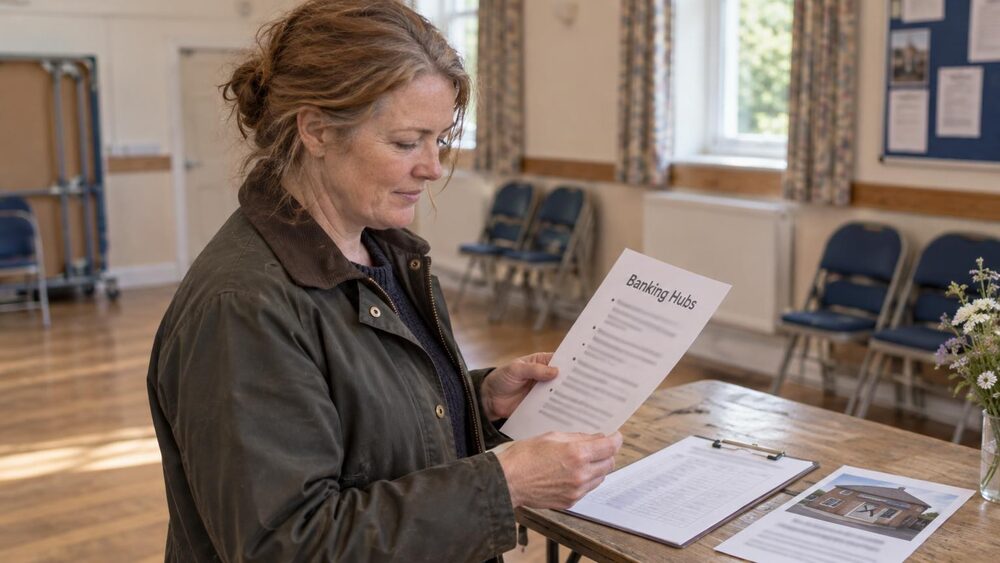
Link recommended on 12 January 2024 that 101 new banking hubs be established in the UK1. The recommendation followed assessments carried out when the last bank branch in an area closed, and requests from communities1.
The backdrop is a long decline in branch numbers. Data from the British Banking Association for 1986 to 2012 and the Office for National Statistics for 2012 to 2023 shows the number of bank branches in operation in the UK fell from 14,689 in 1986 to 5,745 in 20231. Over the same period, building society branches fell from 6,954 to 1,9251.
Banks have attributed the decline to changing customer habits. In an August 2021 letter to the then chair of the Commons Treasury Committee, Mel Stride, the chief executive of Barclays UK, Matt Hammerstein, wrote:
"Profound technological changes, and the ease with which customers can access their accounts digitally means that our physical branch network is experiencing a sustained fall in demand. In fact, the majority of our customers (74 percent) now choose to interact with us via telephone, online, or mobile banking."
TSB Bank said over 90 percent of its transactions were done digitally and over 67 percent of its customers used mobile, online or telephone banking1.
Research cited in the same briefing sets out who uses branches. A June 2023 Which? survey of 2,700 banking customers with a disability or impairment found 52 percent said they had been negatively impacted by bank closures1. Within that group, 35 percent found it fairly or very difficult to speak to their bank by phone, 21 percent struggled with security features such as card readers or remembering passwords, 13 percent reported problems with wheelchair access, 12 percent with accessible debit cards and 10 percent with hearing loops at their local branch1. Separately, 39 percent had issues with customer authentication checks for online card payments1.
An Age UK survey of 2,632 people aged 65 and above, published in May 2023, found 39 percent of respondents with a bank account in Britain were not managing their money online, equivalent to 4.09 million people if extrapolated to the whole UK population1. It also found 75 percent, equivalent to 7.86 million people, wanted to undertake at least one banking task in person at a branch, building society or post office1.
The Federation of Small Businesses reported in April 2022 that four in 10 small high street businesses said cash was the main payment method among their customers, with six in 10 needing to make regular cash deposits1.
Why it matters for households
The 101 hubs are recommendations, not confirmed openings, and the briefing does not set out a timetable for them1. For households in areas that have lost their last branch, the practical question is what replaces it and when. The briefing describes banking hubs as one alternative the government has supported, alongside telephone and digital banking and the Post Office, whose framework allows 99 percent of personal and 95 percent of business customers to deposit cheques, check balances and withdraw and deposit cash at its branches1.
The regulatory background is still moving. The Financial Services and Markets Act 2023, which gained royal assent in June 2023, requires HM Treasury to produce and keep under review a policy statement on cash deposit and withdrawal services, and gives the Financial Conduct Authority regulatory functions in relation to maintaining them1. HM Treasury published that policy statement in August 20231. It said FCA analysis found at least 95 percent of people in predominantly urban areas had access to cash deposit and withdrawal services within a mile of where they lived, and at least 95 percent of people in predominantly rural areas within three miles, and that the aim was to maintain that coverage1. The statement said any proposed alternative service must be established before a significant closure or change to an existing service1.
The FCA launched a consultation on a new regulatory regime to fill gaps in cash access provision in December 20231. The briefing does not report the outcome of that consultation.
What happens next
The House of Lords was scheduled to consider, on 25 January 2024, a question for short debate from Baroness Tyler of Enfield asking what assessment the government has made of the impact of high street bank closures on local communities and the need for a national network of banking hubs1. The briefing does not report when the 101 recommended hubs would open, or which locations were recommended.
Sources1 cited
- Closure of high street banks: Impact on local communities - House of Lords Library lordslibrary.parliament.uk
 FSCSProtects your money if a bank, insurer or investment firm fails
 Financial Ombudsman ServiceFree, independent help when a complaint about a firm is not put right
 MoneyHelperFree, impartial money and pensions guidance, set up by government
 Citizens AdviceFree advice on money, consumer and legal problems in England and Wales