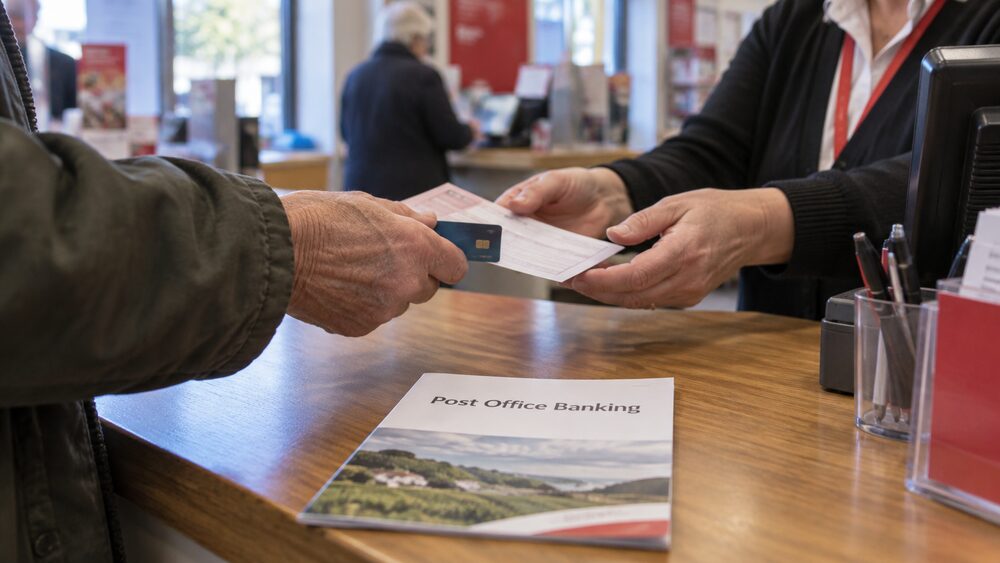
If your local bank branch has closed, there are two places you can still do everyday banking in person: a Post Office branch, or a banking hub. They look similar at the counter, and both are run by the Post Office, but they are not the same thing. A banking hub is a dedicated site owned by Cash Access UK and run by the Post Office, offering a counter service plus community bankers from individual banks on set days. A Post Office branch is a post office that also handles banking for customers of partner banks1.
The practical difference is what else you can do there. Banking hubs only offer banking services, with no mail or parcel posting, while Post Office branches combine counter banking with postal services3. There are far more Post Office branches: the network runs to over 11,500 branches across the UK, and 99% of retail banking customers can carry out basic banking at them1. Banking hubs are newer and are still opening in some areas, so not everywhere has one yet5.
What you can do at either is broadly the same: pay in cash and cheques, take money out, and check your balance1. What you cannot do is open an account. The Post Office does not offer current accounts of its own; it provides in-branch access to partner banks' services6. The limits on how much you can pay in or take out are set by your bank, not by the counter5.
Banking hubs are run by the Post Office but are not Post Office branches
A banking hub is a shared banking site for a town or neighbourhood that has lost its bank branches. It is owned by Cash Access UK and run by the Post Office, and the Post Office describes it plainly: "While they're operated by Post Office, Banking Hubs aren't regular Post Office branches"1. Inside, there is a counter staffed by a Post Office team, often managed by local postmasters, and the counter services themselves are run by Post Office staff3.
The point of the model is that customers of different banks can use one building. The counter handles the same services you would find in a Post Office branch, and on top of that there are community bankers from individual banks attending on specific days, so you can see someone from your own bank about something the counter cannot resolve5. Hubs are funded by Cash Access UK and operated by the Post Office3.
Two limits are worth knowing before you travel. First, a hub is banking only: no stamps, no parcels, no mail3. Second, hubs are not yet everywhere. The Post Office's own guidance says hubs are opening in some areas, while thousands of Post Office branches already offer banking services5. If you are unsure whether your nearest site is a hub or a branch, the services on offer are the quickest way to tell.
Everyday banking at the Post Office: cash, cheques and balance checks
At a Post Office branch you can pay in cash and cheques, withdraw money and check your balance over the counter1. The same three services sit at the centre of a banking hub: pay cash or cheques in, take money out, and check your available balance1. Independent guidance describes the offer in the same terms, listing withdrawing and depositing cash and cheques for customers of nearly all banks, and adding that some branches also handle bill payments depending on who you bank with11.
The Post Office works with most UK personal and business bank accounts, and its framework agreement has covered customers of 30 UK banks and building societies13. One parliamentary committee put the coverage at 99% of personal banking needs and 95% of business banking needs being doable through the Post Office network14. For business customers, the counter can also handle change-giving with some business accounts5.
There are gaps. Basic bank accounts are a mixed picture: most banks offer some banking services through local post offices, but not all basic accounts can be accessed at the Post Office, and one older study found nine accounts that allowed cash withdrawals at a Post Office but not deposits15. Credit union current accounts can be used at a local Post Office for both withdrawals and deposits17. If your account is a basic or credit union account, it is worth confirming what your own provider allows before you rely on the counter.
Paying in cash, coins and cheques: what to bring
Cheque deposits are the most straightforward part of counter banking. The Post Office states there is no limit to cheque deposits at its branches, and the service is available for most major UK banks7. You can deposit cheques, as well as cash, into personal and business accounts at thousands of branches across the UK7. To do it, bring four things: your cheque, your sort code and account number, your bank's paying-in slip, and a branded bank envelope7.
Cash is where the differences bite. The Post Office's own guidance says you can pay in and take out cash, deposit cheques and even get change at thousands of branches, and that you can get cash out from most UK personal and business bank accounts5. Coins are the exception: the Post Office states that no coin facilities are available through the post office9. Banking hubs take a wider view, listing paying cash in or taking cash out including coins, paying in cheques, paying bills and checking your balance among counter services10.
For anyone weighing up whether the counter or an app is the better route for a payment, our guide to paying cash and cheques into your account sets out how each method works and how long the money takes to arrive.
Deposit and withdrawal limits are set by your bank, not the counter
The single most useful rule to remember is that the counter does not decide your limits. Each bank sets its own limits for cash withdrawals and deposits, and the amount you can withdraw at a Post Office branch depends on the withdrawal limits on the specific account you hold5. Your daily cash deposit limit is likewise set by your bank6. Some banks may charge for certain services, and the Post Office directs customers to ask their bank for details5.
HSBC is the clearest worked example in the current market. From 21 September 2026, HSBC UK customers can deposit at most £3,000 per day and £15,000 per calendar year when using HSBC deposit machines, Post Offices, Banking Hubs or multi-bank ATMs8. Larger deposits need a branch with a counter service, and HSBC states: "No, we can't authorise any deposits above these limits at a Post Office counter"8.
The practical consequence is that a large cash deposit may need a bank branch even when a Post Office or hub is closer. If you are planning a deposit near a limit, check your bank's current figure first, because the counter cannot make an exception.
Fees and charges for counter banking
The Post Office does not charge you at the counter for everyday banking, but your bank might. Its own guidance is that no charges are taken at the counter, however some banks may charge for this service6. The same split applies to bill payments: the Post Office does not charge you to pay with a debit or credit card, but your bank may charge its own fees18. Independent guidance notes that some banks let you cash a current account personal cheque or use your cash card at the Post Office free of charge, which is a matter for your bank rather than the counter19.
Where the Post Office does levy its own charges, they sit on its own products rather than counter banking. Its credit card carries a 3% cash advance fee when you withdraw money from the card or buy foreign currency anywhere other than buying Post Office Travel Money20. Its home insurance monthly payment plan can attract a £5 fee charged by Premium Credit Limited to cover affordability and anti-money laundering checks21. Neither is a charge for using the counter.
Which banks can I use at the Post Office or a banking hub?
Participation is by agreement, and it is worth checking before you travel. The Post Office's framework agreement has allowed customers of 30 UK banks and building societies to access cash and basic banking facilities through its network14. Its everyday banking service works with most UK personal and business bank accounts13. Banking hubs serve customers of the banks signed up to that particular hub, and each hub also hosts community bankers from named banks on specific days5.
The named banks vary by site. Recent hub openings have included community banker days for Barclays, Santander, Danske Bank and Ulster Bank in Comber, and for Halifax, NatWest, Barclays and Santander in Bacup1. Individual banks publish their own lists: AIB (NI), Lloyds, Halifax, Santander, Danske Bank and TSB all set out how their customers can use Post Office counters or banking hubs23. If your bank is not on the list for your nearest hub, the counter may still serve you through the shared framework, but the community banker service will not.
Awareness is a known weak point. A parliamentary committee heard that awareness of Post Office banking services "currently rests somewhere between 55% and 60%", and a 2019 consultation found just 1% of people expressing a preference for Post Office banking14. In practice, many people who could use the counter do not know it is available to them.
What banking hubs add, and where they are opening
The extra that a hub brings is the community banker: a named bank's staff attending on set days, so you can discuss something the shared counter cannot handle5. Hubs are opening steadily across the UK, often first in temporary premises while a permanent home is found. Recent examples include Comber in Northern Ireland, Todmorden, Enfield North, Holt in Norfolk, Risca, Bacup, Acomb, Burntisland in Fife and Market Harborough1.
Usage data suggests the model is being taken up where it exists. In research published in July 2026, 39% of consumers who were customers of a bank operating in a banking hub had used it, and 45% of businesses that were customers of a bank servicing in the hub had used it29. Among those using hubs, 44% had deposited cash or a cheque, and 46% believed cash and cheque deposits met their needs29. For businesses, 97% of hub users cited depositing cash or cheques29.
The wider context is branch closures. The Post Office network itself has shrunk in places: Scotland lost 112 Post Offices between March 2011 and March 2021, a reduction of 7.8%, the greatest percentage decrease across all UK nations and regions in that period14. Post Office numbers in Scotland stood at 1,321 as of March 2021, a decrease of 51 from February 202014. Government policy requires the Post Office to maintain at least 11,500 branches, with 99% of the UK population within three miles of one and 90% within one mile14. The Post Office's own figures put 95% of UK residents within a mile of their local branch and 99% within three miles23.
What protects you, and where it stops
The protections that apply to your money do not change because you used a counter rather than a branch. Your account remains with your bank, and the Financial Services Compensation Scheme protection attached to it is unaffected by where you pay in. What changes is the evidence trail and the route for a problem.
The receipt from a Post Office deposit shows only your sort code and account number, so it is thinner than a bank's own paying-in record7. If a deposit goes missing, that receipt is what you have. For a dispute about a payment, a charge or a service, your bank is the firm you complain to, and if you are unhappy with its final response you can take the matter to the Financial Ombudsman Service. The Post Office counter is acting for your bank, not as your bank.
There are also limits on what the counter can do at all. It cannot authorise a deposit above your bank's limit, as HSBC's wording makes explicit8. It cannot open an account for you, because the Post Office does not offer current accounts of its own6. And it cannot help with anything outside the agreed services: a banking hub has no postal counter, and a Post Office branch's service levels and cut-off times vary by location3.
If you are choosing between counter banking and other ways to manage your money, our guides to access to cash and banking at the Post Office go through the alternatives in more detail. For accounts that can be used at a Post Office counter, see basic bank accounts explained, and for the wider picture on closures, bank branch closures and what replaces them.
Sources30 cited
- Banking Hubs Post Office, 2026
- Access to banking services and cash House of Commons Library, 2026
- What is a banking hub Post Office, 2026
- Bank branch closures: is your local bank closing Which?, 2026
- Cash deposit guide Post Office, 2026
- Everyday banking help and support Post Office, 2026
- Where can I pay in cheques Post Office, 2026
- Banking at the Post Office HSBC UK, 2026
- Banking hubs Danske Bank, 2026
- Banking hubs TSB, 2026
- Ways to bank Consumer Council, 2026
- Making the most of your bank account Independent Age, 2026
- Everyday banking Post Office, 2026
- Access to banking services inquiry Scottish Affairs Committee, 2022
- Getting a bank account Citizens Advice, 2026
- Bank and building society accounts Macmillan Cancer Support, 2026
- Credit unions Building Societies Association, 2026
- Bill payments Post Office, 2026
- Banking post-lockdown Which?, 2020
- Travel money Post Office, 2026
- Home insurance Post Office, 2026
- Closure of high street banks: impact on local communities House of Lords Library, 2019
- Bank accounts after bankruptcy StepChange, 2026
- Ways to bank at the Post Office AIB (NI), 2026
- Banking near you Lloyds Bank, 2026
- Deaf and hearing loss support Halifax, 2026
- Managing your account at a banking hub Santander, 2026
- Everyday finances call for insight Which?, 2019
- Impact of bank branch closure research report Consumer Council, July 2026
- How to spot a dodgy Post Office delivery text Which?, 2022
 MoneyHelperFree, impartial money and pensions guidance, set up by government
 FSCSProtects your money if a bank, insurer or investment firm fails
 Financial Ombudsman ServiceFree, independent help when a complaint about a firm is not put right
 Citizens AdviceFree advice on money, consumer and legal problems in England and Wales