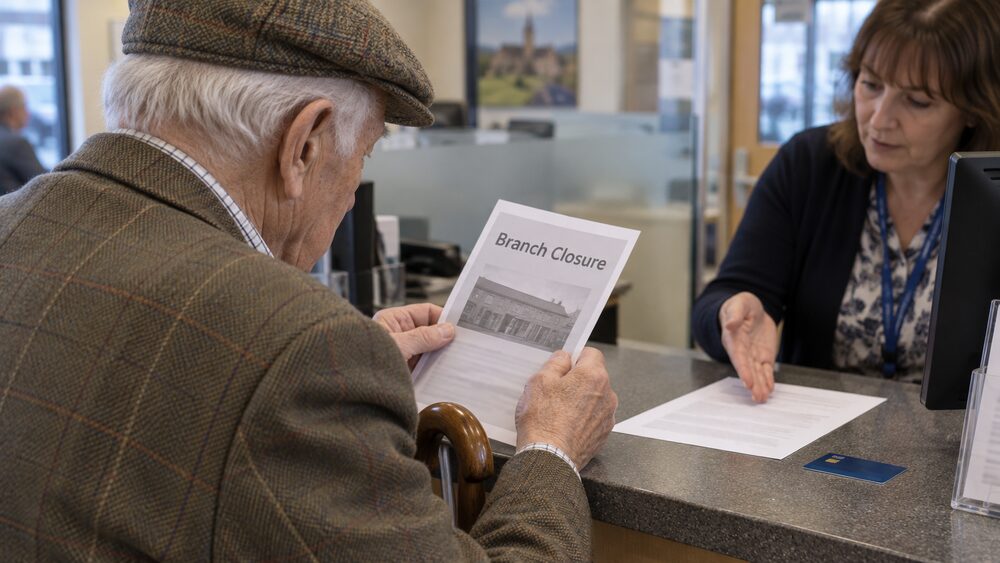
The Access to Banking Standard is a voluntary agreement that most major high street banks have signed up to. It was introduced in 2015 and is overseen by the Lending Standards Board. Its purpose is to make sure customers are better informed when a branch closes, and to require banks to tell customers what options they have locally to keep accessing banking services1.
It cannot stop a branch from closing. The Standard is not a law, and it does not give anyone the right to veto a closure. What it does is set expectations about how a bank behaves when it decides to close a branch: telling customers, explaining the reasons, and pointing to alternatives such as the Post Office, online banking or a nearby branch1.
If your branch is closing, the practical questions are usually about what notice you get, what replaces the branch, and what you can do if the bank did not follow the rules. This page sets out what the Standard covers, where it stops, and where to get help.
What the Access to Banking Standard is
The Standard was introduced in 2015, replacing the Access to Banking Protocol that had been launched by the British Bankers' Association in the same year2. It was implemented following an independent review commissioned by the industry, and the Lending Standards Board now oversees it1.
Its stated purpose is to ensure that customers are better informed about a branch closure and the reasons behind the decision to close. It requires banks to make customers aware of the options they have locally to continue to access banking services, and to provide specialist help for those that need it1. In practice, that means a bank closing a branch is expected to write to affected customers, explain why, and set out what alternatives exist, whether that is a nearby branch, the Post Office, telephone banking or an app.
The Standard sits alongside, rather than instead of, the Financial Conduct Authority's own guidance on branch and ATM closures. The FCA's FG22/6 guidance, published in October 2022, clarified that clear communications to customers about closures should include direct written communications to customers who use the closing branch and will be impacted by its closure4. The FCA also expects to be informed when a signatory firm plans a closure, and its guidance notes that where firms are signatories to the Lending Standards Board's Access to Banking Standard, the FCA expects to be informed no later than the LSB of a firm's plans5.
The Standard also covers reductions in opening hours. The FCA's guidance refers to a specific threshold similar to the Access to Banking Standard, which applies where the opening hours are reduced by more than 30% over one year4. So a branch that stays open but cuts its hours sharply can fall within the same expectations as a full closure.
An industry-wide agreement, not a law
The most important thing to understand about the Standard is that it is not legislation. The Banking Framework Agreement, which underpins Post Office banking access, is described in Parliament as "a voluntary agreement, with no statutory underpinning"3. The Access to Banking Standard works on the same basis: banks sign up to it, and the Lending Standards Board oversees compliance among its members, but no law compels a bank to follow it1.
That matters because it shapes what the Standard can and cannot do. A voluntary code can set expectations about communication and behaviour. It cannot override a commercial decision to close a branch, and it does not create a legal right to a branch in any particular place.
There are, however, legal duties that sit alongside it. Under the Payment Accounts Regulations 2015, certain banks are under a legal obligation to offer basic bank accounts to customers who are legally resident in the United Kingdom and do not have a bank account, or who are not eligible for a standard current account6. The FCA's access to cash regime, which came into force on 18 September 2024, gives the regulator powers under Part 8B of the Financial Services and Markets Act 2000, as set by the Financial Services and Markets Act 20237. Those powers are about cash access, not about branch networks.
"The Banking Framework is a voluntary agreement, with no statutory underpinning"
What banks signed up to under the Standard
The banks that provide basic bank accounts are a useful guide to who operates in this space. The designated providers are Barclays UK, The Co-operative Bank, HSBC UK, Lloyds Banking Group (including Halifax and Bank of Scotland brands), Nationwide Building Society, NatWest Group (including RBS and Ulster brands), Santander UK, TSB and Virgin Money (formerly Clydesdale & Yorkshire Bank)8. These are the nine largest personal current account providers, designated to provide basic bank accounts that comply with the Payment Accounts Regulations9.
The fee-free basic bank account brands offered by these providers include Barclays Basic Current Account, Santander Basic Current Account, NatWest Foundation Account, Ulster Bank (Northern Ireland) Foundation Account, Royal Bank of Scotland (Scotland) Foundation Account, RBS England & Wales Basic Account, HSBC Basic Bank Account, Nationwide FlexBasic, The Co-operative Bank Cashminder, Lloyds Banking Group (including Halifax and Bank of Scotland brands) Basic Account, TSB Cash Account, and National Australia Bank (including Yorkshire Bank and Clydesdale brands) Readycash Account3.
Beyond basic accounts, the main current account providers have agreed to publish better information about the services banks offer to all customers10. Cash Access UK, which runs banking hubs, is owned by Bank of Ireland UK, Barclays, Danske Bank, HSBC UK, Lloyds Banking Group, NatWest Group, Santander, TSB and Virgin Money11.
| Provider group | Basic account brand |
|---|---|
| Barclays | Barclays Basic Current Account |
| Santander | Basic Current Account |
| NatWest | Foundation Account |
| Ulster Bank (Northern Ireland) | Foundation Account |
| Royal Bank of Scotland (Scotland) | Foundation Account |
| RBS England & Wales | Basic Account |
| HSBC | Basic Bank Account |
| Nationwide | FlexBasic |
| The Co-operative Bank | Cashminder |
| Lloyds Banking Group (Halifax, Bank of Scotland) | Basic Account |
| TSB | Cash Account |
What the Standard means when your branch closes
When a branch closes, the Standard's requirements are about information and alternatives. The bank is expected to make customers aware of the options they have locally to continue to access banking services, and to provide specialist help for those that need it1. The FCA's guidance adds that communications should include direct written communications to customers who use the closing branch and will be impacted4.
The FCA's definition of a branch is wide: "the physical site where firms undertake regulated banking activities or provide regulated payment services for their customers, whether consumers or small and medium enterprises (SMEs), who attend in person"4. The guidance also covers partial closures caused by a long-term reduction in opening hours or services which would have a significant impact on customers4.
Separately, since January 2022, banks tell Link (the cash machine network) when they are planning branch closures so it can assess whether that community needs extra cash services2. Link runs access to cash reviews when banks plan closures or if local residents ask for a review, which can result in new ATMs or banking hubs12. The FCA's cash access rules allow for services such as ATMs, banking hubs or adapting Post Office branches13.
Ways to keep banking after a branch closure
There are several routes to keep banking when a branch closes. The right one depends on what you need to do and where you live.
Post Office banking. Under the Banking Framework Agreement, consumers of 30 UK banks and building societies can continue to access cash and basic banking facilities via the Post Office until 20263. The Post Office says 99% of personal banking needs and 95% of business banking needs can be done through its network3. The Post Office is committed to maintaining around 11,500 branches with no further substantive reductions and continued accessibility for all at the national level14. The arrangements allow 99% of personal banking and 95% of business customers to deposit cheques, check their balance and withdraw cash15.
Banking hubs. Cash Access UK, owned by nine banking groups, runs shared banking hubs11. The FCA's cash access rules allow for ATMs, banking hubs or adapting Post Office branches as ways to fill gaps13.
Basic bank accounts. A basic bank account is a transactional bank account which is fee-free for standard operations16. These are normally available if you do not qualify for a bank's standard current account, for example with a bad credit history, an IVA, a DMP, a DRO or having been declared bankrupt18. You will often need to apply for one of the bank's other accounts first, such as their standard current account, and can usually apply online, by phone or in a branch18. Banks should let you open a basic bank account after you go bankrupt19. All high street banks offer bankruptcy-friendly basic bank accounts19. You can usually open a bank account if you have leave to remain or a valid visa20.
Online and mobile banking. Most banks offer apps and online banking. The FCA's BCOBS 7 rules cover the inability of a banking customer to access or use internet banking or mobile banking as a matter that firms must report on21.
Where the Standard does not protect you
The Standard is about communication and alternatives, not about keeping a branch open. The FCA's access to cash powers do not extend to wider banking services such as card and PIN management or fraud and scam support, and do not extend to maintaining branch networks or preventing bank branch closures generally7. The arrangements for Post Office banking are limited to deposit and withdrawal facilities and do not extend to wider banking services6.
Banks can close accounts for reasons unrelated to branches. Banks are required to close bank accounts if they cannot complete 'know your customer' checks required by The Money Laundering, Terrorist Financing and Transfer of Funds (Information on the Payer) Regulations 20176. Banks have to close accounts when unable to conduct "know your customer" checks required by money laundering regulations, or are concerned about accounts potentially being used for financial crime12. Banks and building societies can also close or restrict access to your existing account if you are disqualified under the Immigration Act 2014 section 40G22.
There are rules for basic bank accounts that mean banks are more restricted in the grounds on which a basic account can be closed6. A basic bank account opened under the Payment Accounts Regulations may only be closed without the consumer's consent in limited circumstances, for example, if a consumer has knowingly used, or attempted to use, the account for illegal purposes, or if there has been no transaction on the account for more than 24 consecutive months23. Regulation 25 of the Payment Accounts Regulations provides prescribed grounds on which a designated credit institution must or may refuse to open a payment account with basic features, and regulation 26 the grounds on which such institution may close a basic bank account24.
While banks are generally free to close customer accounts, they must not discriminate against customers based on protected characteristics outlined in the Equality Act 20106.
How the Standard has been monitored
The Lending Standards Board oversees the Standard and its members25. The Financial Conduct Authority expects to be informed when a signatory firm plans a closure, and its guidance notes that where firms are signatories to the Lending Standards Board's Access to Banking Standard, the FCA expects to be informed no later than the LSB of a firm's plans5.
The FCA's FG20/3 guidance, published on 14 September 2020, refers to following the LSB's Access to Banking Standard's communication provisions as they stood on the date of the publication of that guidance5. The FCA's FG22/6 guidance, published in October 2022, amended the requirement to clarify that clear communications to customers about closures should include direct written communications to customers who use the closing branch and will be impacted by its closure4.
The Financial Ombudsman Service can look at complaints about how a closure was handled. In one case study, a customer complained after discovering that his branch had been closed due to a water leak. The bank said he could have gone to the branch in the next town, two miles away, or made the transfer using either telephone or online banking, both of which he was registered for. The ombudsman did not find reason for compensation to be awarded, but noted the bank did apologise and thought that was enough26.
The FCA's cash access regime, which came into force on 18 September 2024, requires banks and building societies designated by the Government to assess and fill gaps, or to protect access to cash7. The 14 largest banks and building societies in the UK must conduct cash access assessments in response to trigger events6. The FCA's PS24/8 policy statement sets out that information requests cover non-designated personal current account providers with 10 or more branches, the Post Office and operators of payment systems through which cashback is provided27.
What can I do if my bank did not tell me about a branch closure?
If you believe your bank did not follow the Standard, the first step is to complain to the bank itself. The Financial Ombudsman Service can then look at the complaint if you are unhappy with the response. The ombudsman is free to use and looks at whether the bank followed the rules and communicated properly.
The ombudsman's case study on a branch closure complaint shows how it approaches these cases. The customer complained after his branch closed due to a water leak. The bank said he could have gone to the branch in the next town, two miles away, or made the transfer using either telephone or online banking, both of which he was registered for. The ombudsman did not find reason for compensation to be awarded, but noted the bank did apologise and thought that was enough26.
The FCA's guidance on branch and ATM closures sets out that firms should continue to follow other applicable requirements where relevant, including the 2010 Equality Act, consumer protection and competition law, and its Handbook provisions28. So a complaint can also draw on those wider rules where they apply.
Where to get help if you lose access to banking
Several free and impartial services can help if you lose access to banking.
MoneyHelper provides guidance on basic bank accounts, how to open, switch or close your bank account, and choosing a bank account for your Universal Credit payment18. It also has guidance on making your money easier to manage by yourself if you have an illness or disability31.
Scope provides advice on accessible banking and financial services, and on managing money for someone else10. Banks have to make their information and services as accessible as possible for their disabled customers31. Under the Equality Act 2010, your bank must provide you with equal access to all its products and services10. Some banks have a specific page for disabled customers and specialist teams that can support people who have access needs10. ATMs that are wheelchair-accessible and have text-to-speech functionality are part of what banks should provide31.
StepChange provides debt advice, including on bank accounts after bankruptcy19.
Shelter provides housing advice, including how to open a bank account if you are homeless33.
The Financial Ombudsman Service can look at complaints about how a bank handled a closure26.
If you lose your payment card or it is stolen, call the Payment Exception helpline so it can be blocked and a new one sent out30. The Payment Exception Service is for people who cannot get a bank or building society account, and allows them to collect their benefit or State Pension payment in cash by visiting a Post Office30.
Sources33 cited
- Access to Banking Standards summary report Lending Standards Board, 2026-09-25
- Bank branch closures: is your local bank closing? Which?, 2026
- Access to Banking Protocol House of Lords Select Committee on Financial Exclusion, 2017
- FG22/6: Branch and ATM closures or conversions Financial Conduct Authority, 2022-10
- FG20/3: Branch and ATM closures or conversions Financial Conduct Authority, 2020-09
- Access to banking services and cash House of Commons Library, 2026-09-26
- PS24/8: Access to cash Financial Conduct Authority, 2024-07
- Basic bank accounts: July 2023 to June 2024 HM Treasury, 2025-11-05
- Basic bank accounts: July 2018 to June 2019 HM Treasury, 2019-12-20
- Accessible banking and financial services Scope, 2026-08-17
- Access to cash in Northern Ireland Northern Ireland Assembly, 2024-10-04
- Access to cash and banking services House of Commons Library, 2026-09-26
- Access to cash Financial Conduct Authority, 2024-09-18
- The UK's ATM network Payment Systems Regulator, 2026-09-26
- Banking Framework Agreement Joint Committee on the Draft Financial Services (Banking Reform) Bill, 2013
- Basic bank accounts: July 2022 to June 2023 HM Treasury, 2024-04-25
- Basic bank accounts: July 2019 to June 2020 HM Treasury, 2021-01-05
- Basic bank accounts MoneyHelper, 2026-09-25
- Bank accounts after bankruptcy StepChange, 2026-09-25
- Current account closed or refused based on immigration status Home Office, 2017-10-30
- BCOBS 7: Information about current account services Financial Conduct Authority, 2018-08-15
- Choosing a bank account for your Universal Credit payment MoneyHelper, 2026-09-25
- Basic bank accounts: July 2023 to June 2024 HM Treasury, 2025-11-05
- Payment Accounts Regulations 2015 legislation.gov.uk, 2025
- The Contingent Reimbursement Model Code Payment Systems Regulator, 2026-09-26
- Consumer wants compensation after local bank branch closed Financial Ombudsman Service, 2026-09-26
- PS24/8: Access to cash Financial Conduct Authority, 2024-07-24
- GC22/2: Branch and ATM closures and conversions Financial Conduct Authority, 2022-06
- How to open, switch or close your bank account MoneyHelper, 2026-09-25
- What to do now your Post Office card account is closing MoneyHelper, 2026-09-25
- Make your money easier to manage by yourself MoneyHelper, 2026-09-25
- Managing money for someone else Scope, 2025-11-27
- How to open a bank account Shelter, 2024-07-16




 MoneyHelperFree, impartial money and pensions guidance, set up by government
 FSCSProtects your money if a bank, insurer or investment firm fails
 Financial Ombudsman ServiceFree, independent help when a complaint about a firm is not put right
 Citizens AdviceFree advice on money, consumer and legal problems in England and Wales