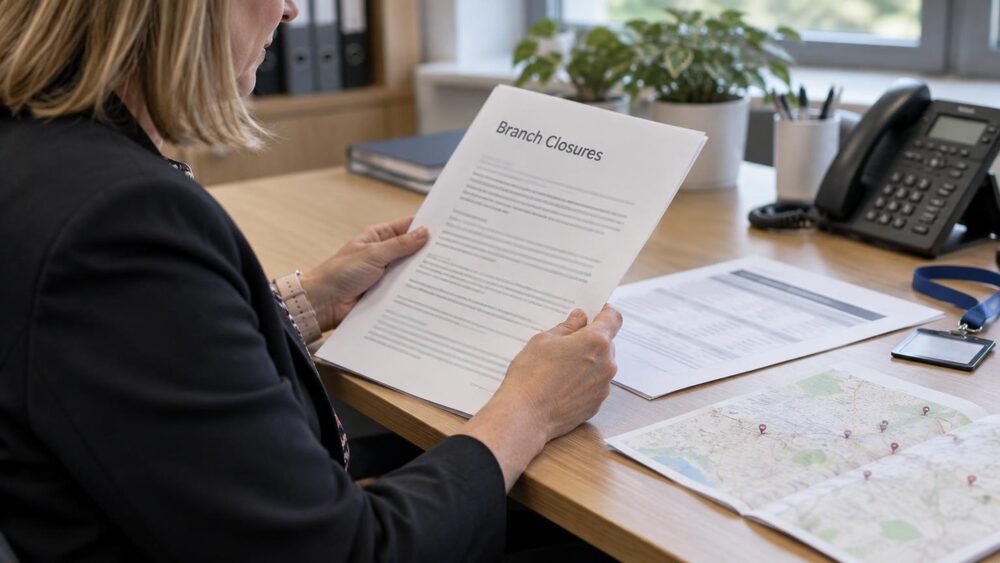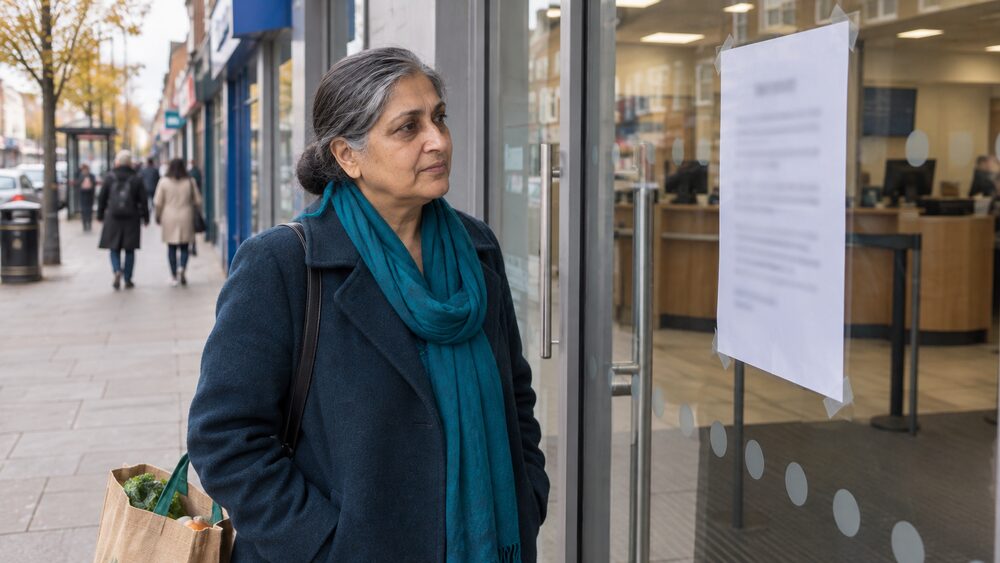
If your local branch is closing, you would normally get at least 12 weeks' warning before the doors shut. The Financial Conduct Authority, the regulator that writes the rules banks follow, says firms should communicate closures to customers at least 12 weeks before they take effect1. That applies to cash machines as well as branches.
The 12 weeks is a minimum for telling you, not a veto. A branch closure is a commercial decision for the bank, and no rule lets a customer stop it. What the rules do give you is time, a reason, information about what replaces the branch locally, and specialist help if you need it.
This page explains the notice you are entitled to, what your bank should tell you, what happens to your account, how to keep banking with cash once the branch goes, and where to take a complaint if the notice falls short.
Branch closure notice: at least 12 weeks
The 12-week figure comes from the FCA's guidance on branch and ATM closures, first published in 2020 and revised in 20226. The regulator's wording is that firms should communicate closures to customers at least 12 weeks before they take effect1. The same expectation appears in the FCA's access to cash policy statement, which covers cash machines as well as branches7.
The guidance applies to closures lasting 6 months or more, which the FCA calls long-term closures3. It also covers partial closures, where opening hours or services are cut back enough to have a significant impact on customers3. So a branch that stays open but drops from five days a week to two is caught by the same expectations as one that shuts entirely.
Banks have their own commitments on top of the rules. Royal Bank of Scotland says it is committed to providing customers with 12 weeks' notice of a branch closure announcement8. The Access to Banking Standard, introduced in 2015, requires banks to engage customers and communities ahead of a planned closure and to offer alternative ways to bank9.
The 12 weeks is about the branch. Account closures are a separate matter with their own notice periods, covered below.
What the FCA closure guidance covers
The FCA's expectations for firms are that they consider the likely impact on customers, communicate changes clearly and in good time, and take appropriate steps to ensure customers can still get appropriate access to banking and cash services10. The guidance builds on three of the FCA's Principles for Businesses, including the duty to pay due regard to the interests of customers and treat them fairly3.
The scope is wider than a single branch. It covers the full closure of a branch, all ATMs operated by a firm at a particular location, or a mobile bank facility no longer operating3. It also covers partial closures, defined as a reduction in branch opening hours or days, or a reduction in branch services, where this would have a significant impact on customers3.
There is a rule that bites before the closure happens. Firms planning to close facilities that affect cash access must keep them open until the necessary cash services are available11. In other words, a branch or cash machine should not disappear before a replacement is in place.
Banks must also inform the FCA about closures6. And since January 2022, banks tell Link, the cash machine network, when they are planning branch closures, so it can assess whether that community needs extra cash services6.
| What is closing | Covered by the 12-week expectation? |
|---|---|
| A full branch | Yes3 |
| All ATMs at one location | Yes3 |
| A mobile bank facility | Yes3 |
| Reduced opening hours or services with a significant impact | Yes, as a partial closure3 |
| An ATM closed only for repair, enhancement or replacement at the same site, for no more than 6 months | No3 |
What your bank should tell you before a branch closes
The FCA expects clear communications to customers about closures to include direct written communications to customers who use the closing branch and will be impacted by it3. That is more than a poster in the window, though a poster is part of how the exact closing date is confirmed. Royal Bank of Scotland, for example, says customers are advised of the exact closing date through a poster displayed in branch, or via a closure guide available in branch or online8.
The Access to Banking Standard is designed to ensure customers are better informed about a branch closure and the reasons behind the decision. It requires banks to make customers aware of the options they have locally to continue to access banking services, and to provide specialist help for those who need it12.
The FCA also expects that branches should not be fully or partially closed until reasonable, fit-for-purpose alternatives are in place3. That is the practical promise behind the notice: not just that you are told, but that something workable replaces what you are losing.
"firms should communicate closures to customers at least 12 weeks before they take effect"
If your bank is also changing your terms, charges or interest rate in a way that disadvantages you, separate rules apply. The firm should give you reasonable notice on paper or in another durable medium before the change takes effect13.
Other ways to bank after your branch closes
Losing a branch does not mean losing your account. Your account number, sort code and terms stay the same. What changes is how you reach the bank.
| Way to bank | What it gives you |
|---|---|
| Another branch | Counter service at the nearest branch still open, which may be some distance away |
| The Post Office | Cash and basic banking for consumers of 30 UK banks and building societies4 |
| Online and mobile banking | Day-to-day banking, from checking balances to moving money |
| Telephone banking | Speaking to someone without travelling |
| Banking hubs | Shared facilities where several banks serve customers from one location |
The Post Office says 99% of personal banking needs and 95% of business banking needs can be done through its network11.
If you are switching banks rather than just losing a branch, the process is different. The usual order is to open the new account before closing the old one, cancel or move standing orders and direct debits, return unused cheques and cards cut into pieces, and leave enough money to cover any uncleared cheques if you are transferring a balance14. The Current Account Switch Service handles most of this automatically.
Getting cash and paying in when a branch goes
Cash access is the part of a closure that affects people most directly, and it has its own protections.
Since January 2022, banks tell Link when they are planning branch closures so it can assess whether that community needs extra cash services6. That assessment can lead to a new cash machine, a banking hub or a deposit service being put in place.
The FCA's access to cash rules require firms planning to close facilities affecting cash access to keep them open until the necessary cash services are available11. That is a firm rule, not just guidance.
There is also a practical limit on how much disruption the system expects at once. During April to June 2020, fewer than 12% of all UK branch locations closed and fewer than 12% of ATM sites closed15. That figure gives a sense of the scale the regulator treats as manageable.
For everyday cash, the Post Office network is the main fallback for many people. You can deposit cheques, check your balance and withdraw cash at Post Office counters if your bank is part of the arrangement4. For more on this, see banking at the Post Office and access to cash.
Where the notice rules do not apply
The 12-week expectation is about branches and cash machines. Account closures follow a different set of rules, and the notice periods differ.
| Account opened | Minimum notice before the bank can close it | Reason required? |
|---|---|---|
| On or after 28 April 2026 | At least 90 days2 | Yes, a clear reason2 |
| Before 28 April 2026 | At least 2 months2 | No2 |
There are situations where a bank can give less notice on an account. If a bank suspects fraud, or if the customer is or has been abusive, banks can give less notice2. Banks are also legally required to close accounts when they suspect the account may be used for financial crime, and when they cannot complete the "know your customer" checks required by money laundering regulations2.
The termination notice rules do not apply at all in certain cases. These include where customer due diligence cannot be applied, where closure is required under section 40G of the Immigration Act 2014, where serious crime is suspected, where the FCA, the Treasury or the Secretary of State require termination, or where the user has engaged in conduct involving an offence16.
Raising concerns about a branch closure
You cannot stop a branch from closing, but you can make your views known and you can complain if the process falls short.
- Complain to the bank through its own complaints process.
- The bank has eight weeks to investigate and give a final response5.
- If it sends a letter of deadlock before then, you do not have to wait the full eight weeks14.
- If you are unhappy with the outcome, take the complaint to the Financial Ombudsman Service, which is free.
- You must complain to the ombudsman within six months of the bank's final response, or from the end of the eight-week period if you do not get one14.
You can also raise concerns with your MP, who can take the matter up with the bank or the regulator. The FCA does not resolve individual disputes, but it does collect information about how firms behave, and it has said some banking companies had "fallen short of expectations" on closures6.
For free, impartial help with banking problems, MoneyHelper offers guidance on joint accounts and everyday banking17. Citizens Advice can help you understand your options and make a complaint5.
Sources17 cited
- PS24/8: Access to cash Financial Conduct Authority, July 2024
- Bank account closure notice periods House of Commons Library, 2026
- FG22/6: Branch and ATM closures or conversions Financial Conduct Authority, October 2022
- Access to banking services and cash House of Commons Library, 2024
- Complaints about banks and building societies Citizens Advice
- Bank branch closures: is your local bank closing? Which?, 2026
- PS24/8: Access to cash Financial Conduct Authority, July 2024
- Branch closures Royal Bank of Scotland, 2026
- Bank branch closures: is your local bank closing? Which?, 2022
- Our response to HMT's call for evidence for the Access to Banking Review Financial Ombudsman Service, 2026
- Access to cash Financial Conduct Authority, September 2024
- Access to Banking Standards summary report Lending Standards Board, 2026
- BCOBS 4: Information to be communicated to banking customers Financial Conduct Authority, 2026
- Getting a bank account Citizens Advice, 2026
- Access to cash during Covid-19 Payment Systems Regulator, 2026
- The Payment Services Regulations 2017, Part 6 legislation.gov.uk, 2026
- Joint accounts MoneyHelper, 2026




 MoneyHelperFree, impartial money and pensions guidance, set up by government
 FSCSProtects your money if a bank, insurer or investment firm fails
 Financial Ombudsman ServiceFree, independent help when a complaint about a firm is not put right
 Citizens AdviceFree advice on money, consumer and legal problems in England and Wales