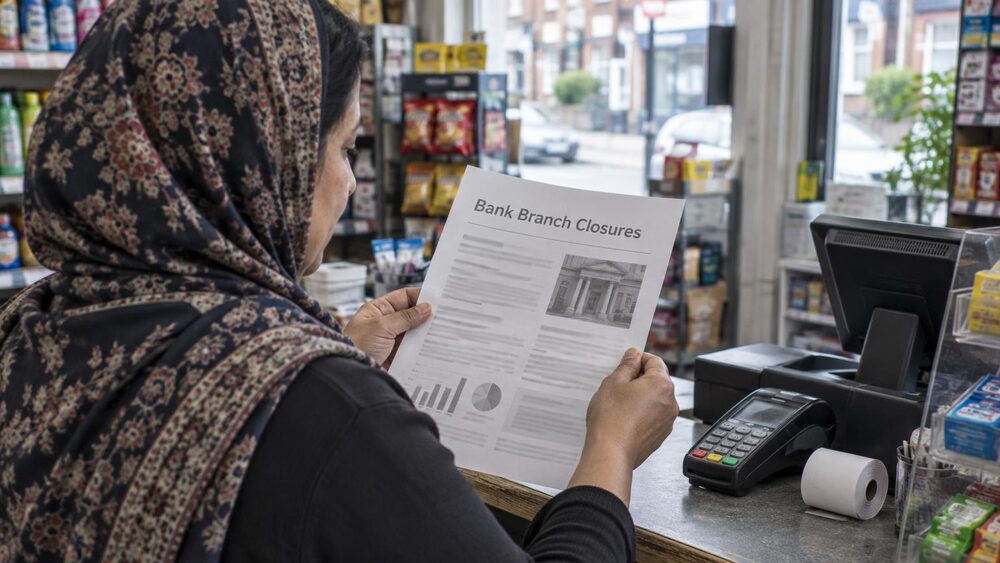
The Consumer Council for Northern Ireland published research in July 2026 on the impact of bank branch closures on consumers and small and medium-sized businesses in Northern Ireland. The report states that Northern Ireland has lost around 48% of its physical bank branches since 20201.
The research was commissioned in February 2025 and carried out by Cognisense, which administered telephone surveys in three areas affected by closures: one urban suburb, one rural town where the last branches in town had closed, and a third location where the last branch had been replaced by a banking hub1. Sample sizes were 206 urban consumers, 201 rural consumers, 194 consumers in the banking hub location, 78 urban businesses, 80 rural businesses and 78 businesses in the banking hub location1. The report notes that the sample sizes are small but provide a snapshot of consumer opinion in each area1.
Among consumers, the most reported impacts of the closures were loss of access to an ATM (36% urban against 38% rural), having to travel to do banking (17% urban against 20% rural) and the inability to make payments or deposits (11% urban against 28% rural)1. For businesses, the most reported impacts were loss of access to an ATM (46% urban against 60% rural), the need to travel to do banking (13% urban against 31% rural) and the inability to get, convert or deposit change (37% urban against 35% rural)1.
Around nine in ten consumers in both urban and rural areas said they had made changes after the closures1. Among consumers, 41% in urban areas and 61% in rural areas used a Post Office, 23% urban and 39% rural travelled to another branch, and 57% urban and 35% rural used the bank's online service or app1. Among businesses, 53% urban and 42% rural used a Post Office, 77% urban and 71% rural travelled to another branch, and 70% urban and 55% rural used online banking or an app1.
The report also gives figures for individual closures. About half (51%) of respondents said they had been impacted by the closure of one branch, over half (53%) by another, and 69% by a further branch1. In the banking hub location, 39% of consumers who were customers of a bank operating in the hub had used it, with withdrawing cash, paying a bill and depositing cash or a cheque the most likely reasons; close to half (45%) of businesses that were customers of a bank servicing the hub had used it1.
"Bank branch closures have had a significant impact on local communities with Northern Ireland having lost around 48% of its physical bank branches since 2020."
The report says stakeholder interviews highlighted wider social and economic consequences, with respondents noting a disproportionate impact on older people, those with disabilities, people lacking digital confidence and those living in rural communities1. It adds that banking hubs can play an important role in mitigating some negative effects of closures, but that they do not yet fully replicate the services previously available through traditional branches, and that satisfaction with some services, including access to community bankers, bill payments and balance checking, was relatively low1.
Why it matters for households
The closures change how people in the affected areas carry out everyday banking. Where a local branch has gone, the report's figures show that consumers most often report losing ATM access, travelling further to bank and, in rural areas in particular, difficulty making payments or deposits1. Businesses report similar pressures, with cash handling and change cited as problems1.
The research indicates that most consumers and businesses changed how they banked, with Post Office use, travel to another branch and online or app banking all reported1. The report also found a continuing preference for in-person banking in certain circumstances, with consumers more likely to prefer branch-based support when applying for credit or seeking help during periods of financial difficulty, and many businesses continuing to value face-to-face interaction for cash handling and more complex needs1.
For households in areas that have lost their last branch, the report's findings on banking hubs are relevant: hubs were used by 39% of consumers and 45% of businesses who were customers of a bank operating in the hub, but the report says the range of services available through hubs does not yet fully match what branches provided1. The report does not set out which specific branches or towns were surveyed, and the locations have not been reported1.
What happens next
The report says that enhancing the range of services available through banking hubs will be crucial to ensure communities continue to have access to the banking support they need1. No further dated steps are set out in the research1.
Sources1 cited
- Consumer Council Template consumercouncil.org.uk
 FSCSProtects your money if a bank, insurer or investment firm fails
 Financial Ombudsman ServiceFree, independent help when a complaint about a firm is not put right
 MoneyHelperFree, impartial money and pensions guidance, set up by government
 Citizens AdviceFree advice on money, consumer and legal problems in England and Wales