A credit union is a not-for-profit financial provider that helps people access banking products like bank accounts, savings and loans1. It is owned and run by its members: the people who save with it and borrow from it decide how it is run, and any surplus is returned to members as a dividend or spent on better services rather than paid to outside shareholders1. To join one, you must share a "common bond" with its other members, such as living or working in the same area, working in the same industry, or working for the same employer3.
Credit unions are an alternative to banks and other lenders for everyday money, not a replacement for them. They offer savings accounts and loans, and many also offer current accounts, junior savings, Christmas savings accounts, cash ISAs and prepaid debit cards4. Their best-known role is small, affordable borrowing: loans start from £503, interest is capped by law at no more than 3% a month (an APR of 42.6%)5, and credit union loans generally carry no setup fees, administration costs or early redemption fees6.
In the UK, credit union adult membership reached 2.17 million in the first quarter of 2026, with total assets of £4.90 billion7. There are more than 500 credit unions in Britain5, and most local areas have one6.
What a credit union is and how it works
A credit union is a group of people, connected by a common bond based on the area they live in, the occupation they work in, or the employer they work for, who save together and lend to each other at a fair and reasonable rate of interest2. Members' savings are used to fund loans to other credit-worthy members of the credit union2. Any surplus income generated is returned to the members by way of a dividend or directed to improved or additional services for members2.
Because a credit union is not run for profit, its structure is different from a bank's. It is a non-profit financial institution owned by members who hold savings in it3, and members involved in the credit union decide how it is run6. Each member has one vote, and volunteer directors are elected from the membership, by the membership4. Lots of smaller credit unions rely on volunteers; only the larger ones have paid staff6.
In law, a credit union is a society registered as a credit union under the Industrial and Provident Societies Act 1965 or the Credit Unions (Northern Ireland) Order 19859, or a credit union within the meaning of the Credit Unions Act 1979 or the Credit Unions (Northern Ireland) Order 198510. In practice, what this means for a consumer is that credit unions are regulated financial providers, authorised in the same way as banks and building societies for the purposes of deposit protection, but with their own legislation that shapes what they may do and charge.
The first credit union in Britain began trading in 1964, and credit unions have since grown to provide loans and savings to more than 1.2 million people across England, Scotland and Wales4. Northern Ireland has its own strong credit union tradition, and the rules there differ in some respects from Great Britain's, which later sections of this guide set out. The sector as a whole held £4.90 billion in assets in the first quarter of 2026, with adult membership of 2.17 million7.
Who can join: the common bond
All credit unions in the UK may only accept members who have a "common bond"3. That may be based on where they live or work, the type of occupation they have or their employer3. In practice the common bond takes several forms: living, working, studying or volunteering in a certain area, working in the same industry or for certain employers, or belonging to the same trade union1. It can be working for a particular employer or in a particular industry, or simply living or working in a specified geographical area4.
Anyone can become a member, but you must share a common bond with the other members4. You need to have a common bond to open an account with a credit union, and you must be a member of a credit union to get a loan from one6. This is the main structural difference from a bank: a bank will accept almost any customer, while a credit union's membership is defined by who it exists to serve.
The common bond often extends to a whole household. Anyone in the house of a person with a common bond with a credit union can usually join6. As long as one member of a family meets the common bond requirements and has joined the credit union, the other family members living at the same address can usually join too11. So if one person qualifies through their job, their partner and children living with them can normally become members in their own right.
Most local areas have a credit union6, so for most people the common bond is simply geography. The dedicated guide to the common bond explains each type in detail, and finding a credit union you can join covers how to work out which ones you are eligible for.
Credit union loans: from £50 to around £3,000
Credit unions provide loans starting from £503, and offer very competitive rates of interest on personal loans of up to about £3,0005. They are said to offer the most competitive rates in the UK for personal loans of up to around £2,00012. This small-amount range is where credit unions are strongest, because mainstream banks often will not lend such small sums and other providers of small loans charge far more.
All credit unions can lend small amounts of money for all purposes, and some can lend larger amounts over longer periods, for example to buy a car or for home improvements11. Credit unions offer loan products suited to individual needs and at rates you can easily afford13. Because the interest rate is capped by law (see the next section), the cost of a credit union loan is predictable in a way that most other small loans are not.
Two rules shape how much you can borrow. First, credit unions will only lend what you can afford14, and they always consider affordability when assessing loan applications3. Second, if you are a member of a credit union, you can usually borrow at least two or three times the amount you have in savings, depending on the credit union's loan policy15. Some credit unions are saving schemes run by their members which also allow you to borrow two or three times as much as you have saved at a low interest rate16.
The guides to types of credit union loan, what a credit union loan costs and applying to borrow cover the detail, including Child Benefit loans, green loans and season ticket loans.
Interest limit: no more than 3% a month by law
By law, the amount of interest charged by a credit union can be no more than 3% a month, an APR of 42.6%5. The same limit applies in Northern Ireland: the maximum interest a credit union may charge on loans is 3% per month17. This is a legal ceiling, not a typical price. Many credit union loans cost 1% a month on the reducing balance of a loan, an APR of 12.7%5.
The cap has a legislative history worth knowing, because it explains why older sources quote different figures. Before 1 June 2006, credit unions could not charge interest on loans exceeding 1% per month, with an associated APR of 12.68%18. The maximum rate was increased from 1% to 2% per month from 1 June 200619. The Credit Unions (Maximum Interest Rate on Loans) Order 2013 then increased the limit from 2% to 3% per month20, with the rate of three per cent per month applying from 1 April 201421.
Because interest is charged on the reducing balance, the cost of a credit union loan falls as you repay it, unlike some high-cost credit where the charge is fixed up front. The cap is one of the reasons the FCA has indicated that consumers wishing to avoid using high-cost credit might consider joining a credit union22. The narrow guide to the maximum interest a credit union can charge works through the arithmetic.
No setup, admin or early repayment fees
Loans from credit unions are generally cheaper than loans from most other providers for smaller amounts and do not incur setup fees, administration costs or early redemption fees5. This matters in three ways:
- Setup fees: there is no charge for arranging the loan, so the amount you borrow is the amount you receive.
- Administration costs: there are no ongoing admin charges added to the loan.
- Early redemption: you can repay a credit union loan early without a penalty fee5.
The absence of early repayment charges is a genuine difference from some other forms of credit, where settling early can still leave you liable for the full interest or a fee. It also means that if your circumstances improve, clearing a credit union loan early saves interest without any catch.
Credit unions may also choose to pay a loan interest rebate, which is a refund of loan interest paid to all members who borrowed during the preceding financial year2. Not all credit unions do this, and it depends on the union's financial results, but where it exists it reduces the effective cost of borrowing further. Ask your credit union whether it operates a rebate.
The details of what a loan costs, including how the APR is worked out, are covered in what a credit union loan costs.
Why you may need to save before you can borrow
Some credit unions will ask you to build savings first6. Loans from credit unions have capped interest rates, but you might need to have a certain amount saved with the credit union before you can borrow1. Some will lend to you as soon as you become a member; others only lend after you have saved for a set period, and affordability is checked against the money you have left after paying your bills11.
This is not a hidden charge, but it is a real condition, and it catches out people who need money urgently. If you need to borrow immediately, look for a union that lends to new members: the narrow guide to borrowing as a new member explains how to find one. If you can save first, you can choose to save as little or as much as you can afford13.
Once you are a member, you can usually borrow at least two or three times the amount you have in savings, depending on the credit union's loan policy15. Some unions run schemes where you save while you repay, so that when the loan ends you have a savings pot rather than nothing: Save As You Borrow explains how these work.
The reason for the savings requirement lies in how credit unions are funded. Members' savings are used to fund loans to other credit-worthy members2, so a union that lends before anyone has saved has nothing to lend. The guides to saving before borrowing and borrowing against your savings cover the options in detail.
Savings accounts and the annual dividend
All credit unions offer savings accounts and loans4. You can choose to save as little or as much as you can afford13, and savings with a credit union work as the funding for its lending2.
The return on credit union savings is a dividend rather than a fixed interest rate. A credit union will normally pay out a dividend to you once a year; the amount you get depends on how much you have saved and how much profit the credit union has made16. The dividend is usually paid annually11. Instead of profit going to outside shareholders, the profit made by a credit union is shared evenly among savings accounts as a dividend, with some reinvested to improve services11.
Because the dividend depends on the union's results, it is not guaranteed and varies from year to year and between unions. A successful year for the credit union will see members receive a dividend on their savings which could be as high as 3%4. In a poor year the dividend may be much smaller or nothing at all. This is the main difference from a bank savings account paying a fixed rate: the credit union dividend shares the union's fortunes with its savers.
Credit union savings are often called "shares", because as a saver you are a part-owner of the union. The guides to credit union savings accounts, withdrawals and notice, what happens to savings when a loan ends and withdrawing shares while repaying a loan cover how these accounts behave in practice.
Other products: Christmas savers, junior accounts, ISAs and current accounts
Many credit unions offer a wide choice of additional products such as junior savings accounts, Christmas savings accounts, prepaid debit cards, insurance products, cash ISAs and in some cases even mortgages4. The larger credit unions offer extra services like Christmas savings accounts, Cash-based Child Trust Funds, ISAs, budgeting accounts, current accounts (whose features may vary) and debt management11. Some offer other insurance products including travel, motor, home insurance and funeral plans11.
- Christmas savings accounts let you put money aside through the year, often locked away until near Christmas so it cannot be spent early. See Christmas savers and Christmas loans.
- Junior savings accounts are for children, and some unions run school savings schemes. See junior savers accounts.
- Cash ISAs pay savings returns free of income tax. FSCS deposit protection covers cash ISAs alongside current accounts, savings accounts and savings bonds23.
- Current accounts are offered by some credit unions, usually with no credit check or overdraft24. See current accounts and prepaid cards.
- Prepaid debit cards allow you to spend without a bank account4.
- PrizeSaver accounts offer a prize draw instead of, or as well as, a return: see PrizeSaver.
Not every credit union offers every product. Historically credit unions offered simple savings and loan products to financially excluded individuals3, and many still do, so check what your local union provides before joining for a specific product. The full range is described in what credit unions offer.
What a credit union cannot offer compared with a bank
A credit union is not a bank. A credit union cannot offer overdrafts, mortgages, electronic banking services and payment methods or business loans in the same way as a bank25. In practice this means fewer products, sometimes no overdraft on the current account24, and often more limited online and app banking than the large high street banks provide.
Credit unions are also exempt from certain rules and regulations that apply to other financial services providers26. Most of the loans that credit unions provide are specifically exempt from the Financial Conduct Authority's Consumer Credit sourcebook (CONC)27. The FCA's rules on affordability checks, for example, apply to most lenders, but the standards credit unions must meet, such as the level of checks a lender may have needed to do before lending, will typically be lower than those imposed on lenders and loans covered by CONC26. Credit unions are also excluded from certain chapters of the FCA's banking conduct rules28, and credit unions, municipal banks and national savings banks are excluded from the scope of the Payment Systems Regulator's mandatory reimbursement policy for authorised push payment scams29.
These exemptions cut both ways. They keep credit unions' costs down, which helps keep loan rates low, but they also mean some protections that apply to bank customers work differently for credit union members. The scam reimbursement exclusion is the clearest example: if you are defrauded into sending money from a credit union account, the rules that can require banks to reimburse you do not apply in the same way29.
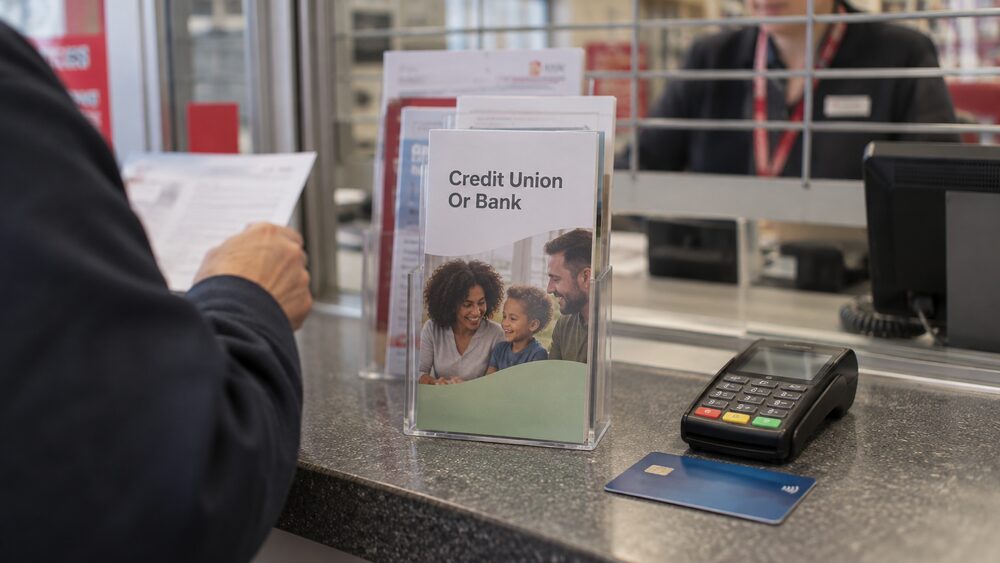
The law itself is recognised as dated. The Woolard Review recommended that the FCA should work with the Bank of England, the Treasury and the Northern Irish government to set the timetable on updating the Credit Unions Act 1979 to allow credit unions to expand their product offering30. Reforms in 2025 allow unions in Great Britain to offer a wider range of financial services, scale by having more members, charge more interest on loans, accept corporate members and invest surpluses in a wider range of products which may generate higher returns3. The comparison guide credit union or bank sets the two side by side, and the Credit Unions Act 1979 and later reforms covers the law.
Paying in, withdrawing and managing your account
There are several ways to pay money into a credit union. Members can pay in directly by payroll deduction or through benefit direct accounts; through retail payment networks such as PayPoint and PayZone; by standing order or direct debit, or in cash at local offices and collection points4. The same range appears in guidance listing payroll deduction from wages, Direct Debit or standing order, cash at the credit union office or a collection point, State benefits paid in directly, and PayPoint cards in some places11.
With a credit union current account, you can usually do the following for free: pay in or take out cash at the credit union, have money paid in such as wages, benefits and pensions, use online, mobile or telephone banking, and get budgeting advice and support1.
Getting money out also takes several forms: cashing a cheque at a local Post Office, cash from a local credit union office, payment directly into a bank account, or a debit card at a cash machine if the credit union operates a current account11. As a credit union member you are in control of your own finances and have a say in how your financial service provider is run13.
How you bank day to day depends on the union. Whether you are looking for a credit union with online and phone banking, a payroll partnership with your employer, or a local branch or service point you can walk into, different unions offer different channels13. Smaller unions with volunteer staff may have limited opening hours6. The guides to how to pay money in, benefits paid into your account, payroll deduction or paying in yourself and what your employer sees about payroll deductions cover the detail.
How to find and join a credit union
To become a credit union member, you need to visit or call your chosen credit union to confirm what information you need to join4. The findyourcreditunion.co.uk website can help you locate credit unions11, and credit union finders are listed separately for England, Scotland and Wales, and for Northern Ireland1. The site's own credit union directory lists unions by area and by employer.
Joining normally means being asked to pay a small fee (for example, £2) or to save a certain amount, such as £101. You will usually need to provide two recent documents to prove your identity and address, for example a passport, driving licence, student or work ID card, bus pass, birth certificate, bank statement or energy bill1.
The steps in order:
- Check which credit unions you are eligible for, using the common bond rules.
- Visit or call your chosen credit union to confirm what information you need4.
- Gather two recent documents proving identity and address1.
- Pay the joining fee or make the first saving the union asks for1.
- If you want to borrow, ask whether the union lends to new members or requires savings first6.
The guides to how to join, joining through your employer, trade or profession, family members joining and keeping membership after you move or change job cover each situation.
FSCS protection: up to £120,000 per person
Money you hold with a credit union is protected by the Financial Services Compensation Scheme (FSCS). FSCS protects up to £120,000 in total across all accounts you hold with the credit union8, and FSCS can pay back any money you hold with a failed credit union, up to its compensation limit of £120,000 per person8. FSCS protection for banks, building societies and credit unions is up to £120,000 per person per banking licence31, and for failures from 1 December 2025 FSCS will automatically compensate you up to £120,000 per eligible person, per bank, building society or credit union32. The limit applies per person per firm, so savings spread across two different credit unions each get their own £120,000 protection31.
The protection covers the same kinds of deposits as banks: current accounts, savings accounts, cash ISAs and savings bonds23. Just like most banks, up to £120,000 per person is protected in a credit union account1. Loans and savings with credit unions are protected by the scheme3.
One point to check is the licence behind the brand. FSCS protection applies per banking licence, so if a credit union operates under more than one name, money held across those names may count together towards one £120,000 limit31. The FSCS publishes a list of banking licences so you can check which brands share one31. A credit union's own page will normally state that it is authorised and regulated by the FCA and that money is protected; for example, the Commonwealth Secretariat Staff Credit Union states it is collectively owned by its members, authorised and regulated, and that money is protected33. You can verify any credit union's status on the FCA Register.
Credit union loans compared with payday and other short-term borrowing
Credit unions are widely recommended as an alternative to payday loans6. The comparison is straightforward on the numbers: credit union interest is capped at 3% a month, an APR of 42.6%5, many loans cost 1% a month on the reducing balance, an APR of 12.7%5, and there are no setup fees, administration costs or early redemption fees5. Payday loans sit outside this framework and typically cost far more for the same amount over the same period.
The sector's own figures give a sense of scale. Credit unions made over 650,000 loans to people on low incomes, saving them on average £401 a year compared with the cost of other borrowing, a total saving to this group of £250m12. There are around 400 credit unions across England, Scotland and Wales, holding £843 million of deposits and loans worth £620 million12.
Credit unions are not the only alternative. Community development finance institutions (CDFIs) also lend to people mainstream lenders reject: see credit unions and CDFIs. Other comparisons that matter for the same small-amount borrowing are payday loans, doorstep lenders, rent-to-own for household goods and no interest loan schemes.
Two cautions apply. First, a credit union loan is still a debt: having a bad credit rating will make it more expensive and harder to borrow money34, and if you have a poor credit rating you may only be able to get a loan at a high interest rate or secured against your home35. Second, borrowing to consolidate existing debts does not make them cheaper by itself: see consolidating debts guidance and the wider debt guide before borrowing more.
If you fall behind, and where to get free help
If you miss payments on a loan, the credit union may be able to use your savings to repay the loan15. This is a significant difference from a bank, where your savings are not automatically available to cover a missed loan payment. It is one reason to think carefully about how much you save with a union you also owe money to, and to tell the union as soon as you know you will struggle.
Credit unions will only lend what you can afford14 and always consider affordability when assessing loan applications3, so problems usually arise from a change in circumstances rather than the original loan. If that happens, free help is available before things escalate:
- MoneyHelper offers free, impartial guidance on everyday money and borrowing1.
- Debt advice charities such as StepChange provide free debt advice, including on credit union loans6.
- Business Debtline provides free guidance on budgeting, saving and borrowing16.
If you have been lent money you could not afford to repay by any lender, the Financial Ombudsman Service can consider complaints about unaffordable lending26. The ombudsman notes that credit union loans are exempt from some of the rules that apply to other lenders, so what it can look at depends on the type of loan27.
The guides to falling behind on a credit union loan, credit union loans and your credit file, how an IVA affects membership and savings and what happens to savings and loans when a member dies cover the difficult cases, including loan protection insurance, life savings insurance and death benefit insurance.
Sources35 cited
- Credit union current accounts Moneyhelper, 2026-09-25
- About credit unions UFCU, 2026-09-26
- Save, bank or borrow with a credit union Welsh Government, 2026
- About credit unions Find Your Credit Union, 2026-09-26
- 10 tips on paying off your debts Which?, 2026-04-06
- Credit unions StepChange, 2026-09-25
- Credit union statistics 2026 Q1 Bank of England, 2026-08-28
- Deposit protection for credit unions FSCS, 2026-09-25
- The Individual Savings Account Regulations 1998 legislation.gov.uk, 1998-07-31
- The Financial Services and Markets Act 2000 (Regulated Activities) Order 2017 legislation.gov.uk, 2017-07-18
- Credit unions consumer factsheet Building Societies Association, 2026-09-15
- CIC fair and affordable finance Responsible Finance, 2026-09-26
- About credit unions All Together Money, 2026-04-01
- Get advice about managing credit Gov.wales, 2022-11-18
- Debt consolidation guide Business Debtline, 2026-09-26
- Budgeting, saving and borrowing Business Debtline, 2026-09-26
- Credit unions research paper Northern Ireland Assembly, 2025-03-14
- Credit Unions (Maximum Interest Rate on Loans) explanatory memorandum 2006 legislation.gov.uk, 2006-05
- Credit Unions (Maximum Interest Rate on Loans) Order 2006 legislation.gov.uk, 2006
- Credit Unions (Maximum Interest Rate on Loans) Order 2013 explanatory memorandum legislation.gov.uk, 2013
- Credit Unions (Maximum Interest Rate on Loans) Order 2013 legislation.gov.uk, 2013-10-08
- Credit unions briefing CBP-8810 House of Commons Library, 2026-07-08
- What is the Financial Services Compensation Scheme? Bank of England, 2025-12-01
- Choosing a bank account for your Universal Credit payment Moneyhelper, 2026-09-25
- Customer-owned banks research paper Northern Ireland Assembly, 2025-01-17
- Unaffordable lending complaints Financial Ombudsman Service, 2026-09-26
- Unaffordable lending: complaints businesses deal with Financial Ombudsman Service, 2026-09-26
- BCOBS 7.1 FCA Handbook, 2018-08-15
- App scams reimbursement policy statement PS23/4 Payment Systems Regulator, 2023-12
- The Woolard Review FCA, 2021-02-02
- Banking licences FSCS, 2026-09-25
- What we cover: banks, building societies and credit unions FSCS, 2025
- About us Commonwealth Secretariat Staff Credit Union, 2026-09-26
- What do I need to know about debt? Bank of England, 2025-08-19
- Consolidating debts nidirect, 2025-09-11




 MoneyHelperFree, impartial money and pensions guidance, set up by government
 FSCSProtects your money if a bank, insurer or investment firm fails
 Financial Ombudsman ServiceFree, independent help when a complaint about a firm is not put right
 StepChangeFree debt advice and solutions from a charity
 Citizens AdviceFree advice on money, consumer and legal problems in England and Wales