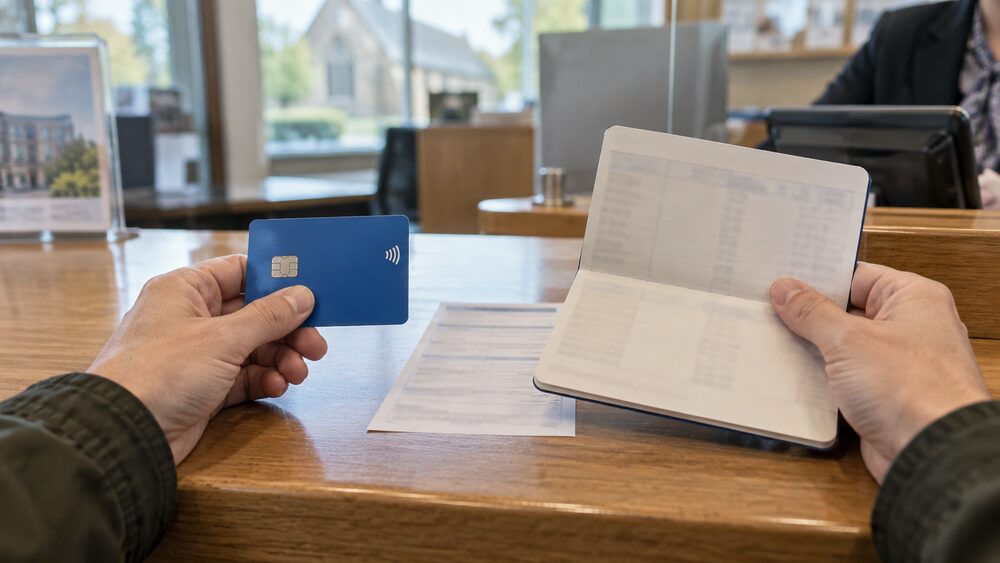
A current account is where your money lands and leaves: wages or benefits come in, bills go out, and a debit card pays for things in shops and online. A savings account is where money sits and grows, kept apart from the money you spend. Most people need both, and the two are not interchangeable.
The difference matters because the rules, the interest and the protection are not the same. Interest on savings is usually paid gross, meaning tax is not automatically deducted before it is paid1. Current accounts usually come with an optional overdraft, a cheque book and a debit card, with Direct Debits and standing orders available2. Savings accounts are for putting money away for the future, for emergencies or to buy expensive items3.
The Current Account Switch Service moves your current account to a new bank within seven days, but it cannot move a savings account or an ISA4. If you hold both a current account and a savings account with the same bank, they may share one £120,000 compensation limit rather than getting £120,000 each6.
What a current account does that a savings account does not
A current account is built for managing money day to day, including paying bills, receiving money such as salary or benefits, and keeping track of spending3. A savings account is built for putting money aside. The two serve different purposes, and the rules treat them differently.
The FCA defines a personal current account as an account, other than a current account mortgage, which is a payment account within the meaning of the Payment Accounts Regulations3. That definition does not include credit card accounts or current account mortgages10. A savings account is not a payment account in the same sense, which is why it cannot be used for the same everyday functions.
In practice, a current account lets you receive benefits and wages, spend in shops, withdraw cash, manage the account online or by mobile app, and set up Direct Debits and standing orders11. A savings account lets you put money away, but it does not come with the same payment features. You can set up a standing order from your current account to move money into your savings account automatically each month12.
A basic bank account sits between the two. It usually has fewer features than a current account, but you can still set up direct debits and standing orders, use a debit card to pay for items and withdraw money from a cash point, have income paid in, and check your balance at a bank, cash machine or online13. Basic bank accounts do not come with a cheque book or an overdraft3.
Everyday payments: cards, cash machines, direct debits and standing orders
A current account is the account that connects to the payment system. It comes with a cheque book to take money out, possibly a debit card for shops and cash machines, a possible overdraft and other credit, and direct debits and standing orders3. A savings account does not usually offer these.
Direct debits and standing orders are the two main ways to make regular payments. A standing order is an instruction you set up with your bank to transfer a fixed amount automatically, for example from your current account to your savings account every month12. A direct debit is an instruction you give to an organisation to collect varying amounts from your account, and it is covered by the Direct Debit Guarantee14.
If the organisation you are paying, or your bank or building society, makes an error, you are entitled to a full and immediate refund of the amount paid15. If you cancel a direct debit and payments are still taken, the bank must refund the payments it made after the cancellation16.
The Financial Ombudsman Service handles complaints about current accounts, savings accounts, direct debits, money transfers, electronic payment platforms, cheques and banker's drafts10. If your bank does not resolve a payment problem, the ombudsman is the next step.
Interest and tax: interest is paid gross
Interest on savings is usually paid gross, which means tax is not automatically deducted before interest is paid1. This applies to savings accounts generally, and providers state it in their terms.
This does not mean savings interest is tax-free. It means you receive the full amount and any tax due is handled through your tax position rather than being taken at source. If you are employed and your savings interest is below your personal savings allowance, you may not need to do anything. If your interest is higher, you may need to declare it.
Current accounts are different. Many pay little or no interest, and the interest they do pay is not the main reason people hold them. The FCA requires banks to give you terms and conditions, interest rates, details of all charges, how information will be given, any spending limits, and what to do if things go wrong when you open a current, basic or instant access savings account3.
For savings accounts other than instant access, you will be given less detailed information, possibly in a summary box to help compare accounts3. That summary box is designed to make it easier to compare different accounts from different banks and building societies3.
Fees and charges on a current account
Current accounts can carry monthly fees, transaction charges and overdraft interest. The FCA requires banks to disclose all charges when you open a current, basic or instant access savings account, along with interest rates, terms and conditions, and what to do if things go wrong3.
Some current accounts charge a monthly fee. Santander, for example, increased the monthly fee on its 1|2|3, Select and Private current accounts from £4 to £5 from 11 May 202617. That is a provider's own figure for its own product, and other providers set their own fees.
Overdrafts are where most current account charges arise. If you overdraw from your account, the bank will charge you interest on a daily basis and can ask that the overdraft is cleared on demand2. For personal current accounts, banks and building societies can no longer charge more for an unauthorised overdraft than for an authorised overdraft2.
Savings accounts generally do not carry monthly fees or overdraft charges, because they are not designed for borrowing. The charges you might see on a savings account are more likely to be exit fees or penalties for early withdrawal on fixed-term products, and those are set out in the product terms.
Overdrafts and the bank's right to move money between accounts
An overdraft is a borrowing facility attached to a current account. Current accounts usually come with an optional overdraft, a cheque book and a debit card2. A savings account does not normally offer an overdraft.
If you have an overdraft and you switch current accounts, the balance can sometimes be transferred. Barclays and NatWest told Which? that if you have an overdraft with your current bank, the balance can be transferred to your new account, provided your agreed overdraft limit is high enough, and this must be arranged before using the Current Account Switch Service18. If the new overdraft covers what you owe, the funds will be sent to your old bank and you will owe the overdraft balance on the new account instead. If it is a lower amount, or you cannot get one, you will need to arrange to pay off the remainder separately before you can switch or close your old account19.
You can switch using the Current Account Switch Service even if you are overdrawn20. But if you open a basic bank account at the same bank where you have an overdrawn current account, the bank may use the money in the new basic account to pay off debts in the old overdrawn account. If you get benefits, tax credits or state pension, it may be worth considering opening at a different bank3.
Savings accounts cannot usually be moved automatically, and you may need to speak with your bank to arrange this21. If you are in a debt management plan, you can normally keep your current bank account if you do not have an overdraft and do not owe your account provider any debt settled in the plan22.
Switching or closing an account with the Current Account Switch Guarantee
The Current Account Switch Service simplifies changing accounts, with the Current Account Switch Guarantee providing protection if something goes wrong4. It is a free service that can automatically switch your current account to another bank or building society3.
Most banks have the Current Account Switch Guarantee that will let you switch accounts within seven days4. The new bank or building society, as a participant of the Current Account Switch Service, guarantees the switching process5. Payments in and out of your new account are switched over in time so that you do not miss any regular bills and payments5.
The service covers personal current accounts only. Savings accounts and Individual Savings Accounts cannot be switched through it5. If you use the service, your old bank will close your old account, and payments to the old account are automatically redirected. If you keep the old account open, the service and the Guarantee cannot be used5.
If anything goes wrong, you will be refunded any interest and charges on your old and new accounts19. The new bank must refund you for any charges incurred as a result of a direct debit or standing order not having been successfully transferred to the new account4.
Inactive accounts, suspensions and changes to terms
If a bank account has not been used for three years or more, My Lost Account is a free service that can help find it23. That applies to bank accounts, and it is the starting point if you think an old account may exist.
Banks must give at least 90 days' notice before terminating an account opened on or after 28 April 2026, and must provide a clear reason behind the action7. For changes to terms and conditions on current, basic and instant access savings accounts, the bank or building society should tell you at least two months before the changes are made3.
Santander's changes to its General Terms and Conditions cover all its current and savings accounts, including cash ISAs and junior ISA17. When a bank changes terms across both current and savings accounts, the notice rules apply to each account type according to its category.
Complaints, refunds and FSCS protection
If something goes wrong, the route is the same whether the problem is with a current account or a savings account. Contact customer services first. If that does not resolve it, make a formal complaint. The bank has eight weeks to investigate and give a final response. If you still do not agree, or eight weeks have passed, you can take your complaint to the free Financial Ombudsman Service19.
The ombudsman handled 32,900 complaints about current accounts across 2025/2624. That figure shows the volume of disputes that reach the ombudsman, not the outcome of any individual case.
FSCS protection covers deposits, current accounts and savings accounts25. It includes current accounts, savings accounts, cash ISAs and savings bonds26, and money in current, saving and fixed-term deposit accounts27. The limit is £85,000 per person, per financial institution8.
If a current account and a savings account share one FRN or authorisation number, they are classed as a single firm and the £120,000 limit is shared across both6. That means holding both with the same bank does not double your protection. A virtual current account is not covered by FSCS; it is covered by e-money rules, with money kept safe at a different bank, but you would need to make a claim to the administrator if your provider failed28.
Claims against an insurer, bank or investment firm that failed before 1 December 2001 are covered by the rules governing the separate compensation schemes that existed before that date29. Credit insurance claims are not eligible for FSCS protection29.
If you are unhappy with your bank and want to move to a more accessible account, you can talk to the bank first, then make an official complaint or move to a more accessible account30. The Financial Ombudsman Service is free to use and covers banking and payment services including current accounts, savings accounts, direct debits, money transfers, electronic payment platforms, cheques and banker's drafts10.
Sources30 cited
- 7 surprising reasons you might need to file a tax return in January Which?, 2025-01-08
- Overdraft debt StepChange, 2026
- Getting a bank account Citizens Advice, 2026-09-26
- How to switch your bank account Which?, 2026-09-07
- Switching your personal current account Zempler Bank, 2026-09-25
- FSCS protected leaflet FSCS, 2025-11
- Bank account terminations House of Commons Library, 2026-09-26
- Where will my money be safe? Which?, 2025-08-04
- Direct Saver brochure NS&I, 2024-07-01
- Banking and payments complaints Financial Ombudsman Service, 2026-09-25
- Choosing a bank account for your Universal Credit payment MoneyHelper, 2026-09-25
- Saving money National Debtline, 2026-09-25
- Basic bank accounts Advice NI, 2026-09-26
- Regular payments Financial Ombudsman Service, 2026-09-26
- Safer ways to pay Consumer Council, 2026
- Customer complains bank failing to cancel direct debit Financial Ombudsman Service, 2026-09-26
- Changes to your current account Santander, 2026-05-11
- Can you switch your student bank account after the first year? Which?, 2026-08-06
- How to open, switch or close your bank account MoneyHelper, 2026-09-25
- Overdrafts explained MoneyHelper, 2026-09-25
- Making the most of your bank account Independent Age, 2026-09-26
- Debt management plans Advice NI, 2026
- Debts after death Business Debtline, 2026-09-26
- Annual complaints data and insight 2025/26 Financial Ombudsman Service, 2025
- Check your money is protected FSCS, 2026-09-25
- What is the Financial Services Compensation Scheme? Bank of England, 2025-12-01
- Check your money is protected FSCS, 2026-09-25
- How to choose the right bank account MoneyHelper, 2026-09-25
- Eligibility rules FSCS, 2026-06-04
- Accessible banking and financial services Scope, 2026-08-17


 MoneyHelperFree, impartial money and pensions guidance, set up by government
 FSCSProtects your money if a bank, insurer or investment firm fails
 Financial Ombudsman ServiceFree, independent help when a complaint about a firm is not put right
 Citizens AdviceFree advice on money, consumer and legal problems in England and Wales