
The Capital One Classic is a credit card aimed at people who are building or rebuilding a credit history rather than those with a long, clean record. Capital One says you are more likely to be accepted if you have some history of managing credit, even if you have had CCJs or defaults in the past, if you are on the electoral roll, and if you have not declared bankruptcy in the last 12 months1. It is a Mastercard, it carries no annual cost, and Capital One says the APR you are offered after checking your eligibility is always the one you get1.
The card's headline feature is a long interest-free period on purchases: up to 56 days on all new spends, provided you clear the balance each month1. That is the ordinary interest-free window that comes from the gap between your statement date and your payment due date, and it disappears the moment you carry a balance forward. The provider's own site carries today's rates, fees and credit limits, and those figures change, so this page does not repeat them.
Capital One is a familiar high street brand rather than a small operator. It offers credit cards, and its app gives access to all your card information instantly1. The firm behind the card, Capital One (Europe) plc, is authorised by the Financial Conduct Authority with reference number 204440, and its trading names include Luma and Capital One2. It has been an active company since it was incorporated on 17 November 19993.
Who can apply for the Capital One Classic
The card is designed for a specific position: not a blank credit file, but one with some history on it. Capital One's own wording is that you are more likely to be accepted if you have some history of managing credit, even if you have had CCJs or defaults in the past, if you are on the electoral roll, and if you have not declared bankruptcy in the last 12 months1. That combination matters. A CCJ or a default is not an automatic refusal, but a bankruptcy within the last year is a bar.
Being on the electoral roll is the single easiest thing to fix before applying, because lenders use it to confirm identity and address. Beyond that, the assessment is about affordability as much as history: a lender looks at income against existing commitments, and a card issued to someone already stretched is a risk to both sides.
A previous refusal by another lender does not disqualify you. Applications are assessed on their own facts, and a decline usually reflects the information on your file at that moment rather than a permanent judgement. What does count against you is a cluster of applications in a short period, because each one leaves a mark.
If you are weighing up whether a card aimed at rebuilding is the right shape of product, credit-builder credit cards explains how this category works and what separates one from another. The wider credit cards guide covers the alternatives.
What the application asks for and what happens next
Capital One offers an eligibility check called QuickCheck. You fill in a few details and it tells you whether you are eligible without affecting your credit score1. That is the sensible first step, because it separates the question "would I be accepted" from the question "what would it cost me to find out".
The distinction matters because of what follows. Capital One states plainly that when you apply for a credit card, the lender will run a hard check on your credit history, and that these types of searches will impact your score1. A hard search is visible to other lenders for a period, so a scattergun approach across several providers in one week is worse than one considered application.
Once you apply, the process is the same shape as any card application: identity and address checks, an affordability assessment, and a decision. If you are approved, the card and its terms arrive, and the credit limit is set by the lender rather than chosen by you. Capital One says you can get up to two credit increases a year1, which is how a limit grows on this kind of account, usually in response to how you run it.
Applications for credit cards generally can be made online, in an app, over the phone or in person depending on the provider4. Capital One's own route is online. The applying for a credit card guide sets out what a lender looks at and how to prepare.
How interest and charges work on the card
The interest-free period is the part most people misunderstand. Capital One says you get up to 56 days interest-free on all new spends, so long as you pay your balance off each month1. The condition is doing the work in that sentence. Clear the statement balance in full and each purchase costs nothing in interest. Carry any of it forward and the position changes completely.
Northern Ireland's official guidance puts the rule bluntly: if you do not pay off the full amount every month on a credit card, you will be charged interest on the whole lot, not just the unpaid amount5. So a balance carried on a card that also has new spending on it can attract interest on purchases that were made recently and have not yet appeared on a statement. This is the single most expensive habit on a credit card, and it is why the interest-free window is only worth having if you can clear the balance.
There is no annual cost on the Capital One Classic1. That does not mean the card is free to run. Interest applies to carried balances, and cash withdrawals are treated differently from purchases: on credit cards generally, you are charged interest on cash withdrawals straight away, with no interest-free window at all6. Withdrawing cash on a credit card is covered in more detail in withdrawing cash on a credit card, and the mechanics of how the charge builds are in how credit card interest is charged.
The provider's site has today's rates, including the APR and any fees that apply to the account.
Managing the card in the app and online
Day to day, the account is run through Capital One's app and online banking: checking the balance, seeing transactions, making payments and setting up a direct debit. The practical decision that matters most is how the monthly payment is set up.
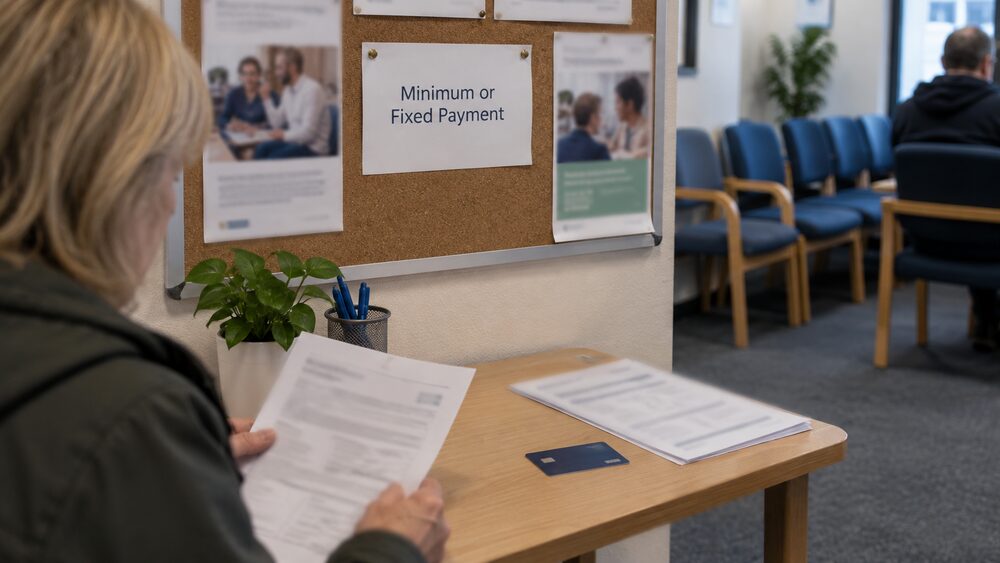
A direct debit for the full statement balance is the arrangement that preserves the interest-free window automatically. A direct debit for the minimum payment keeps the account in good standing but leaves the rest of the balance accruing interest, and it is the arrangement that turns a small balance into a long one. The difference between the two is set out in minimum payment or fixed amount and in credit card minimum payments.
Direct debits and standing orders are not the same thing, and the distinction matters if a payment goes wrong: a direct debit is covered by the Direct Debit Guarantee and can be reclaimed if taken in error, while a standing order is a payment you control and cannot be pulled back the same way7. Setting up a direct debit for the statement balance is the lower-risk option.
One caution applies to any card arrangement where a company takes payments from your card rather than your bank account. A continuous payment authority can be hard to cancel and can change the amount and the payment date8. If you have given a subscription or a lender your card details, that is the mechanism they are using.
Missed payments: what they mean for your credit file
Missing a payment on a credit card is not a private matter between you and the lender. The provider and the credit reference agencies count it as a missed payment, and several missed payments put the account at risk of defaulting9. The record sits on your credit file and is visible to anyone who searches it.
The severity depends on how quickly it is fixed, and the difference between one missed payment and four is the difference between a reminder and a default notice.
| Missed payments | What happens | Recorded on your credit file? |
|---|---|---|
| One or two | Reminders are sent; if you catch up, no further action should be taken | Missed payments may not be recorded, but interest and charges including late payment charges are added10 |
| Three or four | The creditor will soon think about sending a default notice for credit card or buy now pay later debts, and will be considering other recovery steps | The payments are recorded on your credit file10 |
Once recorded, the damage has a long tail. All missed, late or partial payments are recorded on your credit file for at least six years11, and late payments, missed payments and defaults stay on your credit history for six years12. That affects more than future card applications: missed payments can make it harder to get credit in future and harder to remortgage11. The effect is not confined to the person who missed the payment either. On a joint debt, a missed payment is marked on both credit files regardless of who missed it13, and if a payment is missed it is recorded on your credit file as well as your ex-partner's14.
Help if you are struggling with repayments
The most important thing to know is that asking for help does not damage your credit file. The Financial Ombudsman Service states that discussing your options will not have any impact on your credit file, for example when you contact your lender about difficulty while you are up to date with payments15. Debt advice itself does not affect your credit score either, though some formal debt solutions will16. The fear that a phone call will be logged against you is the reason many people delay, and it is unfounded.
What does damage a file is silence. If you think you might miss a payment, the guidance is to contact the lender as quickly as possible and discuss your options12. Lenders have forbearance options, and the earlier the conversation, the more of them are available. If you cannot afford higher repayments, there are rules on what a lender must consider, set out in when you cannot afford to pay more.
Free, impartial help is available and does not cost anything. Help with credit card debt sets out the routes, and the debt guide covers the full range of solutions and your rights. Where you live affects some of the detail: credit card debt in Scotland and credit card debt in Northern Ireland cover the differences.
If a payment holiday is being considered, it is worth understanding what it does and does not do. A payment holiday on a credit card is an arrangement to pause payments, and the interest position during it depends on the terms agreed9.
Fraud protection, disputes and chargebacks
Card payments carry protections that other payment methods do not. If a purchase goes wrong, or a card is used without your authority, there are routes to get the money back, and they work differently depending on what happened.
For a purchase where the goods never arrived or were not as described, Section 75 can make the card issuer jointly liable with the retailer. It applies to purchases over £100 and up to £30,000, and it is a legal right rather than a goodwill gesture. The full conditions are in Section 75: credit card purchase protection, with the threshold explained in the £100 to £30,000 Section 75 threshold and the exclusions in when Section 75 does not protect you.
Where Section 75 does not apply, chargeback is the alternative: a scheme rule rather than a legal right, used to reverse a payment through the card network. Chargeback: how to dispute a card payment explains how to raise one, and Section 75 or chargeback sets out which to use.
For payments made without your authority, the position is different again. Credit card fraud and unauthorised payments covers what counts and what the card issuer must do. On the wider payments system, authorised push payment fraud rules now cover payments made using Faster Payments and CHAPS, with special protections for customers deemed vulnerable17. If a card is lost or stolen, the card is blocked and a replacement sent out18, and the number to call is on your statement and in the app.
Complaints and how Capital One is regulated
Capital One (Europe) plc is authorised by the Financial Conduct Authority under reference number 204440, with Luma and Capital One among its current trading names2. It is an active company, incorporated on 17 November 19993. The FCA register entry is the place to check a firm's permissions and status, and it is worth checking before dealing with any unfamiliar firm.
If something goes wrong, the first step is a formal complaint to Capital One. That is the standard route across financial services: before bringing a complaint to the ombudsman, a formal complaint to the company involved comes first20. The firm then has a period to respond, and if you remain dissatisfied, or eight weeks pass, the Financial Ombudsman Service can look at it.
The ombudsman service publishes complaints data by firm, which gives a sense of how many disputes reach that stage:
| Firm | New cases | Period |
|---|---|---|
| Capital One (Europe) plc | 962 total new cases | 1 January to 30 June 202421 |
| First charge mortgages, all firms | 1,291 new cases | Q1 2026/2722 |
| Conventional annuities, all firms | 96 new cases | Q1 2026/2722 |
Complaints about how your personal data has been handled go to the Information Commissioner's Office rather than the ombudsman. The ICO's position is that a complaint to the organisation comes first, and if you remain dissatisfied you can complain to the ICO23. If the issue is that data held about you is wrong, there is a separate right to have it corrected24. Where a decision about you was made without human involvement, there are specific rights and a route through the courts as well as the ICO23.
The complaining about a credit card provider guide sets out how to escalate a complaint step by step, and consumer protection in UK financial services explains what each regulator covers.
Sources24 cited
- Capital One Classic Mastercard Capital One, 2026
- Capital One (Europe) plc register entry Financial Conduct Authority, 2026-09-26
- Capital One (Europe) plc company filing Companies House, 2026-09-26
- How to open, switch or close your bank account MoneyHelper, 2026-09-25
- Credit cards and debt nidirect, 2025-11-06
- Spending abroad: the 4 dos and 5 don'ts Which?, 2024-07-26
- Direct debits and standing orders explained Which?, 2026-03-05
- Dealing with payday loan debt StepChange, 2026-09-25
- Credit card payment holidays StepChange, 2026-09-25
- Debt collection StepChange, 2026-09-25
- Mortgage arrears StepChange, 2026-09-25
- Getting a mortgage with late payments and defaults Which?, 2025-08-20
- How joint debts affect me StepChange, 2026-09-25
- Divorce and separation StepChange, 2026-09-25
- Financial difficulties with mortgages Financial Ombudsman Service, 2026-09-26
- Debt myths: true or false StepChange, 2026-09-25
- Fighting authorised push payment fraud: a new reimbursement requirement Payment Systems Regulator, 2026-09-26
- Universal Credit advance payments nidirect, 2026-05-20
- App guide Take Five, 2026
- PPI case studies Financial Ombudsman Service, 2026-09-18
- Half-yearly complaints data H1 2024 Financial Ombudsman Service, 2024
- Quarterly complaints data Q1 2026/27 Financial Ombudsman Service, 2026
- Your rights relating to decisions being made about you without human involvement Information Commissioner's Office, 2026-09-25
- Your right to get your data corrected Information Commissioner's Office, 2026-09-26

















 MoneyHelperFree, impartial money and pensions guidance, set up by government
 StepChangeFree debt advice and solutions from a charity
 National DebtlineFree debt advice by phone, webchat and online
 Financial Ombudsman ServiceFree, independent help when a complaint about a firm is not put right
 Citizens AdviceFree advice on money, consumer and legal problems in England and Wales