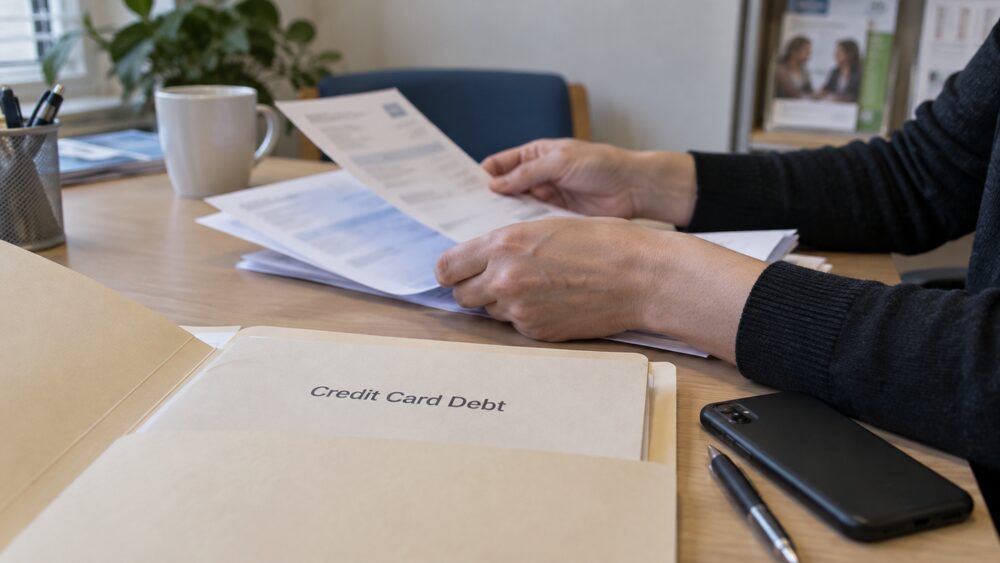
Credit card debt becomes a problem when the repayments stop being affordable, and the most important thing to know is that free, independent help exists. Charities such as StepChange Debt Charity and National Debtline give free debt advice, and the government-backed MoneyHelper service can point you to it. Around 70% of the people StepChange helps have a credit card debt, so you would be far from alone in asking1.
You cannot go to prison for simply not paying a credit card debt1. Credit card debt is what advisers call a non-priority debt: the consequences of not paying are serious, but they are not the same as missing rent, a mortgage or council tax, where losing your home or facing court action can come much faster. That classification shapes which debts to pay first and what a creditor can realistically do, and this page explains both.
The steps below follow the order most advisers would take you through: stop the debt growing, work out where card debt sits among your other debts, get free advice, and consider the options an adviser may recommend, from a debt management plan to breathing space. It also covers what a card company can do if you stop paying, and where to call in each part of the UK.
How credit card debt grows: interest and missed payment charges
Card debt grows in two ways, and both speed up the longer the balance sits there. First, interest is added: if you don't pay off the full amount every month on a credit card, you'll be charged interest on the whole lot, not just the unpaid amount7. More interest is added as the balance gets bigger4. Second, extra charges are added if you miss payments4. A missed payment can also cost you a promotional rate, which is covered in missing a payment on a 0% deal.
The rules on persistent debt exist to stop this cycle running for years. You are treated as being in persistent debt when, in the last 18 months, the amount you have paid in interest and fees is bigger than the amount of borrowed money you have paid back1. When that happens, your credit card company will write to you and ask you to increase your monthly payment4. The company must help you if you have been in credit card debt for more than 18 months, which can include reducing or cancelling interest or fees if you are not able to pay back what you owe8.
At the 36 month point the options widen: the company may suggest an affordable payment plan to clear the debt quicker, or paying off the debt with a loan or credit card, and may also consider pausing interest and charges, reducing your minimum payment, or suspending your account9. A payment holiday is another possibility, but interest builds up while the holiday is in place10. The dedicated pages on how credit card interest is charged, minimum payments and the persistent debt rules explain each of these in more detail.
Stop using the card you want to clear
The first step advisers give is to stop using the credit card being paid off. This means the amount you owe stops growing, making it quicker to repay4. It sounds obvious, but it is the step that changes the arithmetic: every new purchase restarts the growth the interest is causing, and any balance you add may be charged at a different rate from the one you are trying to clear.
The same advice appears in guidance for people facing unemployment or reduced hours: stop using credit cards or adding to credit card debt11. If spending on the card is covering a gap between your income and your outgoings, that gap is the thing to deal with, and a debt adviser can help you look at it as part of a full budget rather than card by card.
Stopping spending does not mean closing the account, and it does not mean the debt stops costing money. Interest continues to be added each month if you don't pay your credit card bill3. What stopping does is freeze the size of the problem so that a repayment plan, a balance transfer or a formal debt solution can actually shrink it. If you are considering moving the balance, the pages on balance transfer fees and money transfer fees set out what moving the debt costs.
Credit card debt is a non-priority debt
Advisers sort debts into priority and non-priority, and the sorting matters more than the size of each debt. A priority debt is one with serious consequences for missing it: rent or mortgage arrears can cost you your home, council tax arrears can lead to enforcement, and some debts can lead to court action much faster. Credit card debt sits in the non-priority group, alongside catalogue debts9 and money you owe to your bank12. Non-priority does not mean unimportant: it means the creditor's route to recovering the money is slower and goes through defined stages, which gives you time to take advice.
The practical effect is about ordering. If you can only pay some bills this month, a debt adviser will usually say to protect the priority debts first and treat the credit card minimum payment as something to negotiate, not something to protect at all costs. That is not a licence to ignore the card: interest and charges keep being added, and missed payments go on your credit file, as explained in how credit cards affect your credit file. But it does mean a card company cannot take your home or send bailiffs in the way a landlord or local authority can, and it means a repayment plan is realistic to negotiate.
If you refuse a repayment plan a card company offers, nothing immediate happens, but the account stays in the normal collections process: interest and charges continue, missed payments are recorded, and the company can eventually pass the debt on or take court action, as the later sections of this page describe.
Free debt advice: StepChange, National Debtline, Citizens Advice and MoneyHelper
Debt advice is for people who cannot afford to pay more than they do now, or who are struggling to make payments or making reduced payments2. It is free. StepChange Debt Charity provides free and impartial debt advice2, including through an online debt advice tool that gives free, expert advice13. National Debtline provides free, confidential and independent debt advice14. Citizens Advice offers free advice on debt and other money problems15. MoneyHelper is a government-backed service that can help you find a way forward if you are worried about money and finding it difficult to know where to start15, and offers free, impartial money and pension guidance16.
| Service | What it offers | Cost |
|---|---|---|
| StepChange Debt Charity | Free, expert debt help and advice, online tool and fee-free debt management plans17 | Free |
| National Debtline | Free, confidential and independent debt advice14 | Free |
| Citizens Advice | Free advice on debt and other money problems15 | Free |
| MoneyHelper | Free, impartial money and pension guidance, backed by government, and a debt advice locator tool16 | Free |
If you are unsure which service suits you, the MoneyHelper debt advice locator tool lists free advice services18. The Money and Pensions Service, which runs MoneyHelper, has highlighted the benefits of debt advice through its advisers, and its guidance is clear that the services are free at the point of use18. MoneyHelper is sponsored by the Department for Work and Pensions16, and its support and guidance are free16.
What happens when you get debt advice
Debt advice starts with a full picture of your money, not with a product. Your adviser will check if you can claim any benefits and help you apply, and can help with finding crisis grants and charity funds, budgeting, negotiating with creditors, and recommending formal debt solutions such as a debt management plan19. StepChange describes its approach as free, flexible debt advice based on a comprehensive assessment of your situation, with practical help and support for however long it is needed15.
A debt advice session typically works through the debts in stages: the adviser separates them into priority and non-priority, works out what is affordable from the person's income, and then sets out the options that follow, from informal arrangements with creditors to formal solutions. Those options differ in cost, risk and effect on a credit file, and an adviser explains each. Regulators expect firms to offer customers access to holistic debt advice to help them maximise their incomes, particularly at the first indication that a customer is struggling to pay20. The standard default notice a creditor must send when payments fall behind even carries a money advice statement pointing people towards free help from the Government's Money Advice Service21.
One thing advice does not do is make your situation worse by itself. Creditors may be less likely to take action against you if they know you are getting debt advice19. Where mental health is involved, the rules add protection: a debt advice provider must request confirmation of whether a debtor is still receiving mental health crisis treatment before the end of the period of 30 days beginning with the day a moratorium started, but not in the first 20 days, and then every 20 to 30 days22.
Debt management plans: free from debt charities
A debt management plan (DMP) is an informal agreement to pay your non-priority debts, including credit cards, at a rate you can afford, usually over a longer period. On a DMP, your creditors may agree to freeze interest and charges and may stop other action like taking you to court, although they don't have to5. The plan is not legally binding on either side, which is both its strength, you can change it if your income changes, and its weakness, creditors can still back out.
The cost of the plan depends entirely on who runs it. Some companies will charge you a fee for debt management plans while others give their services for free5. Most debt management companies charge a fee, so you may have less money from your available income to pay your debts23. Organisations like the StepChange Debt Charity offer free debt management plans5, and StepChange's debt management plans are fee-free17. PayPlan is another provider that offers free advice and can set up a free debt management plan for you, handling payments and negotiating with the people you owe money to24.
Free and independent advice is available on debt management plans, and on any kind of debt problem, before a plan is set up with any provider5. If a plan provider closes while your plan is running, free advice is equally available to work out what to do next24. One protection does not apply here: FSCS protection for debt management firms excludes debt advice itself25, which is a further reason to start with a charity that charges nothing.
Breathing space and IVAs: other options an adviser may discuss
Beyond a DMP, an adviser may recommend a formal solution. Breathing space is a free government-backed scheme allowing individuals time to get debt advice to help relieve the stress6. While it is in place, creditors must stop any interest and charges right away and pause any action to collect the debt26. It is not available in every circumstance: you might already be in another formal debt solution, like an IVA, DRO or bankruptcy, or you might have used breathing space in the last 12 months26.
Creditors keep some rights during breathing space: they can accept payments, ask the debt adviser to cancel the breathing space, or apply to the court to cancel it6. The scheme is heavily used: between the start of the scheme in May 2021 and 30 June 2026, StepChange Debt Charity registered 54% of breathing spaces27, and between May 2021 and 31 July 2026 it registered 56% of breathing spaces in England and Wales28.
An individual voluntary arrangement (IVA) is a formal, legally binding agreement with your creditors, and a debt relief order (DRO) and bankruptcy are the other main formal solutions. Which one suits a person depends on the size of their debts, their assets, their income and where in the UK they live, because the rules differ: Scotland has its own solutions, covered in credit card debt in Scotland, and Northern Ireland's are covered in credit card debt in Northern Ireland. The debt section sets out each solution in full. The point of advice is that these decisions are made with someone who can see the whole picture.
What creditors can do if you stop paying
A card company's powers are real but staged. You cannot go to prison for simply not paying a credit card debt1, and the company cannot simply take money from your wages or home without a court process. What it can do is add interest and charges in line with the terms, issue a default notice, report the debt to credit reference agencies or pass it to a debt collector, sell the debt to another firm, and ultimately take the case to court.
The default notice is a formal warning stage, and it is where the required money advice statement appears21. If a creditor serves a statutory demand, a formal demand for payment, and the debtor does not respond within 21 days, the creditor can apply to bankrupt the debtor30. Bankruptcy for a credit card debt is rare but possible, and it is one of the reasons to take advice before payments stop altogether rather than after.
Two things hold this process in check. First, credit card companies must help you if you are struggling to pay back what you owe, which can include reducing or cancelling interest or fees, and they must help if you have been in credit card debt for more than 18 months8. Second, creditors may be less likely to take action against you if they know you are getting debt advice19, and on a debt management plan they may agree to freeze interest and charges and stop other action like taking you to court, although they don't have to5. The page on unpaid card debt and court action covers the court stage in detail.
Where to call: helplines across England, Wales, Scotland and Northern Ireland
Free help is available in every nation, though the phone numbers and some of the services differ.
| Nation | Service | Details |
|---|---|---|
| England and Wales | Citizens Advice | Helpline Monday to Friday, 9am to 5pm31 |
| Scotland | Citizens Advice Scotland | Opening times 9am to 5pm Monday to Friday32 |
| UK-wide | MoneyHelper | Helpline 0800 138 777716; 0800 011 3797 is also listed on some of its pages |
| Self-employed | Business Debtline | 0800 197 6026, Monday to Friday 9am to 8pm17 |
Citizens Advice lists two numbers for its England and Wales helpline: 0800 240 4420 and 03454 04 05 06, and the current number is listed on the Citizens Advice website. Citizens Advice also shares complaint information nationally with enforcement authorities, including Trading Standards, the Competitions and Markets Authority and regulators, so that action can be taken31.
MoneyHelper offers a bilingual service via a variety of channels, with tools and helplines in English and Welsh16. Its webchat is open Monday to Friday, 9am to 5pm, closed at weekends and bank holidays33, and it can be reached on WhatsApp, with replies between Monday and Friday, 9am to 5pm, except bank holidays33. UK calls are free33. If English or Welsh isn't your first language, MoneyHelper can find an interpreter to help33.
In Wales, Dewis Cymru helps you find money and debt advice services where you live34, and the Welsh Government's Help to Buy - Wales scheme works closely with the debt advice agency PayPlan, though you can use any free debt advice agency35. In Scotland, mygov.scot signposts free, confidential and independent debt advice from National Debtline14. In Northern Ireland, nidirect's debt pages cover debt management plans and debt repayment options, and Advice NI is named as a source of free and independent advice5.
Spotting debt advice scams
Because real debt advice is free, anyone charging for it, or contacting you out of the blue about your debts, is a warning sign. The Money and Pensions Service states it has never, and will never, turn up at your home or contact you out of the blue via phone, WhatsApp, email or text, and that it will never charge anyone for its services36. MoneyHelper publishes guidance on types of scam36, and Citizens Advice offers guidance on what to do if you have been scammed31.
If you are worried about a debt advice firm, you can check whether a financial service has followed the rules, using Citizens Advice's guidance8, and complain to the Financial Ombudsman Service, which handles complaints involving the cost of living15. MoneyHelper's Financial Crimes and Scams Unit can be called on 0800 015 440236. The scams and fraud section covers the wider warning signs.
Sources36 cited
- Credit card debt StepChange Debt Charity, 2026
- Pay off or reduce debt StepChange Debt Charity, 2026
- Priority and non-priority debts One Parent Families Scotland, 2026
- Paying off credit card debt StepChange Debt Charity, 2026
- Debt management plans nidirect, 2025
- What is breathing space? Mental Health and Money Advice, 2025
- Credit cards and debt nidirect, 2025
- Check if a financial service has followed the rules Citizens Advice, 2026
- Catalogue debts StepChange Debt Charity, 2026
- Credit card payment holidays StepChange Debt Charity, 2026
- Unemployment and reduced hours StepChange Debt Charity, 2026
- Overdrafts and other bank debts nidirect, 2025
- Dealing with the debts of vulnerable people StepChange Debt Charity, 2026
- More help with money problems mygov.scot, 2025
- Complaints involving cost of living Financial Ombudsman Service, 2026
- What is financial wellbeing Money and Pensions Service, 2026
- How we help: debt advice StepChange Debt Charity, 2026
- Debt advisers speak out about benefits of debt advice Money and Pensions Service, 2024
- Debt advice Shelter Scotland, 2026
- Paying fair guidelines to support customers in vulnerable circumstances Ofwat, 2026
- Default notices: required statements legislation.gov.uk, 2020
- Debt respite scheme rules legislation.gov.uk, 2026
- Debt repayment options nidirect, 2025
- Your debt management plan provider has closed Citizens Advice, 2026
- Debt management cover Financial Services Compensation Scheme, 2026
- During breathing space StepChange Debt Charity, 2026
- Monthly insolvency statistics June 2026 GOV.UK, 2026
- Individual insolvency statistics July 2026 GOV.UK, 2026
- Credit agreements: getting information Business Debtline
- Statutory demands GOV.UK, 2026
- Consumer protection rights GOV.UK, 2026
- If you cannot pay council tax mygov.scot, 2026
- Get retirement guidance MoneyHelper, 2026
- Get financial or debt advice Welsh Government, 2026
- Cost of living Welsh Government, 2026
- Types of scam MoneyHelper, 2026



 MoneyHelperFree, impartial money and pensions guidance, set up by government
 StepChangeFree debt advice and solutions from a charity
 National DebtlineFree debt advice by phone, webchat and online
 Financial Ombudsman ServiceFree, independent help when a complaint about a firm is not put right
 Citizens AdviceFree advice on money, consumer and legal problems in England and Wales