
The card sits in a range that also includes a balance transfer card, a purchase card, a student card and credit-builder cards, and the terms differ between them. Some HSBC credit cards carry an annual fee, and HSBC says the amount is set out at application, in the Summary Box or in the terms and conditions rather than in one published figure1.
This page covers how the points work and what they are worth, the charges that apply, how balance transfers and interest-free days behave, who can apply, how to run the card in the app, and what happens if repayments become a problem. Rates and current fees change, so the HSBC website carries today's figures.
How HSBC credit cards earn reward points
That is the whole earning mechanic on everyday spending: there is no tiering, no category bonus and no separate rate for different kinds of purchase in the terms HSBC publishes.
Points are not credited the moment you spend. HSBC states that points are awarded up to 60 days after the spend, which applies both to the welcome offer and to the anniversary bonus3. That delay matters if you are timing a redemption around a booking.
Redemption runs through Pay with Rewards, which HSBC says is currently only available to HSBC Rewards primary credit card holders6.
HSBC also runs a separate air miles card, and its explainer on air miles was last updated on 23 September 20267. Points and air miles are different schemes with different redemption routes, so it is worth checking which one a card actually earns before applying.
The annual fee and other card charges
HSBC states that for some credit cards there may be an annual fee, and that the amount is set out at application, in the Summary Box or in the terms and conditions1. That is the position for the range as a whole: there is no single published annual fee for the Rewards card on the pages here, so the figure to work from is the one in the documents you are given when you apply.
Where HSBC does state fees, they are specific. The Premier Credit Card has no annual fee, and HSBC describes it as coming with travel benefits and reward points but no annual fee. The second-card page repeats that the Premier Credit Card has no annual fee.
Beyond the annual fee, the charges that bite are the ones triggered by behaviour:
- Instalment plans: a monthly fee, depending on the plan amount and period, charged at the same amount each month1
- Cash withdrawals: HSBC charges credit card customers a fee for using its cash machines8
- Using the card abroad: fees apply, and non-HSBC cash machines may charge their own fee as well4
Citizens Advice makes the general point that some cards charge a fee each year for use of the card, that the fee is added to the amount due, and that you will be charged interest on it if you do not clear the balance9. It also notes that some providers charge an annual fee10. The practical effect is that an annual fee is not a one-off cost: unless the balance is cleared, it becomes part of what you owe.
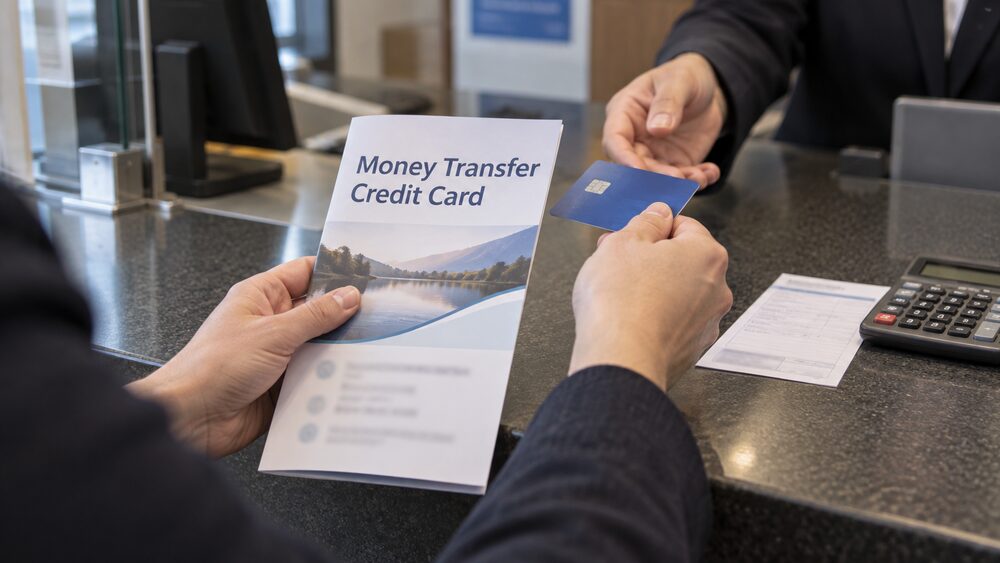
Balance transfers on an HSBC card: how they work
A balance transfer moves debt from one credit card to another12. The 60-day window is the part people miss: the promotional period applies to transfers made in that window, not to transfers made at any point during the deal.
HSBC says that if you move your credit card balance from another provider to HSBC, there is usually a one-off fee, with the amount set out at application or in a balance transfer offer1. At the end of any promotional period, balance transfers and purchases revert to the standard variable rate4.
There is a hard exclusion. Balances cannot be transferred from cards issued by members of the HSBC Group, and HSBC names HSBC UK, first direct and M&S Bank as examples5. The same wording appears on the second-card page and the Premier credit card page, and the transferring-a-balance guidance repeats that the exclusion covers other HSBC Group cards from HSBC UK, first direct and M&S Bank13. So a first direct or M&S Bank balance cannot be moved onto an HSBC card.
The balance transfer card also has an eligibility condition: applicants must not hold an HSBC Basic Bank Account4.
Interest-free days and how payments are applied
HSBC says it will not charge interest on any purchases shown in a statement if you pay your transaction balance by the payment due date14. That is the interest-free period in its simplest form, and Citizens Advice states the same rule generally: if you pay off the whole amount owed on the card by the due date, you will not be charged interest on your purchases15.
The length of that window depends on when you buy. HSBC's guidance on transferring a balance says you get up to 56 days interest free on new purchases, but that this is lost until the balance transfer is fully repaid13. In other words, carrying a balance transfer can switch off the interest-free period on new spending, which is the trap that catches people who use a transfer card for everyday purchases.
How your payment is applied matters as much as how much you pay. HSBC states that payments are allocated in this order: cash advances first, then purchases and standard rate balance transfers, then promotional rate purchases and balance transfers16. The practical consequence is that the most expensive debt is cleared first, but promotional balances sit at the back of the queue, so a payment can be swallowed by other balances before it touches the 0% deal.
"we will allocate your payment to the outstanding balance in the following order: - Cash Advances - Purchases and standar"
If you miss a minimum payment during a promotional rate, HSBC says you lose the promotional rate and interest is charged at the standard rate13. On some cards the preferential terms are withdrawn and not restored later17. Missing a payment can also be recorded with credit reference agencies18.
Who can apply for an HSBC credit card
Eligibility depends on which card. HSBC states that eligibility criteria apply and credit is subject to status7. Several cards in the range are only open to existing HSBC customers:
- Premier Credit Cards: only available to HSBC Premier customers11
- Student Credit Card: a purpose-built card for existing HSBC Student Bank account holders19
- Instalment plans: you must be an existing HSBC credit card holder to be eligible14
- Second card: available for existing Balance Transfer, Purchase Plus and Rewards credit card holders who hold an HSBC Premier Account
- Balance transfer card: applicants must not hold an HSBC Basic Bank Account4
The Rewards card itself is not restricted to existing customers on the pages here, but the standard conditions apply: eligibility criteria and credit status7. Pay with Rewards, the redemption route, is only available to HSBC Rewards primary credit card holders6.
Apple Pay eligibility covers most HSBC UK credit and debit cards, subject to status, and the list includes the HSBC UK Rewards Credit Card20.
Managing the card in the HSBC app and online
HSBC runs its cards through online banking and the HSBC Mobile Banking app, where customers can chat to the bank 24/721. The app is the main route for day-to-day tasks:
- Applying: HSBC says it is usually easiest to apply through the app or online banking, with branch support available if needed4
- Instalment plans: check the credit card section of the app for an offer, and plans can also be chosen at checkout online or in-app using Apple Pay on iPhone or iPad14
- Credit limit: existing customers can manage their arranged limit in the app22
- PIN: you can view your debit and credit card PIN in the mobile app23
For customers who need more support, HSBC publishes guidance for people living with dementia, which covers how banking can be managed when someone else needs to help24.
Card security: what HSBC will never ask you
HSBC states that it will never ask you for your PIN or full banking password23. It also states that it will never ask you to share an OTP or a code generated by your Secure Key, and never ask for the token generated by your Secure Key or mobile phone25.
That matters because the request itself is the fraud. The FSCS says it would never ask you for money26, and HM Courts and Tribunals Service states it will never telephone you to ask for your bank details or to make a bank transfer using your sort code and account number27. Any call, text or email that asks for those things is not from the organisation it claims to be.
If a card is lost or stolen, HSBC customers with mobile or online banking can freeze their cards instantly28. HSBC also runs a dedicated support team for lost or stolen cards, with an emergency cash advance available19. Use the contact details published in the app or on hsbc.co.uk rather than a number from a message.
Persistent debt and help with repayments
Persistent debt has a specific meaning. StepChange explains that it applies where, over the last 18 months, the amount you have paid in interest and fees is bigger than the amount of borrowed money you have paid back29. It covers credit card, store card and catalogue accounts30, and HSBC frames it as persistent debt on your credit card over an 18-month period.
The rules then escalate. Credit card companies must help you if you have been in credit card debt for more than 18 months. At 36 months, StepChange says the options a firm may suggest include an affordable payment plan to clear the debt quicker, or paying off the debt with a loan or credit card, and it may also consider pausing interest and charges, reducing your minimum payment, or suspending your account.
If you are getting persistent debt letters, StepChange lists the routes out: increase your monthly repayments, repay the balance using credit with a lower interest rate, cancel the card and move the balance to a different one with lower interest, get a loan you can afford to repay, or shop around using a price comparison site.
HSBC offers a financial health check with specialists who can talk through banking and financial needs. Free, impartial help is available from StepChange and Citizens Advice, and Citizens Advice publishes a checker for whether a financial service has followed the rules.
Where protection comes from, and where it stops
HSBC UK Bank Plc is authorised by the FCA, with reference number 765112, and appears on the Bank of England's list of banks incorporated in the UK authorised to accept deposits. The FCA register lists its trading names as including HSBC UK Bank, HSBC UK, HSBC, first direct bank, first direct, fd bank, fd, M&S Savings and Investments, M&S Insurance and M&S Bank. That matters for one practical reason: money held across those brands counts towards the same protection limit, because they share one authorisation.
Card payments made on a credit card carry Section 75 protection for purchases over £100 and up to £30,000, and there is a separate chargeback route for disputes that fall outside it. Both are covered in full on this site's pages on Section 75 and chargeback.
Protection stops in several places. It does not cover a balance transfer that goes wrong because the promotional period expired, and it does not stop a promotional rate being withdrawn if you miss a minimum payment13. It does not apply to cryptocurrency purchases, because HSBC refuses credit card payments to purchase cryptocurrency altogether. Its debit cards can be used with cryptocurrency exchanges, but only up to £2,500 for a single transaction and £10,000 in any rolling 30-day period.
If something goes wrong with the card itself, the route is the provider's complaints process first, then the Financial Ombudsman Service. Citizens Advice sets out how to check whether a financial service has followed the rules.
Sources30 cited
- Credit card fees HSBC UK, 2026
- HSBC Rewards credit card HSBC UK, 2026
- HSBC credit cards HSBC UK, 2026
- HSBC Balance Transfer Credit Card HSBC UK, 2026
- HSBC Rewards offer HSBC UK, 2026
- HSBC Rewards card FAQs HSBC UK, 2026
- HSBC credit cards HSBC UK, 2026
- HSBC cash machines HSBC UK, 2026
- The costs and charges of credit cards Citizens Advice, 2026
- Choosing and applying for a credit card Citizens Advice, 2026
- How do credit cards work? HSBC UK, 2026
- Transferring a credit card balance HSBC UK, 2026
- Credit card instalment plans HSBC UK, 2026
- Credit card repayment options HSBC UK, 2026
- Credit card limits HSBC UK, 2026
- Cryptocurrency and HSBC HSBC UK, 2026
- What is two-factor authentication? HSBC UK, 2026-09-14
- Living with dementia HSBC UK, 2026
- HSBC Student Credit Card HSBC UK, 2026
- Apple Pay HSBC UK, 2026
- Managing debt HSBC UK, 2026
- Using a debit card abroad HSBC UK, 2026
- Credit-builder credit cards HSBC UK, 2026
- Dealing with persistent debt StepChange, 2026-09-25
- Persistent credit card debt StepChange, 2026-09-25
- Persistent debt StepChange, 2026-09-25
- Scams: what to look for FSCS, 2026-05-05
- Check if a financial service has followed the rules Citizens Advice, 2026
- HSBC UK Bank Plc register entry FCA, 2026-09-25
- Banks incorporated in the UK authorised to accept deposits Bank of England, 2026-09-01











 MoneyHelperFree, impartial money and pensions guidance, set up by government
 StepChangeFree debt advice and solutions from a charity
 National DebtlineFree debt advice by phone, webchat and online
 Financial Ombudsman ServiceFree, independent help when a complaint about a firm is not put right
 Citizens AdviceFree advice on money, consumer and legal problems in England and Wales