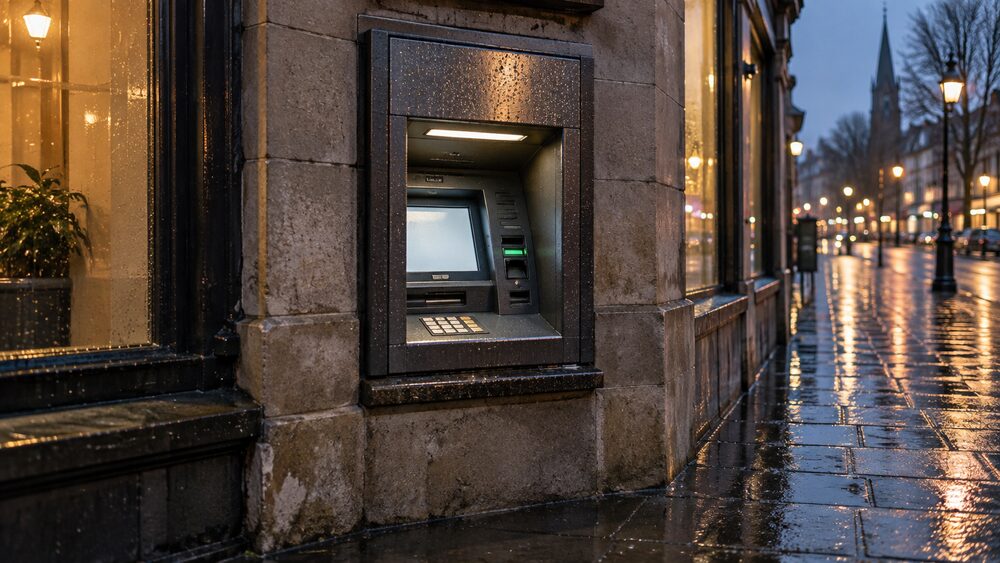
Taking cash out on a credit card is one of the most expensive things you can do with the card. You will usually be charged a cash handling fee of around 2% of the amount you withdraw, and interest is charged from the day you took the money out, with no interest-free period even if you clear the whole balance by the due date1. The interest rate for cash advances is usually higher than the rate for purchases, and the withdrawal is recorded on your credit report3.
The charges apply wherever you get the money: a cash machine, a bank branch counter, or a transaction your provider classifies as cash, such as buying foreign currency. This page explains each cost, how the interest works, which transactions are treated as cash, what it means for your credit file, and the cheaper alternatives that exist.
The cash withdrawal fee: around 2% of the amount
The headline charge is the cash handling fee. Citizens Advice puts this at around 2% of the amount you withdraw, and it is charged each time you take cash out1. Individual providers set their own figures: Nationwide, for example, charges 2.5% of the amount withdrawn on each cash advance on its Select Credit Card, with a minimum of £34. A minimum fee matters for small withdrawals, because a £3 minimum on a £10 withdrawal works out as a much larger percentage than the headline rate suggests.
Abroad, the fee is typically higher. Which? reports a fee of around 3%, with a minimum of £3, when you take money out of an ATM with a credit card, and most credit cards also add a foreign transaction fee of around 3% on non-sterling cash withdrawals5. So a single withdrawal overseas can attract two separate percentage charges: the cash advance fee and the foreign transaction fee.
The fee is charged on the amount you withdraw, not on your remaining balance, so it is a one-off cost per withdrawal rather than an ongoing one. But it stacks on top of the interest, which is where the real cost of a cash advance usually lies.
Interest starts on the day you take the cash out
The second cost is interest, and the timing is what catches people out. StepChange is blunt about it: "You are charged interest from the day you took the money out"2. Citizens Advice says the same in slightly different words: "When you take cash out on your credit card, interest is added to your account straight away, even if you pay off the balance by the due date"1.
This is the opposite of how purchases normally behave. With purchases, if you pay off the whole balance by the due date, no interest is charged6. With cash, the clock starts on the withdrawal date, so every day the money is outstanding adds interest, including the days between the withdrawal and your payment arriving.
The rate itself is also higher. The interest rate for cash advances is usually higher than the interest rate for purchases1. Card providers must quote an APR and display the interest rate clearly on application forms and promotional material, so the cash rate for any particular card is visible before you use it7. Because interest starts immediately and at a higher rate, even a short-lived cash withdrawal can cost noticeably more than the same amount spent on purchases.
Cash advances are not covered by the interest-free period
Many people assume the interest-free period on their card covers everything. It does not. Which? explains that interest on cash withdrawals is "usually charged immediately, even if you repay your balance in full"8. StepChange goes further: "Cash transactions will always charge interest"2. Nationwide's own terms for its Select Credit Card state there is no interest-free period on balance transfers or cash withdrawals4.
The interest-free period, in other words, is a feature of purchases only. It works because a purchase made at the start of a statement period does not begin accruing interest provided the whole balance is cleared by the due date6. A cash withdrawal is treated differently from the moment it happens: there is no grace period at all, so the interest-free window that makes credit cards cheap for everyday spending simply never opens.
The practical consequence is that a card can be simultaneously "interest free" for purchases and charging interest every day on a cash balance. If you want to understand the mechanics in more depth, how credit card interest is charged and how the interest-free period on purchases works cover them in detail.
Which part of the balance is paid off first
Cash withdrawals complicate repayment because most cards carry several interest rates at once. StepChange sets out the three main ones: a purchase rate when you use the card to buy things, a balance transfer rate when you move debt from another card, and a cash transaction rate when you take money out of a cash machine or get cashback at a till9.
When you make a payment, your provider allocates it to the most expensive debt first6. Since the cash rate is usually the highest of the three, money you pay in goes towards the cash balance before purchases. That rule works in your favour here: it means a cash withdrawal cannot sit untouched accruing its higher rate while you pay off cheaper purchases. But it also means that while a cash balance exists, your purchases may take longer to clear, and if you do not pay the full balance, interest is charged on the whole lot, not just the unpaid amount7.
If you only make the minimum repayment, typically around 3% of the balance due or £5, whichever is higher, clearing a cash balance can take a very long time10. Your card company should contact you to warn you about what might happen if you only make minimum payments6. The pages on credit card minimum payments and paying your bill explain the allocation rules and the fastest ways to clear a mixed balance.
Using your credit card for cash abroad
Cash withdrawals abroad combine all the domestic charges with extra ones. Citizens Advice warns that if you withdraw cash on your credit card abroad you may be charged a foreign transaction fee on top of the usual cash advance fee, and that most credit card companies charge a commission when you use the card abroad6. Which? puts the foreign transaction fee at around 3% on non-sterling purchases and cash withdrawals, and the ATM fee at around 3% with a £3 minimum5.
Providers' own terms show how this works in practice. Bank of Ireland UK, for example, states that a fee applies if you use its card to make a cash withdrawal in foreign currency from any cash machine, excluding Bank of Ireland cash machines and some other Bank cash machines in the Republic of Ireland11. The pattern is common: some providers waive their own machine fees but not others', and the cash advance interest still starts on day one.
Two further points are worth knowing before travelling. First, tell your card company before you go, because if it is suspicious about sudden unusual spending it may freeze your card6. Second, a debit card is usually cheaper for foreign cash: MoneyHelper notes a spending or cash machine charge of typically £1 to £3 each time you use a debit card abroad, except for euros in the EU12. The full comparison is on using a credit card abroad, and paying in pounds or local currency covers the choice you face at a foreign till.
How much cash you can withdraw: credit limit and daily limits
How much cash you can take out is limited in two ways. The first is your credit limit: some credit cards have a credit limit, and you will be charged if you go over it13. Providers may charge a fee for exceeding the limit14, and cash withdrawals count towards it like any other borrowing, so a large withdrawal can push a card close to its ceiling and leave less room for purchases.
The second is a daily withdrawal limit set by the card provider or the account it sits on. Which? gives two examples from current accounts: first direct applies a daily cash withdrawal limit of £500, or the foreign currency equivalent, while Starling allows up to six cash withdrawals per day with a daily limit of £300, regardless of currency5. Credit card providers set their own equivalent limits, and the exact figure for a card is in its terms.
Because interest starts on the day of withdrawal, splitting a large amount across several days does not reduce the cost: each withdrawal starts its own interest clock and attracts its own fee. If a cash withdrawal is unavoidable, taking it in one transaction rather than several keeps the fee count down, though the percentage fee is the same either way. credit card limits explains how limits are set and when providers change them.
Other transactions treated as cash
The cash advance rules reach further than cash machines. Several everyday transactions are classed as cash by card providers, which means they attract the cash fee, the higher rate and immediate interest even though no banknotes change hands.
The main ones are:
- Cashback at a till, which StepChange lists alongside cash machine withdrawals as a cash transaction9
- Buying foreign currency, which Which? warns attracts a cash advance fee, a higher APR and no interest-free period even if the bill is repaid in full and on time3
- Gambling transactions, which are subject to their own rules: credit cards cannot be used for gambling in the UK, and the separate page on the credit card gambling ban explains what it covers and where to get help with gambling-related debt
- Credit card cheques, where offered, which are treated as cash advances6
The foreign currency point catches many people out, because buying travel money feels like a purchase. It is not: it is treated as converting the card's credit into cash, which is why the charges are so much heavier. If you need foreign currency, buying it with a debit card or directly from a bank account avoids the cash advance treatment.
Cash withdrawals and your credit file
Every cash withdrawal is recorded on your credit report3. A single withdrawal is not a problem in itself, but the pattern matters. StepChange is explicit about how lenders read it: "Lenders see taking out cash as a sign you are having trouble with money"15. Someone who regularly draws cash on a credit card may find it harder to get credit, or offered worse terms, because the behaviour suggests reliance on borrowing for day-to-day living costs.
This matters especially for people building or repairing a credit history. On a credit-builder card, the whole point is to demonstrate reliable, ordinary use, and cash withdrawals undermine that. The page on credit-builder credit cards covers how these cards work, and how credit cards affect your credit file explains what lenders see.
Cash use has also become less common. UK Finance reported that credit card cash withdrawals fell by more than a quarter compared with March 2019, a shift towards card payments for spending instead16. That decline reflects both the cost of cash advances and the wider move away from cash, and it means heavy cash use on a card stands out more on a credit file than it once did.
Where Section 75 does not apply
Section 75 of the Consumer Credit Act 1974 is one of the strongest protections a credit card offers: for certain transactions made by credit card, the card company is jointly liable with the seller if something goes wrong17. But the protection is tied to buying goods or services, and a cash withdrawal has no seller for the card company to share liability with. Taking cash out is not a Section 75 transaction, so the protection does not attach to whatever the cash is later spent on.
The rules around the edges matter too. Section 75 does not apply to charge cards or debit cards18, and you cannot apply for a Section 75 claim if you paid with a debit card19. The legislation itself excludes claims under non-commercial agreements and claims relating to a single item with a cash price not exceeding £30 or more than £10,00020. The Financial Ombudsman Service adds a modern wrinkle: section 75 might not apply if a customer used a credit card to put funds into a standard e-money account and then used that account to buy something21. And the ombudsman has warned that section 75 only applies to the individual price of items, not the cumulative total, which matters for things like festival packages bought in instalments22.
The practical rule is simple: the protection follows the purchase, not the cash. If you pay a trader by credit card for work or goods, pay by card rather than cash, because you may be able to get your money back if something goes wrong23. The full detail is on Section 75: credit card purchase protection, with the thresholds on the £100 to £30,000 limit and the exceptions on when Section 75 does not protect you.
Cheaper ways to get cash
Almost every alternative beats a credit card cash advance. The cheapest is usually your own current account: a basic bank account comes with a debit card you can use to pay for items and withdraw money from a cash point24, and with a current account you get a cheque book and usually a debit card for shops and cash machines25. Debit card withdrawals in the UK are normally free, and abroad typically cost £1 to £3 per use, except for euros in the EU12.
If you do not have a bank account, there are other routes:
- Some banks let you cash a current account personal cheque or use your cash card at the Post Office, free of charge25
- Credit unions offer ways to get at your money, including cashing a cheque at a local Post Office, cash from a local credit union office, payment directly into a bank account, or a debit card at a cash machine if the credit union operates a current account26
- A basic bank account is available to people who may not qualify for a standard current account, and Business Debtline's guide to safe bank accounts explains how they work24
For planned spending, the cheapest route of all is often not cash but the card itself. Paying a trader by credit card rather than cash gives you the possibility of getting your money back if something goes wrong23. For borrowing specifically, a money transfer credit card moves money from the card into a bank account at a lower cost than a cash advance, and money transfer fees set out what that costs. Opening or switching a bank account is covered in current accounts, and credit unions explains how they work.
Complaints and who to turn to
Credit cards are among the most complained-about financial products, and the volume gives a sense of how often things go wrong. In the Financial Ombudsman Service's annual data for 2025/26, credit cards were the third most complained about product, with 22,783 complaints, of which 8,800 were about perceived irresponsible or unaffordable lending27. The ombudsman upheld 28% of the credit card complaints it resolved in that period27. In the first quarter of 2026/27, 5,783 credit card complaints were opened28, and in the same quarter a year earlier the figure was around 6,600 with a 25% uphold rate29. In 2024/25, the most complained-about issues were irresponsible or unaffordable lending, administration or customer service, and complaints about Section 7530.
If you have a problem with a cash advance charge, an unexplained fee or the way a complaint was handled, the route is fixed. Complain to the card provider first, giving it the chance to put things right. If it does not, or you are not satisfied with the answer, you can take the complaint to the Financial Ombudsman Service, which is free. Citizens Advice explains how to check whether a financial firm has followed the rules and what to do if it has not31. The page on complaining about a credit card provider walks through the process step by step.
Struggling to repay: where to get free help
Cash withdrawals are often a sign that someone is borrowing to cover living costs, and that is the point at which free help matters. The first step StepChange recommends is to stop using the credit card you want to pay off, so the amount you owe stops growing and repaying it becomes quicker32. If you have lost income, the same guidance applies: stop using credit cards or adding to credit card debt33.
Card companies have a duty to help. Citizens Advice is clear that if you are not able to pay back what you owe, a company must help if you are struggling, which can include reducing or cancelling any interest or fees31. For people in persistent debt, the options include increasing monthly repayments, repaying the balance using cheaper credit, cancelling the card and moving the balance to one with a lower interest rate, or getting a loan you can afford to repay34. A debt consolidation loan, or a card with a better deal such as a lower interest rate to transfer a balance to, may be cheaper than relying on the credit card35, but StepChange warns that debt consolidation is a risky way to cope if you cannot pay your debts36.
Free, impartial help is available from debt charities such as StepChange and National Debtline, and from Citizens Advice. Credit cards are the most widely held mainstream credit product in the UK, used by 65% of all adults now or in the last 12 months according to the FCA's Financial Lives survey38, so if you are struggling you are far from alone. The pages on help with credit card debt, persistent credit card debt rules and the wider debt guide set out the options, including what happens when debts cannot be repaid in full.
Sources38 cited
- The costs and charges of credit cards Citizens Advice, 2026-09-25
- Understanding interest charges StepChange, 2026-09-25
- Should I get a credit card? Which?, 2026-09-18
- Select Credit Card rates and details Nationwide, 2026
- Spending abroad: the 4 dos and 5 don'ts Which?, 2024-07-26
- The costs and charges of credit cards (Scotland) Citizens Advice Scotland, 2026-09-25
- Credit cards and debt nidirect, 2025-11-06
- Credit card interest explained Which?, 2026-09-18
- Credit card debt StepChange, 2026-09-25
- Choosing and applying for a credit card Citizens Advice, 2026-09-25
- Personal current account cash access brochure Bank of Ireland UK, 2026
- How to open, switch or close your bank account MoneyHelper, 2026-09-25
- Making the most of your bank account Independent Age, 2026-09-26
- Plastic cards Citizens Advice, 2026-09-25
- Credit cards for a bad credit score StepChange, 2026-09-25
- Household Finance Review 2020 Q1 UK Finance, 2020-03
- Chargeback rights and Section 75 FAQs UK Finance, 2026
- Consumer advice: Section 75 Anglesey County Council, 2025-10
- If a company stops trading or goes out of business Citizens Advice, 2026-09-25
- Consumer Credit Act 1974, Section 75 legislation.gov.uk, 2026
- Electronic money services complaints guidance Financial Ombudsman Service, 2026-09-27
- Festival refunds not guaranteed, warns Financial Ombudsman Service Financial Ombudsman Service, 2026-06-04
- Maintaining your home Independent Age, 2026-09-26
- Safe bank accounts Business Debtline, 2026-09-26
- Getting a bank account Citizens Advice, 2026-09-25
- Credit unions: general information Building Societies Association, 2026-09-15
- Annual complaints data and insight 2025/26 Financial Ombudsman Service, 2025
- Quarterly complaints data Q1 2026/27 Financial Ombudsman Service, 2026
- Quarterly complaints data Q1 2025/26 Financial Ombudsman Service, 2025-08-07
- Annual complaints data and insight 2024/25 Financial Ombudsman Service, 2024
- Check if a financial service has followed the rules Citizens Advice, 2026-09-25
- Paying off credit card debt StepChange, 2026-09-25
- Unemployment and reduced hours StepChange, 2026-09-25
- Dealing with persistent debt StepChange, 2026-09-25
- Credit card payment holidays StepChange, 2026-09-25
- Consolidating credit card debt StepChange, 2026-09-25
- Loans nidirect, 2025-09-30
- Financial Lives Survey 2024: credit and loans Financial Conduct Authority, 2024-05




 MoneyHelperFree, impartial money and pensions guidance, set up by government
 StepChangeFree debt advice and solutions from a charity
 National DebtlineFree debt advice by phone, webchat and online
 Financial Ombudsman ServiceFree, independent help when a complaint about a firm is not put right
 Citizens AdviceFree advice on money, consumer and legal problems in England and Wales