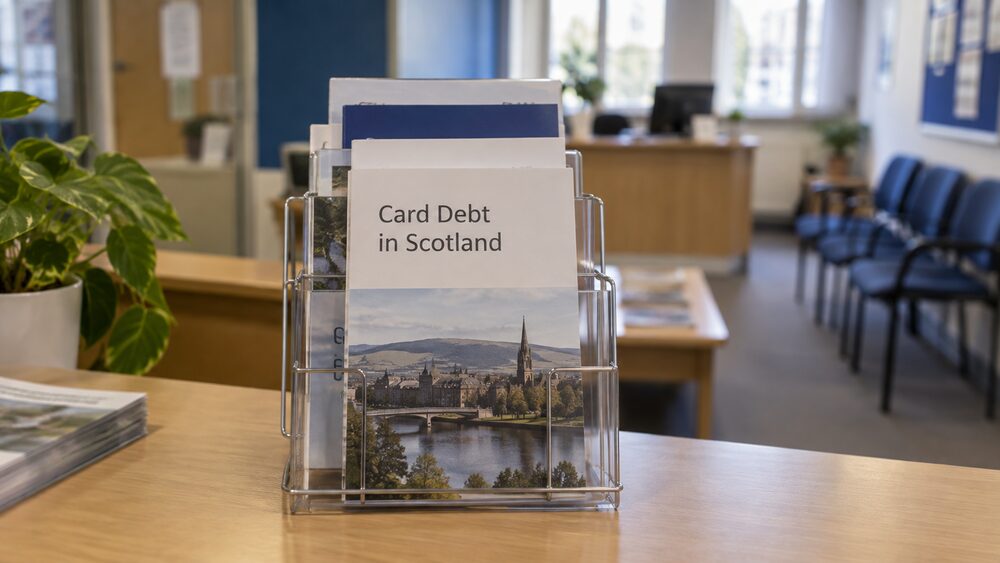
Unpaid credit card debt in Scotland follows a different legal path from the rest of the UK. Court action here ends in a decree rather than a county court judgment, enforcement is carried out by sheriff officers rather than bailiffs, and the formal debt solutions on offer, the Debt Arrangement Scheme, protected trust deeds and sequestration, exist only in Scotland. The debt itself, though, behaves the same way everywhere: interest is added each month you do not pay, and the balance grows.
The scale of the pressure is clear from StepChange's Scotland in the Red 2025 report, which found average combined debts and arrears of £20,116 per client, an increase of 10%, or £1,800, in 12 months1. Across the UK, 47.6% of outstanding credit card balances incurred interest in June 2026, meaning nearly half of all card borrowing was being charged for2. One thing that never happens: you cannot go to prison for simply not paying a credit card debt3.
How much Scottish households owe
StepChange's Scotland in the Red 2025 report gives the clearest picture of what people contacting a debt charity in Scotland owe: average combined debts and arrears reached £20,116 per client, an increase of 10%, or £1,800, in just 12 months1. That figure covers all kinds of debt and arrears together, and it is measured among people who sought advice, so it is not an average across all households. But the direction of travel, a tenth more debt in a single year, shows how quickly balances can build once income falls short.
Household budgets in Scotland are under strain more broadly. Consumer Scotland's energy affordability tracker found that by January and February 2026, 19% of Scottish households were in energy debt or arrears, and over a third of households in energy debt, 35%, had experienced legal or debt recovery action because of it6. The same research shows the burden is not spread evenly: 29% of households with incomes under £20,000 were in energy debt, as were 34% of households with children under five6. A year earlier, the tracker put the figure at 15%, equivalent to 383,000 households in Scotland, and found that half of those in energy debt, 49%, were behind on bills with no formal repayment plan in place7.
Energy debt is not credit card debt, but the two are connected in practice. When money going out on essentials rises, card borrowing is often what fills the gap, and a card balance then competes with energy arrears for whatever is left each month. Nearly half of UK credit card balances, 47.6% as of June 2026, were incurring interest, up slightly from 47.8% a year before in relative terms of the comparison, showing how many people carry a balance rather than clearing it2.
How interest and charges make a card balance grow
Interest on a credit card is charged on the balance you have not paid off, and it compounds: more interest is added as the balance gets bigger8. If you do not pay your bill, the company adds on interest each month9. StepChange gives a worked example of how this mounts: if you owe £1,000 at an interest rate of 20%, you could also owe £200 in interest after a year3.
The way interest is charged catches many people out. Official guidance for Northern Ireland, which mirrors the UK-wide rule, states it plainly:
"If you don't pay off the full amount every month on a credit card, you'll be charged interest on the whole lot - not just the unpaid amount."
niDirect, official guidance10
So a cardholder who pays off most of a £1,000 balance but leaves £50 outstanding can be charged interest as if none of it had been paid, depending on when in the month the payment lands and whether the interest-free period was lost. The mechanics of how card interest is calculated day by day are covered in how credit card interest is charged.
The scale of this is visible in the market data: Which? reported in May 2025 that half of all credit card balances were incurring interest, according to the latest figures from UK Finance11. Carrying a balance is not a rare or unusual position, in other words, it is what around half of card borrowing looks like. The cost of doing so depends on the rate and the size of the balance, and the interest compounds against you rather than for you.
Stopping the balance growing: minimum payments and using the card
The first practical step in dealing with a card debt is to stop using the card you want to pay off, so the amount you owe stops growing and becomes quicker to repay8. It sounds obvious, but a balance that keeps being spent on cannot be cleared no matter how good the repayment plan is.
The second is to understand what minimum payments actually do. If you owe £1,000 and your minimum payment is 3%, you will be asked to pay back £30 a month at least3. Minimum payments are usually a percentage of the balance, so as the balance falls the minimum falls too, and the repayment slows down just as the end comes into view. A worked example from National Debt Line shows a credit card debt of £3,200 at 28% with a minimum payment of £9912. How long minimum-only repayment takes and what it costs is covered in how long paying only the minimum takes.
Paying more than the minimum, or a fixed amount rather than a shrinking one, clears the debt faster and cuts the total interest. The comparison between the two approaches is set out in minimum payment or fixed amount, and ways to speed up repayment in ways to clear card debt sooner.
There is also a rule that intervenes when someone pays only the minimum for a long time. The persistent debt rules apply to credit card, store card and catalogue accounts where someone is making minimum payments over an extended period13. When that happens, the card company must contact you, explain that the way you are repaying is expensive, and ask you to pay more14. This is not a demand for the full balance, but it is a signal that the account is not on track to be repaid reasonably quickly, and it is often the point at which people first seek advice. The detail is in persistent credit card debt rules.
What happens if you miss credit card payments
Missing payments has three immediate effects. Extra charges are added8. The missed payments are recorded on your credit file, and the creditor will soon think about sending a default notice15. And the creditor begins considering other recovery steps, which can include passing the debt to a debt collection agency or starting court action15.
The credit file effect is the one people often underestimate. Missed payments stay visible to lenders and make borrowing more expensive or harder to obtain for years afterwards. On joint debts, a missed payment is recorded on both parties' credit files even if an ex-partner agreed to repay the debt, whereas missed payments on debts solely in an ex-partner's name do not appear on your file16. The wider effects are covered in how credit cards affect your credit file and missing a credit card payment.
Before a creditor can escalate, the rules give you breathing space. For debts regulated by the Consumer Credit Act, which includes most credit card debt, the creditor must send you a default notice first and give you at least 14 days to comply before starting court action17. That 14-day window is a chance to contact the creditor, seek free advice, or propose a repayment arrangement before the matter reaches a court.
If the debt is passed to a debt collection agency, the agency's job is to recover the debt and it will keep contacting you about it15. Being passed to a collector does not change the amount owed or your rights, and it does not prevent you from using the Scottish debt solutions described later in this page. What to expect and what collectors can and cannot do is covered in when your credit card or loan moves to another company.
Credit card debt is a non-priority, unsecured debt
Credit card debt is a non-priority debt18. It is not secured against your home or your possessions, and the consequences of not paying it, while serious, are less immediate than the consequences of not paying a priority debt. Non-priority debts include credit card or store card debts, catalogue debts, unsecured loans, unpaid parking tickets and money owed to family or friends19. Bank money such as overdrafts is also a non-priority debt20, as are catalogue debts21.
"Non-priority" does not mean unimportant. Credit card debts are known as non-priority debts but this does not mean they are not important22. The label is about what happens if you cannot pay everything, and it is the basis for working out which debts to pay first.
The contrast with priority debts shows why the distinction matters:
| Priority debts | What non-payment can lead to |
|---|---|
| Mortgage or secured loan | You may lose your home18 |
| Rent | You can be evicted18 |
| Criminal fines | Your car may be clamped or taken away; for fines of £500 or more, possible prison18 |
| Child maintenance | Goods taken, money arrested from your bank account, wages and benefits, possible jail18 |
| Credit card, store card, catalogue, unsecured loan | Interest, charges, credit file damage, court action and enforcement18 |
Because a credit card company cannot cut off your home, take your car or send you to prison, a card debt can wait when rent, a mortgage or a fine cannot. That is uncomfortable but it is how advice agencies triage debts, and it is why a budget drawn up with free debt advice starts from priority debts. If you owe rent to an old landlord you no longer have a tenancy with, that too is no longer a priority debt and can be treated like a credit card or unsecured loan debt24.
Decrees, not CCJs: court action over card debt in Scotland
If a Scottish creditor takes you to court over an unpaid card debt and wins, the court's order is called a decree. Decrees are the Scottish equivalent to money judgments, known as county court judgments or CCJs, in England and Wales4. The same kind of debt produces a civil bill in Northern Ireland3. The name differs, but the effect is similar: a decree is a court's confirmation that you owe the money, and it opens the door to enforcement.
The process runs in steps, and each one gives you time. Missed payments are recorded on your credit file first15. For Consumer Credit Act debts, the creditor must have already sent you a default notice and give you at least 14 days to comply before starting court action17. If the court grants a decree, enforcement does not follow immediately: the creditor serves a Charge to Pay for debts up to £5,000, or a Charge for Payment for debts of £5,000 or more, and in each case it gives you 14 days to pay the debt before the people you owe can take further action25. A charge for payment also gives you 14 days to pay before a creditor can move towards bankruptcy26.
If the 14 days pass without payment, the creditor can move to diligence, the Scottish term for enforcement. This can include money being taken from your wages or benefits, and bank arrestment, where money in your account is frozen; if you do not pay, the creditor can apply for a furthcoming, which orders your bank to hand over the money18. Diligence in Scotland is carried out by sheriff officers rather than the bailiffs used in England and Wales27.
Two further points matter. First, a decree stays on your credit file for 6 years from the original judgment date, whether the balance has been paid or not4. If you do pay it in full, you can get a letter of satisfaction from the pursuer in the action, or the pursuer's solicitor, explaining that the debt has been paid, then send it to the body that keeps the register of decrees, together with their administration fee and confirmation of your name and address at the time of the decree28. Second, in some cases creditors can ask the court to make you bankrupt29, which is why responding to court papers rather than ignoring them matters so much. The general position across the UK is covered in unpaid card debt: can you be taken to court?.
Balance transfer or consolidation loan: moving what you owe
Moving a card balance elsewhere does not reduce what you owe, it restructures it. A balance transfer moves the debt to another card, usually to benefit from an interest-free period; a money transfer moves it to a current account to clear an overdraft; a consolidation loan replaces several debts with one loan. Debt consolidation means combining debts into a single, new loan, and there are government-backed ways to deal with debt too, such as debt relief orders, IVAs, and in Scotland the Debt Arrangement Scheme31.
Whether moving the debt helps depends on the fees and on whether the new borrowing is actually cheaper over the time it takes to repay. Balance transfer fees, money transfer fees and any loan interest all cost money up front or over time, and the detail is in balance transfer fees, money transfer fees and credit card or personal loan.
The risks are real. A consolidation loan can turn short-term debts into long-term ones, and moving a balance does nothing to stop the underlying borrowing if the old card is then used again. A transferred balance also loses the interest-free period on new purchases in many cases, covered in do balance transfer deals charge interest on purchases?. And if the new borrowing is secured on your home, an unsecured card debt has become a debt you could lose your home over, which changes its priority completely.
For people who cannot afford to repay the debt at all, consolidation is usually the wrong tool, because it assumes the debt is affordable once restructured. StepChange, which has helped hundreds of thousands of people in Scotland deal with debt over more than 30 years32, and other advice agencies assess affordability first and only then discuss whether consolidation, a formal solution, or an informal arrangement fits. The options for moving a balance are explained in balance transfer credit cards, money transfer credit cards and 0% purchase credit cards.
Debt solutions that spread or write off credit card debt
Scotland has its own set of formal debt solutions. The Accountant in Bankruptcy, the Scottish government body that oversees personal insolvency, states the options plainly:
"In Scotland, solutions include an informal agreement, Debt Arrangement Scheme (DAS), protected trust deed or bankruptcy."
Accountant in Bankruptcy, official guidance5
An informal arrangement is an agreement reached directly with creditors, with no court involvement and no statutory protection. The Debt Arrangement Scheme, by contrast, is statutory: the Scottish Parliament approved it by passing the Debt Arrangement and Attachment (Scotland) Act33, and the current scheme already provides debtors with a short breathing space and a statutory repayment plan34. A debt payment programme under the scheme gives extra protections against enforcement action and stops interest and charges31. A trust deed or debt payment programme in Scotland both stop interest and charges35. This is the key difference from informal arrangements: once a DAS programme is approved, creditors who are bound by it cannot pursue enforcement, and the debt stops growing.
A protected trust deed is a formal arrangement where a trustee manages the repayment of part of what you owe, typically over several years, with the remainder written off at the end. Bankruptcy, known in Scotland as sequestration, is the most serious step. Credit card debt is included in sequestration: these debts are cancelled when the bankruptcy ends36. Specific debts including student loans, fines and debts incurred through fraud cannot be included, and these remain payable37. A bankruptcy can end earlier where all the debts, including the trustee's fees and outlays, are paid in full, or where it is shown that a creditor should not have made the person bankrupt37.
The consequences of the formal solutions are significant and shared. Bankruptcy has a big impact on your credit score and will stay on your credit file for six years38. A write-off has a similar effect: the balance should be set to zero on credit reference agency reports, the debt will be registered as a default, and a flag indicating a write-off or partial write-off may be added, with a negative impact on your ability to get credit for up to six years24. There is also a criminal dimension to be aware of: if you borrow £2,000 or more while bankrupt without telling the lender about the bankruptcy, you are committing a criminal offence37.
Two further routes can end a card debt without a formal solution. The first is a creditor agreeing to a write-off in cases of severe hardship, though on joint debts the creditor might write off one person's liability but still pursue the other person for the whole amount24. The second is prescription. In Scotland, debts that cannot be enforced because too much time has passed, 5 years, are called prescribed debt17. The Scottish rule goes further than elsewhere in the UK: the debt is written off and no longer exists by law, and nothing more can be done to collect it30. In Scotland the debt is extinguished, meaning it does not exist and creditors cannot recover it3. But prescription depends on the creditor having taken no relevant action and the debtor having made no payment or acknowledgement, and as noted above, debts where the creditor has already started action to obtain a decree cannot be prescribed30. Making a payment restarts the position: they cannot chase you to pay more if you make a payment, and if you live in Scotland the debt no longer exists once prescribed30.
Which solution fits depends on income, assets, the size of the debt and the other debts alongside it, and this is exactly what a free debt advice session works through. StepChange's Scotland debt guide covers the debt collection process, budgeting, debt advice and more39.
Where to get free debt help in Scotland
Debt advice in Scotland is free from the main charities and publicly supported services. The Scottish Government supports organisations to give free debt advice40. StepChange's advice is free41, and its advisors at StepChange Scotland provide free advice and support across Scotland from a Glasgow office32. Its Scotland debt guide can be downloaded free in English, Urdu, Punjabi or Polish, covering debt collection processes, where to get help, budgeting and what to expect from a debt advice session39.
Other routes include Aberdeen Citizens Advice Bureau's debt and money service, which offers options including the Debt Arrangement Scheme after a full assessment19, and Carers Scotland, which signposts carers to organisations offering free and confidential debt and money advice42. For housing problems connected to debt, Shelter Scotland runs a free helpline for housing advice43. The Scottish Government's cost of living pages signpost further debt and money support40, and mygov.scot covers the Scottish Welfare Fund and more help with money problems43.
A free advice session will normally cover which debts are priority debts, what your budget shows you can afford, and which of the Scottish solutions, if any, fits. Nothing on this page replaces that assessment, because the right option depends on facts specific to each person's circumstances. The wider UK picture, including your rights with creditors and collectors, is covered in debt: a complete guide and help with credit card debt.
Sources43 cited
- Scotland in the Red 2025 StepChange Debt Charity, 2025
- Card spending data, June 2026 UK Finance, 2026
- Credit card debt StepChange Debt Charity, 2026
- Money judgments and certificates of satisfaction FAQs Scottish Courts and Tribunals Service, 2026
- Are you in debt? Accountant in Bankruptcy, 2026
- Insights from the 2026 Energy Affordability Tracker Consumer Scotland, 2026
- Insights from the 2025 Energy Affordability Tracker Consumer Scotland, 2025
- Paying off credit card debt StepChange Debt Charity, 2026
- Priority and non-priority debts One Parent Families Scotland, 2026
- Credit cards and debt nidirect, 2025
- Do you understand your credit score? Which?, 2025
- What is the debt avalanche method and how does it work? National Debt Line, 2026
- Persistent debt StepChange Debt Charity, 2026
- Dealing with persistent debt StepChange Debt Charity, 2026
- Debt collection StepChange Debt Charity, 2026
- What happens to debts when you get divorced? National Debt Line, 2026
- Scotland court action StepChange Debt Charity, 2026
- What debts to pay first StepChange Debt Charity, 2026
- Debt and money services Aberdeen Citizens Advice Bureau, 2026
- Overdrafts and other bank debts nidirect, 2025
- Catalogue debts StepChange Debt Charity, 2026
- Credit card debt Shelter Cymru, 2026
- Court fines in Scotland National Debt Line, 2026
- Write off debt (Scotland) National Debt Line, 2026
- Diligence StepChange Debt Charity, 2026
- Creditors making you bankrupt StepChange Debt Charity, 2026
- Sheriff officers StepChange Debt Charity, 2026
- Money judgments and certificates of satisfaction FAQs Scottish Courts and Tribunals Service, 2026
- How do I apply for bankruptcy? Accountant in Bankruptcy, 2026
- Statute barred debt StepChange Debt Charity, 2026
- Debt consolidation StepChange Debt Charity, 2026
- Minimal asset process bankruptcy StepChange Debt Charity, 2026
- Notes for Guidance: Creditors, Debt Arrangement Scheme Accountant in Bankruptcy, 2024
- Household debt research briefing CBP-9256 House of Commons Library, 2026
- Freezing interest and charges StepChange Debt Charity, 2026
- What happens to my debts? Accountant in Bankruptcy, 2026
- Bankruptcy information document Accountant in Bankruptcy, 2026
- How does bankruptcy affect my credit score? Accountant in Bankruptcy, 2026
- Scotland debt guide StepChange Debt Charity, 2026
- Debt and money Scottish Government, 2026
- Debt advice Scotland StepChange Debt Charity, 2026
- Dealing with debt Carers Scotland, 2026
- Scottish Welfare Fund and more help with money problems mygov.scot, 2026
 MoneyHelperFree, impartial money and pensions guidance, set up by government
 StepChangeFree debt advice and solutions from a charity
 National DebtlineFree debt advice by phone, webchat and online
 Financial Ombudsman ServiceFree, independent help when a complaint about a firm is not put right
 Citizens AdviceFree advice on money, consumer and legal problems in England and Wales