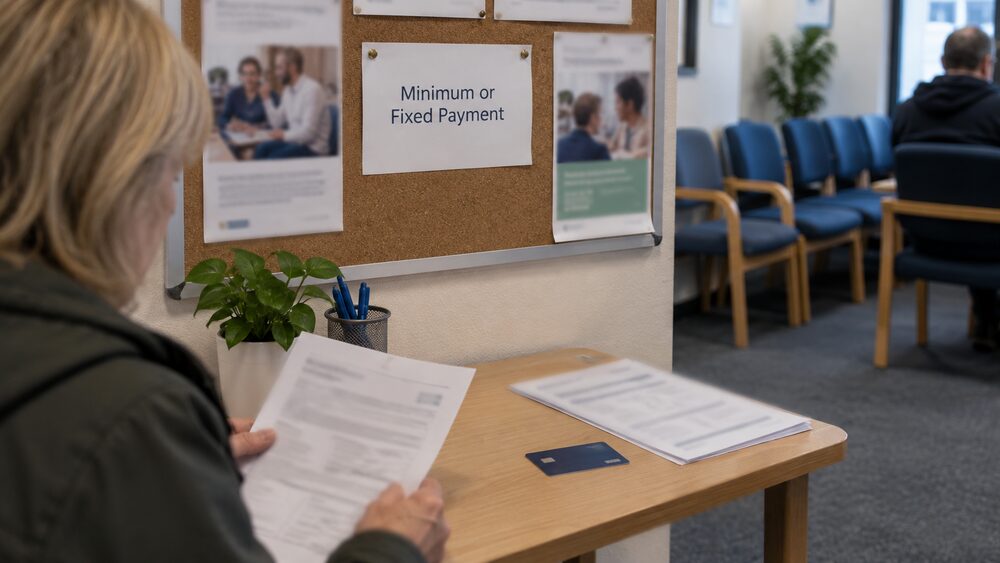
A credit card minimum payment is the lowest amount you must pay each month to keep the account up to date. It is usually calculated as a small percentage of what you owe, plus the interest, fees and charges added that month, so it falls as your balance falls. That is the trap: the smaller the balance gets, the smaller the required payment gets, and the longer the debt lasts1.
A fixed payment works the other way. You choose an amount above the minimum and it stays the same each month, so more of it goes to the balance as the interest bill shrinks. HSBC's own repayment calculator puts it plainly: by fixing your payment, you repay your balance sooner and pay less interest, which could also help you avoid entering persistent debt3.
The two approaches are not alternatives to clearing your balance in full, which costs no interest at all if you have an interest-free period on purchases. They are the choice you face when you cannot clear it. This page sets out how each one behaves, what the rules require, what the regulator's research found about how people actually repay, and how to set a fixed payment up.
What a minimum payment is and how card providers set it
The minimum payment is the contractual floor on your account. RBS defines it as the lowest amount you must pay in order to keep your credit card payments up to date, and it appears on page 1 of your statement2. StepChange's guidance is blunt about what it usually covers: minimum payments usually only cover the interest and charges on a debt1.
Across the major providers the calculation is described in almost identical terms. RBS, NatWest, Ulster Bank and HSBC all say the minimum is usually 1% of the credit card balance, plus interest and fees and charges, while noting it may differ depending on the product you hold2. Experian gives the same floor from the consumer side: your minimum monthly payment must cover at least 1% of the outstanding balance9. Some providers may ask you to pay a flat fee instead10.
Two features matter more than the exact percentage. First, the minimum changes every month with the balance, so it is not a stable figure you can budget around8. Second, because it is charged as a percentage of what remains, it reduces as your balance goes down8. Which's worked example shows the effect: a minimum repayment of at least 2% on a debt of £500 is £10, but once your debt gets to £400 your minimum repayment falls to £88.
Where the balance is small, a flat floor takes over. Nationwide, for example, describes a minimum of 3% of your statement balance, or £5, whichever is greater, on its Gold and Classic cards11. Experian notes that if your balance is low you may have to pay a fixed amount instead, if this is greater9. Student credit cards follow the same shape, with minimums usually ranging between 1% and 3% of what you owe, or a set minimum, whichever is higher depending on the bank9.
Fixed monthly payment or minimum payment: how each one clears a balance
The difference between the two is not the amount you pay in month one. It is what happens in month twelve.
A minimum payment is a moving target. It is recalculated each month from the balance, so as the balance falls the required payment falls with it. The debt reduces, but slowly, and the interest charged on the remaining balance keeps taking a share of every payment. StepChange's summary is that making minimum payments could mean you end up paying the debt over a long time1. Danske Bank states the trade-off directly: only making the minimum repayment will cost you more in interest and take you longer to pay back12.
A fixed payment holds its level. You tell the provider how much to collect each month, and that figure does not drift down as the balance does. HSBC's calculator describes the benefit as repaying your balance sooner and paying less interest, and notes it could also help you avoid entering persistent debt3. HSBC's general card guidance makes the same point in the negative: if you cannot clear the balance, it still makes sense to pay more than the minimum to reduce the amount of interest you pay13.
There is a practical constraint. A fixed direct debit has to be at least the minimum, or the provider collects the minimum instead. HSBC's calculator states that the fixed monthly payment you enter needs to be at least the amount of your minimum payment this month, and that if you owe less than £5 you need to pay the full amount3. First direct applies the same rule to its fixed amount option: it needs to be higher than the minimum shown on your statement, otherwise the minimum is collected14.
Why paying only the minimum keeps you in debt longer
The arithmetic is simple and unforgiving. If the minimum is roughly 1% of the balance plus the month's interest, then almost all of a minimum payment goes to interest and charges, and only a sliver touches the capital. StepChange identifies the cause of persistent debt as exactly this: the minimum payment is less than the added interest15.
The regulator has measured how common the pattern is. The FCA's credit card market study found that 5.2%, about 1.6 million people, of active consumers in the last year repeatedly made only minimum payments while incurring interest16. A further 1.1 million, or 3.7% of credit card holders, had spent at least 12 months making only the minimum repayments17. The FCA also identified 750,000 cardholders who had been making systematic minimum repayments for at least three consecutive years18. Its definition of systematic minimum repayment behaviour is consumers who have made nine or more minimum repayments while also incurring interest charges over 12 months19.
The pattern is sticky. Of consumers making systematic minimum repayments in 2014, 22.6% had been doing so in each of the four preceding years19. The FCA's market study found an additional 1.6 million people who were repeatedly making minimum payments on their credit card debt18.
There is a formal threshold that turns this from a habit into a regulated problem. Only making the minimum payments for over 18 months can mean you are in persistent credit card debt6. Once a provider identifies that, it has duties towards you, which are set out on our page on persistent credit card debt rules. Thinkmoney describes the common trigger from the customer's side: if you have only been making the minimum payments on your credit card for a while, your lender might get in touch about tackling your persistent debt20.
Minimum repayment rules for newer and older card agreements
The rule that governs most cards in force today dates from 2011. Under CONC 6.7.5R, a firm must set the minimum required repayment under a regulated credit agreement for a credit card or a store card at an amount that repays the interest, fees and charges applied to the account, plus one percentage of the amount outstanding4. The rule applies to agreements made on or after 1 April 20114.
That date is the dividing line. The FCA's policy statement is explicit that these rules do not apply to agreements made before 1 April 201121. If your card predates that, your minimum is whatever your original terms say. TSB's product information illustrates the difference between the two regimes on its own book: accounts opened on or after 31 March 2011 have a minimum of 1% of the balance plus interest, while accounts opened before that have a minimum of 2% of the balance or 0.5% plus interest, whichever is the greater5.
The rule has been restated consistently since. The FCA's 2014 market study described the requirement as covering interest rates and other fees on the account plus 1% of the amount outstanding for new credit card contracts since April 201116. Its interim report and annex repeated the same formulation17. The FCA's 2018 policy statement summarised the minimum as covering fees, interest and at least one percent of the balance, or £5, whichever is larger22.
There is one documented exception. During the coronavirus payment deferrals, the FCA said its rules in CONC 6.7.5R would not apply if a firm decided to vary its contracts in order to follow the deferral guidance23. That guidance has since closed, and the legacy is covered on our page on coronavirus payment deferrals. One consequence for anyone who used a holiday: minimum payments rise afterwards, because of the interest added during that time24.
What FCA research found about how people repay credit cards
The FCA has run controlled trials on this exact question, and the results are more interesting than the marketing around repayment tools suggests.
In one experiment, the minimum repayment option was removed from the direct debit setup screen for new customers. About 1 in 5 cards chose a fixed repayment instead of a minimum repayment7. In a second trial aimed at existing direct debit customers, targeted disclosure produced a switch from the minimum payment to a fixed payment direct debit equivalent to between 1 and 2 in every 100 cards7. The same trial found that if people tried to choose a fixed direct debit amount below £5, they were shown a prompt7.
The FCA's Occasional Paper No. 44 reported the outcome of a second experiment targeting credit card users paying their bills via automatic minimum payments. The treatment caused an average reduction in consumers paying only the minimum, and a reduction in credit card debt that was not sustained24. The paper's wider finding, from the FCA's own summary of the research, is that disclosures on time and cost to repay only temporarily reduce credit card debt, and that mistaken beliefs about how repayments amortise explain repeated minimum payment use24.
That last point is the one worth carrying away. People who pay only the minimum often believe the payment is doing more to clear the balance than it is. The FCA's research note on the trials found that removing the minimum repayment option increased repayment choices, but that disclosures had little effect and direct debit changes did not reduce debt7.
StepChange has argued that the structure itself is the problem. In its response to the FCA's consultation on creditworthiness, it said the structure of credit card lending, with low minimum repayment requirements, disincentives responsible lending25. In July 2026 it published a report on the credit card regulatory framework calling for reforms on affordability checks, minimum repayments and earlier support for people in persistent debt26. Which? has reported separately that one in five borrowers only made the minimum repayment on their most recent card27.
Setting a fixed payment: by direct debit, in your app or by phone
A fixed payment is set up as a direct debit instruction, and the mechanics are the same across providers even where the wording differs.
First direct sets out the three options on its cards: a direct debit to pay the minimum amount, a fixed amount, or the full amount14. Experian's guidance is to set up a direct debit to repay your credit card automatically, and notes you can also pay extra online, in your banking app or at a branch28. Macmillan's money guidance frames the same choice for anyone managing repayments alongside treatment: you choose whether to pay off the full amount each month, a set amount or the minimum repayment29.
The fixed amount option carries one rule wherever it appears. If the minimum payment or statement balance due is more than the fixed amount, the minimum payment is taken instead28. HSBC's calculator states the same thing: you need to make sure your fixed amount is more than your current minimum payment, and if it is not, the minimum payment is collected3. First direct's version is that the fixed amount needs to be higher than the minimum amount shown on your statement, otherwise the minimum is collected14.
Some providers offer a way to pay above the minimum without giving up the minimum calculation. RBS and NatWest run a Minimum Payment Plus direct debit, which collects a voluntary payment on top of the contractual minimum, and can be set up through the mobile app, digital banking or over the phone2. The stated purpose is to ensure the balance on your credit card is reducing and to avoid long term debt on your card2. The minimum payment used in the provider's own illustration is based on 1% of the credit card balance plus interest, with no additional spending on the card2.
What happens if you pay less than the minimum
Paying less than the minimum breaches the terms of your agreement. StepChange's guidance is to make minimum payments to avoid breaching the terms of your agreement30. The consequences are set out across the sources.
Citizens Advice says that if you pay less than the minimum payment, your credit card company might add charges, which will affect the size of your debt and your credit score31. Experian lists the same trio of consequences for a late payment: late payment fees, damage to your credit score, and loss of any promotional offers you have9. Business Debtline adds that if you start paying less than your original minimum payment, this could be reported to credit reference agencies32.
The credit file effect is worth understanding in full. Experian's guidance is that missed or late payments can negatively affect your credit score, while a minimum payment that covers most of your monthly balance is unlikely to affect it10. But it also warns that lenders may see only ever making minimum repayments while using a large proportion of your credit card limit as a sign you are struggling, which could negatively impact your credit score9. Mental Health and Money Advice states the position firmly: missing payments or making reduced payments to a credit debt, such as a credit card, will affect your credit rating, making it harder to get credit again in the future33. Defaults stay on your credit record for six years and make it harder to get credit9.
Sources35 cited
- Paying off credit card debt StepChange Debt Charity
- How much will the Minimum Payment Plus be? RBS
- Credit card repayment calculator HSBC UK
- CONC 6.7.5R: Minimum repayments FCA Handbook
- Credit cards TSB
- Credit card debt StepChange Debt Charity
- Helping credit card users repay their debt: summary of experimental research Financial Conduct Authority, July 2018
- Credit card interest rates on the rise: 5 ways to cut the cost of your debt Which?
- Minimum payment on a credit card Experian
- What is a minimum payment? HSBC UK
- Minimum payments Nationwide Building Society
- Managing repayments Danske Bank UK
- Tips for using your credit card HSBC UK
- Direct debits first direct
- Persistent debt StepChange Debt Charity
- Credit card market study: final findings report Financial Conduct Authority, November 2014
- Credit card market study: interim report Financial Conduct Authority, November 2015
- CP17/10: Credit card market study consultation Financial Conduct Authority, April 2017
- Credit card market study: final findings report Financial Conduct Authority, July 2016
- Persistent debt thinkmoney
- Credit card market study: annex 2 Financial Conduct Authority, November 2015
- PS18/4: Credit card market study findings Financial Conduct Authority, July 2018
- Credit cards and retail revolving credit: coronavirus payment deferral guidance Financial Conduct Authority, November 2020
- Credit card payment holidays StepChange Debt Charity
- FCA consultation on creditworthiness StepChange Debt Charity
- Credit card debts a burden StepChange Debt Charity, 29 July 2026
- Why your credit card could be costing you more in 2024 Which?
- Managing credit cards Experian
- The costs and charges of credit cards Citizens Advice Scotland
- Persistent credit card debt StepChange Debt Charity
- If you're struggling to pay your credit card Citizens Advice
- Persistent debt (England and Wales) Business Debtline
- Credit cards and a bad credit score StepChange Debt Charity
- Dealing with persistent debt StepChange Debt Charity
- Persistent debt repayment StepChange Debt Charity




 MoneyHelperFree, impartial money and pensions guidance, set up by government
 StepChangeFree debt advice and solutions from a charity
 National DebtlineFree debt advice by phone, webchat and online
 Financial Ombudsman ServiceFree, independent help when a complaint about a firm is not put right
 Citizens AdviceFree advice on money, consumer and legal problems in England and Wales