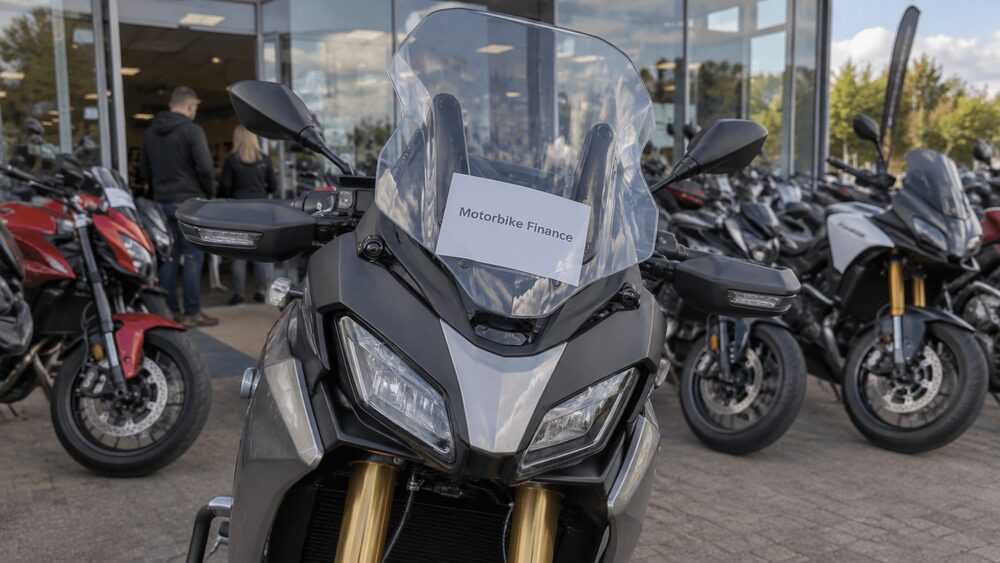
Motorbike finance is a way of spreading the cost of a bike over monthly payments instead of paying the whole price up front. The main routes are the same as for cars: hire purchase (HP), personal contract purchase (PCP) arranged through a dealer, or an ordinary personal loan from a bank or lender. The bike itself is treated the same way as a car in the rules: a bike bought on hire purchase, conditional sale or a logbook loan belongs to the finance company until the agreement is paid off1.
The big difference between the options is ownership. On hire purchase and conditional sale, the finance company owns the bike until you have made the last payment1. On PCP, the finance provider still owns it, and you only keep the bike if you pay the final balloon payment at the end1. With a personal loan, the money goes to the bank or lender rather than a finance company, you own the bike from the start, and the bike is not at risk if you miss payments3.
What motorbike finance is and how it works
Motorbike finance is credit taken out to buy a bike, usually arranged through the dealer at the point of sale or separately as a personal loan. The dealer finance routes are hire purchase and PCP. Some creditors use the term personal contract purchase (PCP) agreement to describe hire purchase agreements for vehicles, so a PCP is a form of hire purchase with a large final payment rather than a separate product in law8. Conditional sale works like HP: the finance company owns the vehicle until you have made the last payment1.
The mechanics are straightforward. You normally pay a deposit, then fixed monthly payments over an agreed term, and at the end the outcome depends on the type of agreement: on HP you have finished paying and the bike is yours; on PCP you choose between handing the bike back, paying a final balloon payment to keep it, or trading it in3. A personal loan works differently: you borrow a sum, buy the bike outright, and repay the bank or lender monthly, with the bike never belonging to anyone but you3.
Because the bike belongs to the finance company during an HP, conditional sale or PCP agreement, the arrangement is a secured one in practice: if you stop paying, the lender can take the bike back1. That is the trade-off for the lower monthly payments these products often offer compared with a loan for the full price of the bike.
Hire purchase, PCP or personal loan: how each one works
The three routes differ mainly in who owns the bike, what you pay each month, and what happens at the end.
Hire purchase (HP). You pay a deposit and then monthly payments, and the finance company owns the bike until you have made the last payment1. Once the final payment is made, the bike is yours. Some creditors describe PCP agreements as a type of hire purchase agreement for vehicles8, and the dedicated guide to hire purchase explains the detail.
Personal contract purchase (PCP). You might pay an initial deposit and make monthly payments much like HP, but these are typically lower because you are only financing part of the bike's value. At the end of the term you can either return the bike, pay a final payment to keep it, or trade it in3. The finance provider still owns the bike throughout1. The guide to personal contract purchase covers how the final payment works.
Personal loan. Monthly payments go to the bank or lender, not a finance company, and your bike is not at risk from missed payments3. There are no restrictions on mileage, and you can sell the bike at any time1. The guides to how personal loans work and car finance or a personal loan set out the comparison in full.
The ownership difference drives everything else on this page: whether you can sell the bike, whether it can be taken back if you miss payments, and whether you can hand it back early. A comparison of the two dealer routes is in PCP or hire purchase.
How long motorbike finance lasts
The length of a motorbike finance agreement is whatever you and the lender sign up to, and it is set out in the agreement itself before you commit. There is no single standard term set by the rules, so the term, the monthly payment and any final balloon payment are all agreed at the outset and shown in your paperwork.
Two things follow from the term you choose. First, the longer the term, the more interest you pay in total, because the debt is outstanding for longer; the guide to how loan interest is calculated explains how that works. Second, the term matters if things go wrong: your rights to end the agreement early, and the lender's right to take the bike back, both depend on how much you have paid towards the total, not on how long is left1.
The term also matters for the motor finance redress scheme, which covers agreements by the date they were taken out rather than their length: motor finance loans taken out between 6 April 2007 and 1 November 2024 are covered6, and that includes finance used for a car, motorbike, van or campervan7.
What motorbike finance costs: interest, deposits and fees
The cost of motorbike finance has three parts: the interest charged on the balance, the deposit you put down at the start, and any fees or charges written into the agreement.
Interest is the biggest variable, and it depends heavily on credit history. Having a bad credit rating will make it more expensive and harder to borrow money10, and people who already have poor credit are typically offered higher rates11. The rate actually offered is shown as the APR in the agreement; the guide to loan APR explains the difference between representative and personal APR.
Deposits work differently on each route. On PCP you might pay an initial deposit and then lower monthly payments, because you are only financing part of the bike's value, with the rest settled by the final balloon payment or by handing the bike back3. On a personal loan there is no deposit in the finance itself: you borrow the amount you need and repay it monthly3.
Fees and charges to look for in the agreement include:
- Excess mileage charges. On contracts with a mileage limit, each extra mile typically costs around 10p, payable at the end of the contract, so underestimating your annual mileage can produce a significant bill5.
- Charges at the end of a PCP. The guide to charges when you return a car at the end of PCP covers what can be charged for damage and excess wear.
- Late payment penalties. Missed payments can trigger fees and damage your credit record; see the section below on what happens if you miss payments.
There are no mileage restrictions at all with a personal loan1, which removes the excess mileage charge entirely, though the monthly payments on a loan for the full price are usually higher than on PCP.
Who can get motorbike finance
Motor finance is regulated credit, so the core requirements are the same as for any loan: the lender must check your credit history and satisfy itself that the repayments are affordable. The guide to loan affordability checks explains what lenders must look at before lending.
Credit history is the main gate. A bad credit rating makes borrowing more expensive and harder10, and people with poor credit are typically offered higher rates rather than the cheapest ones11. Some lenders do lend to people with bad credit, but that is up to them, and the products on offer, such as logbook loans, carry real risks: with a logbook loan the lender takes ownership of the vehicle from the start of the loan until it is paid back, and can take and sell the vehicle if it is not repaid12. The guides to getting a loan with a poor credit history and near-prime and subprime lenders cover that market, and credit union borrowing and community lenders are cheaper alternatives worth knowing about.
Whether you hold a full motorbike licence is not a rule of the credit agreement itself: eligibility is decided by the lender's own credit and affordability checks. If you are unsure, ask the dealer or lender before you apply, because a refused application leaves a mark on your credit file.
One point worth knowing: the motor finance redress scheme covers agreements held by consumers who have since passed away, and their beneficiaries may be able to claim7. That does not affect eligibility for new finance, but it matters if you are dealing with the estate of someone who had a bike on finance; the guide to car finance when the borrower dies covers that situation.
How to apply for motorbike finance
Applying for motorbike finance usually happens in one of two places: at the dealer, for HP or PCP, or directly with a bank, lender or credit union for a personal loan. The steps are broadly the same in each case.
- Check your credit report first. What is on it will shape the rate you are offered, and a bad rating makes borrowing more expensive and harder10. The guide to credit scores and credit reports explains how to check it.
- Compare the total cost, not just the monthly payment. Look at the APR, the deposit, the term, any final balloon payment, and charges such as excess mileage at around 10p per extra mile5. The guide to loan fees and charges lists the common ones.
- Decide the route. Dealer HP or PCP, or a personal loan where you own the bike from the start and face no mileage restrictions1. The comparison page PCP or hire purchase and car finance or a personal loan set out the trade-offs.
- Give accurate information in the application. The lender will run credit and affordability checks, and the agreement must be affordable for the payments to be sustainable.
- Read the agreement before signing. Check who owns the bike, what happens at the end, and what you can and cannot do, including the rules on selling it1.
If you are buying through a dealer, be aware of the difference between a lender and a broker: the dealer often acts as a credit broker and the finance comes from a separate company. The guide to direct lenders and loan brokers explains the distinction and the fees that can follow.
You also have a short window to change your mind after signing. If you withdraw from the finance, the dealer will have to refund the finance company rather than you directly, and the finance company will then have to terminate your agreement and pay you back your deposit plus any payments you have already made, minus any deductions made for fair usage14. The guide to the 14-day right to withdraw covers this in detail.
Selling a bike that is still on finance
This is where the type of finance matters most, and where people get into serious trouble.
On hire purchase, conditional sale, PCP, lease or hire agreements, you cannot sell the bike without the permission of the finance company, because you do not own it until you have paid off the agreement1. It is against the law to sell it until you pay off the finance in full2. If you want to consider a private sale, perhaps because you feel you will get more for the bike than your lender would allow, you will need to seek their permission before agreeing to sell3.
With a personal loan, the position is the opposite: you own the bike, there are no restrictions on mileage, and you can sell it at any time1.
The risk also runs the other way when buying a used bike. If there is outstanding finance on a vehicle and you buy it, you may never legally own it and could lose the vehicle, depending on the nature of the agreement15. Before buying any used bike, check its finance history; the Finance and Leasing Association sets out how to do this15. The guide to buying a car with a logbook debt still on it covers the worst case.
Ending a finance agreement early or handing the bike back
There are several ways a motorbike finance agreement can end before its full term, and they have very different consequences.
Voluntary termination. On HP and conditional sale agreements, if the lender has not already terminated the agreement, it can be voluntarily terminated at any time before the last payment is due4. The bike can be returned, which ends the agreement, but no payments already made are refunded. If more than half of the agreement has been paid, nothing more is owed1. The guide to voluntary termination explains the conditions, and the comparison page voluntary termination or early settlement sets out how the two routes differ.
Early settlement. You can instead pay off the agreement early with a settlement figure. The guide to how a car finance settlement figure is worked out explains what it includes, and paying off a loan early covers your rights on rebates.
Withdrawing after signing. Within the short withdrawal window after taking out the finance, the finance company must terminate the agreement and refund your deposit plus payments already made, minus deductions for fair usage14.
If the bike is faulty or the deal is cancelled. Where finance is rejected, the dealer refunds the finance company, and the finance company terminates your agreement and repays you your deposit and payments, minus fair usage deductions14. The guide to faults on a used car bought on finance covers the linked position on returning the goods.
If you go bankrupt. Ownership of your vehicle is affected by bankruptcy whether you have already paid for it or are still paying for it through finance16. If a logbook loan ends before you are discharged, the official receiver may sell the vehicle or allow you to keep it depending on its value16.
What happens if you miss payments
Missed payments on motorbike finance follow a predictable escalation, and because the finance company owns the bike on HP, conditional sale and PCP, the end point can be losing it.
The lender will contact you after you miss one or two payments, and at that point they should discuss ways for you to catch up and pay the arrears1. Continuous non-payment can result in formal notices of arrears, and after 3 or 4 missed payments in a row, a default notice3. The lender may then take further action to collect the debt and recover the vehicle, possibly using a debt collection agency or applying for a county court judgment (CCJ)1. On lease or hire agreements, the finance company can take the vehicle back if you miss payments1.
Two things are worth acting on early. First, the earlier you talk to the lender, the more options there are: the duty to discuss catching up applies after one or two missed payments, before a default notice is issued1. Second, if the bike is eventually taken, that may not be the end of the debt: the guide to car finance repossession explains what can still be owed, and what happens if you can't pay your car finance covers the options before that point. Bailiffs can take goods including vehicles that are not fully owned until the last payment to the finance agreement has been made17.
If the root problem is that the loan was never affordable, that can be complained about: the guide to complaining about an unaffordable loan explains the route. Payment holidays, where a lender agrees a temporary pause, are covered in payment holidays on loans.
Commission claims and the motor finance redress scheme
Motorbike finance is included in the motor finance commission redress arrangements, because the scheme covers finance used for a motor vehicle, defined to include a car, motorbike, van or campervan, including hire purchase agreements such as Personal Contract Purchases (PCP)7.
The background is that some motor finance agreements included commission arrangements between the lender and the credit broker, and the Financial Conduct Authority has gone ahead with a compensation scheme: motor finance loans taken out between 6 April 2007 and 1 November 2024 are covered6. The scheme is large in scale: the House of Commons Library reports the FCA estimates it will cost lenders £9.1 billion, with £7.5 billion in redress and £1.6 billion to run the scheme18.
What it means for a borrower with a bike on finance, or a past agreement:
- Lenders will contact people who are potentially owed money, and consumers must respond within six months if they wish to join the scheme7.
- The scheme covers agreements held by consumers who have since passed away, and their beneficiaries may be able to claim7.
- Complaints about commission arrangements can be made to the Financial Ombudsman Service, which handles complaints about commission in credit and borrowing19, and Which? sets out how to complain about a commission arrangement on a car finance loan20.
- The legal framework for relevant complaints, including those about discretionary commission arrangements, is set out in FCA rules on relevant motor finance DCA complaints21 and in the scheme's own rules on how lenders must treat cases22.
The full guide to the motor finance redress scheme explains who is covered and how claims work, and how to find out who your car finance was with helps if you no longer have the paperwork. If you are considering a claims firm, read using a claims firm for a car finance commission claim first, because you can complain yourself for free.
Where to get help with a finance problem
If you are struggling with motorbike finance payments, or in a dispute with a lender, free help is available and it is worth taking it before the position escalates.
Free debt advice. If you are having trouble repaying money you owe, you can get free debt advice from StepChange, Which? and Citizens Advice23. The guide to what to do if you can't repay a loan sets out the practical steps, and debt: a complete guide covers the full range of solutions.
MoneyHelper. Information on problems paying is available on the MoneyHelper website, and copies can also be obtained by calling 0800 138 777724.
Complaining. If the complaint is about the lender's conduct, the route is first to complain to the lender and then to the Financial Ombudsman Service if you are not satisfied; the guide to complaining about a lender or finance company explains the process and time limits, and the ombudsman handles complaints about commission arrangements19.
If you were sold finance you could not afford. The guide to complaining about an unaffordable loan covers the grounds and the evidence you need.
If you suspect fraud. If credit has been taken out in your name by a fraudster, the guide to credit taken out in your name by a fraudster explains what to do. Registering with Cifas protective registration does not affect your credit score, but due to the extra checks it can make your credit applications take a little longer25.
Illegal lending. Lending money without a licence is illegal26, and the guide to loan sharks and illegal money lending covers where to report it.
Sources26 cited
- Car finance debt StepChange, 2026-09-25
- Selling assets to pay debts StepChange, 2026-09-25
- Car finance Advice NI, 2026-09-26
- Car repossession: what happens and what you can do about it National Debtline, 2026-09-25
- Car finance explained Which?, 2026-07-21
- Millions of car finance customers to get payouts as FCA goes ahead with compensation scheme FCA, 2026-05
- Motor finance redress scheme Consumer Council Northern Ireland, 2026
- Hire purchase debt National Debtline, 2026-09-25
- Motorbike loans Zable, 2026-09-25
- What do I need to know about debt Bank of England, 2025-08-19
- Debt consolidation loans and bad credit StepChange, 2026-09-25
- Logbook loan debt StepChange, 2026-09-25
- Logbook loans Financial Ombudsman Service, 2026-09-26
- Is there a 14-day cooling off period when buying a car Which?, 2026-09-27
- Checking the history of a motor vehicle Finance and Leasing Association, 2026-09-25
- Bankruptcy and my car StepChange, 2026-09-25
- What can bailiffs take StepChange, 2026-09-25
- Motor finance redress scheme research briefing House of Commons Library, 2026-09-26
- Complaints about commission in car finance Financial Ombudsman Service, 2026-03-30
- How to complain about a commission arrangement on a car finance loan Which?, 2026-03-31
- FCA instrument 2024/1 on motor finance DCA complaints FCA, 2024-01-10
- Consumer redress scheme rules, CONRED 6 FCA, 2026-03-31
- Cost of living crisis debt support FSCS, 2026-09-25
- Mortgages and home finance: MCOB 13 FCA, 2021
- Dealing with fraud National Debtline, 2026-09-25
- Illegal lending Consumer Council Northern Ireland, 2026

 MoneyHelperFree, impartial money and pensions guidance, set up by government
 StepChangeFree debt advice and solutions from a charity
 National DebtlineFree debt advice by phone, webchat and online
 Financial Ombudsman ServiceFree, independent help when a complaint about a firm is not put right
 Citizens AdviceFree advice on money, consumer and legal problems in England and Wales