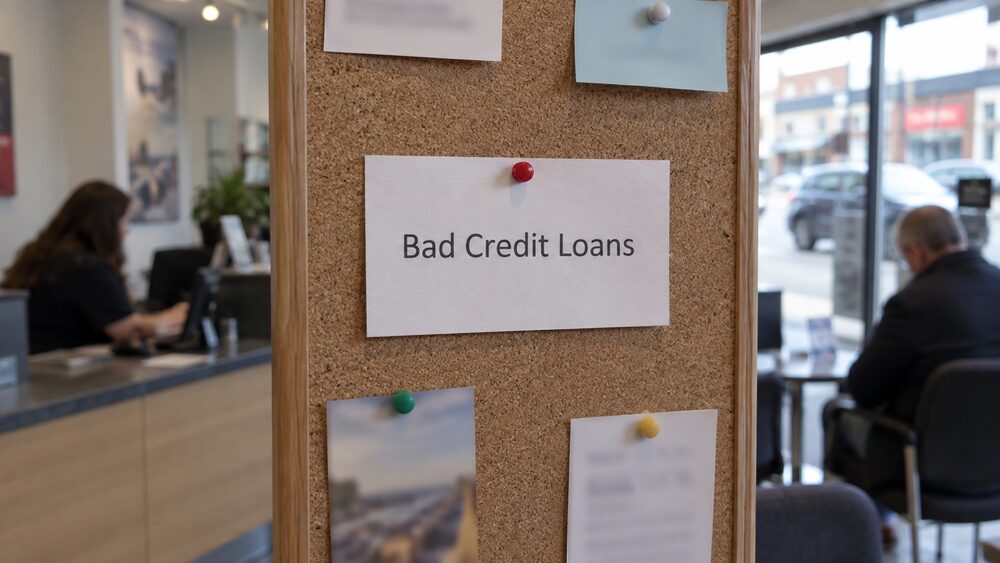
Near-prime and subprime lenders are firms that lend to people whom mainstream banks and card issuers turn away, usually because of a thin credit history, past missed payments, a default or a county court judgment (CCJ). The UK's non-mortgage consumer lending market, worth around £200 billion, is one of the largest consumer-facing sectors in UK financial services, and within it sits a tier of lenders who specialise in higher-risk borrowers1. These lenders are regulated by the Financial Conduct Authority (FCA) in the same way as any other consumer credit firm, but their pricing reflects the risk they take on.
The defining feature of this part of the market is cost. A parliamentary committee reviewing high-cost credit found lenders charging very high interest rates, typically 450 per cent to 2,500 per cent APR, at the extreme end of the market2. Not every near-prime or subprime product is priced at that level, but all of it costs more than mainstream credit, and the Bank of England is blunt about the consequence: having a bad credit rating makes borrowing money more expensive and harder3.
This page explains what these lenders are, who they serve, what they offer, what the borrowing costs and why, and what protections and free help exist if things go wrong. It does not rank or recommend any lender.
What near-prime and subprime lenders are
"Near-prime" and "subprime" are labels lenders and credit reference agencies use for borrowers who do not meet the standard criteria of mainstream banks. A near-prime borrower is usually someone whose credit history is mostly sound but has a blemish or two, or someone with little borrowing history at all. A subprime borrower is someone whose file shows more serious problems, such as defaults, CCJs or a history of missed payments. Lenders price accordingly: the worse the perceived risk, the higher the interest rate offered.
These firms are part of the ordinary regulated market, not a separate shadow system. The FCA's review of the consumer credit market covered the whole £200 billion non-mortgage lending sector, from credit cards and overdrafts to high-cost short-term credit1. Any firm lending to consumers in the UK must be authorised by the FCA, and the rules on affordability, forbearance and complaints apply to near-prime and subprime lenders just as they do to a high street bank.
What separates this tier from mainstream lending is the risk being priced. A lender that accepts borrowers with defaults and CCJs expects more of those loans not to be repaid, and it spreads that expected loss across all its customers through higher interest. That is the core economic reason subprime credit costs more, and it is why the parliamentary committee examining the sector found APRs running from 450 per cent to 2,500 per cent at the high-cost end2. The Bank of England puts the consumer consequence plainly: a bad credit rating makes borrowing more expensive and harder3.
Who these lenders are for: thin files, missed payments and low incomes
The typical customer of a near-prime or subprime lender is someone a mainstream lender has refused or would refuse. The most common reasons are a thin credit file (little or no history of borrowing), missed or late payments, defaults, CCJs, insolvency events such as bankruptcy or an individual voluntary arrangement, or simply an income that mainstream affordability models treat as too small or too irregular.
The mark these events leave is long-lasting. Late payments, missed payments and defaults stay on your credit history for six years4. That means a single difficult year can affect access to credit well beyond it, which is why people who have never been reckless with money can still find themselves in the subprime tier.
Low incomes compound the problem, and the evidence on how stretched many households are is stark. Research on home ownership in England found that just 17 per cent of people have a high enough income to meet lenders' affordability rules at prevailing prices and interest rates8. Among renters, a Welsh Government paper reported that around 4 in 10 (39 per cent) found it difficult to afford their rent payments, compared with 43 per cent and 23 per cent of those with a mortgage9. Households in that position have little room to absorb a shock, and private renters face costs well above social renters: private rent in the UK is 1.7 times higher than social rent10.
Products on offer: credit cards, loans, car finance and mortgages
Near-prime and subprime lending is not one product but a range of them, each aimed at people who cannot get the mainstream version.
- Credit cards for poor credit: cards with low starting limits and higher interest, sometimes marketed as credit builders.
- Personal loans: unsecured loans at higher APRs than mainstream banks charge.
- Car finance: hire purchase, personal contract purchase and conditional sale, often through specialist motor lenders.
- Mortgages: specialist lenders offer mortgages to people with past credit problems, including defaults and CCJs.
- High-cost short-term credit: payday-style lending, subject to a specific cost cap.
- Guarantor and secured loans: lending structured around a third party or an asset.
Peer-to-peer lending also exists at the margins of the market, though it remains small: 0.5 per cent of UK adults (around 0.3 million) held a peer-to-peer loan in the FCA's Financial Lives survey11.
On the mortgage side, specialist lenders sit alongside the mainstream. The Mortgage Charter, agreed in 2023, was signed not only by the big banks but by specialist firms such as Kensington Mortgage Company and OSB Group, trading as Precise Mortgages and Kent Reliance, which lend in the near-prime and subprime mortgage market12. Even mainstream brands appear on schemes aimed at helping borrowers: the Scottish Open Market Shared Equity scheme lists Bank of Scotland, Barclays, Halifax, Lloyds Bank, Nationwide, NatWest, TSB, Skipton, Scottish Building Society and several credit unions among its participating lenders13.
Cost of borrowing: higher APRs and what drives them
The headline numbers are stark. At the extreme end of high-cost credit, the parliamentary committee found interest rates typically running at 450 per cent to 2,500 per cent APR2. For comparison, the average cost of new borrowing from banks by UK non-financial businesses was 6.90 per cent in July 2024, up 5 basis points from 6.85 per cent in June14. That figure is for business borrowing, not consumer credit, but it shows the order of magnitude of mainstream lending costs against which subprime APRs sit.
Three things drive the gap. First, expected losses: a lender whose customers include people with defaults and CCJs expects more loans to go unpaid, and prices that in. Second, smaller loans cost more to arrange: the fixed cost of underwriting a £200 loan is not much smaller than for a £10,000 loan, so the APR on small amounts is naturally higher. Third, less competition: borrowers with poor credit have fewer places to go, so lenders do not have to price as sharply.
The practical consequence is that the total repayable on a subprime loan can be several times the amount borrowed. The FCA's payday cost cap limits interest and fees on high-cost short-term credit, and that cap is explained on a dedicated page. For other subprime products, no cap applies beyond the general rules, so the APR quoted is the number to compare. How APR is worked out, and the difference between representative and personal APR, is covered in loan APR explained.
Near-prime or subprime: how the two differ
The two terms describe points on the same spectrum rather than different markets. A near-prime borrower is close to qualifying for mainstream credit: perhaps one missed payment years ago, or a short credit history because they have never borrowed much. A subprime borrower has a file that mainstream lenders will decline outright: recent defaults, CCJs, insolvency, or a pattern of missed payments.
The difference matters for what you are offered. A near-prime borrower may be accepted by a mainstream lender's second-tier card, or by a specialist lender at a rate not far above mainstream pricing. A subprime borrower is looking at specialist products only, at rates that can be dramatically higher, and in the extreme cases at the 450 to 2,500 per cent APR range the parliamentary committee identified2. The Bank of England's summary applies across the spectrum, in degrees: a bad credit rating makes borrowing more expensive and harder3.
Because the labels are informal, no single list says who is near-prime and who is subprime. Each lender sets its own criteria and scores applications its own way, which is why one lender can refuse an application another accepts. The way to find out where you stand is to check your credit file, which is free to do, and to use eligibility checkers before applying, covered next.
Checking eligibility without harming your credit score
Before applying for any credit, you can check two things for free: your credit score and your eligibility for a particular product.
Your credit score can be checked as often as you like without doing any harm5. Checking your own file is a soft search: it appears on your file but does not affect your score. The same principle applies elsewhere in life: landlords and letting agents can only do a soft search when they credit check a prospective tenant15. Soft searches are visible to you but do not influence lending decisions.
Eligibility checkers, offered by lenders and comparison services, also use a soft search to show the chance of being accepted for a particular product. Because they are soft, running several does not damage your score the way multiple full applications can.
Two cautions apply. First, an eligibility checker is an indication, not a promise: the lender runs its own full affordability assessment, with a hard search, when you actually apply, and can still refuse you. Second, a hard search from a real application does leave a mark, and a cluster of applications in a short period can itself make lenders cautious. The sequence that protects your score is: check your file, use soft-search eligibility checkers to narrow the field, then make one full application to the lender most likely to accept you. How lenders assess affordability is covered in loan affordability checks.
Guarantor loans, secured lending and other alternatives
Subprime lenders offer several structures beyond the ordinary unsecured personal loan, and each carries its own risk.
A guarantor loan is one where another person, for example a friend or relative, guarantees the loan: they agree to pay it back if the borrower cannot16. MoneyHelper notes that guarantor loans can be more expensive than some other types of credit, since they often have higher interest rates16. The risk spreads to a second person: if the borrower stops paying, the guarantor becomes liable for the whole debt, and the effect on the guarantor is covered in what a guarantor pays when the borrower misses payments.
A secured loan is one where an asset, usually a car or the borrower's home, stands behind the debt. The consequence is direct: the lender can take your asset and sell it if you cannot repay your loan17. Secured borrowing is compared with unsecured borrowing in more detail in secured or unsecured borrowing compared.
For many people with poor credit, the cheapest option is not a subprime lender at all. Credit unions are not-for-profit community lenders providing affordable loans and savings, and they provide access to fair and affordable credit for people with a poor credit history, including those who cannot access mainstream forms of credit18. Their loans start from £5018. Credit union borrowing is covered in credit union loans, and other community options in CDFIs and affordable credit and the No Interest Loan Scheme.
What can go wrong: arrears, default and debt spirals
The risk with any high-cost credit is that a missed payment triggers charges and further borrowing, and the debt grows faster than the borrower can repay it. The evidence shows this is not a marginal problem.
The Bank of England's Credit Conditions Survey for 2026 Q2 found that lenders reported default rates for total unsecured lending to households increased in Q2 and were expected to increase in Q3; within that total, defaults on credit cards and on other loans both increased19. In mortgages, the share of regulated balances in arrears of more than 1.5 per cent of the loan balance edged down from a recent peak of 1.2 per cent20. Credit unions, despite lending to higher-risk borrowers, saw total net liabilities of loans in arrears increase by 22.10 per cent to £234.79 million in 2025, with 48.02 per cent of that total overdue by more than 12 months21.
Arrears can build quietly. On the Help to Buy equity loan, arrears build up when one or more monthly interest payments or management fees have not been paid22. On student loans, leaving the UK without telling the Student Loans Company can build up arrears on the account that must be repaid on top of regular repayments23.
The pattern to avoid is borrowing again to service existing debt. Each new subprime loan carries its own high interest, and the total cost of the debt grows. If repayments have become unaffordable, the answer is to seek free debt advice early rather than to borrow more, and what to do if you can't repay a loan sets out the steps.
Where FCA affordability rules protect you
The FCA's rules apply to near-prime and subprime lenders in full. Before lending, a firm must assess whether the borrower can afford the repayments, and lending without a proper affordability check can make the loan unaffordable and the lender liable to put it right.
The scope of the rules is wide. The FCA's policy statement PS24/2 on strengthening protections for borrowers in financial difficulty applies to consumer credit lenders, premium finance firms, mortgage lenders and administrators, home purchase providers and administrators, firms carrying out consumer hiring, firms operating an electronic system in relation to lending, debt collectors, and lenders in supervised run-off, as well as Gibraltar-based lenders passporting into the UK24. In short, if a firm lends to consumers in the UK, these rules reach it.
On guarantor loans specifically, the Financial Ombudsman Service states that when agreeing to a loan, lenders need to make sure the borrower can afford the repayments without too much trouble, and must show what checks they did if the loan is complained about as unaffordable25. The FCA has also been reviewing how consumer credit is advertised, consulting on financial promotions rules so that the cost and risk of credit are presented fairly26.
One protection does not apply to borrowing itself: the Financial Services Compensation Scheme (FSCS) protects deposits, up to £120,000 per eligible depositor, for banks, building societies and credit unions authorised by the Prudential Regulation Authority and FCA6. It does not cover you if you cannot repay a loan. FSCS protection only applies to firms that have been authorised by the FCA or PRA to do business in the UK27, which is a reason to check any unfamiliar lender on the FCA Register before borrowing, and to be wary of firms demanding upfront fees.
Complaints and free debt help
If a lender has treated you unfairly, or lent to you when you could not afford it, the route is the same as for any regulated firm.
- Complain to the lender first, in writing, setting out what went wrong. The lender has a set period to respond.
- Take it to the Financial Ombudsman Service if the lender does not resolve it. The service is free. Where a lender has not done enough to help, the ombudsman may tell it to pay compensation for any distress or inconvenience7.
- Complaints about claims management companies go to the Claims Management Ombudsman, where making a complaint is easy and free28.
The ombudsman's own data shows what borrowers complain about. In a sample of 278 payday loan complaints, the amounts first borrowed were small: 18 per cent involved initial loans of £101 to £200, 18 per cent of £301 to £400, 15 per cent of £201 to £300, 12 per cent of £1 to £100, 10 per cent of £501 to £750, 6 per cent of £751 to £1,000, 5 per cent of £401 to £500 and 4 per cent over £1,00029. Small loans generate large volumes of complaints, which is the shape of the subprime market in miniature.
For debt itself, free help comes before paid help. Official guidance is to get advice before setting up a debt management plan with a provider, and free and independent advice is available from organisations such as Advice NI for debt management plans and any kind of debt problem30. The debt section of this site sets out the full range of free options, and complaining about a lender covers the complaint process in detail.
Sources30 cited
- Consumer Credit Act review consultation paper HM Government, 2022
- High-cost credit review evidence Parliament.uk
- What do I need to know about debt Bank of England
- Getting a mortgage with late payments and defaults Which?, 2025
- How to check your credit score for free Which?, 2025
- FSCS protection limits Financial Services Compensation Scheme, 2026
- Interest and mortgages complaints Financial Ombudsman Service, 2026
- Home ownership in England House of Lords Library, 2026
- Welsh Government paper on rent affordability Senedd Business, 2022
- Family Resources Survey report 2024/25 NISRA, 2024
- Financial Lives Survey 2022: credit and loans Financial Conduct Authority, 2022
- Mortgage Charter HM Government, 2023
- Open Market Shared Equity scheme: how to apply mygov.scot, 2026
- Money and credit: July 2024 Bank of England, 2024
- Credit checks by landlords and letting agents Shelter England, 2026
- Guarantor loans explained MoneyHelper, 2026
- Home Owners Support Fund: separation mygov.scot, 2026
- Save, bank or borrow with a credit union Welsh Government, 2026
- Credit Conditions Survey 2026 Q2 Bank of England, 2026
- Scottish housing market review Q3 2025 Scottish Government, 2025
- Credit union statistics 2025 Bank of England, 2025
- Help to Buy: equity loan arrears HM Government, 2024
- Repaying your student loan HM Government, 2026
- PS24/2: Strengthening protections for borrowers in financial difficulty Financial Conduct Authority, 2024
- Guarantor loans complaints Financial Ombudsman Service, 2026
- CP26/15: Reviewing financial promotions rules for consumer credit Financial Conduct Authority, 2026
- FSCS protected badge leaflet Financial Services Compensation Scheme, 2025
- Claims Management Ombudsman: consumer complaints Claims Management Ombudsman, 2026
- Payday lending report Financial Ombudsman Service, 2026
- Debt management plans nidirect, 2025





 MoneyHelperFree, impartial money and pensions guidance, set up by government
 StepChangeFree debt advice and solutions from a charity
 National DebtlineFree debt advice by phone, webchat and online
 Financial Ombudsman ServiceFree, independent help when a complaint about a firm is not put right
 Citizens AdviceFree advice on money, consumer and legal problems in England and Wales