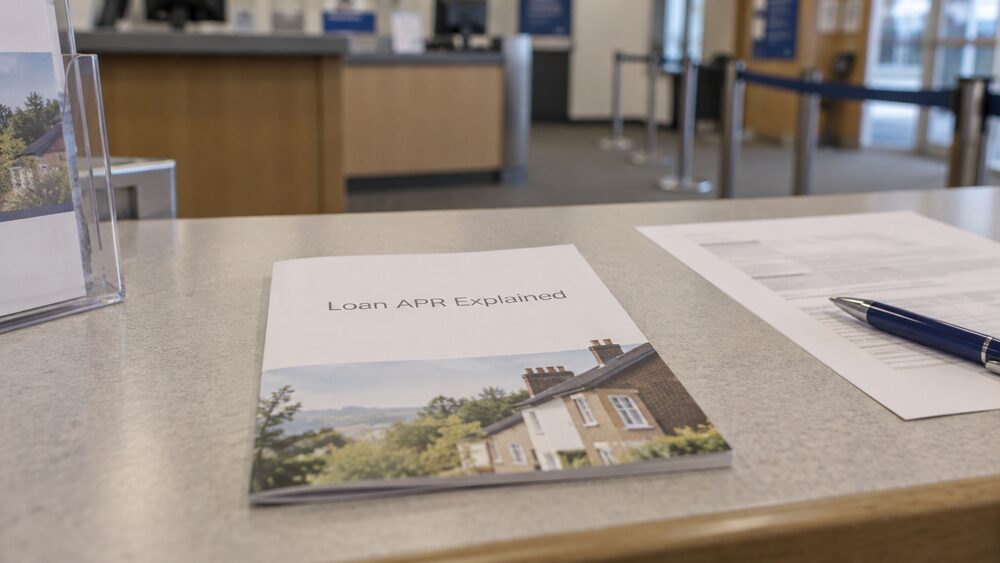
When a lender advertises a loan, the rate in the headline is almost never a promise of what you will pay. It is a representative APR: the rate that at least 51% of people accepted for that product must get1. The rest can be, and often are, charged more. The rate actually worked out for you is your personal APR, and it depends on things like how much you want to borrow, your financial situation and your credit history2.
APR stands for Annual Percentage Rate. It shows how much it costs to borrow money over a year, including interest and fees3. Because it folds fees in, it is generally higher than the quoted interest rate and gives a truer picture of how expensive the loan will be4. This page explains what APR covers, how the 51% rule works, why your personal APR can differ from the advertised rate, and what protections exist around the figures lenders show you.
What APR means on a loan
APR, or Annual Percentage Rate, is the standard way lenders show the cost of borrowing. It is a way that lenders show the interest and additional charges you will pay on what you are borrowing5. Because it brings interest and fees together into a single yearly percentage, it lets you compare different loans on the same basis, rather than trying to weigh a lower interest rate against a higher fee.
The reason APR exists is that the interest rate alone does not tell the whole story. The interest charges on credit are called the Annual Percentage Rate, and this tells you how expensive the loan will be: it is generally higher than the quoted interest rate and shows the true cost of the credit4. A loan with a low interest rate but a large arrangement fee can cost more over a year than a loan with a slightly higher rate and no fee, and the APR is designed to capture that difference.
What APR takes into account, as official guidance for consumers sets out, is the total cost of borrowing, including the total amount of interest you will pay, any additional charges such as a monthly fee for taking out the card, and when and how often you must pay the interest6. In other words, it is not just a rate but a summary of the cost of the deal as a whole, expressed in a form you can put next to any other deal.
The same idea runs across different kinds of borrowing. On a mortgage, APR describes the total cost of the loan, including all costs, arrangement fees and interest charges, shown as a percentage rate7. On cards and personal loans, the same principle applies: the APR is the yearly cost of the credit including interest and fees3. The details differ by product, but the purpose is the same, to give one comparable number for the cost of a year of borrowing.
What APR includes, and the fees it leaves out
APR includes the interest and the compulsory charges that come with the loan. What it does not include are charges that depend on how you behave once you have the loan, such as charges for late or missed payments, or optional extras you choose to add. Because those are not certain to happen, they sit outside the headline figure.
This matters when you compare loans. Two lenders can quote the same interest rate but different APRs, because one charges an arrangement or handling fee and the other does not. The APR is the more honest of the two numbers for comparison purposes, precisely because it captures those fees4. It also matters when reading the small print of a card: the APR you see in an advert reflects the interest charged on purchases, as opposed to cash advances or balance transfers, which can be charged at different rates8.
There is a separate measure worth knowing about if you are looking at mortgages. The APRC, used for mortgages, shows the total cost of the mortgage for its full term, including all fees and any changes in rates over the entire term, whereas APR is often used for loans and credit cards and might not give a clear picture of long-term costs9. So a mortgage advert will usually show an APRC rather than an APR, and the two should not be compared directly.
For most personal loans, though, APR is the figure to look at, and the fees it includes are the ones you cannot avoid. Charges you can trigger yourself, such as late payment fees, are listed separately in the loan's terms, and the guide to loan fees and charges covers the ones to check before signing.
Representative APR: the rate at least 51% of accepted applicants get
The representative APR is an advertised rate that all lenders use to help you compare the cost of borrowing in one handy format1. But it is not the rate everyone gets, and it is not a promise. To be representative, it must be the rate offered to at least 51% of people, but it is not guaranteed, and anyone applying for a personal loan could pay more than the representative APR advertised1.
The 51% figure comes from legislation. Under current legislation the minimum percentage is 51% of customers who are accepted for a personal loan10. The rule in the regulations themselves is that the representative APR is the one that would be provided under at least 51% of the agreements which will be entered into as a result of the advertisement11. This replaced an older approach, under which a "typical APR" had to be provided under at least 66% of agreements11. So the threshold for what counts as representative was actually lowered, from two thirds of borrowers to just over half.
Lenders describe the rule in their own words in much the same way. Nationwide says representative means it is the APR the lender gives to at least 51% of its customers12. Bank of Scotland puts it as: at least 51% of applicants will be offered the advertised rate, based on an assessment of personal circumstances, and others may be offered a higher rate13. The representative APR must be advertised on all loan products, such as credit cards, mortgages and personal loans, when applicable14.
Two things follow from the 51% rule that are worth holding in mind. First, the percentage applies to accepted applicants, not to everyone who applies: people who are refused the loan altogether do not count in the figure. Second, the representative APR is tied to a loan of a particular size: when you see a representative APR, it means that over half of people who have taken out a loan of a particular size from that lender have been given that rate1. That is why the representative APR will change depending on the loan amount2, a point covered below.
The representative example in adverts
Alongside the representative APR, loan adverts carry a representative example: a standard illustration showing a typical borrowing amount, term, rate, monthly payment and total repayable. It exists so that adverts are comparable with each other, and so that the advertised rate is anchored to a real set of figures rather than floating free.
The example is tied to a specific loan size, which is why it cannot be read across to your own borrowing. Barclays' loan calculator states that its results are based on the representative APR for the amount entered, that its representative APRs are based on all loan applications made by Barclays customers, and that actual rates may differ based on personal circumstances, loan amount and term15. In other words, even the lender's own quote for a different amount is built on a different representative APR.
This is also where the representative example in credit card adverts differs from loans. Which? notes that the representative example APR in credit card adverts reflects the interest charged on purchases, as opposed to cash advances or balance transfers8, so a card's advertised APR tells you about one use of the card, not all of them. With a personal loan there is usually a single rate for the whole borrowing, so the example is more directly comparable, but it still only describes the loan size it illustrates.
When you read an advert, the representative example tells you what the deal looks like for the majority of accepted applicants at that loan size. It does not tell you what the deal looks like for you, and the gap between the two is exactly what the personal APR, covered next, is about.
How to use APR to compare loans
APR is at its most useful as a comparison tool, because it puts interest and fees into one number. Used carefully, it lets you line up loans from different lenders and see which is cheaper for the same borrowing, provided you compare like with like.
The first rule is to compare the same loan amount and term. Because the representative APR changes depending on the loan amount2, a representative APR quoted for a small loan is not comparable with one quoted for a large one, even from the same lender. Loan calculators, like those offered by Nationwide12 and Lloyds Bank16, let you see a representative example for the amount you actually want to borrow, which is a fairer basis for comparison than the headline figure in an advert.
The second rule is to remember what the number is. A representative APR is what over half of accepted applicants at that loan size get1, not a guaranteed price. Two lenders with the same representative APR may treat your application very differently: one may offer you the representative rate, the other a higher personal APR. The comparison tells you about the market, not about your quote.
The third rule is to check what sits outside the APR. Late payment charges, early settlement terms and any optional fees are not in the headline figure, and they can matter as much as the rate itself. The guides to how loan interest is calculated, loan fees and charges and fixed vs variable interest rates cover these in detail.
Finally, APR comparisons only work within the same kind of product. Comparing a personal loan APR with a credit card purchase APR, or either with a mortgage APRC, tells you little, because the products work differently and the measures are built differently9. For choosing between types of borrowing, the guide to types of loan is a better starting point than the APR alone.
Your personal APR can be higher than the advertised rate
A personal APR is a rate that has been worked out especially for you, based on things like how much you want to borrow, your financial situation and your credit history2. It is the rate that actually applies to your loan, and it can be the same as, higher or lower than the representative APR17.
Lenders are explicit about this in their own terms. M&S Bank states that a personal APR could be more than the advertised representative APR, and that personal APR is worked out based on your personal circumstances, including credit history and finances, as well as the loan amount and length of your borrowing18. Lloyds Bank says it will work out your personalised loan rate (APR) based on your application details, your credit record and your past account history16. Barclays states that the rate you are offered may differ from the representative APR shown and will be based on your personal circumstances, the loan amount and the repayment term19.
The factors that move the rate are consistent across lenders:
- Your credit history and credit score. HSBC warns that the APR advertised may not be the rate you are offered, which can be due to a number of reasons such as your credit score20.
- The loan amount. The representative APR changes with the amount borrowed2, and the rate offered to you also depends on the amount you ask for18.
- The repayment term. How long you take to repay is part of what the personal APR is worked out on18, and Barclays lists the repayment term among the factors behind its offered rate19.
- Your wider financial circumstances. Lenders assess your financial situation, not just your credit file2.
Some lenders state the point bluntly on specific products. first direct's bike loan states the rate offered will be based on an assessment of your personal financial circumstances, including a credit check, and may be higher than the representative APR21. Its wedding loan says the same: the rate will be based on the lender's assessment of your personal financial circumstances, including a credit check, and may be higher than the representative APR22. Volkswagen Financial Services advises borrowers to bear in mind that your personal APR may differ from the representative APR depending on your circumstances23.
The practical consequence is simple: never budget on the advertised rate. If a loan is only affordable at the representative APR, a higher personal APR could make the repayments a stretch. The guides to loan affordability checks and what to do if you can't repay a loan cover the ground either side of that decision.
Seeing a rate before a full application
Because the advertised rate is not your rate, the useful question is whether you can find out your personal APR before committing to a full application. The answer depends on the lender and the product.
Loans without pre-approval show a representative APR which the lender only has to give to 51% of people who apply24. That is the standard case: you apply, the lender assesses you, and only then do you learn your personal APR. Some lenders and platforms offer a softer route, variously called pre-approval, eligibility checking or a quote, which shows the rate you would actually get before a full application, and typically without a full credit check footprint. Experian's guidance on pre-approved loans draws exactly this distinction between loans with and without pre-approval24.
Where a pre-check is available, it changes what the APR means for you. Instead of comparing representative APRs across the market and hoping, you can compare personal APRs you have actually been offered, which is a much firmer basis for a decision. Where it is not available, the representative APR remains the only figure before you apply, and the 51% rule is the only guarantee attached to it.
A few cautions apply either way. A rate shown before a full application is still subject to the lender's final assessment, so check whether the figure is described as guaranteed or as indicative. And if a rate looks far better than anything else on the market, treat it with care: the guide to upfront fee scams covers the frauds built around too-good-to-be-true loan offers. For the mechanics of applying, see how to apply for a loan.
What protects a borrower, and where it stops
The rules around APR exist to make advertising honest and comparison possible, and they give you several protections. The representative APR must be advertised on all loan products, such as credit cards, mortgages and personal loans, when applicable14, so a lender cannot advertise a rate that almost nobody gets. The regulations require that the representative APR is the one that would be provided under at least 51% of the agreements entered into as a result of the advertisement11, and consumer credit regulations state that the advertised representative APR must be offered to at least 51% of applications expected to result from the ad8. Adverts must also carry a representative example, so the headline rate is tied to real figures.
Before you sign, you must be given pre-contract credit information setting out the APR, the interest rate and the total cost, which is where the image earlier in this page comes in. After signing, you have a 14-day right to withdraw from a loan or finance agreement, covered in the guide to the right to withdraw. Your wider rights under the Consumer Credit Act, including how interest and charges must be shown, are covered in the guide to your rights under the Consumer Credit Act, and Section 75 protection on point-of-sale credit is explained in Section 75 on loans, car finance and point-of-sale credit.
Where the protection stops is equally important to understand. The 51% rule does not entitle you to the advertised rate: lenders do not have to give you the interest rate they are advertising25, and some accepted applicants can be charged more than the representative APR1. The APR does not include charges you trigger yourself, such as late payment fees. And the APR is a cost measure, not an affordability check: it tells you what the loan costs, not whether you can repay it, which is a separate question covered in loan affordability checks.
If a lender's treatment of you seems wrong, whether that is an advertised rate that appears not to meet the 51% rule, or a loan that was unaffordable when granted, you can complain to the lender and then to the Financial Ombudsman Service. The guides to complaining about a lender and complaining about an unaffordable loan set out the process, and free, impartial debt help is available through the routes described in the guide to what to do if you can't repay a loan.
Sources25 cited
- What is APR? RBS, 2026-09-26
- What is APR? RBS, 2026-09-25
- Glossary StepChange Debt Charity, 2026-09-25
- Budgeting, saving and borrowing Business Debtline, 2026-09-26
- What is APR? NatWest, 2026-09-25
- Credit cards and debt nidirect, 2025-11-06
- Home buying and selling jargon HomeOwners Alliance, 2026-07-31
- Credit card interest explained Which?, 2026-09-18
- What is APRC? Halifax, 2026-09-27
- Loans glossary Tesco Bank, 2026-09-25
- The Consumer Credit (Total Charge for Credit) Regulations 2010 legislation.gov.uk, 2010
- Loan calculator Nationwide, 2026
- What is APR? Bank of Scotland, 2026-09-27
- What is APR? Post Office, 2026-07-20
- Loan calculator Barclays, 2026
- Loan calculator Lloyds Bank, 2026-09-27
- What is credit? Zempler Bank, 2026-09-26
- What is APR? M&S Bank, 2022-12
- Personal loans Barclays, 2026
- How to get a credit card HSBC, 2026
- Bike loans first direct, 2026
- Wedding loans first direct, 2026
- APR explained Volkswagen Financial Services, 2026
- Pre-approved loans Experian, 2026
- Why can't I get a 0% interest credit card? Debt Advice Foundation, 2016-02-29






 MoneyHelperFree, impartial money and pensions guidance, set up by government
 StepChangeFree debt advice and solutions from a charity
 National DebtlineFree debt advice by phone, webchat and online
 Financial Ombudsman ServiceFree, independent help when a complaint about a firm is not put right
 Citizens AdviceFree advice on money, consumer and legal problems in England and Wales