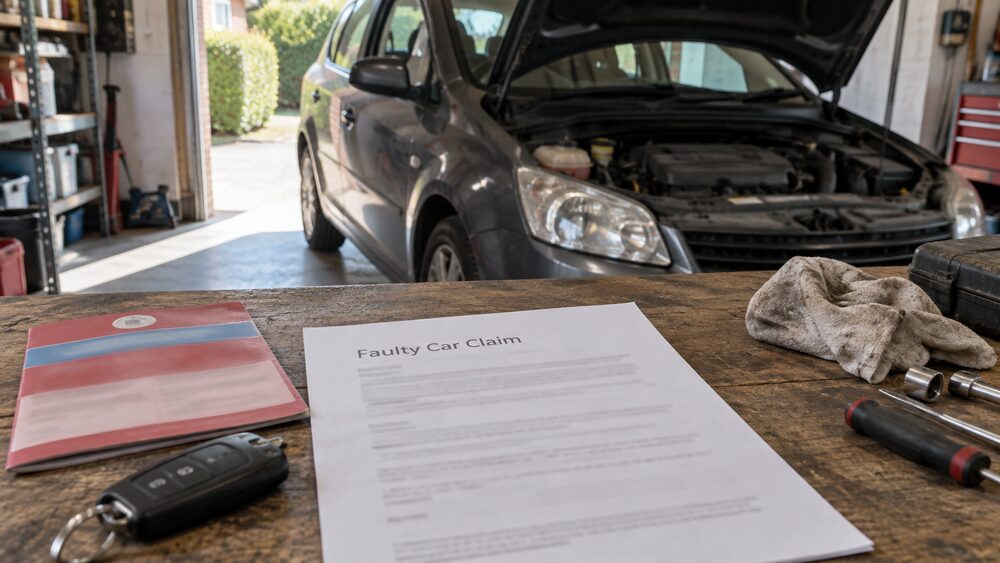
If a used car bought on finance develops a fault, the first thing to understand is who actually owns it. With hire purchase or conditional sale, the finance company owns the car until you have made the last payment, and with a lease or hire agreement it remains the property of the finance company throughout1. That ownership is not a technicality: it is why the finance company, not just the dealer, has a role when something goes wrong.
If a used car bought on finance develops a fault, the first thing to understand is who actually owns it. With hire purchase or conditional sale, the finance company owns the car until you have made the last payment, and with a lease or hire agreement it remains the property of the finance company throughout1. That ownership is not a technicality: it is why the finance company, not just the dealer, has a role when something goes wrong.
Your rights depend on the type of agreement and on when the fault appears. If you bought the car on hire purchase, you have the common-law right to reject a faulty car throughout the duration of the agreement, as long as you stop using the car once you have discovered the fault2. Under the Consumer Rights Act, a faulty car bought from a dealer gives you an initial 30 days to reject the vehicle and claim a full refund3.
What happens if payments stop is worth setting out plainly. The provider and credit reference agencies count a missed payment as recorded on your credit file, and several missed payments put your account at risk of defaulting4. The rest of this page sets out who is responsible for what, what the finance ties you to while the car is off the road, and what happens to your deposit, your payments and your credit file.
The finance company owns the car until you have paid
The ownership rule is the foundation of everything else on this page. When you buy a car with a hire purchase or conditional sale agreement, the finance company owns the car until you have made the last payment1. When you lease or hire a car, it remains the property of the finance company1. With logbook loans, you hand ownership of your car to the finance company until you make the last payment, and the loan company takes ownership of the vehicle until you pay them back1.
This matters because it shapes who can do what. Vehicles bought on hire purchase, PCP or conditional sale are not fully owned by you until the last payment to the finance agreement is made8. If you bought your car with a finance package such as PCP or HP, or a lease, technically your car belongs to the finance company, and it should be able to help you through the process of dealing with a fault2.
Not every way of financing a car works like this. Car finance is considered a secured loan, because the loan is secured against the car, and some car finance options are secured with the vehicle serving as collateral9. A personal loan taken out to buy a car is different: the car is yours, and the lender has no claim on it. That distinction decides whether you can sell the car, whether the finance company can take it back, and who you negotiate with when it breaks down.
Who is responsible for faults: dealer or finance company
Responsibility is split, and the split follows what went wrong. In a case the Financial Ombudsman Service decided, it said the finance provider would not be responsible for any wear and tear issues, but would be responsible if the car was sold with defects you would not expect on a car of that age, mileage and price11. That is the dividing line: age-related wear is one thing, a defect that should not have been there is another.
There is also a statutory route. Section 75 of the Consumer Credit Act 1974 makes the finance or card provider as responsible as the trader for a breach of contract or misrepresentation12. The provision imposes upon credit-card providers and the lenders under other types of restricted-use credit agreements liability to the debtor for misrepresentations and breaches of contract of the supplier14. In practice, that means a claim can be pursued against the lender as well as the dealer, where the agreement and the amount qualify.
Where a repair has already happened, a parallel rule applies to insurers. If your vehicle has been repaired by a garage that your insurer told you to use, then your insurer will be responsible for what went wrong15. If repairs were not to an acceptable standard, the ombudsman will usually tell the insurer to arrange for the repairer to correct the damage, let the customer choose their own repairer at the insurer's cost, or write off the vehicle and pay its pre-accident market value15.
The Financial Ombudsman Service also has a settled approach to car finance complaints where the borrowing funded the car itself: where the credit has been used directly to fund the cost of a car, it would usually instruct the credit provider to take back the car and cancel any further amounts due16.
What car finance ties you to while the car is faulty
A finance agreement keeps running while a fault is sorted out. The payments, the term and the conditions in the agreement do not pause because the car is off the road, and the agreement sets out what you signed up to. Car finance terms usually run 2 to 5 years, with fixed monthly payments over an agreed term, and a deposit is often required at the start17. Ownership does not transfer until the end, or after an optional final payment18.
Mileage is one of the conditions that keeps applying. Mileage restrictions can apply to car finance18. With lease or hire agreements there are often restrictions on use, and the finance company could penalise you for using too much mileage1. A car that spends weeks in a garage is not clocking up miles, but the agreement's terms are not automatically suspended by a fault, so the limit in your own paperwork is what counts.
There is a separate compensation route that some borrowers are pursuing, and it is worth knowing its status. The FCA launched a redress scheme for borrowers, covering certain motor finance agreements19. The Motor Finance Redress Scheme covers used car finance for a motor vehicle taken out between 6 April 2007 and 1 November 2024, for example a car, motorbike, van or campervan, including hire purchase agreements such as Personal Contract Purchases21. Parts of the FCA scheme have been suspended following a legal challenge22.
Selling or handing back a faulty car on finance
Selling a car that still has finance on it is restricted, and the restriction depends on the agreement. With hire purchase, conditional sale, or a lease or hire agreement, you cannot sell the car without the permission of the finance company1. With a logbook loan, it is illegal to sell a vehicle before the logbook loan is paid off, and you cannot sell the car while the loan is outstanding7. It is against the law to sell it until you pay off the finance in full23. If you bought the car with a personal loan, by contrast, you can sell the car at any time1.
The risk of ignoring this falls on the buyer as well as the seller. If there is outstanding finance on a vehicle and you buy it, you may never legally own it and could lose the vehicle, depending on the nature of the agreement24. A vehicle history check will show whether finance is recorded, and if it is, you will be able to find out which company it is with, when it was taken out, how long for and what type of finance it is24.
Handing the car back is a different process from selling it, and it has its own costs. If you end the agreement yourself, you will owe up to half the agreement, plus any arrears and reasonable charges if the car is damaged25. If the car sells for less than what you owe, you will be liable for that shortfall6. On hire purchase or conditional sale, the finance company can take the car back without going to court if you have paid less than a third of the agreement, and on lease or hire agreements it can take the car back if you miss payments1.
Deposit, payments and your credit report if you stop paying
Stopping payments is the step that turns a fault dispute into a debt problem. The provider and credit reference agencies count it as a missed payment, recorded on your credit file, and several missed payments put your account at risk of defaulting4. Your credit file will show that you did not make your agreed payments, which impacts your credit score26. Failing to pay debts, whether secured or unsecured, can affect your credit rating27.
The record lasts. Details are recorded on your file for six years5. Late payments stay on your credit history for six years, as do missed payments and defaults28. Credit accounts in default will stay on your credit report for six years from the date of default29. A default notice will negatively impact your credit rating for six years, and would be quite damaging for future financing plans6. Debts show on your credit file for six years from the date they are paid off, or the date the account defaulted30.
If a rejection succeeds, the money comes back through the finance company rather than the dealer. The dealer will have to refund the finance company rather than you directly; the finance company will then have to terminate your agreement and pay you back your deposit plus any payments you have already made, minus any deductions made for fair usage3. In one ombudsman case, the finance company was told to take back the car, cancel the remaining finance amount and correct any adverse entries it had applied to the customer's credit file, refund the £500 deposit with interest, with the customer paying something towards their use of the car31.
Where to get help
Free, impartial help exists for both sides of this problem. The Financial Ombudsman Service decides complaints about car finance, including cases where a used car failed and was not of satisfactory quality11. It also handles complaints about commission on car finance20. If a complaint is about an unaffordable loan, the ombudsman's approach is set out in its guidance on unaffordable lending16.
On the debt side, if payments have become unmanageable, free debt advice services can set out the options. Bankruptcy is one route with consequences for a financed car: the ownership of your vehicle will be affected by bankruptcy, whether you have already paid for it or are still paying for it through finance, and items of value like your house or car could be sold to pay off your debts32.
If you are unsure who you owe money to, that can be established before deciding anything else30. And if the car itself is the problem rather than the debt, the dealer complaint route runs alongside the finance route, and the finance company should be able to help you through the process because it owns the car2.
Sources33 cited
- Car finance and debt StepChange, 2026-09-25
- How to complain about a car dealer Which?, 2026-03-10
- Is there a 14-day cooling-off period when buying a car? Which?, 2026-09-27
- Credit card payment holidays StepChange, 2026-09-25
- DMP and credit score StepChange, 2026-09-25
- Car finance Advice NI, 2026-09-26
- Logbook loan debt StepChange, 2026-09-25
- What can bailiffs take? StepChange, 2026-09-25
- Car loan vs car finance first direct, 2026
- What is a secured loan? HSBC UK, 2026
- Consumer complains used car failed eight months later Financial Ombudsman Service, 2026-09-26
- Remedies and redress: an overview of your key consumer rights Trading Standards Wales, 2025-09
- Problems with services Isle of Anglesey County Council, 2025-09
- Response to HM Treasury consultation on reforming the Consumer Credit Act 1974 Financial Ombudsman Service, 2023-03-17
- Vehicle repairs Financial Ombudsman Service, 2026-09-16
- Unaffordable lending Financial Ombudsman Service, 2026-09-26
- Car finance Zable, 2026-09-25
- Guide to car finance Post Office, 2026-08-12
- The motor finance redress scheme House of Commons Library, 2026-09-26
- Complaints about commission Financial Ombudsman Service, 2026-03-30
- Motor finance redress scheme Consumer Council for Northern Ireland, 2026
- Car finance complaints: list of lenders Financial Conduct Authority, 2026-09
- Selling assets to pay debts StepChange, 2026-09-25
- Checking the history of a motor vehicle Finance & Leasing Association, 2026-09-25
- Car repossession: what happens and what you can do about it National Debtline, 2026-09-25
- Default notices and missed payments StepChange, 2026-09-25
- What do I need to know about debt? Bank of England, 2025-08-19
- Getting a mortgage with late payments and defaults Which?, 2025-08-20
- Credit reference agencies Business Debtline, 2026-09-26
- Finding who I owe money to StepChange, 2026-09-25
- Consumer told us they were struggling to repay car finance Financial Ombudsman Service, 2026-09-26
- Bankruptcy and my car StepChange, 2026-09-25
- How to go bankrupt StepChange, 2026-09-25








 MoneyHelperFree, impartial money and pensions guidance, set up by government
 StepChangeFree debt advice and solutions from a charity
 National DebtlineFree debt advice by phone, webchat and online
 Financial Ombudsman ServiceFree, independent help when a complaint about a firm is not put right
 Citizens AdviceFree advice on money, consumer and legal problems in England and Wales