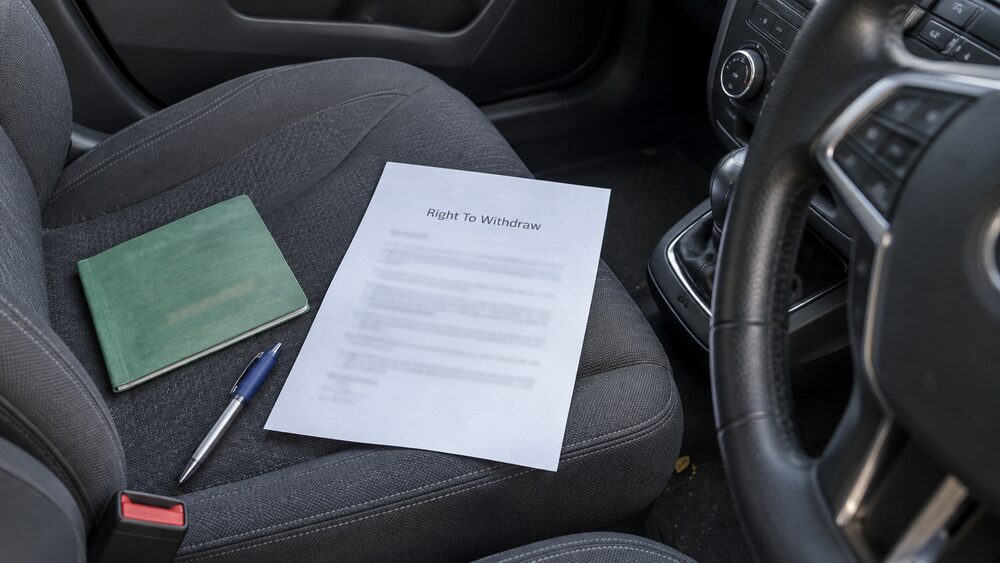
Most people who sign a loan or finance agreement in the UK can change their mind afterwards. The Consumer Credit Act 1974 gives a borrower under a regulated consumer credit agreement the right to withdraw from it, without giving any reason, by giving notice within 14 days1. The right was inserted into the Act by the Consumer Credit (EU Directive) Regulations 2010 and has applied since 20112.
Withdrawing is not free in one sense: you must repay the credit you received, together with the interest that accrued on it while you had the money, and you must do so within 30 days of giving notice3. But the withdrawal itself carries no penalty. The Act states that a withdrawing borrower is "not liable to pay to the creditor any compensation, fees or charges", with one narrow exception for non-returnable charges the lender has already paid to a public administrative body1.
What the right to withdraw lets you do
The right to withdraw is a legal right to walk away from a credit agreement shortly after it is made. Section 66A of the Consumer Credit Act 1974 provides that "the debtor under a regulated consumer credit agreement, other than an excluded agreement, may withdraw from the agreement, without giving any reason, in accordance with this section"1. In plain terms: if you took out a personal loan, a credit card, a hire purchase agreement or most other regulated credit, you have a window in which you can undo the borrowing itself.
What withdrawal undoes is the agreement, not the money. If the lender has already paid out the credit, you do not keep it. The Act requires the withdrawing borrower to "repay to the creditor any credit provided and the interest accrued on it (at the rate provided for under the agreement)"1. So the right is best understood as a cooling-off period for the decision to borrow, not as a way to get free credit for a fortnight.
The right also protects you from being charged for changing your mind. Beyond repaying the credit and accrued interest, the Act says you are not liable for any compensation, fees or charges, except any non-returnable charges the creditor has paid to a public administrative body1. A lender cannot impose an "administration fee" or penalty for a valid withdrawal.
The right sits alongside other protections in the Consumer Credit Act, such as the rules on how agreements must be formed and documented, which are covered in your rights under the Consumer Credit Act. It is separate from the right to cancel, which applies in different situations and is explained later on this page.
14 days to change your mind: when the clock starts
The withdrawal period is 14 days, and it begins on the day after what the Act calls "the relevant day"2. The relevant day is whichever is the latest of several trigger points: the day the agreement is made, the day the creditor first informs you of a credit limit, the day you receive a copy of the agreement under section 61A or are informed as specified there, and the day you receive a copy of the agreement under section 631. In practice this means the clock may start later than the day you signed, particularly where the lender sends you documents or a credit limit after the agreement is made.
Lenders describe the window in their own terms. Sainsbury's Bank, for example, tells personal loan customers: "Yes, you have 14 days to cancel, starting from when you receive your loan"5. That is consistent with the statutory rule, since receiving the funds or the final documents is often what fixes the relevant day.
How the withdrawal and repayment periods run, from signing to settling up.
One point matters if you leave it to the last moment. The rules on disclosure of information state that "the point for determining whether notice of withdrawal is within the 14 days is the despatch of the notice by the consumer, rather than receipt by the lender"6. So a notice posted on the last day counts, even if the lender receives it afterwards.
Which loans and finance agreements it covers
The right applies to regulated consumer credit agreements, which covers most credit taken out by individuals for personal rather than business purposes. That includes unsecured personal loans, credit cards, hire purchase and conditional sale agreements, credit-sale agreements and similar products. The FCA's rulebook confirms the breadth of the regime: CONC 11 covers both credit agreements and agreements relating to credit broking, debt counselling, debt adjusting, credit information services and credit references7.
The underlying EU Consumer Credit Directive, which shaped the UK rules, put it simply: "The consumer shall have a period of 14 calendar days in which to withdraw from the credit agreement without giving any reason"8. The UK implementing regulations say the same: "The consumer has the right to withdraw from a credit agreement within 14 days, without giving any reason. The consumer must repay the amount borrowed and the interest accrued between drawing down the credit and repaying it"6.
For goods bought on credit, withdrawal has a specific effect on ownership. Where credit has been provided under a conditional sale, hire-purchase or credit-sale agreement and you pay the sum payable in full, "title to the goods purchased or supplied under the agreement is to pass to the debtor on the same terms as would have applied had the debtor not withdrawn from the agreement"2. In other words, once you settle up, the goods become yours exactly as they would have done if you had never withdrawn.
There is also a knock-on effect for linked finance. The Directive provides that where you exercise a right of withdrawal concerning a contract for the supply of goods or services, you are "no longer be bound by a linked credit agreement"8. This is the situation where a retailer arranged the finance for a purchase; withdrawing from the purchase can end the finance too. The mechanics are covered in cancelling linked credit when you return the goods.
Where the right to withdraw does not apply
Section 66A lists the excluded agreements. The right does not apply to:
- an agreement for credit exceeding £60,260, other than a residential renovation agreement
- an agreement secured on land
- a restricted-use credit agreement to finance the purchase of land
- an agreement for a bridging loan in connection with the purchase of land1
The £60,260 ceiling was a deliberate choice in the 2010 regulations, which state that "the right of withdrawal is not being applied to any agreements above £60,260" and that "second-charge mortgages have been excluded"6. The disclosure regulations make the same point: "the right of withdrawal has not been extended to loans above £60,260"6.
The Consumer Credit Act itself also disapplies Part V (except section 56) to non-commercial agreements and to debtor-creditor agreements enabling the debtor to overdraw on a current account3.
Some products fall outside the right because they are not conventional credit at all. Student loans are their own regime: you repay Tuition Fee Loans, Maintenance Loans and postgraduate loans under student finance rules rather than consumer credit rules9, and the government's own guidance is blunt that "you'll have to pay back any loan you get"10. Equity release works differently again: with a lifetime mortgage, "you usually don't have to make repayments on the loan while you remain in your home", and the loan is repaid after you move out or die11. Neither is a product you can walk away from under section 66A.
How to withdraw: giving notice to the lender
Withdrawing is done by notice, and the Act keeps the formality deliberately light: "the debtor must give oral or written notice of the withdrawal to the creditor before the end of the period of 14 days beginning with the day after the relevant day"1. The same wording appears in the Act as published: notice may be oral or written3. So a phone call can in principle be a valid withdrawal, though written notice leaves you with a record.
For written notice sent electronically, the Act sets a rule about where it must go and when it counts: "it must be sent to the number or electronic address specified for the purpose in the agreement, and where it is so sent, it is to be regarded as having been received by the creditor at the time it is sent"1. Check your agreement for the specified address or number before sending.
A practical checklist:
- Find the address, number or electronic address in your agreement specified for notices.
- Give notice of withdrawal, orally or in writing, before the end of the 14th day.
- Keep evidence of when the notice was despatched or sent, since despatch is what fixes whether you were in time6.
- Repay the credit plus accrued interest within 30 days of giving notice3.
If you are unsure whether your agreement is one you can withdraw from, the exclusions in the previous section are the place to start, and the lender's own terms should state the position. Where a lender has failed to communicate terms and conditions properly, a separate right to cancel can arise instead, as explained below.
What you have to pay back: the amount borrowed plus interest
The price of withdrawing is repaying what you received, with interest. Section 66A requires the withdrawing borrower to repay "any credit provided and the interest accrued on it (at the rate provided for under the agreement)"1. The implementing regulations describe the same obligation: "The consumer must repay the amount borrowed and the interest accrued between drawing down the credit and repaying it"6.
Two things follow from that wording. First, interest accrues only for the days you actually had the credit, at the rate in the agreement. If you withdraw on day two of a loan, you owe two days of interest, not a month's. Second, nothing else is owed. The Act's bar on compensation, fees and charges means the lender cannot add a withdrawal penalty on top1.
If no credit has been provided yet, for instance because you withdraw before the funds are released, there is nothing to repay and the agreement simply ends. If credit has been provided and you repay the sum payable in full under a goods finance agreement, title to the goods passes to you on the same terms as if you had not withdrawn2.
For guidance on how interest is worked out generally, see how loan interest is calculated, and for the costs attached to loans more widely, loan fees and charges.
30 days to repay once you have withdrawn
Once you have given notice of withdrawal, a second clock starts. The Act provides that the amount payable "must be paid without undue delay and no later than the end of the period of 30 days beginning with the day after the day on which the notice of withdrawal was given"2. The schedule to the 2010 regulations states the same requirement: repayment of the credit "without delay and no later than 30 calendar days after giving notice of withdrawal"4.
So the full sequence is: the relevant day fixes the start of the 14-day withdrawal window; your notice starts the 30-day repayment window; and by the end of that window you must have repaid the credit plus accrued interest. If you withdraw on the last possible day, you could have up to 30 further days to find the money.
If the sum is not paid by the deadline, the Act treats it as recoverable: the amount "must be paid without undue delay and no later than the end of the period of 30 days" and is recoverable as a debt if unpaid3. In other words, the lender can pursue the outstanding sum through ordinary debt recovery. If repaying within 30 days is going to be a struggle, free debt advice is available from charities such as StepChange, and what to do if you can't repay a loan sets out the options.
Car finance and the right to withdraw
Car finance agreements are regulated consumer credit agreements in most cases, so the 14-day right to withdraw applies to hire purchase, conditional sale and credit-sale agreements in the usual way. The distinctive feature is what happens to the car. As noted above, where credit has been provided and you pay the sum payable in full, title to the goods passes to you on the same terms as if you had not withdrawn2. You can therefore keep the car by settling the finance within the 30 days.
Withdrawing is not the only way out of car finance, and the routes differ. A hire purchase or conditional sale agreement can often be ended early under section 99 of the Consumer Credit Act, and the prescribed terms require the creditor to state any amount payable to end the agreement in that way12. However, the rebate rules do not apply where a hire-purchase or conditional sale agreement is terminated by the debtor under section 9913, so the two routes are not interchangeable.
The Financial Ombudsman's case studies show how these situations play out. In one, a borrower named Tom who was struggling with car finance was told by the ombudsman's team that the finance company should "take back the car, cancel the remaining finance amount and correct any adverse entries it had applied to Tom's credit file, refund the £500 deposit with interest, with Tom paying something towards his use of the car"14. In another, a borrower named Judith was told about "another option which would allow Judith to hand back the car, sell it, and deduct the proceeds from the total amount she owed"15. These were outcomes of complaints about affordability and about options not being explained, not withdrawals under section 66A, but they illustrate that ending car finance early takes several forms.
Logbook loans are different again. With a logbook loan, "you can still use your vehicle, but the lender takes ownership of it from the start of the loan, until you've paid the money back", and the lender can take and sell the vehicle if you do not repay16. As nidirect puts it, "you only become the vehicle's legal owner again when you have settled the agreement in full"17. Logbook lending is covered in more detail in logbook loans.
For the main car finance products, see hire purchase (HP) explained, personal contract purchase (PCP) explained and conditional sale agreements explained.
Withdrawal and cancellation: two rights, different rules
The right to withdraw under section 66A and the right to cancel are distinct, and they apply to different agreements. The FCA's CONC 11.1 sets out the right to cancel, which covers credit agreements and related agreements where the lender has not complied with the requirement to communicate terms and conditions: "There is a right to cancel under CONC 11.1.1 R where the lender has not complied with CONC 2.7.6 R (requirement to communicate terms and conditions)"7. CONC 11.1 also states there is no right to cancel in respect of agreements to which section 66A applies, agreements secured by a legal mortgage on land, and certain land purchase and bridging agreements7. The two rights are therefore largely mutually exclusive: where withdrawal applies, cancellation generally does not, and vice versa.
The cancellation regime for distance and off-premises financial services contracts, in COBS 15 and BCOBS 6, has its own rules. Where the same transaction attracts more than one right to cancel, "the firm should apply the longest cancellation period applicable"18. Firms may also give longer or additional cancellation rights voluntarily, but if they do, those rights "should be on terms at least as favourable to the consumer as those in this chapter, unless the differences are clearly explained"18. The banking equivalent says the same for banking customers19.
Two refinements are worth knowing. Where a financial services contract comprises an initial service agreement followed by successive operations of the same nature over time, "the right to cancel shall apply only to the initial agreement"20. And for certain pension arrangements, from 6 April 2026, the right to cancel is replaced with "a pre-contract right to withdraw the consumer's offer of at least 14 calendar days", with the combined period of the withdrawal right and any residual cancellation right required to be at least 30 calendar days21. For a cancellable life policy or units bought when opening or transferring an ISA, the right to cancel, or the substitute right to withdraw, applies to the entire arrangement23.
Peer-to-peer loans: how withdrawal works
Peer-to-peer agreements, where a platform matches borrowers with individual lenders, have their own withdrawal rules in the FCA's CONC 11.2. The borrower's right is similar in shape to the statutory one: the borrower may withdraw "by giving oral or written notice of the withdrawal to the firm (on behalf of the lender) before the end of the period of 14 days beginning with the day after the day the agreement is made, or the day the borrower receives the terms of the agreement and pre-contractual information, if later"24.
The notice rules mirror the Act's. Written notice may be given electronically, sent to the number or electronic address specified in the agreement, or by post to, or left at, the postal address specified in the agreement. Electronic notice "is to be regarded as having been received by the firm (on behalf of the lender) at the time it is sent", and notice by post counts at the time of posting25.
The repayment obligation also matches: the amounts payable on withdrawal must be paid "without undue delay and no later than the end of the period of 30 days beginning the day after notice of withdrawal was given", and if not paid by the end of that period, the agreement may provide that the sum may be recovered from the borrower as a debt25. The FCA also requires that a peer-to-peer agreement must not impose "any other obligations of the borrower in connection with the exercise of the rights in CONC 11.2.3 R"25, so a platform cannot add its own exit charges on top.
Peer-to-peer lending sits alongside the wider loans market described in how personal loans work and types of loan.
Payday loans: withdrawal alongside other protections
A payday loan is a regulated consumer credit agreement in the ordinary way, so the 14-day right to withdraw applies unless the agreement is an excluded one. Official guidance describes the product: a payday loan "must be repaid by the time you receive your next regular pay cheque, usually within 30 days of the loan being made"26. Withdrawing within the 14-day window and repaying within 30 days of notice can therefore run to roughly the same deadline as the loan's own term.
The warning that comes with payday lending applies with force after any borrowing. nidirect cautions: "If you can't repay the full amount in time then your loan rolls over, your debt escalates and you could get into financial difficulty"17. The cost cap rules also matter here: for high-cost short-term credit, the lender "must not demand payment of the sum in (ii) in less than 30 days from the day in (ii)"27. Payday lending is covered in full in payday lending and high-cost short-term credit, and cheaper options are set out in cheaper alternatives to a payday loan.
If a lender will not accept a withdrawal
A valid withdrawal, given in time and in the right form, cannot lawfully be refused. If a lender disputes your withdrawal, the first step is to complain to the lender directly, using its complaints process, and to keep your evidence of when the notice was despatched or sent, since despatch is the statutory test6. The route is set out in complaining about a lender or finance company.
If the lender does not resolve the complaint, the Financial Ombudsman Service can look at it. The ombudsman's case studies show it engaging with the practical realities of borrowers in difficulty. In one case about a lender accepting money to reduce arrears, the ombudsman concluded: "We thought it was reasonable for the lender to ask for evidence of where the funds had come from before accepting this money", which shows both that lenders may ask questions and that the ombudsman tests whether their conduct is fair. In another, involving the sale of a property to clear buy-to-let mortgage debt, the ombudsman examined whether the lender had acted properly throughout.
One related power to be aware of is the right of set-off. StepChange explains that "banks can take money from you account to pay debts if you fall behind. This called the 'right of set off'"28. Where a firm exercises set-off, FCA rules require it to "provide prompt notification to the consumer, clearly identifying the date the right was exercised and the amount debited from the consumer's account"29. This is not a response to withdrawal, but it is a way money can leave your account when a debt is disputed, and knowing the notification rule helps you check what has happened.
Free, impartial help is available: StepChange offers free debt advice, and the Financial Ombudsman Service is free to use. If the underlying problem is that the loan was unaffordable in the first place, complaining about an unaffordable loan explains that route.
Sources29 cited
- Withdrawal from certain agreements, Consumer Credit Act 1974 Part V legislation.gov.uk, 2026
- Section 66A, Consumer Credit Act 1974 legislation.gov.uk, 2026
- Consumer Credit Act 1974 (as published) legislation.gov.uk, 1974
- Schedules, Consumer Credit (EU Directive) Regulations 2010 legislation.gov.uk, 2026
- Sainsbury's Bank Personal Loans Sainsbury's Bank, 2026
- Consumer Credit (Disclosure of Information) Regulations 2010 explanatory memorandum legislation.gov.uk, 2010
- CONC 11.1 The right to cancel, FCA Handbook Financial Conduct Authority, 2016
- EU Consumer Credit Directive 2008/48/EC legislation.gov.uk, 2008
- Repaying your student loan GOV.UK, 2026
- Student finance calculator GOV.UK, 2026
- Equity release, Financial Ombudsman Service Financial Ombudsman Service, 2026
- Consumer Credit (Total Charge for Credit) Regulations 1983 schedules legislation.gov.uk, 1983
- Regulation 2, Consumer Credit (Early Settlement) Regulations 2004 legislation.gov.uk, 2026
- Case study: consumer told us he was struggling to repay a car finance agreement Financial Ombudsman Service, 2026
- Case study: consumer says options were not explained when she wanted to exit a hire purchase agreement early Financial Ombudsman Service, 2026
- Logbook loans, Financial Ombudsman Service Financial Ombudsman Service, 2026
- Loans, nidirect nidirect, 2025
- COBS 15.2 The right to cancel, FCA Handbook Financial Conduct Authority, 2007
- BCOBS 6.1 The right to cancel, FCA Handbook Financial Conduct Authority, 2009
- COBS 15.6, FCA Handbook Financial Conduct Authority, 2026
- COBS 15, FCA Handbook Financial Conduct Authority, 2026
- COBS 15, FCA Handbook Financial Conduct Authority, 2026
- COBS 15.5, FCA Handbook Financial Conduct Authority, 2007
- CONC 11, FCA Handbook (P2P right of withdrawal) Financial Conduct Authority, 2014
- CONC 11.2 Right of withdrawal: P2P agreements, FCA Handbook Financial Conduct Authority, 2014
- Payday loans, nidirect nidirect, 2026
- FCA instrument 2014/56 (high-cost short-term credit rules) Financial Conduct Authority, 2015
- Banking and borrowing, StepChange StepChange, 2026
- BCOBS 4, FCA Handbook Financial Conduct Authority, 2013




 MoneyHelperFree, impartial money and pensions guidance, set up by government
 StepChangeFree debt advice and solutions from a charity
 National DebtlineFree debt advice by phone, webchat and online
 Financial Ombudsman ServiceFree, independent help when a complaint about a firm is not put right
 Citizens AdviceFree advice on money, consumer and legal problems in England and Wales