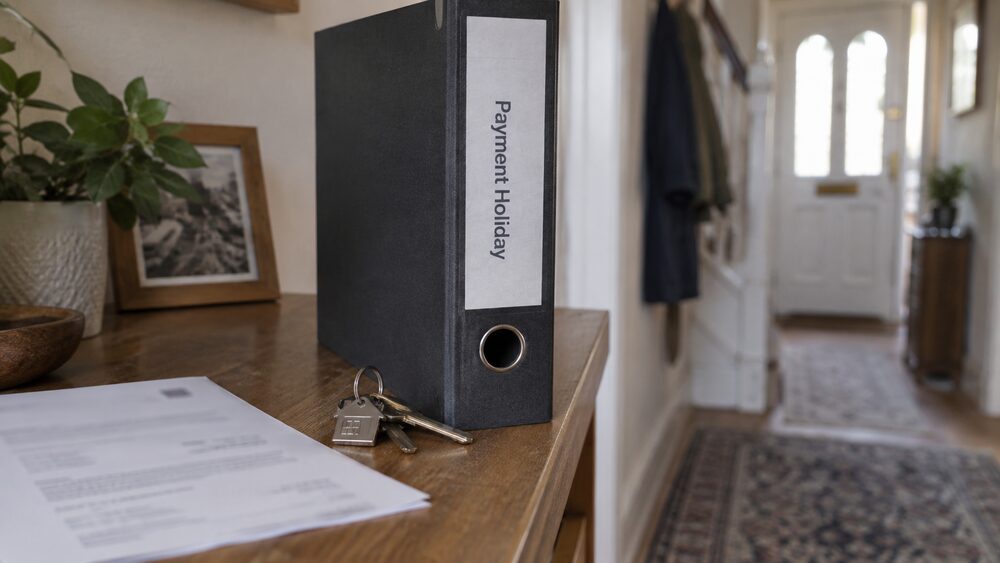
A payment holiday is a short-term pause from your monthly payments, agreed with the lender you owe1. It is not a gift and it is not a write-off: you still owe everything you did not pay, and interest and charges may keep being added while the break runs2. On a loan, your monthly payment rises afterwards to cover the missed payments and the interest charged during the break; on a credit card, your minimum payments rise because of the interest added during that time1.
The length is set by your lender, not by a single national rule. Guidance for creditors describes a payment holiday as usually one to six months4, and one lender's own guidance describes loan payment holidays of up to three months5. Some lenders set conditions: one insurer's terms allow up to six months but only two holidays, at least 12 months apart6.
The most important thing to understand before you ask is that a payment holiday is not free. Interest continues to be charged during a payment holiday7, and taking one will also increase the outstanding balance on which future interest is calculated7. If you are already struggling, free and impartial help is available from debt charities and the Money Advice Service, and asking your lender what it can offer is the first step, not the last.
What a payment holiday is
A payment holiday is a short-term pause from your monthly payments1. It is a temporary arrangement where your creditors may stop interest and charges for a short time, though they are not obliged to4. It is not the same as having a debt written off, and it is not the same as Breathing Space, which is a separate scheme and does not write off debt8.
You can apply for a payment holiday on a mortgage, a credit card, a loan or a hire purchase agreement3. The emergency payment freeze used during the coronavirus pandemic was wider still, covering mortgages, loans, credit and store cards, plus catalogue credit, and covering a payment holiday as well as reduced payments or increased credit limits9. That scheme has closed, but it shows the range of products where a pause has been offered.
A payment holiday is different from simply missing a payment. If you stop paying without an agreement, you fall into arrears and your lender can take action. With a holiday, the pause is agreed in advance, which is why the first step is always to talk to your lender rather than to stop paying.
Payment holidays on personal loans
On a personal loan, a payment holiday pauses your monthly instalments for an agreed period. One lender's guidance describes loan payment holidays of up to three months5, while general guidance for creditors puts payment holidays at usually one to six months4. The lender decides, and it may set conditions.
Those conditions vary. One lender required borrowers to have made at least one loan repayment, have a direct debit in place, be up to date with repayments and have at least 30 days remaining on the loan term, with repayment holidays standard on personal loans subject to approval9. Another lender states that loan payment holidays cannot be taken on consecutive months and are subject to approval10.
When the holiday ends, your monthly payment to the loan rises to cover the missed payments and the interest charged during the payment break1. If you can afford to make any payment during the holiday, it helps: one lender says that, as long as you are not in arrears, any payments made during a repayment holiday are treated as additional payments and can reduce the overall interest and term of your loan11. Additional payments you make will not replace your regular monthly repayments once the holiday ends11.
Credit card payment holidays: a temporary pause
A credit card payment holiday is when your provider lets you stop payments for a while2. It is temporary, and you may be able to get one if you are behind on payments or going through financial difficulties and have spoken to your provider2. As with loans, the creditor does not have to agree1.
The cost works differently from a loan. Card providers will allow interest to build up while the holiday is in place, and your minimum payments will rise afterwards because of the interest added during that time2. You still have to pay the full amount and any interest added during the break2. One lender's guidance warns that a payment holiday does not stop interest being charged each month, so you pay more overall10.
There is one protection worth knowing. A payment holiday is not marked as a missed payment on your credit file2. That does not mean there is no record at all: the gap in payments may be marked on your credit file and can make it harder to get credit in future1. Whether you lose a promotional 0% deal if you take a payment holiday depends on the lender, so it is worth asking before you agree8.
Interest and cost: why a payment holiday is not free
The central point about payment holidays is that they defer cost rather than remove it. Interest and charges may still be added during the holiday1, and interest and charges may continue to be added to your debt3. Taking a payment holiday will also increase the outstanding balance upon which future loan interest charges are calculated7.
What that means in practice depends on the product:
- Loans: your monthly payment rises to cover the missed payments and the interest charged during the break1.
- Credit cards: your minimum payments rise to cover the extra interest that was not paid1.
- Mortgages: your monthly payment rises to include the missed payments and extra interest, and the new amount depends on how long is left of your mortgage term1. In most cases, the longer left in the term, the lower the rise in payments1.
You do have to make up the payments missed during a payment holiday, and these get treated as arrears3. On a mortgage, payments must be caught up before the term ends and interest may be charged12. Lenders have several ways of handling the catch-up: adding the holiday period onto the end of the existing mortgage term, recalculating the monthly repayment amount, or payment of a lump sum after the holiday13.
How to ask your lender for a payment holiday
The process starts with a conversation, not an application form. You need to ask for a payment holiday, but the people you owe do not have to agree to it1. You may be able to request a credit card payment holiday if you are going through financial difficulties and have spoken to your provider2. The provider then makes a decision based on your situation, and it may ask you to provide evidence of your financial difficulty and complete an affordability test2.
A few practical points make the process smoother:
- Contact each lender separately. If you have more than one account with a lender, for example a credit card, loan or mortgage, you will need to arrange a payment holiday for each account, and if you have accounts with different lenders you will also need to speak to each one8.
- Be ready to explain your situation. Lenders ask for information about your circumstances, and for a loan application this typically includes your address, contact details, date of birth, employment details, monthly income and expenses14.
- Ask how it will be recorded. Ask your lender whether the holiday will appear on your credit file and whether you will lose any promotional rate8.
- Confirm the terms in writing. Agree the length of the holiday, what happens to interest, and how the missed payments will be collected afterwards.
If you are behind on payments, that is not necessarily a barrier. You may still be able to get a payment break if you are already behind on payments6, and you may be able to get a credit card payment holiday if you are behind on payments2.
Where a payment holiday may not be offered
Not every debt comes with a payment holiday option, and not every lender offers one. Creditors may agree to a short-term payment holiday, but they do not have to agree15. What is available varies by product, by lender and by your circumstances.
Some products are a poor fit for a pause. Payday loans are not suitable for large expenses like a holiday, home improvements or Christmas, or for paying off existing debts16, and they charge higher interest than other types of borrowing17. If you are considering high-cost credit to bridge a gap, it is worth knowing that credit-builder credit cards can be cheaper than high cost credit like payday loans18, and that free debt advice is available before you borrow.
Some arrangements that sound like payment holidays are not. Breathing Space is not a payment holiday and does not write off debt19. A mortgage repayment holiday is generally only available if you have previously overpaid on your monthly mortgage repayments for a certain period, and must be agreed in advance with your lender20. On a Debt Arrangement Scheme in Scotland, you can have up to a six month break from making DPP payments, and a six month break adds a further six months to the DPP end date21. If you have a sudden and short-term drop in your income of 50% or more, you may be able to arrange a payment holiday of up to six months under that scheme22.
If you are struggling to repay: other options and free help
A payment holiday is one option among several, and it is worth knowing what else lenders can offer before you commit. Help that creditors may be able to offer includes flexibility with repayment dates, a payment break or payment holiday, an affordable repayment plan based on your budget sheet, or a cheaper alternative if you are struggling to meet the ongoing costs of an essential service23.
For mortgage borrowers, lenders may allow a temporary mortgage payment holiday, a temporary switch to interest-only payments, or extending the term of the mortgage to reduce your monthly payments25. After redundancy, a lender may allow you to take a payment holiday, consolidate arrears, extend the term, or switch to an interest-only mortgage27. Some lenders will offer payment holidays to give you time to get back on track if you are in mortgage arrears6.
If you cannot afford anything at all, you can ask for a payment holiday; if money is tight but not impossible, you might be able to make lower payments for a short period, or ask to pay less for a while longer based on what you can afford19. For credit card debt, alternatives include a debt consolidation loan, which may be cheaper than relying on your credit card, or finding a credit card with a better deal such as a lower interest rate to transfer your balance to2. Other routes for persistent debt include increasing your monthly repayments, repaying the balance using credit with a lower interest rate, cancelling the card and moving the balance to a different one with lower interest, getting a loan you can afford to repay, or shopping around using a price comparison site5.
Free and impartial help is available. Debt charities such as StepChange and National Debtline offer free advice, and you can ask for credit card payment holidays and breaks in making mortgage payments17. If you are dealing with a priority debt, such as your mortgage, rent, council tax or energy, it is worth working out which debts to tackle first19. If you are on benefits, payments due on a bank holiday are usually paid on the last working day before the holiday, which can affect your budgeting28.
Sources29 cited
- Payment holiday for debt repayments StepChange, 2026-09-25
- Credit card payment holidays StepChange, 2026-09-25
- Emergency funding StepChange, 2026-09-25
- Debt moratorium and forbearance StepChange, 2026-09-25
- Credit card debt StepChange, 2026-09-25
- Mortgage payment holidays StepChange, 2026-09-25
- Payment holidays Experian, 2026
- Payment holidays Experian, 2026
- Bad credit mortgages Which?, 2025-10-08
- What to do if you can't pay your mortgage Which?, 2025-12-10
- Top tips for borrowing Citizens Advice, 2026-09-25
- Get advice about managing credit Welsh Government, 2022-11-18
- Mortgage arrears StepChange, 2026-09-25
- Mortgage jargon buster Virgin Money, 2026
- Debt Arrangement Scheme StepChange, 2026-09-25
- Debt Arrangement Scheme (Scotland) National Debtline, 2026-09-25
- Redundancy and what to do StepChange, 2026-09-25
- Cost of living if you can't afford essential costs (Scotland) National Debtline, 2026-09-25
- Work out your priority debts StepChange, 2026-09-25
- Government debt consolidation StepChange, 2026-09-25
- Payday loan calculator StepChange, 2026-09-25
- Considering a payday loan StepChange, 2026-09-25
- Buy now pay later StepChange, 2026-09-25
- Store finance debt StepChange, 2026-09-25
- Different types of debt Independent Age, 2026-09-26
- Dealing with debt problems StepChange, 2026-09-25
- Credit cards and bad credit score StepChange, 2026-09-25
- How benefits and pensions are paid nidirect, 2026-07-15
- Support with living costs Carers UK, 2026-09-26



 MoneyHelperFree, impartial money and pensions guidance, set up by government
 StepChangeFree debt advice and solutions from a charity
 National DebtlineFree debt advice by phone, webchat and online
 Financial Ombudsman ServiceFree, independent help when a complaint about a firm is not put right
 Citizens AdviceFree advice on money, consumer and legal problems in England and Wales