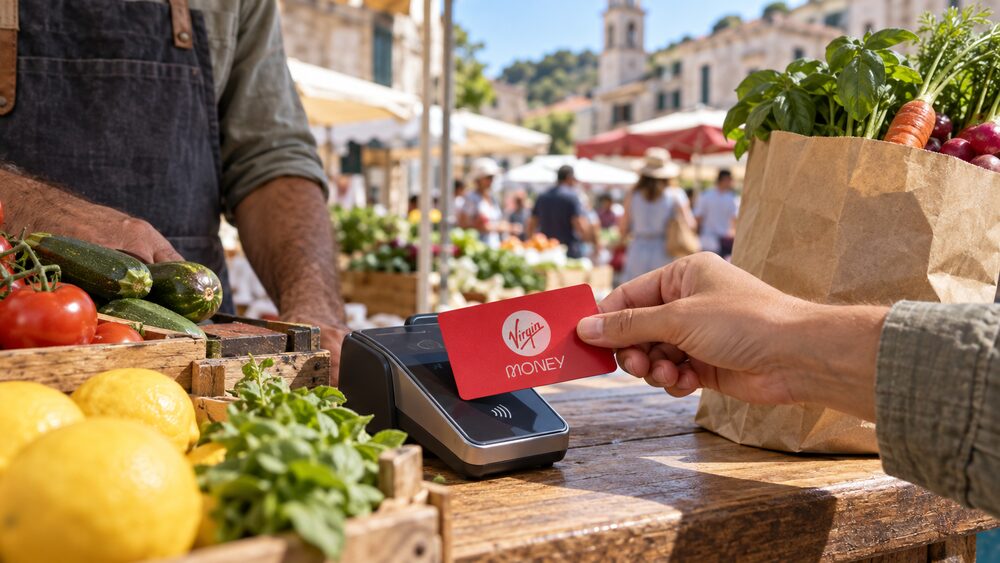
The Virgin Money M Plus Account is a current account with a free linked savings account attached to it. It is open to anyone from the age of 16, subject to status, and it comes with no charge for using your debit card or withdrawing cash abroad. The account pays interest monthly, and you can apply online, in a branch or by phone1.
The account is one of a small family of Virgin Money current accounts. It sits above the basic Essential Current Account and alongside the packaged Club M Account, which adds insurance and other extras for a monthly fee. The M Plus Account is the one to look at if you want a straightforward account with a linked saver and no travel charges, rather than a bundle of insurance1.
Virgin Money's business transferred to Nationwide on 2 April 2026, and Nationwide now manages Virgin Money current accounts, savings accounts, credit cards, loans, mortgages and business accounts. Your account stays branded Virgin Money, and contact details and web addresses stay the same4.
What the M Plus Account includes
The M Plus Account is a standard sterling current account. You get a debit card, the ability to set up Direct Debits and standing orders, Faster Payments in and out, and access through the app, online banking, phone and branches. Virgin Money says you can open a bank account online or by downloading the app9.
The debit card is a Mastercard, which Virgin Money says can be used to withdraw cash and pay for goods and services at millions of locations worldwide, wherever you see the Mastercard acceptance mark10. You do not need to tell Virgin Money when you are travelling abroad; the bank says it monitors your account in the same way as if you were using it at home11.
The account also plugs into Virgin Money's cashback scheme. If you hold an M Plus Account, along with certain other Virgin Money accounts and credit cards, you can register for cashback. Cashback can be transferred to a UK bank account, sent to a Virgin Money credit card, or traded for an e-Gift voucher at participating merchants12.
Interest is worked out daily and added to the account on the last working day of the month, according to the account's rates and charges page2. One Virgin Money terms document says interest is paid monthly and added on the 27th of each month, while the M Plus terms say the last working day of the month. The two documents disagree on the exact day, so confirm it with the bank if the timing matters to you8.
The linked M Plus Saver and Savings Pots
The M Plus Account comes with a free linked savings account, the M Plus Saver14. It is an instant access account, so you can pay money in and take it out whenever you want, with no fees or charges and no minimum pay-in amount7.
The saver is not standalone. Virgin Money states that you may only open an M Plus Saver if you have an M Plus Account with the bank in the same name or names7. If you close the current account, the linked saver goes with it.
The M Plus Saver includes Savings Pots, which are separate pots you set up inside the account for individual savings goals15. Virgin Money's other saver, the M Saver, works the same way, letting you set up Savings Pots for your goals16. Savings pots are extra savings accounts linked to your main account, so you can keep money for a holiday, a car or a deposit separate from your everyday savings17.
Interest on the linked saver is paid quarterly, not monthly like the current account18. Virgin Money's own savings calculator can show what a balance would grow to over time, but the figures it produces depend on the rate at the time you use it19.
Fees and charges: what is free and what costs extra
Most everyday banking on the M Plus Account is free. Virgin Money's rates and charges page lists no fee for cash withdrawals in pounds in the UK, no fee for cash withdrawals in pounds outside the UK, no fee for cash withdrawals in a foreign currency outside the UK, no fee for debit card payments in pounds, no fee for debit card payments to a company based outside the UK, and no fee for Faster Payments, subject to limits2.
There are charges for less common services. Cancelling a cheque is free, and refusing a payment due to lack of funds is free2.
Incoming international payments are free in some cases and charged in others. SWIFT payments within the EEA are free for all currencies including sterling up to £100 or equivalent, and free for euro, Swedish krona or Romanian leu over £100.
Virgin Money says it will always give you at least 14 days' notice before it takes interest and fees from your account2. When it changes rates, it usually publishes the change in The Daily Mail, The Daily Record and The Yorkshire Post2.
Using your card and sending money abroad
The M Plus Account's selling point for travellers is that Virgin Money charges nothing for using the card or withdrawing cash abroad1. The rates and charges page confirms no fee for foreign currency cash withdrawals outside the UK, no fee for pound withdrawals outside the UK, and no fee for debit card payments to a company based outside the UK2.
That does not mean the transaction costs nothing. If a payment is made in a foreign currency, the exchange rate applied is the one used on the day, and any fee charged by the ATM operator is separate. Virgin Money's credit card pages note that ATM providers may charge an additional fee for withdrawing cash, so it is something to look out for20. The same caution applies to a debit card used at a foreign cash machine.
For sending money abroad, Virgin Money requires a current account with a sort code starting 82 or 05, or a linked foreign currency account, to make a SWIFT payment21. The charges for those payments are set out in the fees section above.
Virgin Money also offers separate travel and money transfer cards. Its Travel Credit Card is described as letting you spend fee-free worldwide with no foreign exchange fees, and its credit cards use Mastercard's daily exchange rate to convert foreign currency payments into pounds22. Those are different products from the M Plus Account, with their own terms.
Overdrafts: arranged and unarranged borrowing
An arranged overdraft is not automatic on the M Plus Account. Virgin Money says it only offers arranged overdrafts on the M Plus Account, Club M Account, Private Current Account and Current Account Tracker23. The M Plus Account's arranged overdraft terms are described as "as personally advised", meaning the limit and terms are set for you individually rather than published as a standard figure24.
To apply for an arranged overdraft on an M Plus Account, you need to have held the account for more than six months, and you apply using an online form. Virgin Money may ask for proof of your income to support the request23. You can check whether you are eligible on the website before applying, and Virgin Money says this will not leave a mark on your credit file2.
An unarranged overdraft is different. MoneyHelper explains that these are also known as unplanned or unarranged overdrafts and happen when you spend more than you have in your bank account without agreeing it in advance, including going over the limit of an authorised overdraft26. StepChange notes that an overdraft carries high interest and charges, and that the bank charges interest for using the overdraft27.
Virgin Money lists the warning signs it watches for: using an unarranged overdraft, going past an arranged overdraft limit, not keeping to account terms, having payments refused for lack of funds, and a reduced regular income29. If you are struggling, the bank has a financial difficulty page, and free help is available from MoneyHelper and debt advice charities such as StepChange29.
Who can open an M Plus Account
The M Plus Account is available to anyone from the age of 16, subject to status1. That is younger than many current accounts, which typically require you to be 18. Virgin Money's Essential Current Account, by contrast, requires you to be at least 1827.
The M Plus Saver has its own age rule. Virgin Money says you need to be 18 or over and live in the UK to open it, though over 16s can open an account in a store7.
You will need to pass identity checks. Virgin Money asks for standard information and ID verification when you apply, and sets out the minimum documents and information it requires25. Applications are subject to status, which means the bank assesses your circumstances before accepting you2.
If you want a joint account, Virgin Money offers joint bank accounts, and the M Plus Account can be held jointly. A joint account means both holders can use the account and are jointly responsible for it14.
Opening or switching to an M Plus Account
You can open an M Plus Account online, in a branch, or by calling 0800 121 73652. Virgin Money also lets you open a bank account by downloading its app9. You will be asked to fill out a simple form and agree a switch date if you are moving an existing account across, in addition to ID verification and standard information25.
Switching is done through the Current Account Switch Guarantee. Virgin Money says you can move your account to it in less than seven days with the guarantee18. In the mobile app, you open the new account, tap on the three dots and select "Switch to Virgin Money", then choose either a full switch or a payment transfer30. A full switch moves your balance, Direct Debits and incoming payments and closes your old account; a payment transfer moves only your payments and leaves the old account open.
If you hold accounts with both Nationwide and Virgin Money, note that you need to contact both separately to make changes to your accounts31. That matters after the transfer of Virgin Money's business to Nationwide, because the two brands still run separate service operations for many purposes.
Complaints, scam refunds and protection for your money
If something goes wrong, Virgin Money asks you to contact it directly and free of charge first. If you are not satisfied with the outcome, you can refer the complaint to the Financial Ombudsman Service, and you need to do this before six months from the date of the bank's complaint decision or resolution letter13. Complaints can be made through Virgin Money's complaints process, an online complaint form, in a branch, or by writing to the team at Virgin Money, Sunderland, SR43 4JB4.
On fraud, Virgin Money says it has eight key ways of protecting customers' money, including checking application information, monitoring accounts, checking payment details, sending one-time passcodes, getting money back, blocking accounts and securing connections32. If you think your money is at risk, the bank's guidance is to contact it straight away and freeze your card in the app33. Virgin Money says it will help you secure your account and investigate33.
For authorised push payment scams, Virgin Money's savings and current account terms state that you are protected for up to £85,000 if you contact the bank within 13 months of the last payment8. That is a reimbursement commitment that goes beyond the minimum required, and it applies to scam claims where you report within that window. The current FSCS deposit protection limit is £120,000 per eligible person, per bank, building society or credit union35.
Your money in the account is protected by the Financial Services Compensation Scheme, which covers eligible deposits up to £120,000 per person, per bank35. Because Virgin Money's business transferred to Nationwide on 2 April 2026, it is worth checking how balances across the two brands count towards that limit, since protection applies per banking licence rather than per brand name4.
Sources35 cited
- M Plus Account Virgin Money, 2026
- Rates, fees and charges Virgin Money, 2026
- Club M Account Virgin Money, 2026-09-25
- Nationwide transfer questions Virgin Money, 2026-04-02
- Nationwide and Virgin Money transfer Nationwide, 2026
- Deceased current accounts and savings Virgin Money, 2026
- M Plus Saver Virgin Money, 2026-09-25
- Current account terms and conditions Virgin Money, 2026
- Virgin Money Current Account Tariff Virgin Money, 2026
- Debit cards Virgin Money, 2026
- M Power current account and Nationwide Virgin Money, 2026
- Virgin Money cashback Virgin Money, 2026
- Financial difficulty Virgin Money, 2026
- Joint bank account Virgin Money, 2026
- Set up your M Plus Saver account Virgin Money, 2026
- Set up your M Saver account Virgin Money, 2026
- Private debit cards Virgin Money, 2026
- Switching Virgin Money, 2026-09-25
- Savings calculator Virgin Money, 2026
- Using your credit card abroad Virgin Money, 2026
- Current accounts Virgin Money, 2026
- Travel cards Virgin Money, 2026-09-25
- Overdraft request Virgin Money, 2026
- Virgin Money Current Account Fee Information Virgin Money, 2025-02-01
- Minimum documents and information required Virgin Money, 2026
- Overdrafts explained MoneyHelper, 2026-09-25
- How can I stop living in my overdraft? StepChange, 2026-09-25
- Overdraft debt StepChange, 2026-09-25
- How we're protecting you Virgin Money, 2026
- Making payments Virgin Money, 2026
- Supporting someone with their finances Nationwide, 2026
- Fraud vs disputes Virgin Money, 2026
- Fraud Virgin Money, 2026-09-25
- Money transfer cards Virgin Money, 2026-09-25
- Banks, building societies and credit unions Financial Services Compensation Scheme, 2026-09-25











 MoneyHelperFree, impartial money and pensions guidance, set up by government
 FSCSProtects your money if a bank, insurer or investment firm fails
 Financial Ombudsman ServiceFree, independent help when a complaint about a firm is not put right
 Citizens AdviceFree advice on money, consumer and legal problems in England and Wales