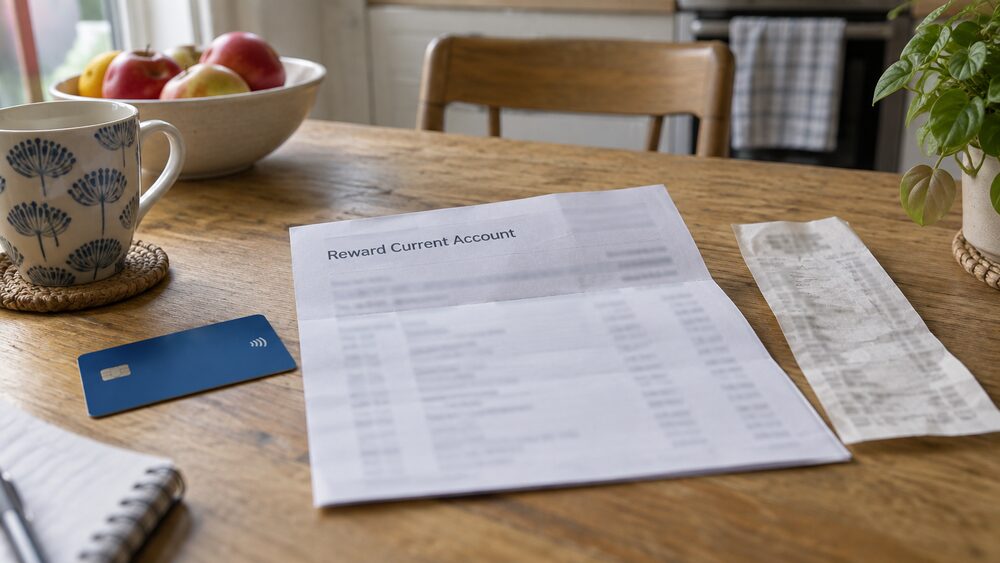
Reward and cashback current accounts pay you something back for banking with them, but the two main types work in completely different ways. One pays a fixed amount each month if you meet conditions: the NatWest Reward account pays £4 a month in cashback when you have at least two Direct Debits of £2 or more, plus an extra £1 a month for logging into the mobile app1. The other pays a percentage of what you spend: Chase pays 2% cashback on eligible everyday spending, capped at £20 a month2. A third type, retailer cashback through schemes such as Barclays Cashback Rewards and Halifax Cashback Extras, pays a percentage back at selected shops.
None of this is free money in every case. Halifax's Reward current account charges a £3 monthly fee3, and NatWest's Reward account charges £21. The reward only makes you better off if what you earn exceeds what you pay and what you would otherwise have spent anyway. This page explains the fees, the monthly conditions, what happens when you miss one, and the situations in which cashback you have already earned can be lost, including when an account is closed or the holder dies.
Two kinds of reward: a fixed monthly payment or cashback on spending
A fixed monthly reward is a payment the bank makes to you each month, usually in cash or "Rewards", as long as you meet its conditions in that month. NatWest's Reward account is the clearest example: £4 a month for running at least two Direct Debits of £2 or more, and £1 more for logging into the app1. The conditions are the whole deal: the bank is paying you to route your regular banking through the account, because a customer who pays in their salary and keeps their bills there is far less likely to leave.
Cashback on spending is different. Here the reward is a percentage of what you spend on a card, sometimes everywhere and sometimes only in set categories or shops. Chase pays 2% on eligible debit and credit card spending in categories such as groceries, transport and restaurants, up to £20 a month2. Retailer schemes such as Barclays Cashback Rewards and Halifax Cashback Extras pay a percentage back at participating retailers when you activate an offer and pay with a registered card3. With these, the more you spend at the right places, the more you earn, which is a reason to be careful: cashback is only a benefit on spending you were going to do anyway.
The two types can sit on the same account. Halifax's Reward account charges its £3 fee and pays retailer cashback through Cashback Extras3, while Barclays' Blue Rewards pays a fixed monthly cashback and gives access to the separate Barclays Cashback Rewards retailer scheme7.
Monthly fees and what they pay for
Many reward accounts charge a monthly fee, and the fee is often the first thing to check, because it is charged whether or not you earn the reward that month.
| Account | Monthly fee | What the fee buys |
|---|---|---|
| Halifax Reward | £33 | Retailer cashback through Cashback Extras, up to 15% at selected retailers |
| NatWest Reward | £21 | £4 a month cashback for two Direct Debits, plus £1 for an app login |
| Barclays Bank Account with Blue Rewards | £37 | £7 monthly cashback, requiring two active Direct Debits and £800 paid in each month |
The Barclays example shows how the arithmetic works. The fee is £3 and the reward is £7, so the net gain is £4 a month, but only if both Direct Debits are active and at least £800 is paid in every month7. Miss the pay-in in one month and the £3 fee is still taken, which turns a gain into a loss for that month.
Fees on reward accounts are not new, and they have not always been small. A University of Bristol study of prepaid accounts found that account holders who used the reward scheme paid on average £8.95 a month for the use of their account8. The same principle applies today: a fee-paying account only pays for itself if the rewards are genuinely used and genuinely exceed the fee. A fee-free account with a cashback offer, such as Chase's, avoids this risk altogether, though Chase attaches its own conditions instead9.
Packaged reward accounts, which bundle insurance and other benefits into a higher fee, are covered separately in packaged bank accounts, including when buying the insurance separately works out cheaper.
NatWest and RBS Reward accounts change on 1 October 2026: higher fees, new benefits, no app login bonus
NatWest and Royal Bank of Scotland, which share the same group, are making significant changes to their paid Reward accounts from 1 October 2026. The most visible change across the range is the end of the £1 monthly reward for logging into the mobile banking app: Reward and Premier Reward account holders will no longer receive it from that date6.
At the same time, the monthly fees on the tiered accounts are rising and the benefit packages are being refreshed:
| Account | New monthly fee from 1 October 2026 | What changes |
|---|---|---|
| Reward Silver | £1210 | New benefits including a travel eSIM, DragonPass Premier+ airport benefits, 24/7 Virtual GP and mental health support; the £1 app login reward ends |
| Reward Platinum | £2311 | DragonPass Premier+ travel perks, health benefits and family mobile phone insurance; the £1 app login reward ends |
| Premier Reward Black | £3912 | Expanded travel, lifestyle and wellbeing benefits; Home Emergency, Cinema and Ticket Booking benefits and the £1 app login reward are withdrawn |
For someone on the standard Reward account, the position after 1 October is £4 a month cashback for the Direct Debit condition, with the £2 fee unchanged and the app login pound gone1. For someone on the tiered accounts, the question becomes whether the new benefits are worth the higher fee, which depends entirely on whether they would otherwise buy things like airport lounge access or a virtual GP service. The notice of changes page explains the notice banks must give before changing an account's terms.
Separately from the ongoing rewards, NatWest has used switching offers to attract new customers: £175 for switching a main current account in 202213, and a £200 offer reported in 20261. NatWest and RBS also ran a £1,000 prize draw for customers holding both a current account and a savings account who turned on the "round ups" feature13. These are one-off incentives rather than ongoing rewards, and the rules matter: you will not be eligible if you previously received a switching incentive from the NatWest group, including NatWest, RBS or Ulster Bank, and you cannot switch from another bank in the group1. The bank switching offers page covers how these work.
Retailer cashback schemes: Barclays, Halifax and Virgin Money
Retailer cashback schemes pay a percentage of what you spend at participating retailers, usually after you activate an offer in an app. Halifax's Reward account offers up to 15% cashback with selected retailers when you pay with a Reward debit card, with the offers and cashback amounts varying by retailer3. Lloyds and Bank of Scotland have offered eligible switchers 15% cashback at selected retailers alongside a switching incentive14. Virgin Money Cashback is registered in the credit card app, and the available offers change regularly15.
Barclays Cashback Rewards is free to join4, but it has eligibility rules and a timeline that matter. To take part you must be over 18, a UK resident, and have a personal Visa card that is eligible to be registered to a UK billing address, with registration completed through the Barclays app4. Business and corporate Visa cards, Visa prepaid cards and the Amazon Barclaycard are excluded4. Cards held in Apple Pay, Google Pay or Samsung Pay can be registered; other third-party wallets may not be reliably tracked, and redemption may be rejected4.
The timeline from purchase to money in your account runs like this:
Two details in that timeline are worth fixing in mind. First, the product page says cashback stays pending for 35 days, while the scheme terms say at least 35 working days, which may be longer depending on the purchase: the documents describe the same period in different units, so the terms are the safer guide5. Second, earned cashback is rounded down to the nearest penny, and available cashback has no monetary value until it has been redeemed through the options the scheme provides4. There is no minimum redemption amount: you can redeem any cashback you have earned, though retailers set their own minimums if you exchange cashback for an e-gift card5.
Chase cashback: 15 payments a month and £1,000 in savers
Chase runs the most heavily conditioned cashback offer among the app-based banks. The headline is 2% cashback on eligible everyday spending, capped at £20 a month, which works out as cashback on up to £1,000 of spending2. The eligible categories are groceries, everyday transport, fuel and electric charging, restaurants and cafes, and takeaways; taxis are excluded from everyday transport2. Payments of 50p and over qualify2.
The conditions are assessed month by month, and the cashback is paid the following month:
To earn cashback in a given month, you must have made at least 15 payments in the previous calendar month using your Chase debit card, Chase credit card or Direct Debit, and kept a combined balance of £1,000 or more across your Chase saver accounts every day for that entire month, excluding round-up accounts2. Standing orders, refunds and bank transfers do not count towards the 15 payments2. Both a Chase current account and a Chase saver account are required9. The 2% applies to GBP sterling debit and credit card payments made in the UK and the Channel Islands2, and the Chase credit card also advertises 2% cashback on everyday spending, up to £20 a month17.
New customers get a grace period: for the rest of the first calendar month and the following calendar month, Chase pays 2% cashback on eligible transactions even if the conditions are not met2. Before the current offer, Chase paid 1% cashback on spending for the first year, reported in 202418, so the structure of the offer has changed before and may change again. Chase states it may stop running the offer at any time for any reason, giving 30 days' notice before it ends2.
What happens when a condition is missed
Missing a monthly condition does not usually incur a penalty charge; it simply means the reward is not paid for that month. The conditions vary by account, and they are the fine print that decides whether a reward account pays you or costs you:
- NatWest Reward: at least two Direct Debits of £2 or more, and a monthly app login for the extra £11
- Barclays Blue Rewards: two active Direct Debits and at least £800 paid in each month for the £7 cashback7
- Chase: 15 qualifying payments and £1,000 held in Chase savers every day of the previous month2
The fee, where there is one, is charged regardless. That is the practical risk: a £3 fee with no reward that month is a £3 loss. With Chase, which does not charge a monthly fee on its current account9, the cost of missing the conditions is simply the cashback forgone.
Providers can also change or end schemes, and this is where the terms matter. Chase may stop its offer at any time with 30 days' notice2. Visa may terminate Barclays Cashback Rewards as a whole or in part at any time, providing 30 days' notice, and may amend the terms with 14 days' notice4. Barclays states that if the scheme closes it will give 30 days' notice before the service ends so customers can redeem their balances5. The general rule is that reward and cashback offers are not guaranteed for the life of the account, and the NatWest and RBS changes on 1 October 2026 are a live example of rewards being withdrawn while fees rise11.
Joint accounts, additional cardholders and who earns the cashback
On a joint account, the reward usually belongs to the account, not to each person separately. Barclays' rules for Blue Rewards joint accounts state that only one account holder can join Blue Rewards and use it to earn cashback; on Premier Banking joint accounts, all account holders can register, with rewards going into their individual cashback accounts5. A joint account normally allows two or more people to receive payments, pay by debit card, transfer money and manage the account, depending on the bank19.
The same one-per-account principle applies to switching incentives: cash incentives are usually limited to one payment per account, so a couple switching a joint account does not receive double the bonus20. The joint bank accounts page covers how joint accounts work and the risks each holder takes on for the other's debts.
Joint accounts also have consequences in insolvency. If one holder is made bankrupt, any money left in the account is given to the official receiver, and half of any credit balance is paid to the official receiver21. Reward money sitting in a joint account is treated like any other balance at that point. The bank accounts and bankruptcy page covers this in more detail.
Where unredeemed cashback is lost: closing, leaving or death
Unredeemed cashback is not the same as money in your account. Barclays' terms state that available cashback has no monetary value until it has been redeemed4, which means it can expire unused in several situations.
Leaving a scheme. If you unsubscribe from Barclays Cashback Rewards, you can redeem your available cashback for 40 days, after which any remaining available and pending cashback expires4. If you leave Blue Rewards or Premier Banking without a linked Barclaycard, you get 40 days to redeem the balance, after which the remaining cashback is lost; with a linked Barclaycard, cashback can still be earned on that card but not on debit cards5. Closing the Cashback Rewards account itself takes 40 days5.
Closing the account. The general lesson from other savings products is that closing an account early can forfeit a bonus outright. Under the Help-to-Save regulations, the amount of a bonus is nil if the account is closed or otherwise ceases to be a Help-to-Save account before the end of the period the bonus would be payable for22. Reward account terms should be checked for the same kind of clause before closing. The closing a bank account page covers the mechanics of closure.
Death. Barclays states plainly that cashback in a Barclays Cashback Rewards account cannot be transferred or redeemed by anyone else, so it is lost if the holder dies5. The bank account behind it is treated separately: banks will usually freeze the account once notified of the death23, and money can normally only be taken out if the executor transfers it24, though the bank may still release money for funeral costs25. Other accrued rewards are handled differently by other providers: under the Help-to-Save rules, the provider must pay any bonus accrued to the date of death to the account holder's personal representatives, within 21 days of the end of the month in which HMRC receives evidence of the death and of the status of the personal representatives26. NS&I's Direct Saver balance becomes part of the estate and continues to earn interest27, and NS&I index-linked certificates become part of the estate, continue to accrue interest and can be cashed in by personal representatives or transferred to beneficiaries28. Childcare account rules similarly pay the relevant percentage to the account holder's personal representatives29. The what happens to a bank account when someone dies page covers the process for the account itself.
Missing cashback and how to complain
Cashback that fails to track or never appears is one of the most common problems with these schemes. Barclays provides a route inside its app: log in to the Barclays app or Barclaycard app, go to the Barclays Cashback Rewards account, and use the options to report missing cashback or report a missing redemption5. If a new eligible card is registered, it should be active within 48 hours4, and after rejoining it can take up to 24 hours for offers to reappear5.
If the provider does not resolve the problem, the Financial Ombudsman Service can consider complaints about banking and payment services, including cases where a cheque bounced after being paid in, a banker's draft turned out to be fake or went missing and the bank would not refund, or similar service failures30. Complaints about reward schemes are treated as complaints about the provider running them.
Two related cautions come from consumer research. Pay by Bank transactions lack Section 75 and chargeback protections, so purchases made that way, including any made in pursuit of cashback, have weaker refund rights if something goes wrong31. And scammers have used fake bank refund offers as bait: one scam circulating in 2022 targeted Barclays customers with claims of "refunds on debit card purchases for last 18 months" of between £500 and £20,000 per customer, a figure designed to lure people into handing over details32. A genuine cashback scheme never asks you to move money or share codes to release a payment.
Who offers reward and cashback accounts in the UK
Reward and cashback features are spread across most of the UK banking market, from high street banks to app-only providers. The main providers of basic bank accounts, which gives a sense of the groups serving the market, are Barclays UK, The Co-operative Bank, HSBC UK, Lloyds Banking Group (including Halifax and Bank of Scotland), Nationwide Building Society, NatWest Group (including RBS and Ulster brands), Santander UK, TSB and Virgin Money33. The Cash Access UK scheme, which keeps cash access available, is owned by Bank of Ireland UK, Barclays, Danske Bank, HSBC UK, Lloyds Banking Group, NatWest Group, Santander, TSB and Virgin Money34.
Within that market, the reward and cashback offers described on this page sit as follows:
- NatWest and RBS: the Reward account with its £2 fee and £4 cashback1, plus the tiered Reward Silver, Reward Platinum and Premier Reward Black accounts whose fees rise on 1 October 202611
- Halifax: the Reward current account with its £3 fee and Cashback Extras retailer offers3
- Barclays: Blue Rewards with its £7 monthly cashback7 and the free Barclays Cashback Rewards retailer scheme5
- Chase: the app-based current account with no monthly fee and the 2% cashback offer9
- Virgin Money: cashback registered through the credit card app, with offers that change regularly15
- Lloyds and Bank of Scotland: 15% cashback at selected retailers offered to eligible switchers14
Credit cards add another layer. The Barclaycard Rewards card offers 0.25% cashback18, and Halifax has offered a cashback credit card paying £20 cashback when £1,000 is spent within the first 90 days of opening the account35.
For most people the choice comes down to whether a fee-paying account's rewards will reliably exceed its fee, or whether a fee-free account with conditions, such as Chase's, fits how they already bank. The types of current account page sets out the full range, and current account fees and charges covers the other costs to check before switching.
Sources35 cited
- How to switch your bank account Which?, 2026-09-07
- Chase cashback terms and conditions Chase, 2026-09-26
- Halifax Reward Current Account Halifax, 2026-09-27
- Barclays Cashback Rewards cardholder terms Barclays, 2025-10
- Barclays Cashback Rewards Barclays, 2026
- NatWest customers set to lose £1 monthly app login reward Mirror, 2026
- Switching a current account without closing your existing account Which?, 2017-11-10
- Personal Finance Research Centre report on prepaid accounts University of Bristol, 2012
- Chase current account Chase, 2026-09-26
- RBS Reward Silver account RBS, 2026
- NatWest Reward Platinum account NatWest, 2026
- RBS Premier Reward Black account RBS, 2026
- NatWest, Lloyds Bank and Nationwide launch switching bonuses Which?, 2022-10-03
- Can you switch your student bank account after the first year? Which?, 2026-08-06
- Virgin Money Cashback Virgin Money, 2026
- Chase 2% cashback offer Chase, 2026-09-26
- Chase credit card Chase, 2026-09-26
- Spending abroad: the 4 dos and 5 don'ts Which?, 2024-07-26
- Joint accounts MoneyHelper, 2026-09-25
- 6 ways couples can cut taxes and maximise their savings Which?, 2025-02-15
- Bank accounts after bankruptcy StepChange, 2026-09-25
- Help-to-Save Regulations 2018 legislation.gov.uk, 2018-01-24
- Funeral costs in Scotland mygov.scot, 2026-09-07
- Bank accounts and finances: planning ahead Marie Curie, 2023-12-20
- Financial help at the end of life Macmillan, 2026
- Help-to-Save Regulations 2018 (as made) legislation.gov.uk, 2018-01-24
- NS&I Direct Saver brochure NS&I, 2024-07-01
- Can I pass on my NS&I bonds when I die? Which?, 2026-09-07
- Childcare Payments Regulations 2015 legislation.gov.uk, 2015-03-04
- Cheques and bankers' drafts: complaints the ombudsman can help with Financial Ombudsman Service, 2026-09-26
- Which? warns shoppers on Pay by Bank protections Which?, 2025-07-11
- 5 big cost of living scams to watch out for Which?, 2022-07-19
- Basic bank accounts: July 2023 to June 2024 HM Treasury and FCA, 2025-11-05
- Cash Access UK: Northern Ireland Assembly research paper Northern Ireland Assembly, 2024-10-04
- 8 things you need to know about balance transfer credit cards Which?, 2023-02-06



 MoneyHelperFree, impartial money and pensions guidance, set up by government
 FSCSProtects your money if a bank, insurer or investment firm fails
 Financial Ombudsman ServiceFree, independent help when a complaint about a firm is not put right
 Citizens AdviceFree advice on money, consumer and legal problems in England and Wales