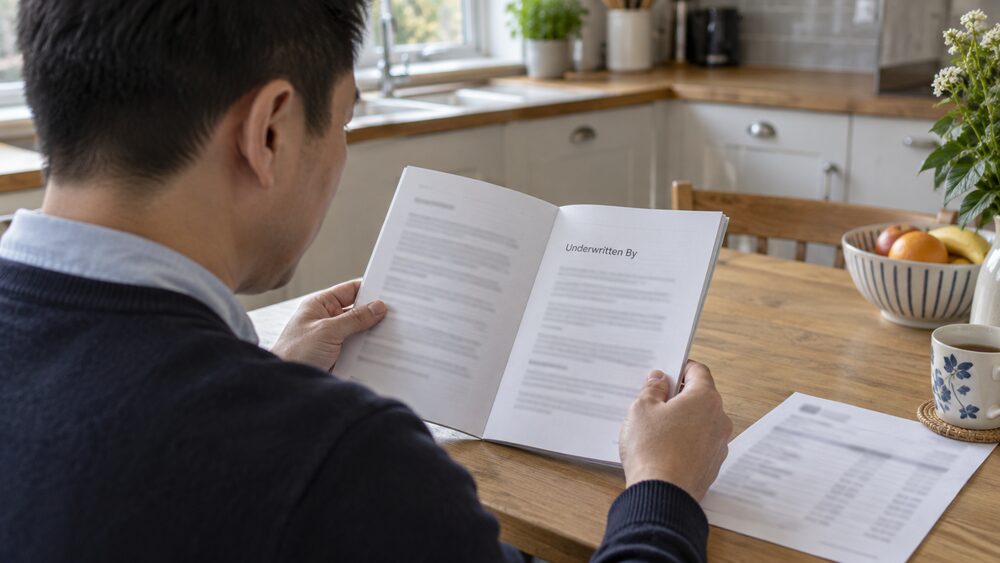
Most high street banks and building societies sell home insurance, but the bank whose name is on the advert is very rarely the company that insures your home. Royal Bank of Scotland Home Insurance, for example, is provided and administered by Uinsure, an insurance intermediary, rather than by the bank itself1. The same pattern runs across the market: the bank or building society sells the policy and puts its brand on the paperwork, while a separate insurer underwrites the risk and pays claims.
That matters to you in three ways. First, the cover you get depends on the insurer behind the brand, not on the bank, so two banks can sell very different policies. Second, when something goes wrong you deal with the insurer and the administrator, not the branch. Third, the protections that apply are the insurance ones, not the ones that guard the money in your current account. The Financial Ombudsman Service describes home insurance, sometimes called household insurance, as usually made up of two main parts: cover for the building itself and cover for the contents within2.
Bank home insurance is usually underwritten by an insurer
When a bank or building society sells home insurance, it is acting as a distributor. The policy is underwritten by an insurer, and the day-to-day administration, sending documents, taking premiums, handling changes, is often carried out by a specialist administrator. Royal Bank of Scotland Home Insurance is a typical example: the bank's own product page states it is "provided by Uinsure Limited" and "provided and administered by Uinsure Ltd"1.
The practical consequence is that the bank branch has no role in your cover once the policy is in force. Your policy schedule, the document that sets out what is covered, the excess and any exclusions, names the insurer and the administrator, and those are the firms you deal with for changes, renewals and claims. The bank's name on the marketing is a brand relationship, not a promise that the bank stands behind a claim.
It also means the same insurer can appear behind several different high street brands, and the bank can change which insurer it works with over time. The firm to check is the one named as the insurer on your schedule, and the guide to claims handlers and policy administrators explains who does what after you buy.
Buildings, contents or combined: what bank policies cover
Bank home insurance follows the same structure as cover bought anywhere else. Buildings insurance covers the structure of your home and permanent fixtures; contents insurance covers the possessions inside your home; and a combined policy, sometimes called buildings and contents, includes both under one policy1. Official flood guidance describes the same split: one policy can cover damage to the structure of your home, like walls, ceilings and floors, and another covers the things you own4.
Most insurers will offer a discount if you insure both buildings and contents with them5, which is why combined policies are often cheaper than buying the two separately. Renters normally need only contents cover, since the landlord is responsible for the building. Homeowners, by contrast, are responsible for any repairs needed and for replacing damaged belongings, as Welsh housing guidance puts it after a flood6.
Bank policies also sell optional extras, and these raise the premium. Citizens Advice lists the common add-ons: flooding or subsidence cover if you live in a high risk area, accidental damage, alternative accommodation, damage to boundary walls, fences, gates, driveways and swimming pools, damage to underground pipes, cables and gas and electricity supplies, glass in windows, doors, conservatories and skylights, liability cover and legal expenses cover7. The guides to buildings insurance, contents insurance and accidental damage cover explain each part in detail.
Which insurers stand behind high street bank brands
The insurer behind a bank brand is named in the policy documents, and it varies by bank. Royal Bank of Scotland's home insurance is provided by Uinsure1. Santander's home insurance is reviewed by Which? as a policy sold under the Santander brand, and in Which?'s analysis of combined policies the average buildings score across the policies examined was 71%8. Tesco sells home insurance directly and via comparison websites9, showing how the same cover can reach you through several routes.
Because the bank is a distributor, the level of cover is set by the insurer and the policy wording, not by the bank's reputation for banking. Two policies sold through banks can differ widely in what they pay out, the excess they charge and what they exclude. Which? has analysed 58 home insurance policies from 29 insurers and found significant differences in what policies cover, including disasters that some policies might not cover at all10.
The check to make before buying is simple: find the insurer named on the quote or policy schedule, and read that firm's policy wording. The brand you know from the high street tells you how you will buy the policy and who takes your payment, but the insurer's name tells you who pays your claim and on what terms.
Home insurance from specialist and mutual providers
Banks are not the only financial firms selling home cover. Building societies are mutual organisations owned by their members rather than shareholders, and the Building Societies Association represents all 42 UK building societies as well as 7 of the largest credit unions11. Over the past three years building societies and mutual-owned banks have provided more than 360,000 mortgages to first-time buyers12, and many of those borrowers will be offered home insurance by the same institution.
Specialist and mutual insurers also sell directly to the public. Church-linked insurers such as Ecclesiastical and Methodist Insurance sell home policies with charitable donation offers attached, and the guide to church and charity-owned insurers covers how they work. Specialist brokers are another route: MoneyHelper describes insurance brokers as experts who help you decide what type of insurance and level of cover you need and recommend a suitable policy at a price you can afford13, and the British Insurance Brokers' Association says brokers can access a wide range of insurance providers14.
A broker may be useful where your home is unusual, a listed building, a thatched property or one with a flood history, because a broker can search insurers that a single bank brand does not use. The comparison page on using a broker or buying direct sets out the trade-offs, including how brokers are paid.
What bank home insurance costs and how premiums are set
The premium for a bank-branded policy is set by the insurer behind it, using the same factors as the wider market. Insurers use postcodes to determine the risk of an area in terms of crime and flooding risk, for example, along with the age of the home, the type of home (timber framed, thatched or flat roof, listed or in a conservation area) and the coverage chosen5. The guide to how insurance premiums are worked out explains the mechanics, including Insurance Premium Tax.
Two rules shape what you pay over time. Since 1 January 2022, when you are sent a renewal quote your home insurance company has to offer you the same deal as a new customer3, which ended the old practice of charging loyal customers more. The pricing rules and renewals guides cover this in full.
Cover levels differ between policies even when the price looks similar. Most home insurance policies offer storm damage cover as standard, but the level of cover may differ between providers15, and an insurer may refuse a claim if your building has suffered from subsidence in the past or you have not undertaken proper maintenance of the property15. Paying monthly usually costs more in total than paying annually, because the instalments are a credit arrangement: see paying monthly for insurance. The excess you agree also moves the price, and underinsurance can cut a payout if the sum insured is too low.
Packaged bank accounts that include home cover
Some current accounts bundle insurance into a monthly fee. These packaged accounts typically include several insurance products alongside the home cover, such as travel or gadget insurance, and the home element is usually a form of home emergency or contents cover rather than a full buildings and contents policy. Home insurance itself is, as the ombudsman describes, usually made up of two main parts, cover for the building and cover for the contents2, and packaged account cover often sits alongside rather than replacing them.
Packaged account benefits change, and a change can remove cover you were relying on. One example: from 1 October 2026 the Premier Reward Black account's fee rises to £39 a month with expanded travel, lifestyle and wellbeing benefits, while its Home Emergency, Cinema and Ticket Booking benefits and the £1 app login Reward are withdrawn. Anyone whose home emergency cover came from that account would need to replace it separately.
The dedicated guide to insurance in packaged bank accounts explains what these accounts include, what the fee works out as, and the checks to make before paying a monthly fee for cover you might already have elsewhere.
Prize draws and new-customer offers: what to check
Bank and insurer brands run time-limited incentives to attract new home insurance customers, and they are worth reading carefully rather than taking at face value. Current examples include a TSB £5,000 prize draw for new customers taking out a home insurance policy between 11 May and 11 October 2026, and a Virgin Money prize draw under which customers buying a new policy by 29 October 2026 can enter a draw to win back the cost of their first year of insurance, with winners notified by email or post using the details on their application by 26 March 2027.
Charity-linked offers work on a similar principle. Ecclesiastical donates £130 to the customer's church or cathedral for new home insurance policies taken out before 31 December 2026, and Methodist Insurance's offer of a donation of 20% of the first year's premium on new home policies also ends on 31 December 2026. Loyalty schemes can affect the price too: Tesco Clubcard members receive a discount on their home insurance, whether buying new cover or renewing9.
None of these offers changes the cover itself. The policy wording, the excess and the exclusions are the same whether or not an offer is running, and an offer with a deadline is a marketing device, not a measure of value. The things to compare remain the sum insured, the excess, what is excluded and whether the insurer covers risks your home actually faces. Since 2022 the renewal quote must match what a new customer would be offered3, so a new-customer incentive does not signal that renewing later will cost more by design.
Buying through your bank or comparing the wider market
Buying home insurance from your bank or building society is convenient, especially if you already bank there, but it is one route among several. Tesco, for instance, sells home insurance both directly and via comparison websites9, and most insurers and intermediaries sell through several channels. The choice is between buying a single branded policy, using a comparison site to see many quotes at once, or using a broker who can recommend a suitable policy at a price you can afford13.
If you have a mortgage, the lender will usually require buildings insurance, but that does not mean buying it from the lender. Home insurance is not a legal requirement, but buildings insurance is required by most mortgage lenders and strongly recommended1, and most mortgage lenders will require you to hold it8. Citizens Advice is clear on the rules: your lender should give you a choice of insurer or allow you to choose one yourself. They can reject your choice of insurer but cannot make you use their own insurance policy unless your mortgage package includes insurance7.
So the practical approach is to treat your bank's quote as one quote among several. Check the insurer behind it, compare the policy wording rather than the price alone, and remember that the lender's approval may be needed for the insurer you choose. The guides to buildings insurance and how much buildings cover you need help with the sum insured, which is the figure most often set wrongly.
How claims and repairs are handled by the insurer
When you claim, you deal with the insurer named in your policy, not the bank that sold it. Official flood guidance is direct: contact your insurance company to tell them your home was flooded and you want to make a claim, and if you rent, ask your landlord to contact the company that insures your home4. The bank branch cannot start a claim, appoint a loss adjuster or approve repairs.
The sequence matters. Speak to your insurer before carrying out significant clean-up or repair work, unless immediate action is needed to protect people or prevent further damage16. Insurers can make emergency payments and can help repair or rebuild damaged properties, and most home insurance policies will also provide alternative accommodation where a property has been damaged and is no longer safe to live in16. As a homeowner you remain responsible for repairs and for replacing damaged belongings6, which is why the insurer's agreement before work starts matters: work done without it may not be paid for.
Repairs themselves are a common source of disputes. In one Financial Ombudsman Service case study, a couple complained after a wrongly diagnosed boiler issue left them without hot water; the cover involved was home emergency cover provided by their home insurer18. The ombudsman can look at poor repairs and unsuitable alternative accommodation, and the guides to making a claim, storm and flood claims and poor repairs or unsuitable alternative accommodation cover the detail. Reported industry developments, such as Axa's in-house Building Repair Network developed with Cotality UK and due to launch in October 2026 to overhaul the property claims journey, show insurers bringing repair management in-house, which changes who contacts you about work but not who decides the claim.
Complaints and where to get help
Start with the firm involved. Banks and building societies are required by law to have a written complaints process which tells customers how to make a complaint19, and insurers operate under the same obligation. If your complaint is about a refused claim, the ombudsman is explicit: if you have a complaint about an insurance company or claim, it can help20. The process is to talk to your bank or building society first, then fill in the ombudsman's complaint form; a case handler is assigned to investigate and may ask for more information21.
The ombudsman's powers go beyond simply upholding or rejecting a complaint. It may ask the insurer to pay compensation for distress or inconvenience22, as well as putting the claim right. Its easy-read leaflet lists what it covers: bank accounts and bank cards, insurance for your home, car or when you travel to another country, and problems with loans23. It is against the law for a bank or building society to discriminate against you, for example because of your race, sex, disability, religion or sexuality19, and complaints about discrimination can go through the same route.
Free help is available at every stage. Citizens Advice can help you frame a complaint, and the ombudsman service is free to use. The site's guide to complaining about an insurer sets out the steps in order, and why claims are rejected covers the common grounds, from underinsurance to giving wrong information.
Where FSCS protection stops
The protection most people associate with a bank brand does not extend to home insurance. The Financial Services Compensation Scheme states it can only protect money held by UK branches of authorised banks and building societies24, and its deposit protection covers eligible deposits, not insurance policies25. The 'FSCS Protected' badge you see in bank windows indicates a PRA-authorised bank, building society or credit union is protected by FSCS26, and it is displayed by UK-authorised banks, building societies, credit unions and certain overseas firms with branches in the UK26. It says nothing about insurance.
Insurance has its own, separate FSCS rules. Brokers point to security for eligible classes of insurance provided by the Financial Services Compensation Scheme14, which mainly matters if your insurer fails while owing you a claim or an unexpired part of your premium. The firm that matters is the insurer named on your schedule, not the bank that sold the policy. The guide to what happens if your insurer fails explains how insurance protection works and where its limits are.
Sources26 cited
- Renters contents insurance Royal Bank of Scotland, 2026-09-26
- Complaints we can help with: home insurance Financial Ombudsman Service, 2026-09-26
- Price changes coming in 2022 and what it means for your money Which?, 2022-01-03
- After a flood: making an insurance claim nidirect, 2024-08-29
- The cost of home insurance British Insurance Brokers' Association, 2022-11-18
- Flooding Shelter Cymru, 2026-08-17
- Buildings insurance Citizens Advice, 2020-02-20
- Santander home insurance review Which?, 2026-09-17
- Tesco home insurance review Which?, 2026-09-17
- Revealed: the disasters your home insurance policy might not cover Which?, 2022-03-11
- Mortgage flexibility starts to reduce barriers for first-time buyers Building Societies Association, 2026-01-29
- Without action, home ownership is set to become Britain's biggest financial divide Building Societies Association, 2026-08-11
- When to use an insurance broker MoneyHelper, 2026-09-25
- Why use a broker British Insurance Brokers' Association, 2025-04-02
- Does your insurance policy cover heatwaves? Which?, 2023-06-08
- The ABI offers advice to anyone affected by wildfires in Suffolk and across the UK Association of British Insurers, 2026-07-31
- ABI advice following recent wildfires Association of British Insurers, 2026-08-14
- Couple complain after wrongly diagnosed boiler issue leaves them without hot water Financial Ombudsman Service, 2026-09-27
- Complaints about banks and building societies Citizens Advice, 2026-09-25
- Complaints we can help with: insurance Financial Ombudsman Service, 2026-09-26
- IT problems at banks Financial Ombudsman Service, 2026-09-25
- Underinsurance Financial Ombudsman Service, 2026-09-26
- How we can help, easy read leaflet Financial Ombudsman Service, 2026-09-26
- Can't find the firm you're looking for? Financial Services Compensation Scheme, 2026-09-25
- Banks, building societies and credit unions Financial Services Compensation Scheme, 2026-09-25
- Check your money is protected Financial Services Compensation Scheme, 2026-09-25




 MoneyHelperFree, impartial money and pensions guidance, set up by government
 Financial Ombudsman ServiceFree, independent help when a complaint about a firm is not put right
 FSCSProtects your money if a bank, insurer or investment firm fails
 Citizens AdviceFree advice on money, consumer and legal problems in England and Wales
 GOV.UKOfficial information on tax, benefits and government services