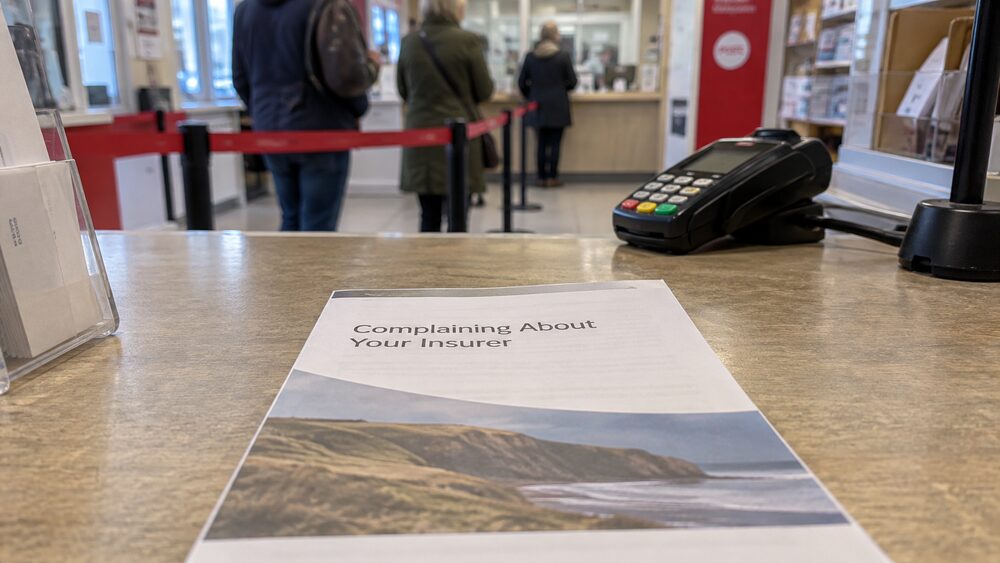
If an insurer has rejected a claim you thought was covered, dragged its heels, or handled your policy badly, you have a two-step route to put it right. First you complain to the insurer itself. Then, if you are unhappy with its answer or it fails to reply in time, you can take the complaint to the Financial Ombudsman Service, a free and independent body that can tell the insurer what to do1.
The ombudsman deals with complaints across the whole range of insurance people buy for their homes, cars and travel, and it received 42,897 insurance complaints between 9 July 2024 and 8 July 20253. Where a complaint is upheld, it can order an insurer to deal with a claim it rejected, add interest to money that should have been paid, fund further repairs, and pay compensation for distress or inconvenience4. The stages of the process, the limits of the ombudsman's powers, and where to go for help are set out below.
Complain to your insurer first
The ombudsman will not look at a complaint until the business involved has had the chance to deal with it. Its guidance is plain on this point:
The ombudsman's process starts with the business itself: a complaint has to go to the company involved before the ombudsman will look at it1.
The same wording appears across the ombudsman's own pages on insurance complaints: make a formal complaint to the company first2. This is not a formality. Insurers can and do resolve complaints at this stage, and a complaint made directly to the insurer starts the clock on the deadlines that later give you the right to escalate. The ombudsman's process is that you make a formal complaint to the company, then fill in its complaint form if you are still unhappy; a case handler is assigned and may ask you for more information7.
A formal complaint is different from a routine phone call about a claim. It asks the insurer to treat the matter under its complaints procedure, which ends with a final response letter explaining its position. Keep a note of the date you complained and what you sent, because the timing matters at the next stage. If the complaint is about a rejected claim, gather the policy documents, the claim correspondence and anything that shows what you were told when you bought the cover. The page on why insurance claims are rejected explains the common grounds insurers give, and how to make a home or travel insurance claim covers the claim process itself.
If you are unhappy with the insurer's answer, or it does not reply at all, the next step is the ombudsman. You do not lose anything by complaining to the insurer first: the service is free, and the insurer cannot charge you for making a complaint.
When you can take an insurance complaint to the ombudsman
Two things open the door to the ombudsman. The first is a final response letter you are unhappy with. The second is silence: if the insurer does not send you a final response letter within eight weeks, you can bring the complaint to the ombudsman without waiting for one9. The ombudsman puts it simply:
"If you're not happy with their response, or they don't reply in time, you can bring your complaint to us."2
The eight-week rule is the same one that applies across financial services. Guidance on credit union accounts, for example, tells customers to take their complaint to the free Financial Ombudsman Service if they are unhappy with the final response or the timeframe has passed10. The rule matters because it stops an insurer from blocking escalation simply by sitting on a complaint.
A final response letter should tell you the insurer's decision and, in most cases, that you have the right to refer the matter to the ombudsman. Once you have that letter, or once eight weeks have passed, the choice is yours. You are not obliged to accept the insurer's answer, and referring the complaint does not affect your right to keep the policy or to pursue a claim that has already been paid in part. The page on how long an insurer has to respond to a complaint covers the deadlines in more detail.
What the Financial Ombudsman Service covers: home, car, travel and more
The ombudsman's remit is broad. Its consumer leaflet lists the things it can help with, including bank accounts and bank cards, insurance for your home, car or when you travel to another country, and problems with loans11. On insurance specifically, it says:
"We receive complaints from consumers about a range of insurance products."12
That range includes the products most households hold. The ombudsman publishes dedicated guidance on home insurance complaints, including storm damage, underinsurance and how claims are settled4, on motor insurance, including vehicle valuations and write-offs15, and on travel insurance, including policies and pre-existing medical conditions16. It also covers mobile phone and gadget insurance18, and complaints about misrepresentation and non-disclosure, where an insurer says you gave wrong or incomplete information6.
The service is not limited to individuals. It can consider complaints from microenterprises and small and medium-sized businesses as well as consumers19, so a small firm with a dispute over its commercial cover may also be able to use it. More broadly, the ombudsman can look at complaints about businesses regulated by the Financial Conduct Authority, including some pension schemes and their services20. Its work across financial services includes banking problems such as account closures, disputed transactions, IT failures and problems with switching services21, unaffordable lending across credit products from car finance to payday lending22, and complaints about how a financial business dealt with a scam involving unauthorised payments, stolen details or identity theft23. It can also look into complaints about the bank or payment service provider that received money taken in a scam, considering the steps taken to recover it and whether it should have had concerns about its customer's account24. In March 2024 the ombudsman also published online guidance for businesses about insurance complaints25.
For a consumer with an insurance dispute, the practical point is simple: if the insurer is regulated by the Financial Conduct Authority, and most UK insurers are, the ombudsman can normally consider a complaint about it. The section on insurers lists the firms in the market.
How to refer a complaint to the ombudsman
The referral itself is straightforward. The ombudsman's guidance on motor insurance complaints puts the whole process in one line: fill in its complaint form15. The form asks for the details of the complaint, the insurer's response and what you think would put things right. Once the ombudsman has the form, it assigns a case handler, who may come back to you for more information7. The service is free and easy to use9.
There are rules in the background that entitle you to make the referral. Under the FCA's insurance conduct rules, a policy summary for a pure protection contract or a commercial customer must state how to complain to the insurer and that complaints may subsequently be referred to the Financial Ombudsman Service26. Payment services rules point the same way: if you are unhappy with a provider's response, you can take the matter further by referring it to the ombudsman27. The UK's payment account switching regulations require that consumers be given details of their right to make a complaint to the Financial Ombudsman Service28. And if you complain through a claims management company about poor service, you will be referred to the ombudsman29.
A few practical points make a referral stronger:
- Complain to the insurer first and keep the final response letter, or note the date if eight weeks pass without one1.
- Fill in the ombudsman's complaint form with the facts, dates and what you want to happen15.
- Respond to the case handler's questions and send any documents asked for7.
- Wait for the outcome. If the complaint is upheld, the ombudsman tells the business what it needs to do to put things right, and may ask it to compensate for any distress or inconvenience.
You do not need to pay anyone to do this. Claims management companies charge for a service the ombudsman provides free, and the ombudsman's own materials stress that bringing a complaint is straightforward and costs nothing9.
Compensation for distress or inconvenience
Putting a claim right is often only part of the remedy. Across its guidance, the ombudsman repeatedly reserves the power to award compensation for the non-financial impact of a firm's mistakes. On home insurance underinsurance complaints it says it may ask the insurer to pay you compensation13. On travel insurance it says it may tell them to pay you compensation for any distress or inconvenience16. On pre-existing medical conditions complaints, it says it will consider whether you have experienced any distress or inconvenience as a result of what the insurer did wrong17. The same wording appears in its guidance on scams23, mobile phone and gadget insurance18, IT problems at banks30, personal pensions31, cheques and banker's drafts32, workplace pensions33, interest-only mortgages34 and mis-sold travel insurance35.
The common thread is that the distress or inconvenience must result from what the business did wrong. A delayed claim that leaves a home unrepaired, a rejected claim that forces a family to cancel a holiday, or months of chasing an insurer over a write-off valuation are the kinds of harm this covers. The compensation sits alongside the practical remedies: dealing with a rejected claim, adding interest to money that should have been paid, paying for more work if the complaint was about repairs, and paying compensation for any loss or inconvenience caused4.
There is no fixed tariff, and the ombudsman decides each case on its facts. The dedicated page on compensation for distress and inconvenience explains how these awards work in practice.
Where the insurer is told to pay the claim
The most consequential remedy is an order to pay a claim the insurer rejected. The ombudsman sets out its approach on pre-existing medical conditions complaints:
"If we think your insurer has unfairly turned down a claim, we may recommend that they: reconsider the claim in line with the terms and conditions of the policy, or pay the claim and add interest to cover the period from the date of the claim until the date the settlement is paid."17
In mis-sold travel insurance cases, the logic is similar: where the customer would have bought a different policy that would have covered their claim, the ombudsman would ask the insurer to pay the claim35. Underinsurance complaints show the same reasoning applied to home insurance. Where the insurer did not ask for the full contents replacement cost or rebuild cost, where its questions were unclear, or where the consumer was not warned about the consequences of underinsurance, the ombudsman will usually say the insurer has to pay the claim in full13. Its business guidance on underinsurance states the outcome plainly:
"So we'll usually ask them to pay the claim in full."36
The ombudsman may also consider interest and compensation for distress and inconvenience on top of the payment36. But the power cuts both ways. In one published case study, a customer complained that her insurer had paid a third party's injury claim against her; the ombudsman found that the insurer was correct to pay the third party's claim, and the complaint was not upheld37. The ombudsman does not side with the consumer automatically: it looks at whether the insurer acted fairly and reasonably in the circumstances.
Complaints about the amount or quality of a settlement are also in scope. The ombudsman lists the examples it sees: an insurer arranged repairs but has not fixed the damage, the repairs caused additional damage, the insurer says repair but the customer thinks replacement is needed, the replacement is not the same as the lost item, the money offered is not enough, or the customer is dissatisfied with the quality of the insurer-appointed builder's work14. The pages on poor repairs or unsuitable alternative accommodation and what happens if your car is written off cover these disputes in detail.
Complaints about brokers and policy summaries
Not every insurance complaint is about an insurer. Many policies are bought through brokers, and a complaint may be about the advice given or the way the policy was sold rather than the way a claim was handled. Independent guidance confirms that you can also complain to the Financial Ombudsman Service so it can determine if the provider treated you fairly and reasonably38. The same first-step rule applies: complain to the broker first, then escalate if you are unhappy with the response. The comparison of using a broker or buying direct explains what a broker does and when responsibility sits with the broker rather than the insurer.
The paperwork around a policy also carries rights. The FCA's rules require a policy summary to state how to complain to the insurer and that complaints may subsequently be referred to the Financial Ombudsman Service26. Similar disclosure rules apply elsewhere in financial services: the ombudsman publishes guidance for businesses on complaints about ISAs39, and the payment services regulator tells customers who are still unhappy that they can contact the Financial Ombudsman Service40. If a policy summary or renewal document does not tell you about your right to complain, that is itself something the ombudsman can look at.
For consumers who used a claims management company, the route is slightly different. Complaints about a claims management company itself go via a separate process, but a complaint about poor service will be referred to the ombudsman29. The page on claims handlers and policy administrators explains who to contact about a claim when several firms are involved.
Insurance complaints in numbers: over half are about claims
The ombudsman publishes annual figures on the complaints it receives, and insurance is consistently one of the largest categories. Between 9 July 2024 and 8 July 2025 it received 42,897 insurance complaints, of which 41,185 came from within the UK3. The year before, 9 July 2023 to 8 July 2024, the figure was 42,82841. Two years earlier, 9 July 2021 to 8 July 2022, it was 30,54019, and in the year from 9 July 2019 to 8 July 2020 it was 30,37542.
The long-run picture shows how the workload has shifted. In its 2008/09 review, the ombudsman reported that complaints relating to insurance made up 39.5% of the total number of new cases it received, and that 51% of insurance complaints were about claims43. That year, buildings and contents insurance disputes rose by 29% and 23% respectively, and 26% of complaints were made on behalf of consumers by claims management companies43. The following year, insurance disputes increased by 38%, while complaints about banking and credit rose by 30%44. By 2017/2018 the balance had changed: banking and credit accounted for 31% of complaints received and general insurance 11%45. In that year the ombudsman recorded 3,174 complaints about travel insurance45.
Claims remain the heart of the matter. The examples the ombudsman gives of home insurance complaints are almost all claim disputes: unfinished repairs, damage caused by repairs, repair versus replacement, inadequate settlements and poor builder work14. In its half-yearly complaints data for the first half of 2024, the ombudsman noted that over half of banking and credit complaints were brought by professional representatives46, a reminder that a growing share of complaints across financial services now arrives through intermediaries rather than directly from consumers. The figures also show that volume alone says nothing about outcomes: a complaint is decided on its facts, not on how many similar complaints the ombudsman has received.
Where protection stops
The ombudsman's reach has limits. It can look at complaints about businesses regulated by the Financial Conduct Authority20, so a firm outside that perimeter, or a dispute that is not about a financial service, may fall outside its scope. Its insurance work covers complaints from consumers about a range of insurance products12, but it does not replace the courts: for very large losses, or disputes the ombudsman cannot consider, legal action may be the only route, and that is a matter for a solicitor or a legal expenses policy, not the ombudsman.
The service is free and easy to use6, and it is impartial: it does not take the consumer's side automatically, and its published case studies include complaints it did not uphold37. If it decides against you, that decision does not bind you, but it does bind the business if you accept it. Nor does the ombudsman's involvement protect against an insurer failing: that is the role of the Financial Services Compensation Scheme, which is separate and works differently.
Two further limits are worth knowing. Paying a claims management company does not improve your position: the ombudsman's service is free, and complaints about poor service from such firms are simply referred on29. And the ombudsman is not the place to complain about the underlying events, only about how the financial business handled them: it looks at whether the firm treated you fairly and reasonably38. For free, impartial help with money questions more broadly, MoneyHelper and the guidance on consumer protection in UK financial services set out where to turn.
Sources46 cited
- Complaints that involve gambling-related harm Financial Ombudsman Service
- How to complain: consumer video transcript Financial Ombudsman Service
- Alternative Dispute Resolution annual activity report 2024-2025 Financial Ombudsman Service
- Storm damage home insurance complaints Financial Ombudsman Service
- Personal accident insurance complaints Financial Ombudsman Service, 2026-09-27
- Misrepresentation and non-disclosure complaints Financial Ombudsman Service
- Debt collecting complaints Financial Ombudsman Service
- Storm damage complaints Financial Ombudsman Service, 2026-09-27
- Savings and endowments complaints Financial Ombudsman Service
- Credit union current accounts MoneyHelper
- Consumer leaflet, easy read Financial Ombudsman Service
- Insurance complaints we can help with Financial Ombudsman Service
- Underinsurance home insurance complaints Financial Ombudsman Service
- Settling home insurance claims Financial Ombudsman Service
- Vehicle valuations and write-offs Financial Ombudsman Service
- Travel insurance policy complaints Financial Ombudsman Service
- Travel insurance and pre-existing medical conditions Financial Ombudsman Service
- Mobile phone and gadget insurance complaints Financial Ombudsman Service
- Financial Ombudsman Service ADR activity report 2021-22 Financial Ombudsman Service
- Research briefing on the Financial Ombudsman Service House of Commons Library
- Banking and payment complaints Financial Ombudsman Service
- Unaffordable lending complaints Financial Ombudsman Service
- Scams involving unauthorised payments and identity theft Financial Ombudsman Service
- Scams where you were tricked into making a payment Financial Ombudsman Service
- Ombudsman News 189 Financial Ombudsman Service
- ICOBS 6: insurance conduct of business Financial Conduct Authority
- If you've fallen victim to a scam Payment Systems Regulator
- Payment Account Regulations 2015 legislation.gov.uk
- Complain about a claims management company GOV.UK
- IT problems at banks Financial Ombudsman Service
- Personal pension complaints Financial Ombudsman Service
- Cheques and banker's drafts Financial Ombudsman Service
- Pensions organised by employers Financial Ombudsman Service
- Interest-only mortgage complaints Financial Ombudsman Service
- Mis-sold travel insurance: business guidance Financial Ombudsman Service
- Underinsurance home insurance complaints: business guidance Financial Ombudsman Service
- Case study: third party drivers and injury claims Financial Ombudsman Service
- Housing-related debts Advice NI
- Lifetime ISA complaints Financial Ombudsman Service
- When you make a payment Payment Systems Regulator
- Alternative Dispute Resolution annual activity report 2023-2024 Financial Ombudsman Service
- ADR activity report 2019-20 Financial Ombudsman Service
- Annual report 2008/09 Financial Ombudsman Service
- Annual review 2009/2010 Financial Ombudsman Service
- Full review 2018 Financial Ombudsman Service
- Half-yearly complaints data, H1 2024 Financial Ombudsman Service





 MoneyHelperFree, impartial money and pensions guidance, set up by government
 Financial Ombudsman ServiceFree, independent help when a complaint about a firm is not put right
 FSCSProtects your money if a bank, insurer or investment firm fails
 Citizens AdviceFree advice on money, consumer and legal problems in England and Wales
 GOV.UKOfficial information on tax, benefits and government services