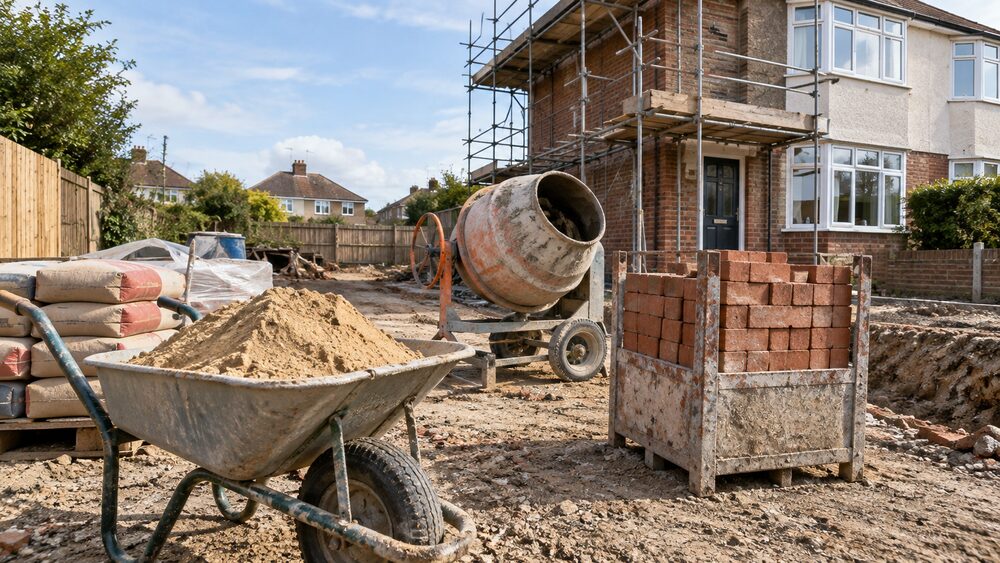
The figure you insure your home for under a buildings policy is not its price, its market value or what you paid for it. It is the rebuild cost: what it would cost to clear the site and put the same building back, from the ground up. For many homes that figure is very different from what the house would sell for, and in either direction.
Getting it wrong has consequences. If your home's true rebuild cost is £400,000 but you insured it for £200,000, you are 50% underinsured, and some insurers would pay only 50% of a claim, leaving you to find the rest1. Building costs have also moved sharply: the additional cost to build a home since 2020 is about £76,000 per home2, so a sum insured a few years ago may no longer be enough today.
Rebuild cost is not the same as your home's market value
Market value is what a willing buyer pays for the whole property: the building, the land it stands on, and the pull of the neighbourhood. Government schemes that lend against property make the point clearly. Under Help to Buy Wales, the equity mortgage you repay is linked to the value of your home at the point of repayment, not the amount you originally borrowed6. The schemes are working with market value, because that is what a sale would realise.
Buildings insurance works the other way round. It is not concerned with what the property would fetch, only with what it would cost to reconstruct the building itself. The two figures come apart for a simple reason: a large part of a home's market value sits in the land and the location, neither of which needs rebuilding after a fire or a flood. The site survives even when the building does not.
The gap can run in either direction. Building your own home can cost less than buying a house already built by a developer7, which shows that construction cost and market price are set by different forces. A modest house on an expensive street can have a market value far above its rebuild cost. A listed building, a home built of unusual materials or a property in an area with modest prices but high construction costs can have a rebuild cost above its market value, because rebuilding it would mean specialist work, demolition and starting again.
This distinction matters every time you buy, renew or change a buildings policy. If you insure for the market value and it is lower than the rebuild cost, you are underinsured and a claim can be cut back. If you insure for the market value and it is much higher, you may be paying for cover the building does not need. The buildings insurance guide explains what a buildings policy covers in general.
What the rebuild cost covers: demolition, site clearance and professional fees
Rebuilding a home is more than the price of bricks and labour. A realistic rebuild figure has to include everything that stands between a destroyed building and a finished replacement.
The scale of what is involved is easiest to see in self-build budgets, where the same costs have to be planned from scratch. Guidance for people raising money to build their own home lists the costs to cover: land costs, professional fees, building work and materials7. Strip out the land, which an existing homeowner already has, and the remaining headings map onto a rebuild: the professional fees for architects, structural engineers and planning, and the building work and materials themselves.
A rebuild also has to account for what happens before any building starts. If a home is destroyed, the remains have to be demolished and the site cleared before anything can be rebuilt, and those costs belong in the figure. The point is visible from the opposite direction in the rented sector: landlords do not have to rebuild a property if it is very badly damaged and must be pulled down8, which is a reminder that demolition and a cleared site are their own stage in the process, with their own costs.
Where major work is being done, specialist insurance reflects the same structure. Renovation policies cover the existing structure and the new works, and include public liability9, because a home in the middle of a building project faces risks an ordinary occupied house does not. A rebuild after a claim is, in effect, a building project on a cleared site, and the sum insured has to carry the whole cost of it.
What your mortgage lender requires
If you have a mortgage, buildings insurance is not optional. Guidance for home buyers sets out the ongoing costs of owning a home, and the list includes mortgage repayments, mortgage protection insurance, life assurance, contents insurance, rates, utility bills, ground rent and service charges10. Buildings insurance sits alongside these as a standing cost of homeownership, and a lender will normally require it as a condition of the loan.
The reason is straightforward. The lender's security is the building. If it were destroyed with no insurance in place, the borrower would still owe the mortgage but the lender would hold a ruin. Requiring buildings cover, insured for at least the cost of rebuilding, protects the loan as much as the homeowner.
In practice this means the sum insured on your policy is not just a number you pick for yourself. The lender expects it to be adequate, and if it is not, the lender may insure the property itself and add the premium to your mortgage, usually at a higher cost than arranging cover yourself. Checking the rebuild figure when you buy, and whenever you remortgage or make alterations, keeps both the lender's requirement and your own protection in line with reality.
What affects your home's rebuild cost
No two homes cost the same to rebuild, and the drivers are construction ones rather than the things that drive market value.
The biggest single driver in recent years has been the cost of building itself. The additional cost to build a home since 2020 is about £76,000 per home2, a rise that flows straight into rebuild figures. A sum insured before that rise may now fall short even though the house has not changed at all.
The building's own characteristics matter next. Size is the obvious one, but the materials, the age, the design and any unusual features all change what reconstruction would cost. A standard modern house is cheaper to rebuild per square metre than a listed building requiring like-for-like materials and specialist trades.
Changes you make to the home change the figure too. Renovation insurance is designed for a wide range of projects: renovations, extensions, conversions, new builds, self-builds, restorations and contract works9. An extension or a loft conversion adds floor area and structure that did not exist when the sum insured was set, so the figure has to be revisited when the work is finished. The telling your insurer about changes guide covers what you must disclose mid-policy.
When to get a surveyor's valuation
For many ordinary homes, insurers' own guidance and calculators give a reasonable starting figure. But there are times when a professional valuation is the safer route, and the clearest evidence of what a professional valuation involves comes from schemes that require one.
A market valuation by a Royal Institution of Chartered Surveyors (RICS) certified valuer is valid for 3 months3. That short shelf life tells you something about valuations generally: they are a snapshot of costs and values at a point in time, not a permanent answer. Where a scheme needs a valuation to stay current, an updated report must be made within 2 weeks of the expiry date of the original report, completed, signed and dated by the same RICS surveyor, and sent on within 5 days of issue11.
A valuation is not the same as a survey, and the two cost different amounts and do different jobs. A Building Survey may start at about £400, but could be considerably more, and may not be available if your home is a flat12. For a rebuild figure on an unusual, listed, very large or heavily altered home, a surveyor's assessment of the rebuilding cost is the figure an insurer is most likely to accept.
New-build homes carry a different consideration. The building warranty will usually cover the cost of structural repairs in the first 10 or 12 years for new-build homes13, so in the early years of a new home the question is less about rebuild cost and more about what the warranty does and does not cover. The NHBC Buildmark and Premier Guarantee guides explain the main warranties.
Keeping cover in line with rising costs
A rebuild figure is not set-and-forget. Costs move, homes change, and a policy that was right at the outset can quietly drift into underinsurance.
The scale of drift is not small. With the additional cost to build a home since 2020 running at about £76,000 per home2, a sum insured in 2020 could now be far below a genuine rebuild bill even for an unchanged house. That is the case for reviewing the figure at each renewal rather than assuming the old number still holds.
Renovation and building work is the other main trigger. Policies for building projects are extendable, and refundable subject to no claims9, so cover can be adjusted as a project runs rather than bought once at the start. Joint names cover is available when required9, which matters where a lender or contractor needs to be named on the policy during works.
After a flood claim there is a further option worth knowing about. From 2021, insurance claim payments have been permitted to include an element of resistant and resilient repair, above the like-for-like reinstatement cost14, under the Build Back Better approach. The Build Back Better guide explains how this works after a flood.
What happens if you are underinsured
Underinsurance is one of the most common and most costly problems in home insurance, and it works through a mechanism most policyholders have never heard of: the average clause.
The principle is that the insurer only ever received premium for part of the risk, so it only pays for part of the loss. The Ombudsman's worked example: if the rebuild cost of your home is £400,000 but you valued it at £200,000 in your policy, you are 50% underinsured, and some insurers would only pay 50% of a claim, with the consumer paying the rest1. The reduction applies to the whole claim, not just the shortfall, so even a small claim is cut by the same proportion.
The effect is not theoretical. In one complaint the Ombudsman records, underinsurance issues reduced a buildings insurance claim payout by 50%1. In a case study, a loss adjuster estimated the cost of rebuilding a house at around £150,000, but it was only insured for £100,000, so the settlement was reduced15. The Ombudsman decided that the insurer should meet the claim as though the homeowner was not underinsured, and paid him the money originally deducted15, but that outcome depended on how the insurer had asked its questions, as the next section explains.
The underinsurance and the average clause guide covers the mechanism in more depth, and how insurance premiums are worked out explains why the premium you paid is central to what happens next.
Complaining about an underinsured claim
If an insurer reduces a claim on grounds of underinsurance, the outcome at the Financial Ombudsman Service depends heavily on how the cover was sold and what the insurer asked.
The Ombudsman's general approach is that the consumer should be put back in the position they would have been in if the problem had not happened16. Where the consumer answered the insurer's questions reasonably and the insurer would still have insured them at the same premium, the Ombudsman is unlikely to find it fair for the insurer to reduce or decline the claim16. Where the consumer paid less premium than they should have, the insurer can reduce the claim in proportion: if they paid £400 but should have paid £500, they receive 80% of the claim value16. And where the insurer would not have insured the consumer at all, the Ombudsman is likely to find it fair for the insurer to reduce or decline the claim, and the insurer may also void the policy16.
Crucially, reducing the claim payment, known as applying average, voiding the policy, or adjusting the claim in other ways may not be considered fair if the insurer's questions or guidance were unclear16. The Ombudsman will usually say the insurer has to pay the claim in full if the insurer did not ask for the full rebuild cost, the questions were unclear, or the consumer was not warned about the consequences of underinsurance1.
"We'll usually say they have to pay the claim in full if any of the following are true:"
Where the wrong information came from the policyholder, the rules on misrepresentation apply. The insurer may want to charge more for the policy where there has been no claim, retrospectively apply a restriction to the policy, settle a claim proportionately, or avoid the policy17. The misrepresentation guide covers this in detail.
The process for complaining is fixed. Complain to the insurer first. It must get back to you within 15 days, either with a response or to explain why it cannot yet give one, and then send you a response within 35 days4. If it does not send a final response letter within eight weeks, or you are unhappy with its response, you can bring the complaint to the Ombudsman5. You then have 6 months from the date on your final response to refer the complaint18.
Redress can go beyond the claim itself. The Ombudsman may ask the insurer to pay interest, or compensation for distress and inconvenience1. In one home insurance complaint it upheld, it asked the insurer to pay a total of £700 for the distress and inconvenience caused19, and in another case it awarded up to £300 for distress and inconvenience16. The complaining about an insurer guide sets out the full process, and compensation for distress and inconvenience explains how these awards are decided.
Sources19 cited
- Underinsurance on home insurance Financial Ombudsman Service, 2026-09-26
- Home ownership in England House of Lords Library, 2020
- Help to Buy equity loan repayment application checklist GOV.UK, 2024-04-04
- Scams involving unauthorised payments and identity theft Financial Ombudsman Service, 2026-09-26
- Goods and services bought on credit Financial Ombudsman Service, 2026-09-25
- Help to Buy Wales post-sale information leaflet Welsh Government, 2025-06
- Raising money to build your own home nidirect, 2024-09-02
- Housing help if your home is flooded Shelter England, 2025-10-27
- Home renovation insurance guide British Insurance Brokers' Association, 2026-02-11
- Buying a home: things to consider nidirect, 2026-02-25
- How to get a valuation of your Help to Buy home GOV.UK, 2025-08-18
- Your right to buy your home: a guide GOV.UK, 2026-04-08
- Shared ownership scheme: repairs and home improvements GOV.UK, 2026-09-28
- Insurance and Flood Re: a Wales perspective Welsh Government, 2025-03-17
- Case study: consumer questions loss adjuster's valuation after fire Financial Ombudsman Service, 2026-09-26
- Underinsurance home insurance complaints Financial Ombudsman Service, 2026-09-26
- Misrepresentation and non-disclosure complaints Financial Ombudsman Service, 2026-09-26
- How to complain Financial Ombudsman Service, 2026-09-25
- Case study: couple complain after wrongly diagnosed boiler issue Financial Ombudsman Service, 2026-09-27


 MoneyHelperFree, impartial money and pensions guidance, set up by government
 Financial Ombudsman ServiceFree, independent help when a complaint about a firm is not put right
 FSCSProtects your money if a bank, insurer or investment firm fails
 Citizens AdviceFree advice on money, consumer and legal problems in England and Wales
 GOV.UKOfficial information on tax, benefits and government services