The first direct 1st Account is a current account with no monthly fee, and it is the account most people mean when they talk about banking with first direct. It comes with a debit card, an arranged overdraft that has an interest-free buffer on the first part of the borrowing, and no first direct fees for using the debit card abroad. New customers who switch to it using the Current Account Switch Service and meet a set of conditions can receive a cash payment: £210, made up of £175 with a £35 boost on top1.
The account is aimed at people who want a straightforward current account without a monthly charge and who are comfortable banking mainly by app and phone. first direct is signed up to the Current Account Switch Service, and a switch takes 7 working days1. The provider's own site carries today's figures for interest, overdraft charges and any current offer, and those change, so the numbers to check before applying are there rather than here.
This page covers what the account offers, how its charges and overdraft work, who can open one, how the switching offer is paid, and what happens if you change your mind or something goes wrong.
What the first direct 1st Account offers
The 1st Account is a full current account rather than a stripped-back one. It pays no credit interest, so it is not a place to hold a balance for its own sake, and first direct does not issue an interest certificate for it for that reason1. What it does provide is the everyday plumbing: a debit card, Direct Debits and standing orders, faster payments in and out, and access through the app, Online Banking and phone.
It also acts as the gateway to the rest of first direct's range. Several of the provider's savings products are open only to 1st Account holders, including the Regular Saver, the Savings Account and the Fixed Rate Cash ISA5. The home improvement loan requires a first direct current account, and the same account is the one that Sharedealing proceeds are paid into8. If you want more than one first direct product, the 1st Account is usually the one you need first.
The account is also the one that carries the switching offer, and it is the account the provider's travel money service is built around: you can order currencies to your door with fee-free delivery using the 1st Account9. For a joint account, the same product is available in joint names, and the switching offer is limited to one payment per customer or joint account10.
| What the account gives you | What it does not |
|---|---|
| No monthly fee1 | No credit interest on the balance1 |
| A debit card, Direct Debits and standing orders1 | No interest certificate issued4 |
| Access by app, Online Banking and phone1 | No appointee accounts11 |
| An arranged overdraft with an interest-free buffer3 | The buffer does not apply to Offset Mortgage customers1 |
| No first direct fees on the debit card abroad1 | Cash machine operators abroad can charge their own fees1 |
No monthly fee: how the account's charges work
There is no monthly fee on the 1st Account, which is the headline difference between it and a packaged account1. That does not make it free in every circumstance. The charges that can arise are the ones attached to borrowing and to the services you choose, not to holding the account.
The main one is overdraft interest. The 1st Account's arranged overdraft has an interest-free buffer on the first part of the borrowing, and interest applies above that3. The provider publishes a worked example of what borrowing costs, and its own site gives the current figure; the amount depends on how much you borrow and for how long. Interest on borrowing is charged as a rate applied to the amount you are overdrawn, which is how overdraft interest generally works12.
Beyond that, the charges to watch are the ones that come with using the account in ways that fall outside the standard service. Sending money abroad is free to an HSBC account anywhere in the world, but other international payments can carry a fee13. Using a credit card rather than the debit card abroad brings its own charges, including a cash fee and a non-sterling transaction fee on the credit card4. The account itself does not charge for switching in or out: first direct states it will not charge for transferring money and payment details to a new UK account14.
The arranged overdraft and its interest-free buffer
An arranged overdraft is a borrowing limit agreed in advance with the bank. That buffer is a fixed feature of the account rather than something you apply for separately, and it applies to the arranged overdraft only. first direct publishes the current rate and a worked example of the cost on its own site, because both change3.
The distinction between arranged and unarranged matters here. An arranged overdraft is the limit the bank has agreed; going beyond it, or borrowing without an agreement in place, is unarranged and is treated differently, with its own charges and its own rules3. The interest-free buffer does not extend to unarranged borrowing.
If you are already overdrawn and thinking about switching, the overdraft does not transfer with you. The old account has to be cleared or dealt with separately, and the new bank carries out its own affordability checks before agreeing a limit. There is more on this in switching while overdrawn.
Where the interest-free buffer does not apply
The interest-free buffer is a feature of the 1st Account's arranged overdraft, and there are circumstances where it does not apply at all. The clearest is an Offset Mortgage linked to a 1st Account: for those customers the interest-free limit does not apply1. Offset Mortgages are no longer on sale to new customers, so this affects existing borrowers rather than anyone opening an account now.
It is also worth being clear about what the buffer is not. It is not a free overdraft in the sense of money you can spend without consequence. It is an interest-free slice of an arranged borrowing limit, and the rest of the limit is charged at the account's overdraft rate3. Borrowing beyond the arranged limit is unarranged and falls outside the buffer entirely.
Basic bank accounts work differently, and the contrast is useful. A basic bank account does not provide an overdraft facility at all, so no interest is charged on the account and no fees are added for returned Direct Debits or standing orders15. That is a different trade-off from the 1st Account: no borrowing, but no borrowing charges either. If you want to understand the alternative, see basic bank accounts explained.
Using your debit card and cash machines abroad
The 1st Account's debit card carries no first direct fees when you spend abroad or withdraw cash from a cash machine outside the UK1. That applies to purchases in a foreign currency and to cash machine withdrawals, and it also covers making a debit card payment in a foreign currency while you are still in the UK1. You do not need to tell first direct that you are travelling before you use the card abroad9.
The card is a Mastercard debit card, and it can be used anywhere in the world in the same way as at home16. The virtual version can be added to Google Pay and Apple Pay before the physical card arrives, so the card is usable from the day the account opens17.
What the account does not control is the exchange rate. The rate applied to a foreign currency payment is set by the card scheme, not by first direct, and it is applied when the payment is converted. If a cash machine or retailer offers to charge you in pounds rather than the local currency, that is a conversion the retailer or its bank performs, and choosing the local currency usually gives a better exchange rate and avoids an additional conversion fee18. The same principle applies to credit card use abroad, where first direct charges a non-sterling transaction fee and a cash fee on cash withdrawals, so the debit card and the credit card behave differently4.
Who can open a 1st Account
The eligibility rules are short. You need to be over 18, a UK resident, and you must not have been declared bankrupt or registered for an Individual Voluntary Arrangement1. You also need an email address to apply19.
You will need proof of identity and proof of address, and proof of income in some cases1. The provider may ask for identification documents before it can proceed with an application, particularly where you no longer hold an account with it20. Having a recent payslip or bank statement to hand shortens the process if income evidence is requested.
- Over 181
- UK resident1
- Not bankrupt and not in an IVA1
- An email address to apply19
- Proof of identity and proof of address, and proof of income in some cases1
The account can be opened in a sole or joint name, and the switching offer is limited to one payment per customer or joint account10. If you are opening an account for someone else under a power of attorney or as a deputy, first direct does not offer appointee accounts, so that route is not available11. Being appointed as a deputy does not require you to hold a first direct account, but you will need to provide identification and confirmation of your address14.
If you have been refused an account elsewhere, or you are worried about a poor credit history, the basic bank accounts route is designed for exactly that situation, and it does not involve a credit check in the same way.
How the switching offer works and who qualifies
The switching offer is a cash payment for new customers who move their banking to first direct and meet a list of conditions. The payment is £210, made up of £175 with a £35 boost on top, and the boost applies to accounts opened between 14 September and 2 December 20261.
The conditions have to be met within 45 days of the account opening. You need to switch using the Current Account Switch Service, including at least 2 Direct Debits or standing orders, deposit £1,000, make 5 or more debit card payments, and log on to digital banking1. The switch itself takes 7 working days1.
The payment timing is separate from the switch. Once all the criteria have been met, the money arrives by the 20th of the following month10. The offer is limited to one payment per customer or joint account, so a couple switching a joint account receives one payment, not two10.
| Condition | Detail |
|---|---|
| Switch route | Current Account Switch Service1 |
| Direct Debits or standing orders | At least 21 |
| Deposit | £1,0001 |
| Debit card payments | 5 or more1 |
| Digital banking | Log on1 |
| Deadline | Within 45 days of the account opening1 |
| Payment date | By the 20th of the following month10 |
If a payment does not arrive when you expect it, the first step is to check that every condition was met within the 45 day window. There is a separate guide to what to do in switch bonus not paid.
Opening an account or switching from another bank
You can apply for a 1st Account in the app or by phone16. Applying in the app or online is the quicker route: if you are approved, you get a virtual card and access to Online Banking straight away, and the physical debit card takes on average 6 days to arrive in the post1. The virtual card can be used with Google Pay and Apple Pay in the meantime17.
Switching is done through the Current Account Switch Service, which first direct is signed up to16. The steps are:
- Open the new first direct account and pass the eligibility and identity checks19.
- Give first direct your existing account details and your preferred switching date22.
- first direct moves your payments across and closes the old account when the switch completes22.
- The switch takes 7 working days from the date you agreed1.
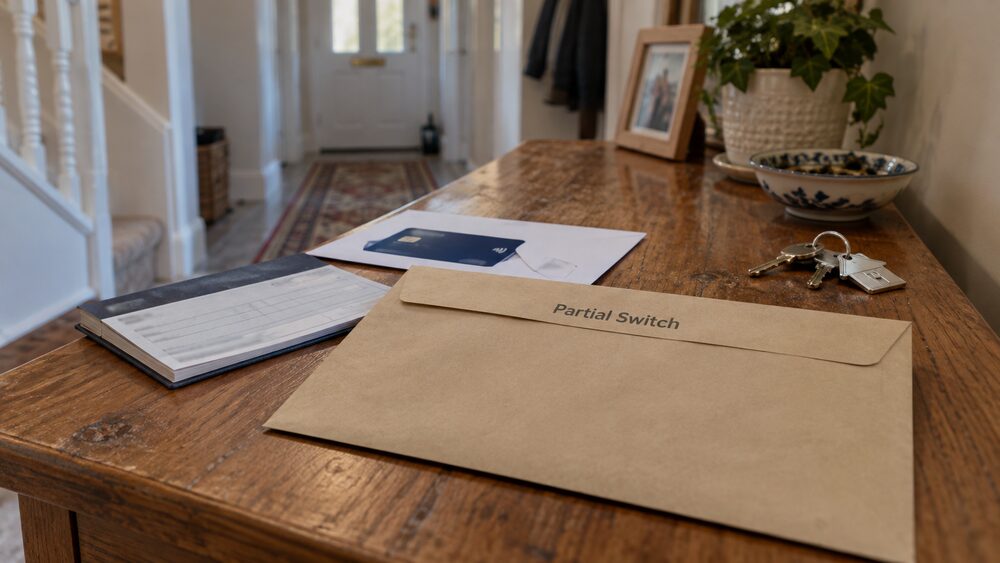
If you would rather not close your old account, a partial switch moves your payments across without closing it. The general steps for changing bank are the same either way: open the new account before closing the old one, make sure standing orders and Direct Debits are cancelled or moved, and leave enough money in the old account to cover anything that has not yet cleared21. There is more on the mechanics in the Current Account Switch Service and on the alternatives in partial switching.
Changing your mind, problems and complaints
There are two separate cancellation rights to keep apart. The account itself has a 14 day period after you receive your welcome pack in which you can close it1. An arranged overdraft has its own 14 day cancellation period, beginning on the day the overdraft is provided or the day you receive the letter, whichever is later3. Cancelling one does not automatically cancel the other, so if you want to end both, say so.
If something goes wrong with the account, the first step is first direct's own complaints process. If the problem is not resolved to your satisfaction, you can take it to the Financial Ombudsman Service, which looks at complaints about current accounts free of charge. For problems with the switching payment specifically, the conditions and the 45 day window are the place to start, because most disputes turn on whether each condition was met in time.
If you are struggling with an overdraft rather than disputing it, free and impartial help is available. MoneyHelper offers guidance on opening, switching and closing accounts, and debt advice charities can help where borrowing has become unmanageable21. There is more on the options in struggling to repay an overdraft.
Sources22 cited
- 1st Account first direct, 2026
- Switching bank accounts first direct, 2026
- 1st Account overdraft first direct, 2026
- Credit card help first direct, 2026
- Savings Account first direct, 2026-03-12
- Regular Saver first direct, 2026
- Fixed Rate Cash ISA first direct, 2026-09-10
- Home improvement loan first direct, 2026
- Card or cash abroad first direct, 2026
- Joint account first direct, 2026
- Managing someone else's money glossary first direct, 2026
- Understanding interest charges StepChange, 2026
- International payments first direct, 2026
- Court of Protection order first direct, 2026
- How to open, switch or close your bank account MoneyHelper, 2026-09-25
- Bank account with benefits first direct, 2026
- Travel debit card first direct, 2026
- Using your cards outside the UK first direct, 2026
- What you need to open a bank account first direct, 2026
- Transaction history policy first direct, 2026
- How to switch your bank account Which?, 2026-09-07
- How to switch current accounts first direct, 2026




 MoneyHelperFree, impartial money and pensions guidance, set up by government
 FSCSProtects your money if a bank, insurer or investment firm fails
 Financial Ombudsman ServiceFree, independent help when a complaint about a firm is not put right
 Citizens AdviceFree advice on money, consumer and legal problems in England and Wales