A basic bank account is designed for people who cannot get a standard current account, often because of a poor credit history, an IVA, a debt management plan, a debt relief order or bankruptcy. You do not have to pass a credit check to be offered one, and the nine largest banks and building societies in the UK have agreed to offer them with no monthly fees1.
A basic bank account is designed for people who cannot get a standard current account, often because of a poor credit history, an IVA, a debt management plan, a debt relief order or bankruptcy. You do not have to pass a credit check to be offered one, and the nine largest banks and building societies in the UK have agreed to offer them with no monthly fees1.
You will usually need to be at least 16, or over 18 for some banks, and a UK resident1. Basic bank accounts do not come with an overdraft, and they must be fee-free for standard operations when provided in sterling3. You can have wages, benefits and tax credits paid in, pay bills by Direct Debit and use a debit card, but you cannot borrow on the account.
If you are turned down, the bank should tell you why, and you may be able to complain to the Financial Ombudsman Service if you believe you were treated unfairly4. This page sets out who qualifies, what ID you need, how to apply and where to get help.
Basic bank accounts are for people who cannot get a standard account
Basic bank accounts are normally available if you do not qualify for a bank's standard current account1. That includes people with a bad credit history, an IVA, a debt management plan, a debt relief order, or who have been declared bankrupt1. The account is designed for people who may not be able to open a standard current account, for example because of a low credit score7.
They are not available to businesses, though charities may find the industry body UK Finance's guide on how to open a charity bank account helpful8. Some banks provide a basic bank account for business banking if you do not qualify for their business current account, but not all banks offer it and some may charge fees2.
The nine largest banks and building societies in the UK have agreed to offer basic bank accounts with no monthly fees to people who have no bank account, who have an account elsewhere but want to change provider, or who have an account but are in financial difficulty and want their bank to open a new, functional account for them2. The scheme rules say a firm must offer a basic bank account only if it offers one and the customer meets its eligibility criteria9.
Age and UK residency rules
You will need to be at least 16 to open a basic bank account, or over 18 for some banks1. From age 16, you can open a bank account without asking your parents; under 16, you need a parent or guardian's permission10. Lloyds, for example, says its Basic Account is available only to personal customers aged over 18 who are resident in the UK and are either an EU national or have permission to stay in the UK for at least 12 months11. Ulster Bank's Foundation account also requires you to be 18 or over and a UK resident12.
Residency rules vary by provider. Some accounts are open to UK residents aged 16 or over, while others require you to be a UK resident or resident in the UK for tax purposes13. For a standard current account, you typically need to be aged 18 or over and a UK resident15.
If you are not a UK national, you will usually need to show that you have permission to stay in the UK. The exact requirement depends on the bank. For people arriving from Ukraine under the Homes for Ukraine scheme, the government's guidance says guests can apply for an account in person at a branch, over the phone, online, or using a mobile app16.
| Provider | Minimum age | Residency requirement |
|---|---|---|
| Lloyds Basic Account | Over 18 | UK resident, EU national or permission to stay for at least 12 months11 |
| Ulster Bank Foundation | 18+ | UK resident12 |
| Bank of Ireland UK Basic Cash Account | Not stated | Open to those with little or no credit history in the UK17 |
ID you need to open one, including visas for non-UK nationals
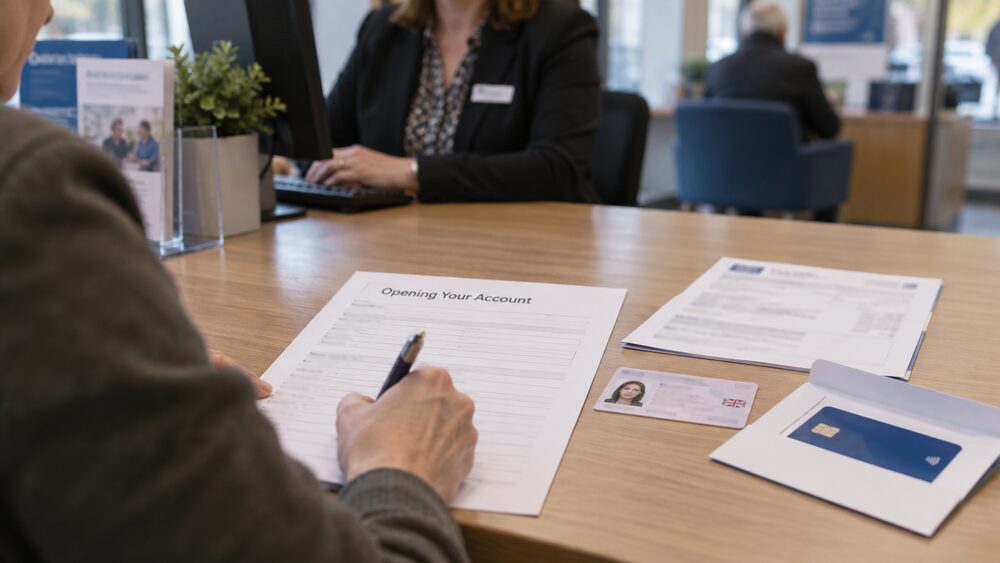
To open a bank account, you will need evidence of who you are, for example a passport or driving licence18. Most banks will ask for a driving licence or passport to prove your identity, or a photo of these if you are applying online, often with a selfie1. You will usually need ID to prove your identity, like a driving licence, passport, recent bills or official documents15.
You usually have to show the bank two separate documents that prove who you are, for example your passport, and where you live, for example a recent bill13. If you cannot provide these, a letter from a responsible person such as a GP, teacher, social worker or probation officer may be accepted13.
Other documents that may be accepted include letters from the DWP, HMRC, JobCentre+, your local council, GP, minister of religion, social landlord, armed services officer, warden, care home manager, employer, college or training provider1.
No credit history does not rule you out
You do not have to pass a credit check to be offered a basic bank account, but banks use a credit check to check your identity1. You do not need to pass a credit check to get a basic bank account19. Some accounts are specifically open to people with little or no credit history in the UK, such as Bank of Ireland UK's Basic Cash Account17.
A 2012 study found that only two banks, Barclays and the Co-operative Bank, had a basic bank account available to people regardless of their credit record20. The position may have changed since then, but the principle remains that a poor credit history should not by itself stop you getting a basic account.
If you have a bad credit rating and have been refused bank accounts, you could ask to open a basic bank account or see if you can open an account with a credit union21. Credit unions are financial co-operatives that offer savings and borrowing to their members, and they may be more flexible about credit history22.
How to apply: online, by app, by phone or in person
You will often need to apply for one of the bank's other accounts first, such as their standard current account1. Depending on the account you have chosen, you can usually apply online, using an app, over the phone, or in person15. You can complete an application form online, in person or by phone10.
To open a bank account you usually have to fill in an application form in a branch, online, or sometimes over the phone, and provide proof of identity including your full name, date of birth and address14. Guests under the Homes for Ukraine scheme can apply in person at a bank or building society branch, though they may need to make an appointment, over the phone, online, or using a mobile app16.
If you are applying for a basic account because you have been refused a standard one, the bank may ask you to apply for its standard current account first and then offer you the basic account if you do not qualify1.
If you are turned down or have a problem: complaints and help
If you cannot open a basic bank account, the bank should tell you why you have been turned down23. The reason is given unless the bank suspects fraud or money laundering1. Reasons for refusal include not agreeing to a credit check, failing the ID check, suspected unlawful or fraudulent use, or being threatening, abusive or violent towards staff1. If the reason is not given, or the refusal seems unfair, a complaint can be made to the Financial Ombudsman Service24.
If the bank does not tell you why, or you feel you have been turned down unfairly, you may be able to complain to the Financial Ombudsman Service4. The institution must also tell you how to complain to the institution and the Financial Ombudsman Service and provide the relevant contact details3.
The Financial Ombudsman Service is free and independent. It can look at complaints about banks and building societies, including refusals of basic bank accounts. In the first quarter of 2026/27, the ombudsman opened 8,945 complaints about current accounts24.
If you are struggling with debt or need help managing your money, free and impartial advice is available from MoneyHelper, Citizens Advice, National Debtline and StepChange1.
Is money in a basic bank account protected by the FSCS?
Yes, if your money is held with a UK branch of an authorised bank or building society. The Financial Services Compensation Scheme can only protect money held by UK branches of authorised banks and building societies25. The scheme protects up to £120,000 per eligible person, per bank or building society6.
If you have money in multiple accounts with multiple banks that are part of the same banking group and share a banking licence, they are treated as one bank, and the £120,000 limit applies across all of them6. Joint accounts are also eligible for FSCS protection up to the same limit of £120,000 per eligible person25.
You can check whether your money is protected using the FSCS protection checker25. If you cannot find your bank or building society, the FSCS has guidance on what to do25.
Sources25 cited
- Basic bank accounts MoneyHelper, 2026-09-25
- How to open a bank account online Which?, 2026-04-23
- Basic bank accounts: July 2023 to June 2024 HM Treasury, 2025-11-05
- Safe bank accounts National Debtline, 2026-09-25
- Debt management: basic bank accounts Advice NI, 2026
- Banks, building societies and credit unions FSCS, 2026-09-25
- Opening a new bank account safely Surviving Economic Abuse, 2023-11
- Basic bank accounts House of Commons Library, 2026-09-26
- BCOBS 4.1 FCA Handbook, 2026-09-26
- Basic Account Lloyds Bank, 2026-09-27
- Foundation account Ulster Bank, 2026-09-25
- Basic Cash Account features Bank of Ireland UK, 2026-09-25
- Getting a bank account Citizens Advice, 2026-09-25
- Getting a bank account (Scotland) Citizens Advice Scotland, 2026-09-26
- Managing your own money Scope, 2025-08-18
- Getting ready to claim Universal Credit Turn2us, 2026-02-25
- Supporting guests to open a bank account: Homes for Ukraine GOV.UK, 2025-09-15
- How to open, switch or close your bank account MoneyHelper, 2026-09-25
- Basic bank accounts with no credit check Shelter England, 2025-03-27
- Banking for people on low incomes University of Bristol, 2012
- Bankruptcy advice: basic bank accounts Advice NI, 2026
- Save money on your social life StepChange, 2026-09-25
- Fair and affordable finance Responsible Finance, 2026-09-26
- Quarterly complaints data Q1 2026/27 Financial Ombudsman Service, 2026
- Check your money is protected FSCS, 2026-09-25

 MoneyHelperFree, impartial money and pensions guidance, set up by government
 FSCSProtects your money if a bank, insurer or investment firm fails
 Financial Ombudsman ServiceFree, independent help when a complaint about a firm is not put right
 Citizens AdviceFree advice on money, consumer and legal problems in England and Wales