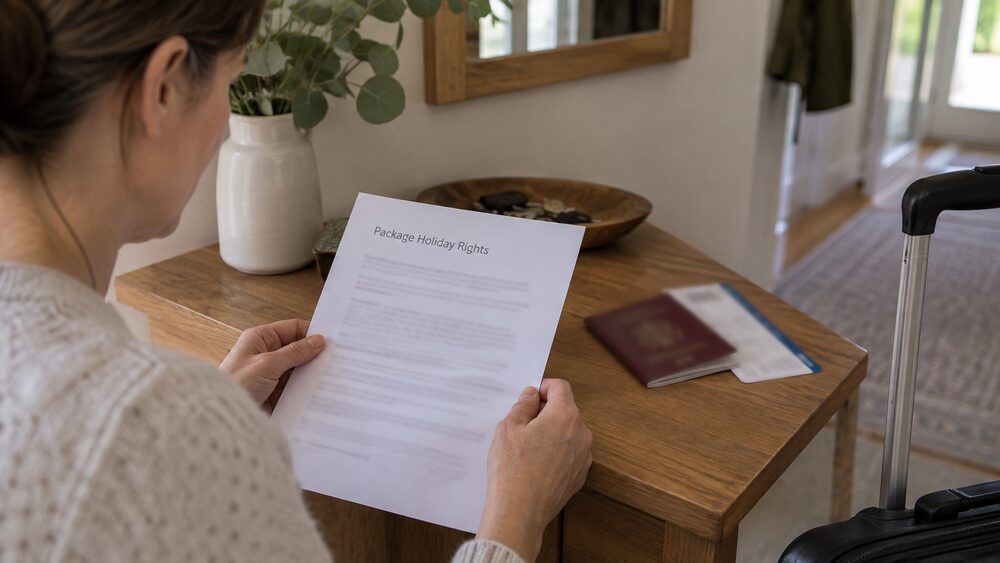
A package holiday in the UK comes with legal rights that a pile of separate bookings does not. The Package Travel and Linked Travel Arrangements Regulations 2018, in force since 1 July 2018, put duties on the "organiser" of the package: the price cannot be pushed up freely after booking, a full refund is due within 14 days if the organiser cancels, help and accommodation must be provided if you are stranded, and money must be protected if the company fails1. The regulations replaced the 1992 package travel rules across the UK2.
What makes a booking a package is the combination of services, not the label on the website. A package is a combination of at least two different types of travel service for the same trip, sold under a single contract, at a single inclusive price from one point of sale, advertised as a package, or assembled through linked online booking processes where your details are passed on and a second contract follows within 24 hours1. When those conditions are met, the organiser is responsible for the whole holiday, including parts supplied by other companies.
What counts as a package holiday
The legal test looks at how the holiday was put together, not what the seller calls it. Under the regulations, a "package" means a combination of at least two different types of travel service for the purpose of the same trip or holiday, where the services are combined by one trader before a single contract is made, or purchased from a single point of sale at an inclusive price, or advertised as a package, or combined after a choice-of-services contract, or bought through linked online booking processes where the trader passes on your data and a second contract is concluded within 24 hours of the first1.
In practice, the classic package is a flight plus accommodation plus transfers sold together by one tour operator. But the definition reaches further. The same regulations apply if you paid for two elements of the same holiday in a single transaction, or you book a secondary service, such as car hire, with a hotel or flight4. A "minor" for these purposes is anyone below the age of 18, which matters for how bookings involving children are handled1.
The breadth of what counts as a travel service is what gives the definition its bite. When your booking is a package, you are covered for the hotel, the car hire, the transfers, the tours, the food and just about everything else included in it4. That matters when something goes wrong: the organiser cannot point at a local supplier and say it was nothing to do with them.
If your booking is not a package, other rules may still help. A hotel booked on its own with a UK travel company may have some protection under the Consumer Rights Act4. And if you paid by credit card, you may be able to get a refund for credit card payments between £100 and £30,0003.
Linked travel arrangements get less protection than packages
Not every combination of bookings is a package, and the gap matters. A "linked travel arrangement" means at least two different types of travel service purchased for the same trip, not constituting a package, under separate contracts, where a trader facilitates your separate selection and payment at one point of sale, or targets you to procure at least one additional travel service that is booked within 24 hours of the first booking confirmation1.
The everyday version of this is a website that sells you a flight and then, at checkout or in a follow-up message within 24 hours, steers you to a hotel or car hire booked under a separate contract. Each contract stands alone, so there is no single organiser responsible for the whole trip, and the package rights, such as the 8% price rise limit and the 14-day refund deadline, do not attach to the arrangement as a whole.
Linked travel arrangements do carry one protection the regulations single out: the trader must protect the money you pay, in the way the insolvency protection rules require, so a booking that falls short of a package is not entirely without cover1. But the richer rights, compensation for a ruined holiday, help when stranded and the right to cancel on a significant change, belong to packages.
One further boundary is worth knowing. The Consumer Contracts (Information, Cancellation and Additional Charges) Regulations 2013, which give a 14-day cooling-off right for distance sales, do not apply to package travel contracts within the meaning of the 2018 regulations5. So a package holiday is not a purchase you can simply unwind under the general online cooling-off rules; the cancellation rights that apply are the package ones described below.
Price rises after booking: the 8% limit and 20-day cut-off
A package price is not set in stone, but the regulations fence off how far and how late it can move. A price increase may only be made if the organiser notifies you clearly and comprehensibly of it, with a justification, at the latest 20 days before the start of the package1. Where a price increase exceeds 8% of the total price of the package, the cancellation rules apply and you may terminate the contract1.
The 8% threshold is where your rights bite. You can cancel your package holiday without fees if the price rises 8% or more after you have booked and paid for it6. Below that threshold, the rise can stand if it is properly notified and justified, and your options are to accept it or cancel on the ordinary termination terms.
The 20-day rule works as a hard cut-off: once you are inside the final 20 days, the price you have is the price you pay. If a rise is notified in time but takes the increase over 8%, the choice passes to you, and cancelling is free of termination fees.
Cancelling or transferring your package
If you need to cancel your holiday for your own reasons, you are not legally entitled to a refund from the travel agent or tour operator6. The regulations allow the traveller to terminate the package travel contract before the start of the package, but the organiser may require an appropriate and justifiable termination fee1. In unavoidable and extraordinary circumstances at the destination, such as serious security risks, no termination fee is due and a full refund is payable1.
Termination fees are usually a percentage of what you paid, and they can increase the closer the trip gets. As an example of how steep they can be, cancelling 60 days before the start of the holiday could lose you 50% of its cost6. The exact scale is set by the organiser, so the figure to check before cancelling is the fee table in your booking conditions.
There are two ways out of a fee. The first is a significant change: if any part of your package holiday is changed significantly, including accommodation, transport, departure place or destination, or advertised facilities, you can cancel without paying termination fees6. The second is the 8% price rise described above.
Transferring the booking to someone else is a separate right. You can transfer your package holiday to a friend or relative as long as they meet all the requirements of the trip, for example any age requirements6. Under the regulations, notice given 7 days or more before the day the package starts is always deemed reasonable, and the transfer costs must not be unreasonable and must not exceed the cost incurred by the organiser as a result of the transfer1. So a transfer fee is allowed, but only a genuine one.
When the organiser cancels: refunds within 14 days
When the company cancels, the position reverses entirely. If the company you booked with cancels your holiday, you are entitled to a refund and possibly compensation6. The refund must be made without undue delay and in any event not later than 14 days after the package travel contract is terminated, and that deadline applies whether the contract was ended by you or by the organiser1.
Compensation on top of the refund is not automatic. It depends on why the holiday was cancelled, and the exclusions described in the next sections apply. But the refund itself is a fixed right with a fixed clock.
If the refund does not arrive, there is a named route to chase it. For packaged holidays, if the travel provider does not provide the refund within 14 days of cancellation, contact ATOL for a flight package holiday, or ABTA or a similar guarantee scheme8. Keeping your booking confirmation and payment records makes that chase straightforward.
Something went wrong on holiday: what you can claim
A package that goes ahead but goes badly wrong is where the compensation rights earn their keep. If your holiday is cancelled, delayed or substantially changed, you have the right to make a claim for loss of value, out-of-pocket expenses, or loss of enjoyment, inconvenience or disappointment6. Loss of value is the gap between what you paid for and what you got; out-of-pocket expenses are the costs you ran dealing with the problem; and the last category recognises that a holiday is bought for enjoyment, not just for beds and flights.
The claim sits against the organiser, whoever actually caused the fault. That is the point of the package definition: because the services were sold together, the organiser answers for the hotel, the transfers and the rest4. You do not have to chase a supplier in another country for a problem the organiser sold you.
How you pursue the claim follows a familiar path. Complain to the organiser first, in writing, with your evidence. If the organiser is a member of a trade body, its dispute resolution service may take the complaint. ABTA membership provides financial and legal protection for holidays booked with its members3. As a last resort, consider taking your provider to the small claims court4; the site's guides to small claims court in England and Wales, the simple procedure in Scotland and small claims in Northern Ireland cover that route.
Where a travel company has stopped trading, the Financial Ombudsman Service has shown how the pieces can fit together. In one case study, a customer told the ombudsman that the travel company she used to book a holiday had stopped trading; because she had paid by credit card, the ombudsman told her she may be ATOL protected and might be able to make a claim via the Civil Aviation Authority9. Credit card payments between £100 and £30,000 can support a refund claim in their own right3.
Where compensation stops: caps and exclusions
The right to compensation is real but bounded. The package travel contract may limit the compensation to be paid by the organiser, as long as that limitation does not apply to personal injury or damage caused intentionally or with negligence, and does not amount to less than 3 times the total price of the package1. So a cap is lawful, but it has a floor, and it can never touch the most serious categories of harm.
The other main boundary is circumstances outside the organiser's control. Compensation for cancellation or changes is not due where the organiser shows the problem arose from unavoidable and extraordinary circumstances, the same concept that removes termination fees when such circumstances affect the destination1. The organiser bears the cost of necessary accommodation for stranded travellers in those circumstances, but does not pay compensation on top for the disruption itself.
Travel insurance sits alongside these rights, and it has its own limits. A policy limit is the maximum amount your policy will pay out under a certain section, and policies can carry sub-limits within those sections, for example for baggage10. An insurance claim might require you to pay an excess fee, it might be subject to limits, and the policy will only cover the named policyholders8. Insurance is there for the things the organiser is not liable for, such as illness cutting a trip short, not as a substitute for the package rights.
If the insurance itself was mis-sold, that is a separate complaint. The Financial Ombudsman Service looks at mis-sold travel insurance complaints on the grounds of misrepresentation, and where the customer would have bought a different policy that would have covered their claim, it asks the insurer to pay the claim11. It may also ask the business to compensate the customer for any distress or inconvenience11. The ombudsman's travel insurance pages explain how to bring that complaint.
Stranded abroad: help and up to 3 nights' accommodation
If events beyond anyone's control leave you stuck abroad, the organiser owes you active assistance. Where unavoidable and extraordinary circumstances prevent the agreed return, the organiser must bear the cost of necessary accommodation for a period not exceeding 3 nights per traveller1. That is a cost the organiser absorbs, not one it passes back to you.
The 3-night limit has carve-outs. It does not apply to persons with reduced mobility, those accompanying them, pregnant women, unaccompanied minors and persons needing specific medical assistance, where the need was notified at least 48 hours before the start of the package1. For those travellers, the assistance is not capped at three nights.
The organiser must also help with practical difficulties generally, and may charge a fee for that assistance if the difficulty is caused intentionally by the traveller or through the traveller's negligence, but the fee must be reasonable and must not exceed the actual costs incurred by the organiser1. So a rescue from a mess of your own making can be billed, but only at cost.
Separate rights apply to the journey itself. If you are travelling by air, road, rail or sea commercial services, you have the same rights if you are denied boarding, or suffer a cancellation or long delay3. The site's guide to flight delay compensation covers the air rules in detail.
If the travel company goes bust: insolvency protection
The regulations do not leave your money exposed to the travel company's solvency. The organiser of a package who is established in the United Kingdom must provide effective security to cover, in the event of the organiser's insolvency, refunds of payments for travel services not performed and, where carriage is included, repatriation and necessary accommodation costs1. An organiser who fails to comply with these insolvency protection provisions commits an offence and is liable to a fine1.
In the market, that security is usually delivered through schemes people recognise by name. You also have protection under the ATOL scheme for package holidays if your holiday company goes bust6, and holidays booked with ABTA members provide financial and legal protection3. The site's comparison of ATOL vs ABTA sets out what each covers when a holiday goes wrong.
If the company fails, the practical steps follow the same pattern as the ombudsman's case study: check whether the booking was ATOL protected, and if you paid by credit card, a refund claim for payments between £100 and £30,000 may be available3. The guide to when a company goes bust covers the wider position on deposits and orders.
Travel insurance sold alongside a holiday has its own backstop. The Financial Services Compensation Scheme will only consider a claim relating to travel insurance where the policy was sold alongside a holiday or other related travel if it relates to business conducted on or after 1 January 200912. FSCS compensation for most products and services is currently limited to £85,000 per eligible customer13. The guides to FSCS limits and what the FSCS does not cover explain where that protection stops.
The same rules across the UK
Package holiday rights do not change at the border. The Package Travel and Linked Travel Arrangements Regulations 2018 came into force on 1 July 2018 and replaced the 1992 regulations throughout the UK2. The penalties for a trader who fails in its duties are set out for England and Wales, Scotland and Northern Ireland alike: on summary conviction, a fine in England and Wales, or in Scotland and Northern Ireland a fine not exceeding the statutory maximum, and on conviction on indictment, a fine1.
The general consumer framework follows the same pattern. The Consumer Contracts (Information, Cancellation and Additional Charges) Regulations 2013 extend to England and Wales, Scotland and Northern Ireland14, so the boundary between package rights and cooling-off rights works the same way everywhere.
Some neighbouring rules do differ by nation, and it is worth not assuming uniformity elsewhere. In Northern Ireland, the law on services and discrimination is slightly different but has a similar effect to the rest of the UK in the areas it covers15. Where a dispute over a holiday ends up in court, the process differs: small claims in England and Wales, the simple procedure in Scotland, and separate small claims arrangements in Northern Ireland, each covered by the guides linked above.
Sources15 cited
- The Package Travel and Linked Travel Arrangements Regulations 2018 legislation.gov.uk, 2018
- The Package Travel, Package Holidays and Package Tours Regulations 1992 (revoked) legislation.gov.uk, 2018
- UK passenger consumer rights when travelling to the EU GOV.UK, 2020-12-31
- Nightmare holiday? You might be able to claim your money back Which?, 2025-09-03
- The Consumer Contracts (Information, Cancellation and Additional Charges) Regulations 2013 legislation.gov.uk, 2013-12-11
- I have to cancel my package holiday: what are my rights? Which?, 2026-03-10
- How to complain about your holiday booking Which?, 2026-05-19
- Cancellations and refunds: helping consumers understand their rights and routes to refunds Financial Conduct Authority, 2020-10
- Customer tells us travel company used to book holiday stopped trading Financial Ombudsman Service, 2026-09-27
- Travel insurance policy excesses and limits Financial Ombudsman Service, 2026-09-26
- Mis-sold travel insurance Financial Ombudsman Service, 2026-09-26
- FSCS eligibility rules Financial Services Compensation Scheme, 2026-06-04
- FSCS Annual Report and Accounts 2024 Financial Services Compensation Scheme, 2024-07-29
- Digital Markets, Competition and Consumers Act 2024, explanatory notes legislation.gov.uk, 2024-05
- The Equality Act 2010: discrimination in services and public spaces House of Commons Library, 2026-07-08






 Citizens AdviceFree advice on money, consumer and legal problems in England and Wales
 Financial Ombudsman ServiceFree, independent help when a complaint about a firm is not put right
 MoneyHelperFree, impartial money and pensions guidance, set up by government
 Citizens Advice ScotlandFree advice across Scotland