If a trader in Northern Ireland owes you money, or you owe money a creditor is chasing through the courts, the small claims process is the low-cost route for disputes worth less than £5,000. nidirect guidance states that if the amount is not more than £5,000, you can take your case to the Small Claims Court and you don't need a solicitor1. The County Court deals with the small claims process, and the costs are limited, though you do have to pay a court fee2.
Before any court paperwork, most disputes are better resolved by complaining to the business directly, then using Northern Ireland's free consumer help services: Consumerline for disputes with traders, and the Consumer Council for energy, water, transport and postal complaints. Both are free, and both can resolve many disputes without a hearing. This page explains how the small claims process works in Northern Ireland, what help is available before and alongside it, and where to turn if you live elsewhere.
Small claims in Northern Ireland: disputes under £5,000
The small claims process in Northern Ireland is designed for straightforward disputes where the debt is less than £5,000, and it is handled by the County Court with limited costs2. Unlike the small claims track in England and Wales, where claims up to £10,000 are normally allocated and claims for personal injury or housing disrepair only qualify if under £1,0006, the Northern Ireland route is a distinct process with its own forms and deadlines. A court fee is payable to issue a claim2.
The process uses three main forms: Form 125, the notice of action for a small claim; Form 126A, the notice of dispute; and Form 126B, the notice of acceptance of liability2. Once a claim is issued, the person receiving it has 21 days from the date the forms are sent to respond2.
If you are the person being claimed against, there are two main routes after the forms arrive. If you disagree with the claim, you complete Form 126A, the notice of dispute, and return it to the court within 21 days2. A hearing will then be scheduled for your case, and a judge will make the final decision2. The grounds for disputing a claim include: the claim amount is incorrect; you do not owe the money; the debt is statute barred; or you have paid the debt in full2.
If you accept that you owe the money but cannot pay in full right now, you can ask for time to pay. You fill in Form 126B, the notice of acceptance of liability, tick yes to the question asking whether you wish to apply for time to pay, state your payment offer, and send the form with a copy of your budget and a list of people you owe to the court2. Time to pay must be arranged within 21 days of the notice of application being issued2. If the people you owe agree, the decree is granted and the court orders you to pay the money; if they do not accept your offer, a judge reviews the claim and decides how much you have to pay2. Payment is made to the people you owe, not to the court, and includes the court fee2.
If the claim against you is successful, you get a County Court judgment (CCJ)2. The guide for creditors published by the Department for the Economy covers procedures in Northern Ireland and is the reference point for how creditors pursue debts through this process7.
Complain to the business first
Whatever the dispute, the first step in every complaints route is the same: raise it with the business itself. The Information Commissioner's Office, which handles data protection complaints, states that if you are unhappy with how an organisation handled your request, the first step is to complain to it8. The same principle applies to complaints about decisions made about you without human involvement: first complain to the organisation, then to the ICO if you remain dissatisfied, with the courts also an option if you take independent legal advice9.
The Financial Ombudsman Service applies the same rule to financial firms: before bringing a complaint to it, the first step is to complain to the company involved10. The Consumer Council likewise advises consumers to make a complaint to the provider in the first instance to give them the opportunity to put things right4, and to contact the company straight away if something has gone wrong11.
The point of complaining first is not just courtesy. The Consumer Council will only take on a complaint once you have raised it with the company and allowed them time to respond, and have either not received a response or are unhappy with the response11. Keeping a record of what you sent and when matters, because the Consumer Council later requests copies of all communication between you and the company about your complaint12. For financial firms specifically, our guide to making a complaint sets out how to write the complaint and what to include.
Consumerline: free advice on disputes with traders
Consumerline is the free consumer advice service for Northern Ireland, run by the Trading Standards Service. It is the place to contact for further information on how to make a complaint against a trader or to ask about your consumer rights13. It is for Northern Ireland consumers only14.
The helpline number is 0300 123 6262, and it is open Monday to Thursday from 9am to 5pm, and on Friday from 9am to 4pm3. The online web form is available from Monday 9am to Friday 4pm, except on bank and public holidays14. Consumerline is unable to accept personal callers at its office, so contact is by phone, web form or through its website at www.consumerline.org14.
Consumerline can also refer your complaint to the Trading Standards Service for investigation, or to the Financial Conduct Authority, which authorises lenders15. A Department for the Economy news item from August 2026 directed consumers who believe they have been misled or subject to unfair trading practices to contact Consumerline on 0300 123 6262 or via the webform16.
For online shopping problems, Consumerline's guidance is clear about who is responsible: your contract is with the retailer, not the delivery company, so you need to contact the retailer if something has gone wrong, though you can also complain directly to the parcel operator, especially with repeat problems13. The retailer must prove that the blame was not theirs within 6 months of you receiving the goods13. If you think you have been surcharged unlawfully by a merchant for using your card, the complaint route in Northern Ireland is the Department for the Enterprise, Trade and Investment17.
When Consumerline passes a case to Trading Standards
Consumerline is the front door, but it does not investigate traders itself. If suitable, Consumerline will forward details of any complaint to the Trading Standards Service for investigation14. This referral pattern is the same across the UK: the consumer helpline in Scotland can pass information about complaints to Trading Standards18, and the National Audit Office has described how details about consumer complaint cases are recorded and then referred to the relevant consumer protection body, usually Trading Standards, when further action is believed to be required19. In England, Scotland and Wales the equivalent service is the Citizens Advice Consumer Service, reachable on 0808 223 1133, Monday to Friday, 9am to 5pm20.
Trading Standards investigations can lead to real enforcement outcomes in Northern Ireland. In August 2026, a County Down letting agent pleaded guilty to consumer protection and fraud offences relating to mishandled tenancy deposits, was fined £3,000 and ordered to pay £3,100 compensation16. Consumers who believe they have been misled were directed to Consumerline in that case16.
Consumer Council complaints: energy, water, transport and post
The Consumer Council is the statutory consumer representative body for Northern Ireland, serving Northern Ireland's 1.9 million citizens under its sponsor department, the Department for the Economy21. It can help with unresolved complaints about energy, water, postal services and transport in Northern Ireland4.
Its complaint handling service is open to consumers in Northern Ireland with an unresolved complaint with an electricity, oil or gas supplier, or who are unhappy with the outcome of a complaint to an energy provider22. Its investigations cover electricity and gas companies (billing issues, customer service failings or problems with your meter), transport (airlines, ferry travel or public transport), water (billing issues or problems with water pressure or quality), and postal services (compensation for items being lost or damaged)4. It handles complaints about ferry services operating to, from and within Northern Ireland5, and it can send an official complaint about water and sewerage to the Consumer Council23.
For water complaints, the order of contact matters: if you have a complaint about water and sewerage, contact Northern Ireland Water first, before complaining to the Consumer Council23. The Consumer Council normally works as a Stage 2 body, which means you are supposed to contact the service provider first24.
The service is free to use4, and it has helped thousands of consumers in Northern Ireland, returning millions of pounds to local people, from airline refunds to fixing electricity billing issues12. Beyond complaints, it offers practical help with household costs: an appliance cost checker designed for Northern Ireland electricity consumers25, guidance on understanding your electricity and gas bill and how your meter works, advice on home heating oil, and information on switching supplier, billing method or tariff25. It also provides a free water bill check that gives a breakdown of your bill, checks billing is correct and identifies savings, and it has returned hundreds of thousands of pounds to businesses and individuals who were overpaying on their water bill26.
What the Consumer Council can and cannot do for you
When the Consumer Council takes on a complaint, it requests copies of all communication between you and the company about your complaint, communicates by telephone, letter, email or in person, reviews the complaint, contacts the company, works on your behalf, and keeps you informed, showing you the company's response12. It will investigate the issue and do what it can to help you4.
There are firm limits on its powers. The Consumer Council states that it cannot guarantee what the outcome of an investigation will be, or compel companies or organisations to take certain actions12. Its legal responsibilities are drawn from legislation, licences given to companies working in Northern Ireland, and cooperation agreements set in memorandums of understanding28.
Insurance is outside its remit. The Consumer Council does not have any statutory remit for insurance, and it does not take or investigate consumer complaints regarding insurance28. A motor or home insurance dispute in Northern Ireland instead goes to the Financial Ombudsman Service. Advice NI's overview of consumer protection in Northern Ireland notes that the Consumer Council also deals with complaints about parking charge notices received from private parking companies24, which is worth knowing if a private parking firm is chasing you.
Flight and ferry complaints: deadlines to meet
Ferry and flight complaints run on strict timetables, and missing them can end the claim. For ferry travel, you must submit the complaint to the ferry company within two months of the date you experienced the disruption5. The ferry company must respond to you within one month of receiving your complaint, with a final reply no later than two months from the date the ferry company received your complaint5.
If a ferry is delayed or cancelled, passengers should be informed as soon as possible, and if this is on the day of travel, no later than 30 minutes after the scheduled time of departure5. Compensation for delay is set at 25% of the ticket price, and the delay thresholds depend on the journey's scheduled length: at least 1 hour for a journey scheduled to last up to four hours, 2 hours for four to eight hours, 3 hours for eight to 24 hours, and 6 hours for more than 24 hours5. ABTA's guidance for UK departures sets out the same 25% rate for the affected part of the journey, with the same hour thresholds by journey duration29.
If you are delayed more than 90 minutes while at the ferry or port terminal, you are entitled to reimbursement of the ticket price within seven days30. The ferry operator must pay compensation within one month of the submission of a substantiated claim for compensation30. ABTA advises writing to the company detailing your concerns within two months from the date on which the service was performed or should have been performed29.
If the ferry company does not resolve the matter, the Consumer Council handles complaints about ferry services operating to, from and within Northern Ireland5. For flights, the Consumer Council can help with airline refunds12, and our guide to flight delay compensation covers the rules for disrupted flights. Package holidays have their own protections, explained in package holiday rights and financial protection.
Template letters and asking someone to act for you
A clear written complaint is the foundation of every route on this page, whether it ends at the company, with an ombudsman, or in the small claims court. The Consumer Council's own process depends on the paper trail: it requests copies of all communication between you and the company about your complaint12, so dated letters, emails and responses are what carry the case forward.
If you want someone else to act on your behalf, the Consumer Council asks for your permission in writing12. The legislation that establishes the General Consumer Council for Northern Ireland allows it to investigate a complaint made by or on behalf of a consumer, where it appears to raise issues of general relevance concerning consumer matters relating to postal services in Northern Ireland31, so a relative, friend or adviser can raise a matter for you, provided the authorisation is in place.
For creditors chasing debts, the Department for the Economy's guide for creditors covers procedures in Northern Ireland7, and it is the counterpart to the small claims forms described above. If you are on the receiving end of a claim, the grounds for disputing it (the amount is incorrect, you do not owe the money, the debt is statute barred, or you have paid in full) all need evidence, which is another reason to keep copies of everything2.
Help with debt and money worries
If the dispute is really about money you cannot pay, the small claims process is only one part of the picture, and free debt help exists in Northern Ireland. StepChange, the debt charity, explains the Northern Ireland small claims process from the debtor's side, including the time to pay route and the 21 day deadlines2. nidirect also publishes guidance on loans15, and the Consumer Council's Banking to Borrowing material covers the borrowing landscape for Northern Ireland consumers21.
The Consumer Council's energy guidance points to the wider help available: there are advice agencies, grants and schemes available to help with the cost of home energy25. Its free water bill check can identify overcharging and savings on water bills26. For disputes with lenders, Consumerline can refer complaints to the Financial Conduct Authority, which authorises lenders15, and unresolved financial complaints go to the Financial Ombudsman Service. Our guide to debt covers the full range of debt solutions and sources of free advice.
Where to get help if you live outside Northern Ireland
The services on this page are mostly tied to where you live. Consumerline is for Northern Ireland consumers only, and consumers from England, Scotland and Wales are directed to the relevant number at Consumer Advice on GOV.UK14. That service, the Citizens Advice Consumer Service, has a helpline on 0808 223 1133, Monday to Friday, 9am to 5pm20. In Scotland, consumer rights guidance is available through mygov.scot18.
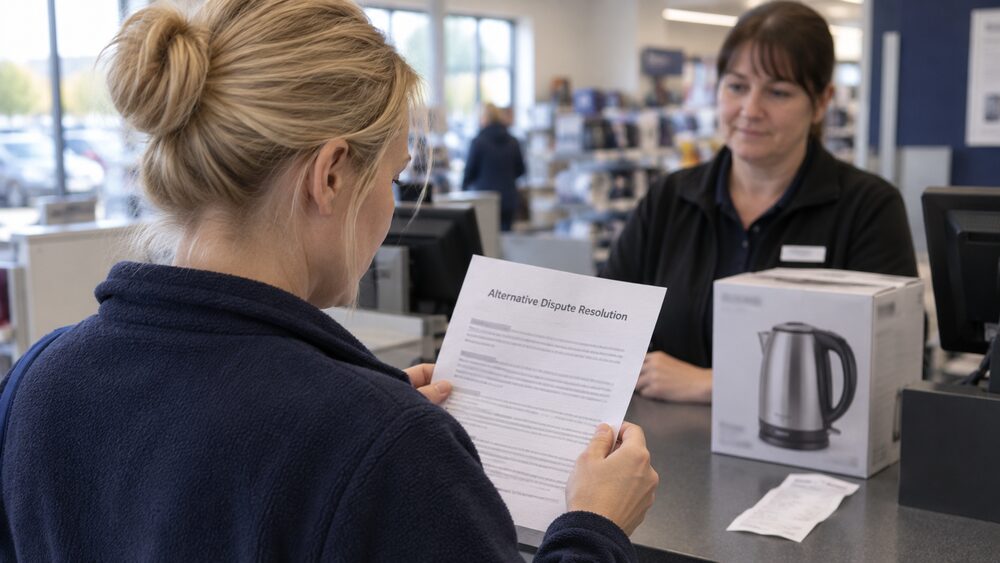
The Consumer Council cannot help consumers who live outside Northern Ireland, unless the complaint is about a flight that departed from or arrived into Northern Ireland4. So a ferry or energy complaint from a Great Britain resident about a Northern Ireland company needs a different route, such as alternative dispute resolution or the courts where you live.
Some processes simply differ by nation. The Claims Management Ombudsman states that in Northern Ireland different rules apply, and if you are in Northern Ireland, or dealing with a claims management company based there, it asks that you let it know32. The Financial Ombudsman Service notes that discrimination law is different in Northern Ireland, but you are still protected and it can still look into your complaint33. State pension claims are handled by the Northern Ireland Pension Centre for people living in Northern Ireland, while people in England, Scotland or Wales must claim via GOV.UK34, and the process for claiming a deferred State Pension is different if you live outside Northern Ireland35.
If your dispute is with a trader and court is the next step, the equivalent processes elsewhere are the small claims court in England and Wales and the simple procedure in Scotland. Our guide to money in Scotland, Wales and Northern Ireland explains more broadly how the rules differ between the nations.
Sources35 cited
- Guarantees and warranties nidirect, 2025-09-12
- Northern Ireland small claims StepChange Debt Charity, 2026-09-25
- Consumer protection rights GOV.UK, 2026-09-25
- Get help with your complaint Consumer Council for Northern Ireland, 2026-09-26
- Ferry travel Consumer Council for Northern Ireland, 2026
- Thinking of suing in court Trading Standards Wales, 2025-03
- A guide for creditors Department for the Economy, 2025-10-01
- Your right to get your data corrected Information Commissioner's Office, 2026-09-26
- Your rights relating to decisions being made about you without human involvement Information Commissioner's Office, 2026-09-25
- Complaints that involve gambling related harm Financial Ombudsman Service, 2026-09-26
- How to complain effectively Consumer Council for Northern Ireland, 2026
- Our complaint handling process Consumer Council for Northern Ireland, 2026
- Shopping safely online Consumer Council for Northern Ireland, 2026
- Contact Consumerline to make a complaint or ask advice nidirect, 2026-09-16
- Loans nidirect, 2025-09-30
- County Down residential agent pleads guilty to misleading consumers and fraud Department for the Economy, 2026-08-21
- The IFR and consumers Payment Systems Regulator, 2026-09-25
- Consumer rights mygov.scot, 2022-07-01
- Citizens Advice Bureau consumer service cases National Audit Office, 2016-12-14
- Check your agent's name GOV.UK, 2025-07-22
- Banking to Borrowing Consumer Council for Northern Ireland, 2026-09
- Complaints about electricity, oil and gas Consumer Council for Northern Ireland, 2026
- Make a complaint to the NI Consumer Council nidirect, 2025-05-06
- Who does what in consumer protection in Northern Ireland Advice NI, 2023-10-25
- Save energy and money Consumer Council for Northern Ireland, 2026
- Water bill health check Consumer Council for Northern Ireland, 2026
- Our complaint handling process Consumer Council, 2026
- Consumer experiences of motor and home insurance in Northern Ireland Consumer Council for Northern Ireland, 2026-06
- Ferry complaints ABTA, 2026
- My ferry has been delayed, what are my rights? ABTA, 2026
- General Consumer Council for Northern Ireland Act 2007 legislation.gov.uk, 2007-07-19
- Claims Management Ombudsman leaflet Claims Management Ombudsman, 2026-09-27
- Complaints that involve discrimination Financial Ombudsman Service, 2026-09-26
- Get your State Pension nidirect, 2026
- Claiming or inheriting a deferred State Pension nidirect, 2026


 Citizens AdviceFree advice on money, consumer and legal problems in England and Wales
 Financial Ombudsman ServiceFree, independent help when a complaint about a firm is not put right
 MoneyHelperFree, impartial money and pensions guidance, set up by government
 Citizens Advice ScotlandFree advice across Scotland