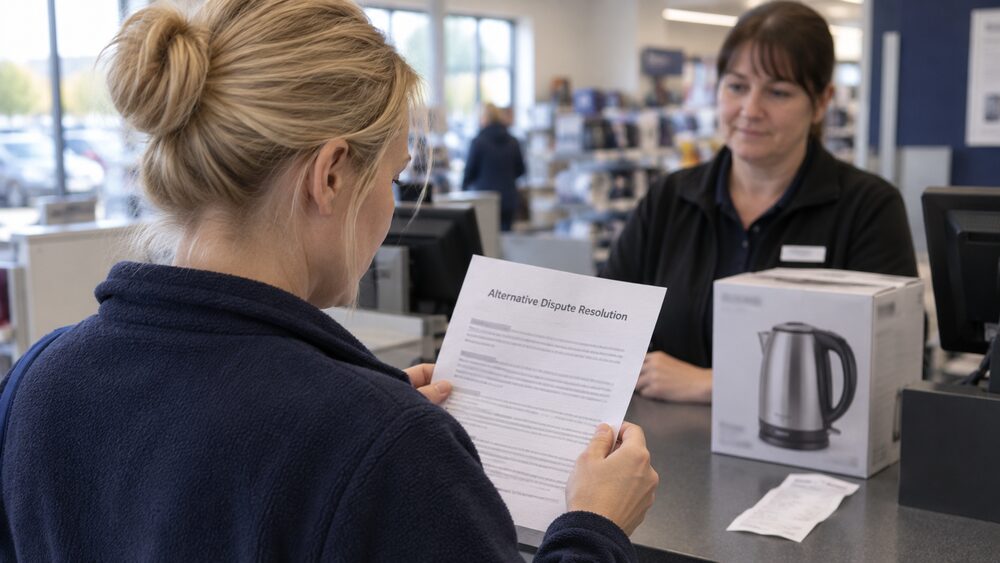
Alternative dispute resolution, usually shortened to ADR, is a way of settling a dispute with a trader without going to court. Instead of a judge, an independent body looks at both sides of the argument and decides what a fair outcome is. ADR covers a range of processes: Parliament's research on the subject lists "direct negotiation, mediation, arbitration, ombudsman schemes, conciliation, or adjudication" as the main forms1. For a consumer with a complaint about a faulty sofa, a botched repair or an online order that never arrived, it usually means handing the dispute to a scheme that specialises in that market.
The main attraction is cost and speed. ADR is "usually a cheaper and quicker route for resolving a dispute than the alternative of beginning legal proceedings in court"1. In some sectors it is free to the consumer, and in a few, including financial services, energy and aviation, the trader is required by law to take part1. In most retail markets, though, a trader cannot be forced into ADR, so the first question is always whether the trader you are dealing with has joined a scheme.
This page explains how ADR works for consumer disputes in the UK: when you can use it, how to check a trader's membership, what a complaint involves, what the scheme can and cannot look at, and what your options are if you do not like the answer.
What alternative dispute resolution is and what it can do for you
ADR is an umbrella term. What the processes on the list have in common is that a third party, independent of both you and the trader, helps settle the dispute instead of a court. Some processes are consensual and advisory: in mediation, a neutral person helps both sides reach their own agreement, and nothing is imposed. Others are decisive: an ombudsman or adjudicator weighs the evidence and issues a decision, which may be binding on the trader if you accept it. The form the process takes matters, because it determines whether you can walk away at the end.
For consumers, the practical benefits are the ones Parliament's researchers set out: ADR is usually cheaper and quicker than court, and in sectors where consumer detriment is high, such as financial services, energy and aviation, it is mandatory for the trader1. A scheme also applies its own standards of fairness rather than only the strict legal position, which can matter where your complaint is about poor service or delay rather than a clear breach of contract.
The UK government consulted on the ADR framework for consumers in 2014, and that consultation has concluded6. The rules that came out of that period, the Alternative Dispute Resolution for Consumer Disputes Regulations 2015, set minimum standards for schemes and duties on traders to tell you about them4. Those regulations were revoked on 6 April 2026 as part of wider reforms to the redress system, which refreshed the grounds on which bodies can dismiss complaints7. The schemes themselves continue to operate, and the practical steps for a consumer are largely unchanged.
Complain to the trader first: the eight-week rule
No ADR scheme will take a dispute straight from the shelf. Consumers who want redress "must, as a first step, use the trader's own internal complaints procedure"1. This is not a formality: the trader gets the chance to put things right, and the scheme gets the trader's response, its files and its final position as the starting material for its own review.
The rule that unlocks the next stage is the eight-week rule. If you complain to a business, "it will need to respond within eight weeks"8. The Financial Ombudsman Service applies the same structure across financial products: complain to the company first, and if it does not send a final response within eight weeks, or you are unhappy with the response, you can bring the complaint to the ombudsman2. nidirect gives the same advice for bank disputes in Northern Ireland: give the bank at least eight weeks to try to resolve the complaint, after which the bank should send a final decision letter telling you how to contact the Financial Ombudsman Service9. The ombudsman can look at a complaint even earlier, but only where the business and its customer both agree10.
Public bodies follow the same pattern. Help to Buy Wales tells applicants that if it cannot provide a final response within the eight-week time limit, it will send a letter with an update on the investigation and the options for dispute resolution, known as the "eight-week response"11. The same wording appears across the ombudsman's own guidance, from car finance commission complaints to fraud markers and buy now pay later disputes8.
Two things are worth keeping in mind at this stage. First, keep your complaint in writing, or follow up a phone call in writing, because the paper trail is what the scheme will read. Second, the trader's final response is not the end of your statutory rights. Under the Consumer Rights Act 2015, the short-term right to reject and other remedies sit alongside further options, including claiming damages, seeking specific performance, relying on the breach against a claim for the price, and, for breach of an express term, treating the contract as at an end, though not so as to recover twice for the same loss14.
Whether your trader has to take part in ADR
This is the point that most often surprises people. "Traders do not have to agree to use ADR for a consumer complaint (unless it is compulsory for them by law, by trade association membership or by contract)"1. In most retail markets, membership is voluntary, so a trader can simply decline, and the scheme cannot force it to engage.
There are exceptions, and they are significant ones:
- Financial services, energy and aviation: ADR is mandatory in these regulated sectors, where the risk of consumer detriment is high1.
- Letting and estate agents: they must by law join a Government-approved redress scheme, though the law gives them some choice about which scheme to join1.
- Trade association members: some associations require their members to use a particular ADR scheme as a condition of membership1.
- Contractual commitments: a contract can bind the trader to ADR, for example an arbitration clause1.
Even where a trader is not obliged to take part, it is not free to stay silent. Traders "are required to provide certain information about ADR to consumers"1. The 2015 Regulations put a duty on every trader, once it has exhausted its internal complaints procedure, to tell the consumer on a durable medium that it cannot settle the complaint, to give the name and website address of a competent ADR entity, and to say whether it is obliged or prepared to submit to ADR3. So a refusal must at least be an open one, in writing, with the scheme named.
The framework is tightening. The Digital Markets, Competition and Consumers Act 2024 prohibits ADR procedures for consumer contracts where the provider of the procedure is not accredited or exempt16. The aim is that when you do use a scheme, it meets minimum standards and has been approved by a competent authority, since a provider of an ADR scheme "must show that they meet certain minimum standards and must be approved by a 'competent authority'"1.
How to check a trader is a member of a scheme
The check starts with the trader's final response letter. When a trader has exhausted its internal complaint handling procedure, the law requires it to inform you, on a durable medium, of the name and website address of a competent ADR entity and whether it is obliged or prepared to submit to that scheme4. If the letter names a scheme, go to that scheme's website and confirm the trader is listed as a member, because membership can lapse or change.
If the letter does not name a scheme, or you have had no letter at all, there are other routes:
- Look up the scheme for the sector. Sectors with mandatory ADR, such as financial services, energy and aviation, have a designated body, and letting and estate agents must belong to a Government-approved redress scheme1.
- Check the trader's own website or terms and conditions for a complaints section naming its ADR body.
- Contact the Citizens Advice Consumer Service, which provides consumer rights information, advice on solving specific problems, signposting and referrals, and an ADR helpdesk function18.
- In Wales, Trading Standards guidance on suing in court and consumer advice pages can help identify the right route15.
One structural point is worth knowing when you check. ADR bodies must be independent: the rules state that an ADR official must not be employed or remunerated directly by a trader who is a party to the dispute, and remuneration must not be linked to the outcome of the procedure4. A scheme run by a trade body can still qualify, provided the person deciding your case is independent in this sense. If you cannot satisfy yourself that the deciding person is independent of the trader, that is a reason to question the arrangement before you commit to it.
Shop and online purchases: using a retail ADR scheme
For ordinary shopping disputes, faulty goods, late deliveries, refused refunds, the route is a retail ADR scheme. Schemes of this kind operate in specific retail markets, and a scheme such as RetailADR handles consumer disputes with traders in the sectors it covers. The pattern for using one is the same as for ADR generally: you complain to the trader in writing first, and you either receive a final written response, sometimes called a deadlock letter, or you give the trader eight weeks to respond, before the scheme will accept the case.
What a retail scheme can do depends on the underlying consumer law, and that law is substantial. For goods that do not conform to the contract, the Consumer Rights Act 2015 gives you the right to repair or replacement, and the right to a price reduction or the final right to reject14. Where a trader has misled you or used aggressive selling, the Digital Markets, Competition and Consumers Act 2024 gives you the right to unwind the contract, the right to a discount and the right to damages19. A retail ADR scheme decides disputes by reference to these rights, so it is worth setting out in your complaint which one you are relying on and what outcome you want.
Cost varies by scheme, and it is one of the first things to check. Some routes are free: the mediation service available for court claims of £10,000 or less in England and Wales states plainly, "This service is free"21, and a mediation service "could be quicker and cheaper than going to court"22. Before sending a complaint to any retail scheme, ask in writing what it charges the consumer, if anything, and whether the trader pays the scheme's costs.
If the trader has not joined a retail scheme and will not agree to take part, your options narrow to negotiation, free mediation where it is available, or a court claim. The guide to small claims court in England and Wales, simple procedure in Scotland and small claims in Northern Ireland covers the court route, and the comparison of the ombudsman versus small claims court sets out how the two differ.
How an ADR complaint works, step by step
The process is broadly the same whichever scheme you use. The trader's own procedure comes first, and the law then requires the trader, once that procedure is exhausted, to inform you on a durable medium that it cannot settle the complaint, to name a competent ADR entity and its website, and to state whether it is obliged or prepared to submit to it3. That letter is your gateway.
In more detail:
- Complain to the trader in writing. Set out what went wrong, what you want, and keep copies. Give the trader up to eight weeks to respond2.
- Get the final response, or run out the clock. The trader either sends a final response naming a scheme, or eight weeks pass without one. Either unlocks the next stage2.
- Check the scheme and the trader's stance. Confirm membership and whether the trader is obliged or prepared to take part3.
- Submit the complaint to the scheme. Schemes accept complaints by post, online and sometimes by telephone. Include the trader's final response, your correspondence, receipts and any evidence of loss.
- The scheme reviews the complete file. Once it has the complete complaint file, it must notify the parties of the outcome within 90 days, though the period can be extended for highly complex disputes, with notice to the parties4.
- You accept or reject the outcome. See the next section.
The 90-day period is a legal requirement on the scheme, not a promise of a fixed date, and the clock starts from the complete complaint file, not from your first email. Sending everything at once, the final response letter, the correspondence, proof of purchase and your statement of loss, is the single most useful thing you can do to keep the case moving.
Accepting or rejecting a decision
When the scheme issues its decision, the choice is yours. If you accept it, the dispute is settled on those terms, and where the scheme is binding on the trader, the trader must comply. If you reject it, nothing has been imposed on you, and your legal rights are intact.
The Financial Ombudsman Service puts the position plainly for its own decisions:
"If you aren't happy with our final answer, we can't help you anymore. But you can take your complaint to court if you want."5
That logic carries across ADR generally: rejecting the outcome leaves the dispute unresolved, and court remains open. The trade-off is that court starts from the beginning, with its own costs, procedures and time limits, and ADR's advantage of being "usually a cheaper and quicker route" than court is lost1.
Some schemes build a response period into their process. Under the FCA's consumer redress rules on motor finance commission, an early settlement offer gives the consumer one month to respond26, and a lender that receives an objection must undertake one of the specified actions within two months of receiving the further details of the objection, or of the expiry of that one-month period if no details are received26. Deadlines of this kind are common, so read the decision letter for any time limit on accepting.
Appeal routes from ADR decisions are limited. There is no general appeal from an ombudsman's final decision to another body; the alternative is court. Where the dispute is about the scheme's own approval or accreditation, the legislation allows an applicant or operator to appeal against refusal, cancellation or a penalty to the Tribunal, which must apply the same principles as a court on judicial review27, but that route is for the scheme operator, not the consumer. If you believe the scheme mishandled your case, the recourse is a complaint to the scheme itself, or to the body that accredits it.
Deadlines: 12 months from the trader's final response
The deadline that matters most is the one that starts when the trader declares deadlock. The prescribed period is "12 months from the date on which the trader informs the consumer that the trader is unable to resolve the consumer's complaint"3. The Regulations require the scheme's own submission period to be not less than 12 months from that notice date20. In practice, you have at least a year from the deadlock letter, but no scheme has to accept a complaint after its stated period, and the scheme can refuse a dispute that was submitted outside it4.
Other time limits sit alongside this one:
| Deadline | Period | Where it applies |
|---|---|---|
| Trader's final response | eight weeks from your complaint | Before most schemes will act8 |
| Scheme submission | at least 12 months from the trader's deadlock notice | Bringing the complaint to the scheme3 |
| Scheme outcome | 90 days from the complete complaint file, extendable for complex cases | The scheme's decision4 |
| Financial Ombudsman referral | six months from the business's final response | Financial services complaints29 |
The six-month rule for the Financial Ombudsman Service is the one that catches people out after a retail dispute has been refused: "You must contact us within 6 months from getting the final response from the business"29. The ombudsman's own history shows the 90-day discipline is not new: it has given its answer to complaints within 90 days since the EU directive on ADR came into force in July 201530.
One recent change to know about: the Alternative Dispute Resolution Regulations 2015 were revoked on 6 April 2026, and the Financial Ombudsman Service's policy statement records the refreshed dismissal grounds that followed7. If you started a complaint under the old rules, check with the scheme how the change affects your case, and in any event do not let the 12-month period run down while you wait.
What ADR schemes will not look at
Schemes can refuse a dispute, and the law sets out the grounds. A body may refuse where the consumer did not first contact the trader, where the dispute is frivolous or vexatious, where it has already been considered by another court or ADR procedure, where the value falls outside the scheme's monetary thresholds, or where the complaint was submitted late, that is, outside a period that must be at least 12 months from the trader's deadlock notice4.
In practical terms, the common refusals are:
- No complaint to the trader first. Skipping the trader's own procedure is the most frequent reason a scheme will not engage1.
- Already litigated or mediated. A dispute previously considered by a court or another ADR procedure can be refused4.
- Outside the scheme's value limits. Schemes set monetary thresholds, and a claim above them can be refused4.
- Out of time. Complaints submitted after the scheme's period, which must be at least 12 months from the deadlock notice, can be refused4.
- Frivolous or vexatious. A dispute with no reasonable basis can be refused4.
Some bodies are also clear about what falls outside them entirely. The Adjudicator's Office, which looks at complaints about HMRC, states that it cannot reconsider "the formal decision made as part of the Alternative Dispute Resolution process"31. In Scotland, a bankruptcy decision such as the approval or refusal of discharge has its own review process through the Accountant in Bankruptcy rather than a consumer ADR route32. The general lesson is to confirm the scheme's scope before you invest time in a complaint, and the page on which ombudsman handles which complaint maps the main bodies.
Other sectors with their own schemes
Beyond retail, several sectors run their own independent dispute resolution, and knowing which one applies is half the battle.
Financial services is the largest. The Financial Ombudsman Service is the ADR body for banks, insurers, lenders and pension providers, and participation is mandatory1. Its decisions can include compensation for distress and inconvenience, not just the financial loss itself. In one case study, the ombudsman "told the lender to pay him compensation for the distress and inconvenience he'd experienced"33; in another, involving home emergency cover, it asked the insurer "to reimburse Alex and Sarah for the extra cost of the heating bills and the electric heaters"34. The guides to complaining about a bank and taking a complaint to the ombudsman cover that route in detail.
Housing and home buying. Help to Buy Wales runs its own complaints process with the eight-week response structure described above11. Builders of new homes are covered by housing redress schemes, and complaints about stress, inconvenience and extra costs can succeed where the scheme has power over the builder33.
Government-run redress schemes. The Horizon Convictions Redress Scheme runs a two-stage ADR process for claimants who opted for detailed assessment and cannot agree an offer: stage 1 is case management and facilitated discussions, where Dentons mediates conversations between the claimant and the department, and stage 2 is an independent panel that assesses the case and makes a recommendation on the redress payable35.
Benefits and insolvency. A closed claims review for New Style Jobseeker's Allowance asks specific questions, including whether you knew the claim was closed, how you found out, what action you took and how you supported yourself afterwards36. Complaints about insolvency practitioners go through a gateway, but the responsibility for providing evidence falls on the complainant, though the gateway can access open source documentation such as Companies House filings37.
PPI-style "alternative redress". Where a single-premium policy was mis-sold, the approach may be to compensate the consumer by putting them back in the position they would have been in with a regular-premium policy instead, with the regulator's guidance indicating an alternative regular-premium policy would have cost £9 per £100 of benefit38. This is a redress calculation rather than a dispute route, but it shows the kind of outcome ADR bodies in financial services reach.
Disputes with HMRC
Tax disputes have their own ADR arrangement. HMRC guidance states: "You can apply for alternative dispute resolution if you do not agree with our decision"39. It can also be used during a compliance check, without affecting your right to appeal the underlying decision39. ADR with HMRC is voluntary, and it does not replace the formal appeals process; if it does not settle the matter, the appeal route is still there.
Two boundaries are worth knowing. First, the Adjudicator's Office handles complaints about HMRC's handling of your affairs, its service and its staff, but it cannot look at the formal decision made as part of the ADR process itself31. Second, a tax dispute is about the tax, not a consumer purchase, so consumer ADR schemes and the Financial Ombudsman Service have no role. If your HMRC complaint is about poor handling rather than the tax calculation, complain to HMRC first, then to the Adjudicator's Office31.
Where to get free help
You do not have to work out the route alone, and the main sources of help are free. The Citizens Advice Consumer Service provides pre-shopping tips, information on consumer rights, advice on solving specific problems and on general consumer matters, energy and post, signposting and referrals to other organisations, and an ADR helpdesk function18. In Wales, Trading Standards publishes consumer advice covering the court alternative and related problems15. For court claims of £10,000 or less in England and Wales, the free mediation service is available alongside the claim21, and the government's guidance on options when you are owed money sets out the routes including mediation22.
For financial complaints specifically, the Financial Ombudsman Service is free to consumers and provides its own complaint form and guidance on how to complain2. The pages on how to complain to a financial firm and the eight-week rule cover that process, and the wider guide to consumer protection in UK financial services puts the pieces together.
Sources39 cited
- Alternative dispute resolution for consumers, Commons Library research briefing CBP-7336 UK Parliament, 2026
- Transfers from personal pension arrangements: how to complain Financial Ombudsman Service, 2026
- The Alternative Dispute Resolution for Consumer Disputes (Amendment) Regulations 2015 legislation.gov.uk, 2015
- The Alternative Dispute Resolution for Consumer Disputes (Competent Authorities and Information) Regulations 2015 legislation.gov.uk, 2015
- Financial Ombudsman Service consumer leaflet, easy read Financial Ombudsman Service
- Alternative dispute resolution for consumers consultation, Ref BIS/14/594 GOV.UK, 2014
- Modernising the Redress System policy statement Financial Ombudsman Service, 2026
- Complaints about car finance commission Financial Ombudsman Service, 2025
- Overdrafts and other bank debts nidirect, 2025
- ADR: the Financial Ombudsman Service's role Financial Ombudsman Service, 2026
- Help to Buy Wales: complaints Welsh Government, 2026
- Fraud markers: how to complain Financial Ombudsman Service, 2026
- Buy now pay later: how to complain Financial Ombudsman Service, 2026
- Consumer Rights Act 2015, section 19 legislation.gov.uk, 2026
- Thinking of suing in court: Trading Standards Wales consumer advice Trading Standards Wales, 2025
- Digital Markets, Competition and Consumers Bill 2022-23, Commons Library briefing CBP-9781 UK Parliament, 2026
- Digital Markets, Competition and Consumers Act 2024 legislation.gov.uk, 2024
- Citizens Advice Bureau Consumer Service cases, National Audit Office report National Audit Office, 2016
- Anglesey Council Trading Standards consumer advice Isle of Anglesey County Council
- Schedule to the ADR for Consumer Disputes Regulations 2015 legislation.gov.uk, 2015
- Options if you're owed money GOV.UK, 2026
- Make a court claim for money GOV.UK, 2026
- Making a complaint about a creditor StepChange, 2026-09-25
- How to complain about building work Which?, 2025-12-08
- Solve an ongoing consumer problem Citizens Advice, 2019-09-26
- CONRED 6: motor finance commission consumer redress scheme rules FCA Handbook, 2026
- The ADR for Consumer Disputes (Amendment) Regulations 2015, appeals legislation.gov.uk, 2015
- Schedule 4 to the ADR for Consumer Disputes (Amendment) Regulations 2015 legislation.gov.uk, 2015
- How to complain: consumers, video transcript Financial Ombudsman Service, 2026
- Financial Ombudsman Service annual review 2015/16 Financial Ombudsman Service, 2016
- How to complain to the Adjudicator's Office about HMRC or the VOA GOV.UK, 2019
- What if I am unhappy with a decision made by my trustee or AiB Accountant in Bankruptcy, 2024
- Case study: lender didn't say early repayment charge Financial Ombudsman Service, 2026
- Case study: home building insurance Financial Ombudsman Service, 2026
- Horizon Convictions Redress Scheme: applying for financial redress GOV.UK, 2024
- New Style Jobseeker's Allowance closed claims review GOV.UK, 2026
- Insolvency practitioners: guidance on how to complain GOV.UK, 2025
- Ombudsman approach to redress for mis-sold PPI policies Financial Ombudsman Service, 2026
- HMRC compliance checks: help and support GOV.UK, 2021





 Citizens AdviceFree advice on money, consumer and legal problems in England and Wales
 Financial Ombudsman ServiceFree, independent help when a complaint about a firm is not put right
 MoneyHelperFree, impartial money and pensions guidance, set up by government
 Citizens Advice ScotlandFree advice across Scotland