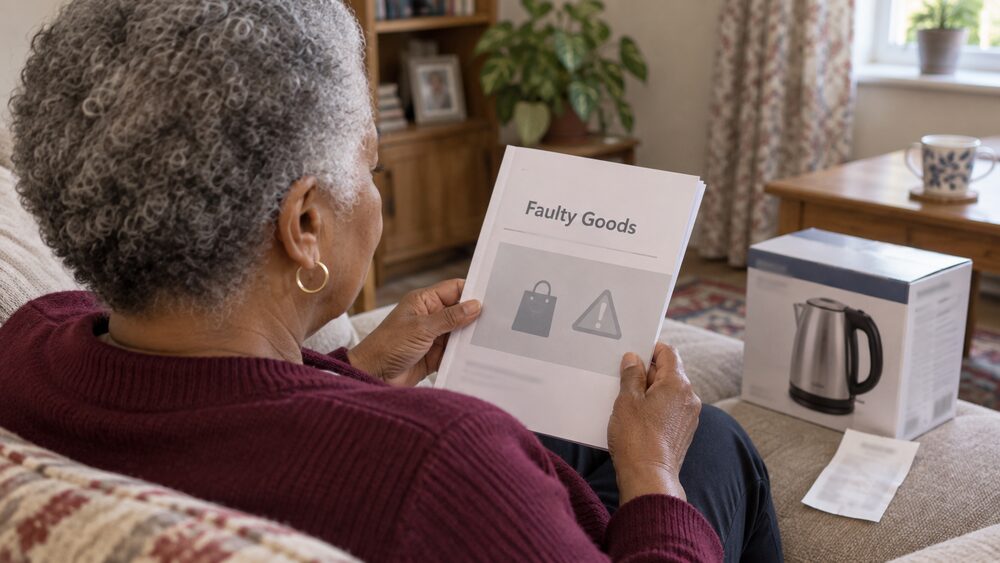
If something you have bought is faulty, you have the right to claim a refund, repair or replacement depending on how long you have had the item1. The rule that decides which of those you can ask for is the 30-day right to reject: return a faulty item within 30 days of receiving it and you are entitled to a full refund, whatever the retailer's own returns policy says2.
If something you have bought is faulty, you have the right to claim a refund, repair or replacement depending on how long you have had the item1. The rule that decides which of those you can ask for is the 30-day right to reject: return a faulty item within 30 days of receiving it and you are entitled to a full refund, whatever the retailer's own returns policy says2.
After those first 30 days, the retailer must be given the opportunity to repair or replace the faulty goods before you can claim a refund3. And after the first six months, the burden of proof switches to you: you would need to show the fault was present when you bought the item2.
The rights come from the Consumer Rights Act and apply to goods that are of unsatisfactory quality, unfit for purpose or not as described4. They cover new and used goods, in-store and online purchases, and cars bought from a dealer5.
Your rights when goods are faulty: refund, repair or replacement
The Consumer Rights Act gives you the right to make a claim for a refund, repair or replacement depending on how long you have had the faulty item1. The three tests goods must meet are that they are of satisfactory quality, fit for purpose, and as described4. If what you have bought fails any one of those, you have a claim against the retailer1.
The remedy you can ask for changes over time. In the first 30 days you can reject the goods and get your money back. Between 30 days and six months, the retailer has the right to attempt a repair or replacement first. After six months, you can still claim, but you carry the burden of proving the fault was there from the start7.
Some faults fall outside these rights. If the item was damaged by wear and tear, an accident or misuse, the retailer is not responsible4. The same applies if the fault is simply that you have changed your mind, which is a different situation with different rules.
If your order arrives damaged or faulty, you have the right to refuse it and get a refund, repair or replacement10. Faulty downloads are covered too: if you are having a problem with a faulty download you may be able to claim a refund, repair or replacement under the Consumer Rights Act11.
The 30-day right to reject: a full refund
You have 30 days from taking ownership of a product, which could be the date of purchase or the date it was delivered to you, whichever is later7. Within that window you have the legal right to a refund if you return your faulty item, regardless of what the retailer's returns policy says2. You get a 30 day right to reject the faulty product and get a full refund, and the retailer should cover the cost of the return3.
The 30 days runs from the day after the goods were supplied under official guidance12. If you exercise your short-term right to reject for a refund, that is, to reject the goods within 30 days, you are entitled to your money back13.
The right applies to a wide range of goods. It covers refurbished products bought from an online retailer or a physical store2. It covers a faulty car bought from a dealer: the Consumer Rights Act gives you an initial 30 days to reject the vehicle if it is faulty and claim a full refund6. It even covers fake goods: you are legally entitled to a full refund on fake goods within 30 days of paying for them14.
There is one important exclusion. This right to a refund does not apply to faulty digital content. For digital content, the retailer has one opportunity to repair or replace it before a refund can be claimed7.
After 30 days: one repair or replacement first
Once the first 30 days have passed, you have to give the retailer the opportunity to repair or replace any faulty goods3. Outside the 30-day right to reject, the consumer must give the retailer one opportunity to repair or replace before claiming a refund7. If more than 30 days have passed since you bought the item that is faulty or not as described, you can ask for a repair or a replacement4.
The retailer must pay the costs of repairing or replacing your faulty item, and must also pay to deliver it back to you7. In the first six months of ownership, the retailer has a legal obligation to cover the cost of returning the faulty item to the manufacturer7.
If the repair or replacement is unsuccessful, you can then claim a refund. No deductions can be made from a refund in the first six months after purchase4. The retailer can make a deduction from any refund for fair use after the first six months of ownership if an attempted repair or replacement fails7.
Motor vehicles are the exception to the no-deduction rule. For motor vehicles, the retailer can make a deduction for fair use after the first 30 days7.
After six months the burden of proof shifts to you
For the first six months, the onus is on the seller to prove your defective product was of satisfactory quality7. A fault discovered within six months of receiving the goods is assumed to have been there when you bought them13. The retailer must prove that the blame was not theirs within 6 months of you receiving the goods15.
After the first six months, the burden of proof switches to you to prove the fault you have found was present at the time you purchased the goods in store, or first took ownership of them if you bought online2. For a vehicle, it will be up to you to prove there was a problem with the vehicle beyond normal wear and tear when it was sold to you6.
This does not mean your rights end at six months. You can raise a problem about a product for up to six years from the date of buying it, regardless of the terms of any guarantee8. Under the law, you have six years to take a claim to court for faulty goods, but there is a shift of responsibility after six months from the retailer to the consumer to prove responsibility for the issue16.
The six-month rule applies to digital content too. If you discover a fault with digital content within six months of the date it was supplied to you, it is assumed the fault was there from the start13.
Paying by card: Section 75 and chargeback as a back-up
If the retailer will not help, the way you paid can give you a second route. Under Section 75 of the Consumer Credit Act, your credit card provider is jointly liable with the retailer if something goes wrong, meaning you can claim a refund if you get faulty goods or your item never arrives. This applies even if you only put part of the cost on the card9.
A Section 75 claim is a legal right for a customer to claim from the card provider if something goes wrong with a purchase. This includes paying a deposit by credit card, even if that is less than £10017. If you bought a faulty item online and paid with a credit card, Section 75 still applies for purchases made from overseas websites3.
Buy now, pay later is covered in some cases. Section 75 of the Consumer Credit Act is available on deferred payment credit agreements, so you may be able to get a refund from the lender if something goes wrong with what you have bought. This is the same protection you would have if you used a credit card18.
Chargeback is the fallback where Section 75 does not apply. It is the route to ask for your money back if you paid with a debit card or charge card, or with a credit card or buy now, pay later and you cannot use Section 7519. If you used a debit card to buy what turned out to be bogus goods or services, or if you used a credit card and the price was less than £100, you may be able to take advantage of the chargeback scheme20.
There is an important difference between the two. There is not an automatic legal right to receive your money back through chargeback rights or Section 75, as this will depend on the supplier's terms and conditions, scheme rules such as Mastercard, Visa or Amex, applicable government laws and regulations, and the approach taken by your card issuer21.
Where to complain if the retailer refuses
Start with the retailer in writing, setting out what is wrong, when you bought the item and what you are asking for. If the retailer refuses to accept your claim, you may need to enforce your rights through the courts22. In England and Wales that means the small claims court; in Scotland the simple procedure; in Northern Ireland the small claims process.
For card payments, the complaint can go to the card provider instead. Consumers may choose to complain to the firm and to seek redress from it, and refer the complaint to the Financial Ombudsman Service if the firm does not satisfy the complaint and it is appropriate23. If you are not happy with the answer you get, or the firm does not reply to you within eight weeks, you can take your complaint to the Financial Ombudsman Service24.
Where a claims company is involved, the regulator is different. Complain to the FCA if you are unhappy with the conduct of a claims company25. In Northern Ireland, Consumerline can refer your complaint to the Trading Standards Service for investigation or the Financial Conduct Authority, which authorises lenders26. In Wales, if you do not accept the findings or offer of redress from Help to Buy Wales, you can refer the complaint to the Financial Ombudsman Service27.
Free, impartial help is available. Citizens Advice and Trading Standards services can explain your options, and the Consumer protection in UK financial services section covers the wider rules on complaints and redress.
Sources27 cited
- What are my statutory rights and when do they apply? Which?, 2026-07-30
- I want to return my goods: what are my rights? Which?, 2026-09-15
- Online shopping: do I have to pay VAT, import and handling costs? Which?, 2025-07-30
- How to complain to a company if you didn't get what you paid for Which?, 2025-07-22
- How to complain about a car dealer Which?, 2026-03-10
- Is there a 14-day cooling-off period when buying a car? Which?, 2026-09-27
- What do I do if I have a faulty product? Which?, 2026-09-01
- Guarantees and warranties nidirect, 2025-09-12
- Should I get a credit card? Which?, 2026-09-18
- My delivery or online order hasn't arrived: what can I do? Which?, 2026-04-14
- Can I cancel an online order? Which?, 2025-07-30
- Remedies and redress: an overview of your key consumer rights Trading Standards Wales, 2025-09
- Getting evidence to prove your claim Trading Standards Wales, 2025-10
- Report fake or counterfeit goods Citizens Advice, 2026-09-25
- Online shopping and parcel delivery rights Consumer Council, 2026
- Product manufacturing complaint not handled as requested Resolver, 2026-09-26
- Before you get work done on your home Citizens Advice Scotland, 2026-09-25
- Buy now, pay later Financial Conduct Authority, 2026-02-11
- Getting your money back if you paid by card or PayPal Citizens Advice, 2026-09-25
- Other problems: consumer advice Isle of Anglesey County Council, 2025-10
- FAQs: chargeback rights and Section 75 UK Finance, 2026
- How to complain if you've been misled by a sale or special offer Which?, 2026-08-20
- FCA Handbook: unfair contract terms Financial Conduct Authority, 2026
- How to switch your bank account Which?, 2026-09-07
- Complain about a claims company GOV.UK, 2026-09-26
- Loans nidirect, 2025-09-30
- Help to Buy Wales: complaints Welsh Government, 2026






 Citizens AdviceFree advice on money, consumer and legal problems in England and Wales
 Financial Ombudsman ServiceFree, independent help when a complaint about a firm is not put right
 MoneyHelperFree, impartial money and pensions guidance, set up by government
 Citizens Advice ScotlandFree advice across Scotland