Owing money to HMRC is different from owing a bank or a credit card company. HMRC is a government department with powers most creditors do not have: it can change your tax code to collect a debt from your wages or pension, take money from your bank account without a court order, and ultimately apply to make you bankrupt. At the same time, it is also one of the more flexible creditors, with an online payment plan you can set up yourself for bills under £30,000, and helplines for people who cannot pay.
The most important thing to know is that HMRC treats tax debts as priority debts. Like council tax and energy arrears, unpaid tax can lead to enforcement that reaches your income, your bank account and in the last resort your home, so it should be dealt with before non-priority debts such as credit cards and loans1. Contacting HMRC early, before the due date if possible, keeps the widest range of options open2.
HMRC has an online tool to help you find the right guidance and support if you owe money for tax or penalties, covering what help is available if you cannot pay on time and what will happen if you do not pay your tax bill3. This page explains the whole picture: why the debt arose, what penalties and interest add, how to pay in instalments, what HMRC can do if you do not, and where free help fits in.
Why you might owe HMRC money
Most people who owe HMRC money did not set out to. The debt usually appears as a letter after HMRC checks its records at the end of a tax year. If you have paid too much or too little tax by the end of the tax year (5 April), HMRC will send a tax calculation letter, known as a P800, or a Simple Assessment letter8. A P800 is sent if HMRC finds a difference between what you paid and what you owed9.
Common triggers sit behind those letters. If your bank or building society tells HMRC you have more than £10,000 in savings interest, HMRC will send you a notice to file a tax return10. HMRC may send a Simple Assessment tax bill if you go over your Personal Allowance and have tax to pay on your State Pension, owe income tax that cannot be automatically deducted, or owe £3,000 or more11. Simple Assessment bills, formally called PA302, are issued when HMRC could not collect the underpaid tax through your tax code12. HMRC works these out using information from employers, pension providers, banks and building societies12.
Self assessment creates debts in a different way: the bill is yours to calculate and pay by the deadline, and anything unpaid or any return filed late starts the penalty process described in the next section. A separate category is the loan charge, which applies to certain disguised remuneration schemes: if you used such a scheme, HMRC may treat the loans as taxable income, and it is aware that contact about these debts, sometimes from third parties, can be unexpected and distressing13. There is a settlement scheme for the loan charge, and contacting HMRC about it does not commit you to settling under its terms15.
If a letter or text about a debt takes you by surprise, check it is genuine before responding. HMRC publishes guidance on checking whether a text message16 or a letter17 you have received from it is genuine, because its name is often used in scams. You can also check your employers, estimated income and tax codes yourself in the PAYE section of HMRC online services or the HMRC app, which is the quickest way to spot a wrong code before it creates an underpayment18.
Penalties and interest when tax is paid late
Two separate things build up on an unpaid tax bill: penalties, which are fixed charges, and interest, which accrues on the amount outstanding. For tax years before Making Tax Digital for Income Tax, the payment penalties are 5% of the income tax you owe at that time once you are 30 days late, and 5% again at 12 months late6. Filing penalties are separate: £100 for a return up to 3 months late, and £300 or 5% of the income tax due, whichever is higher, once the return is at least 6 months late6.
For the 2024 to 2025 tax year the first late payment penalty works differently: 2% of what was outstanding at day 15, plus 2% of what was still outstanding at day 30 once you are 31 days or more overdue6. For the 2025 to 2026 and 2026 to 2027 tax years it is 3% on the tax you owed at day 15 if you are 16 to 30 days overdue, and 3% of what was outstanding at day 15 plus 3% of what was still outstanding at day 30 once you are 31 days or more overdue6.
Interest also runs on late payments. HMRC's practice of charging a higher rate of interest on unpaid tax than it pays on overpaid tax reflects commercial practice and is in line with tax authorities in other jurisdictions such as Australia, Canada and New Zealand20. The practical effect is that a tax debt grows the longer it is left, so the cheapest option is almost always to deal with it early, even if that means arranging to pay in instalments rather than in one go.
Paying in instalments: up to 12 months online for bills under £30,000
If you cannot pay your self assessment bill in one go, HMRC's online service lets you set up a payment plan yourself, provided you owe less than £30,000 and plan to pay the debt off within the next 12 months or less4. The same terms are described for Scotland: the online plan covers bills under £30,000 spread over up to 12 months6. This is the nearest thing HMRC has to a self-service "time to pay" arrangement, and it does not require a phone call.
Larger bills, or debts you need longer to clear, are handled by talking to HMRC. There is no limit on the amount of time HMRC can give you to pay a debt4. Repayment plans of up to 10 years can be agreed, usually with no more information needed, if you are paying more than £10 a month5. Even if you can only afford less than £10 per month, HMRC may still agree if the debt can be paid off in under three years5. Where you cannot afford £10 a month and the debt will take longer than three years to pay off, HMRC may agree to put the debt on hold for 12 months5.
Two conditions shape what HMRC will accept. First, HMRC will not agree to a payment plan if your returns are outstanding, so filing everything comes before negotiating21. Second, where you have other debts, HMRC will usually expect you to pay 50% of the money you have available for your creditors each month towards the arrangement4. That figure comes from the budget a debt adviser would help you build, using a standard financial statement: see budgeting for repayments for how that works.
If you cannot afford to pay within 30 days, call HMRC on 0345 302 14295. The same number is the helpline for asking HMRC to stop recovering a tax credit overpayment22. Contact HMRC as soon as possible if you have missed a tax deadline or know you will not be able to pay a tax bill on time2.
What to do if you cannot afford to pay at all
Some people cannot afford anything like a full payment plan, and HMRC has a process for that too. It can agree not to pursue a tax debt, sometimes called remission, where two things apply: you have very little or no spare income after your essential household bills and this is likely to continue for a long time, and you have no assets which could be sold to raise money to help clear the debt22. It is important to understand what this means: HMRC will not formally write off a tax debt in these circumstances, but may agree not to pursue it based on your circumstances22. The debt still technically exists.
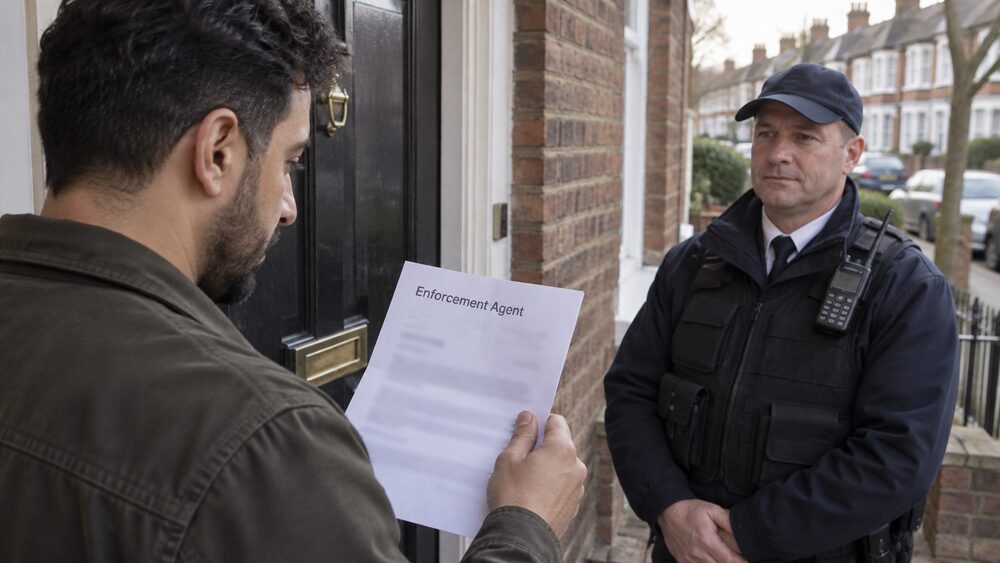
If HMRC decides to pursue the debt instead, its enforcement actions include passing the debt to a debt collection agency, taking you to court for a County Court judgment (CCJ) or decree, and sending bailiffs (enforcement agents) or sheriff officers to your home5. In England or Wales, HMRC can apply for a CCJ and can apply to make you bankrupt over unpaid tax, VAT or National Insurance1. A striking feature of HMRC debts is that some enforcement does not need a court order at all, unlike most consumer debts1.
Before enforcement gets that far, the free options are worth using. A free debt adviser can help you build a budget, negotiate with HMRC and check whether a formal debt solution would deal with the tax debt. The main formal solutions are described in debt solutions across the UK: a debt management plan, an individual voluntary arrangement, a debt relief order or bankruptcy, or in Scotland a protected trust deed, sequestration or the Debt Arrangement Scheme. Which of these can include a tax debt, and on what terms, varies, so advice matters here more than in most debt situations.
Tax credit overpayments are still collected after tax credits ended
Tax credits have now ended and you cannot make a new claim for Child Tax Credit or Working Tax Credit7. But the ending of the benefit did not end the debts: tax credit overpayments are owed to and collected by HMRC, and they are still being recovered21. An overpayment arises where HMRC paid you too much, typically because your earnings were more than it thought5.
If you moved to Universal Credit, HMRC will have sent you a letter called "Your Tax Credits over-payments" (TC1131)23. From that point the position can change hands: HMRC is likely to move the debt to the Department for Work and Pensions (DWP) to recover as though it were a Universal Credit overpayment, unless there is an ongoing dispute or mandatory reconsideration21. Deductions from Universal Credit are covered in more detail in benefit overpayments and deductions from benefits.
Recovery methods include deductions from an ongoing tax credits claim or Universal Credit claim, reducing your tax code, the same enforcement methods as a tax debt, or agreed deductions from your benefits in writing21. HMRC can continue to reclaim tax credit overpayments while it reviews your dispute, so disputing does not pause collection on its own5.
There are two important limits on recovery. HMRC may agree not to recover the overpayment if it was caused by a mistake by HMRC and you followed the rules for reporting mistakes and changes in circumstances21. And in cases of hardship, or if you have mental health issues, you can ask that the overpayment be written off, with a budget and evidence of physical or mental health problems21. HMRC runs a special payment helpline on 0345 302 1429 for exactly this kind of request22.
How HMRC collects unpaid tax: bank accounts, wages and tax codes
HMRC's collection powers are what mark a tax debt out from ordinary consumer debts. The gentlest route is through your tax code. If you are employed or get a pension, HMRC will usually collect tax on savings interest through your tax code, adding an estimated amount for the current tax year based on information your bank or building society gave it for the previous year10. Underpayments found at year end are often collected the same way in the following year.
Where the tax code cannot be used, HMRC sends a Simple Assessment bill12. Beyond that, the powers get sharper. If you owe HMRC at least £1,000, it can ask your bank whether there is any money in your account to pay the debt4. It does not need a court order to do this, and money can be taken from individual, joint and business accounts21. This is the answer to one of the most common worries people have about HMRC debts, and it is why tax debts belong in the priority category.
Other unpaid charges follow the same route. HMRC can collect Lifetime ISA withdrawal charges that remain due but unpaid in the same way as tax charged on a formal tax assessment24. And if you do not pay your tax bill, HMRC will take enforcement action to get the money you owe2. In Scotland, the position on avoidance and enforcement is set out on mygov.scot, and Scottish income tax rules mean you must tell HMRC if you change address in Scotland, since where you live affects the rates you pay2.
Bailiffs, sheriff officers and debt collectors: where their powers stop
HMRC often passes debts to debt collection agencies, and it is worth being clear about what those agencies are. They are not bailiffs and have no rights to force entry to your business or home and take goods21. A debt collector can write, phone and ask for payment, but the goods in your home are not at risk from a collection agency acting alone.
Actual seizure of goods is a step HMRC reserves for itself, and it describes its stronger powers as a last resort. These include taking control of goods, summary warrants and court action including insolvency proceedings20. Taking control of goods is the enforcement agent (bailiff) process, and in Scotland the equivalent is diligence carried out by sheriff officers. Your rights at this stage are the same as with any other creditor: enforcement agents must follow set rules about entry, notices and fees, covered in bailiffs and enforcement agents, what bailiffs can take and when bailiffs can force entry, with the Scottish equivalents in diligence in Scotland.
If a debt collector is chasing you, the rules on contact and harassment apply as they do to any other debt: see debt collectors and sold debts and when a debt collector calls, visits or threatens you. One difference from consumer debts is that HMRC debts do not need a court order before some enforcement steps1, so the sequence of letters and claims you would expect from a bank does not always appear.
Where bankruptcy and court action come in
If a tax debt stays unpaid, HMRC can escalate to the courts. For income tax debts, HMRC passes cases to its Enforcement and Insolvency Service office in Worthing4. If you owe less than £2,000 of income tax, in some situations HMRC could recover the debt through the magistrates' court4. Larger debts go through the civil courts: in England or Wales HMRC can apply for a CCJ and, for tax, VAT or National Insurance, can apply to make you bankrupt1.
The bankruptcy route follows a set sequence. A creditor, including HMRC, can serve a statutory demand, and if the debtor ignores it or cannot repay the money, the creditor can apply to a court to make someone bankrupt or get a company wound up26. To bankrupt someone because they owe money, the creditor must present a bankruptcy petition to a court, check for other bankruptcy petitions against the debtor, fill in the forms and deliver them to the court27. Bankruptcy in England and Wales is covered in full in bankruptcy, with separate pages for Northern Ireland and sequestration in Scotland.
Bankruptcy does write off the debt, but at a heavy price: your assets, potentially including your home, pass to a trustee and the record stays on your credit file. That is why it sits at the end of HMRC's process rather than the beginning, and why getting advice before matters reach this stage matters. The comparison pages on IVA or bankruptcy and sequestration or the Debt Arrangement Scheme set out the alternatives side by side.
Extra help if your health or circumstances make dealing with HMRC hard
HMRC's own guidance recognises that not everyone can deal with a tax debt in the standard way. Its support covers getting extra support due to your health or personal circumstances, disagreeing with a tax decision or penalty, what help is available if you cannot pay your tax on time, and what will happen if you do not pay your tax bill3. If a bereavement is involved and you cannot call the helpline, you must fill in form P1000 to tell HMRC who is dealing with the money, property and possessions of the person who died3.
For tax credit overpayments specifically, hardship and health evidence can change the outcome: HMRC can consider writing off all or part of the debt in cases of extreme hardship, or where there is evidence of mental health problems21. The same principle applies to tax debts through the remission process described above, where a budget and evidence of your circumstances must be shown22.
Two further protections exist whatever the debt. Breathing Space, the 60-day protection from creditor action, applies to qualifying debts, and there is a separate mental health crisis Breathing Space: see Breathing Space and mental health crisis Breathing Space. Free debt advice charities can also deal with HMRC for you, and debt and mental health explains how health evidence is used in debt negotiations generally.
Disputing what HMRC says you owe
If you think the amount is wrong, say so, but expect collection to continue meanwhile. For a tax credit overpayment, use Form TC846 to dispute it21; HMRC can continue reclaiming the overpayment while it reviews your dispute5. For tax credit overpayments arising after a move to Universal Credit, contact HMRC25. If HMRC is running a compliance check into your affairs and you think it should stop, write to HMRC to tell them why3.
For income tax, the starting point is the P800 or Simple Assessment letter itself. If you pay too much under a Simple Assessment, you will need to contact HMRC for a refund12. If a dispute cannot be resolved with HMRC, the next step is an appeal to the First-tier Tribunal (Tax Chamber). For indirect taxes such as VAT or customs duties there is a pre-appeal rule: you must either pay or deposit the tax in dispute, or make a hardship application to HMRC explaining why paying first would cause you difficulty, before submitting the appeal28.
A few practical points strengthen a dispute. Check the tax code HMRC used, in the PAYE section of HMRC online services or the HMRC app18. Check that the letter is genuine17. And keep paying what you do not dispute, since undisputed amounts still attract penalties and interest while the dispute runs.
Council tax is not an HMRC debt
People sometimes assume HMRC collects all government debts, but council tax arrears belong to your local council. Council tax is a priority debt7, and in Scotland the council can ask a sheriff officer to take the money you owe from your earnings or bank account7. The enforcement route is the court system, not HMRC's powers, and the detail is in council tax arrears.
The stakes are high enough to be worth knowing: in England, you can go to prison for non-payment of council tax arrears, criminal fines and maintenance1. That is a consequence of the court process for those specific debts, not of owing HMRC money. If you have both a tax debt and council tax arrears, both are priority debts and a debt adviser can help you split limited money between them; priority and non-priority debts explains how that works.
Making Tax Digital and self-employed tax debts
Making Tax Digital for Income Tax changes how the self-employed and landlords report, and it interacts with debts in two ways. From 6 April 2026 onwards, HMRC is introducing a requirement for some sole traders and individual landlords to use Making Tax Digital6. From September 2026, HMRC may sign someone up automatically where it is aware that the person was required to register for the 2026 to 2027 tax year and has not done so4. The scheme extends to those with qualifying income over £30,000 from April 2027 and over £20,000 from April 20284.
Second, the penalty regime differs between tax years, as set out above: the older 5% penalties for non-MTD tax years, and the day 15 and day 30 percentage penalties for the 2024 to 2025 tax year onwards6. Which regime applies to your bill depends on the tax year it relates to, so check the letter before assuming what the penalties will be.
Being signed up for Making Tax Digital does not create a debt by itself, but it does mean quarterly reporting, and people who fall behind on reporting tend to fall behind on payment too. If a Making Tax Digital bill arrives that you cannot pay, the options in this page apply in full: the online plan for bills under £30,000, the helpline on 0345 302 1429 for anything else, and free debt advice if neither is affordable4.
Sources28 cited
- What debts to pay first StepChange Debt Charity, 2026-09-25
- Avoid problems paying your tax bill mygov.scot, 2024-08-02
- Find out what to do if you owe money to HMRC GOV.UK, 2025-08-18
- Income tax debt (England and Wales) Business Debtline, 2026-09-26
- Tax credit overpayments StepChange Debt Charity, 2026-09-25
- Income tax debt (Scotland) Business Debtline, 2026-09-26
- Council Tax if you cannot pay mygov.scot, 2026-04-01
- Check your Income Tax for the current year: overpayments and underpayments GOV.UK, 2026-09-25
- Common letters from HMRC HMRC, 2026-09-28
- How you pay tax on savings interest GOV.UK, 2026-09-28
- Understanding tax and your pension GOV.UK, 2025-03-27
- Understand your Simple Assessment tax bill GOV.UK, 2026-09-25
- Loan schemes and the loan charge: an overview GOV.UK, 2026-06-03
- The loan charge GOV.UK, 2026-07-17
- Find out about the loan charge settlement scheme GOV.UK, 2026-07-17
- Check if a text message you've received from HMRC is genuine GOV.UK, 2026-09-18
- Check if a letter you've received from HMRC is genuine GOV.UK, 2021-07-30
- Tell HMRC if you have a new job or more than one job GOV.UK, 2025-01-16
- Late tax returns and penalties Which?
- Collecting tax debts as we emerge from coronavirus HMRC, 2021-06-30
- Your priority debts (Scotland) Business Debtline, 2026-09-26
- Tax credit overpayments (Scotland) Business Debtline, 2026-09-26
- Money taken from your Universal Credit payments nidirect, 2026-05-15
- Lifetime ISA withdrawal charges and charge-free withdrawals GOV.UK, 2022-04-06
- Who to talk to about deductions from your Universal Credit nidirect, 2026-06-30
- Options if you're owed money GOV.UK, 2026-09-27
- Apply to bankrupt someone GOV.UK, 2026-09-27
- How to appeal to the First-tier Tax Tribunal GOV.UK, 2026-06-22



 StepChangeFree debt advice and solutions from a charity
 National DebtlineFree debt advice by phone, webchat and online
 MoneyHelperFree, impartial money and pensions guidance, set up by government
 Citizens AdviceFree advice on money, consumer and legal problems in England and Wales
 Citizens Advice ScotlandFree advice across Scotland