
A debt collector who calls, writes or knocks on your door has real powers, but they are narrower than the letters often suggest. A collector can visit you at home, speak to you discreetly about the debt, try to set up a payment arrangement and ask you to pay them. They cannot force entry to your house, take anything from it, demand cash payments from you, or threaten and harass you1. Harassment by creditors is a criminal offence, and it may count as harassment if the people you owe call you too often4.
A debt collector who calls, writes or knocks on your door has real powers, but they are narrower than the letters often suggest. A collector can visit you at home, speak to you discreetly about the debt, try to set up a payment arrangement and ask you to pay them. They cannot force entry to your house, take anything from it, demand cash payments from you, or threaten and harass you1. Harassment by creditors is a criminal offence, and it may count as harassment if the people you owe call you too often4.
If a collector is pressuring you, the first thing worth knowing is that free, confidential and independent debt advice exists, and it does not cost anything. National Debtline, run by the Money Advice Trust, has been giving free professional debt advice for over 30 years and helps more than 100,000 people each year6. Its freephone number is 0808 808 4000, open 9am to 8pm Monday to Friday and 9:30am to 1pm Saturday7.
This page sets out what collectors may and may not do, how to tell pressure from harassment, what to do about a visit or a call, and where to get free help, including what National Debtline can and cannot do for you.
What a debt collector can and cannot do
A debt collector is not a bailiff. They have no court order behind them, which is why their powers stop at persuasion. StepChange's guidance is blunt about the limits: a collector cannot take anything from your home and cannot force you to make a payment2. Age UK's summary of the rules is the same: debt collectors cannot force entry to your house, take anything from it, or demand cash payments from you3.
What they can do is more limited than the tone of their letters. They can visit you at home, speak to you discreetly about your debt, try to set up a payment arrangement, and ask you to make payment to them2. They are not allowed to threaten or harass you, and they cannot tell other people about your debt without your permission1.
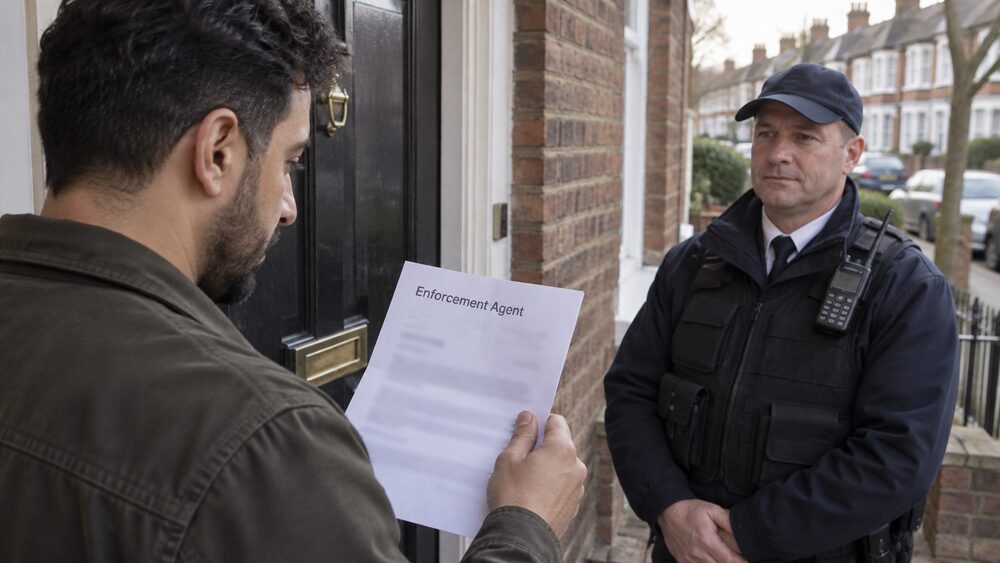
A visit can happen without notice. StepChange confirms that a debt collector can come to your house without notice, though they will usually call or write first2. If someone turns up, you are not obliged to let them in, and you are not obliged to pay them at the door. If you are unsure whether the person at your door is a collector or a bailiff, the two have very different powers, and it is worth checking which one you are dealing with before you say anything.
When calls and letters cross into harassment
Pressure is not the same as harassment, but the line is not as far away as collectors sometimes imply. Citizens Advice states plainly that harassment is a criminal offence, and suggests pointing this out in writing and saying you can take further action if the creditor continues4. StepChange's guidance adds that it may count as harassment if the people you owe call you too often5.
If calls are constant, at unreasonable hours, or made to your workplace or to relatives, that pattern matters. Keeping a log of every call, with the date, time and what was said, gives you something concrete to refer to if you complain to the collector, to the original creditor, or to a regulator. A written request asking a company to deal with you only in writing is a common first step, and National Debtline provides free sample letters you can use to contact them in writing1.
If the debt is not yours, say so. The Credit Services Association's description of the collection process says that where you explain to the adviser on the phone or in writing that the debt does not belong to you, the company will update the records on their database and stop contacting you11. That is a specific route out of the calls, and it works best in writing.
Free help when a debt collector is pressuring you: National Debtline
National Debtline is the specialist free service for people in England and Wales dealing with problem debt, and it is set up for exactly this situation. It describes itself as providing free, impartial debt advice, and as a registered charity it has no commercial interest in which solution you choose12. Its advisers have been helping people get out of debt for over 30 years12.
The service is free at every stage. National Debtline says it is free to use, always9. If you ask it to help you set up a debt management plan, it will not charge you for that help and neither will the DMP provider it works with7. That matters, because fee-charging companies exist in the same market and charge for work that charities do at no cost.
National Debtline is an independent registered charity, authorised and regulated by the Financial Conduct Authority9. It is not a lender, a debt buyer or a lead generator. It also publishes free sample letters you can use to contact creditors in writing, which is often the practical thing a reader needs first1.
Other free services cover the same ground. StepChange offers an online debt advice tool and advice on your circumstances13. Citizens Advice covers harassment by creditors and the action a creditor can take4. For anyone in Scotland, Shelter Scotland provides money and debt advice14, and mygov.scot points to free, confidential and independent debt advice15.
What National Debtline can and cannot do for you
Knowing the limits saves a wasted call. National Debtline cannot help if you do not have debt, cannot speak to the people you owe money to for you, does not give face-to-face advice, does not give money to pay your debts, and cannot give written information in your language16.
What it can do is substantial. It can explain your options, help you work out what you can realistically afford, and talk you through the formal and informal solutions available. It cannot ring the collector on your behalf, but it can tell you what to say and give you the letters to say it in1.
If you have an old debt, timing matters. National Debtline states that if you have not written to a creditor or made a payment towards a particular debt for several years, it can give advice before you write to the creditor or make a payment17. Making contact or a payment on a very old debt can restart the clock on how long a creditor has to pursue it, so advice before acting is one option.
Ways to get advice: phone, webchat and My Money Steps
There are three routes into National Debtline, and they suit different situations9.
- Phone. Call 0808 808 4000, freephone, open 9am to 8pm Monday to Friday and 9:30am to 1pm Saturday7. Best if you want to talk it through with an adviser.
- Webchat. Chat online through the National Debtline website9. Useful if you cannot make a call during opening hours, or would rather not speak aloud.
- My Money Steps. An online tool that works through your situation at your own pace19. If it is not right for you, National Debtline offers phone advice and webchat as alternatives19.
Other free services have their own routes. StepChange offers an online debt advice tool13. The Contact freephone helpline can provide details of both national and local debt advice services, and depending on where you live may put families in touch with a specialist debt counselling service for families with disabled children20.
Debt solutions an adviser can help you arrange
An adviser's value is partly in what they can negotiate. Housing Rights guidance for mortgage holders sets out what you can ask your other creditors to do: stop interest and charges, stop collection agencies recovering debt, accept token payments, and write off the debts21. Not every creditor agrees, but these are the asks an adviser will help you frame.
Debt advisers can help you contact the organisation you owe money to and help you agree a payment plan with them22. Shelter Scotland's advisers go further: they check whether you can claim any benefits and help you apply, look for crisis grants and charity funds, help with budgeting, negotiate with creditors, and recommend formal debt solutions such as a debt management plan23.
The formal options differ by nation, which is why the same advice does not fit everyone. In Scotland, a money adviser may be able to ask creditors to agree to a composition, a partial write off of the debt, and seek an early end to a debt payment programme under the Debt Arrangement Scheme24. In England and Wales, a debt relief order stops creditors contacting you for payment, taking you to court, or sending a debt collector to your home25. Where a debt advice provider considers that a debtor meets the eligibility criteria, the conditions are met and the debts are qualifying debts, it must initiate a mental health crisis moratorium on the debtor's behalf14.
If you owe money to HMRC, the route is different again: free, confidential and independent advice from a debt adviser is available, and HMRC publishes its own guidance on what to do if you owe it money26. Water companies have their own escalation path, which starts with a reminder notice and a phone call before anything more serious28.
Beware callers pretending to be National Debtline
Not everyone who says they are a debt charity is one. The Money Advice Trust warns that some companies cold call people pretending to be National Debtline, Business Debtline or the Money Advice Trust29. The Debt Advice Foundation reports that criminal organisations and unlicensed debt management companies regularly pretend to be charities like it, making unsolicited calls to obtain personal details or sell inappropriate debt solutions30.
Which? has reported specific forms of this, including unexpected calls claiming to be from debt advice companies, impersonations of Citizens Advice, and calls from a debt management company called 'Debt Solutions'31. The pattern is consistent: an unexpected call, a claim to be a charity, and a request for personal or financial details.
There is a second scam risk worth knowing about. People may contact you pretending to be a bank or utility company5. Experian lists debt collection contacting you about bills you do not recognise as a warning sign of identity fraud32. If a collector is chasing a debt you have never heard of, that is a reason to check your credit report as well as to dispute the debt.
Support if you need extra help to communicate
Debt advice is a conversation, and some readers need adjustments to have it. National Debtline cannot give written information in your language, which is a real limit if English is not your first language16. It can still take a call, and a friend, family member or support worker can help.
The Financial Ombudsman Service says you can ask someone else to help you with a complaint or speak on your behalf, and that this might be a friend, family member or support worker33. The same principle applies to a call to a debt charity: you can have someone with you, and you can ask them to speak for you.
If you are helping someone else, National Debtline publishes guidance for people worried about someone else's debt16. Debt advice interviews can also include assisting you with court proceedings, so if the debt has reached court, say so when you make contact34.
Scope's guidance on practical and emotional support when in debt is written for disabled people and covers the extra pressures that come with it22. If your situation involves domestic abuse, Shelter notes that where you do not feel safe to report a change online, you can speak to your work coach on the phone or at the jobcentre35. If your debt is affecting your mental health, that is a reason to ask for help sooner, not a reason to wait.
Where to complain about a debt collector
If a collector has broken the rules, there are routes to complain. Start with the collector and the original creditor in writing, keeping a copy. Citizens Advice suggests pointing out in the letter that harassment is a criminal offence and that you can take further action if the creditor continues4.
If the firm is regulated, the Financial Ombudsman Service can look at complaints about financial businesses, and you can ask someone else to help you with the complaint or speak on your behalf33. For a debt advice provider's own service, each charity has its own complaints procedure: Christians Against Poverty, for example, asks clients to telephone one of their debt advisers at head office or write to its Service Quality and Insight Delivery Manager36.
If you are dealing with a debt that is not yours, or a caller who will not identify themselves properly, the Credit Services Association's process description is a useful reference point for what a legitimate collector should do11. And if you suspect tax fraud rather than a debt, that goes to HMRC's reporting service, where you do not have to give your personal details and any information you do give will be kept private and confidential37.
Sources37 cited
- Can debt collectors come to your house and take your belongings? National Debtline, 2026-09-25
- Home visits from debt collectors StepChange, 2026-09-25
- Debt advice Age UK, 2026-08-26
- Harassment by creditors Citizens Advice, 2026-09-25
- Phone calls about debt StepChange, 2026-09-25
- Becoming debt free National Debtline, 2026-09-25
- Debt management plans National Debtline, 2026-09-25
- Free debt advice contacts Which?, 2025-08-26
- Worried about someone National Debtline, 2026-09-25
- Debt collection process Credit Services Association, 2026
- Getting ready for advice National Debtline, 2026-09-25
- How to do budget planning National Debtline, 2026-09-25
- Writing off credit card debt StepChange, 2026-09-25
- Mental health crisis moratorium regulations legislation.gov.uk, 2026
- More help with money problems mygov.scot, 2025-06-04
- Support resources National Debtline, 2026-09-25
- Work and education StepChange, 2026-09-25
- How we can help you National Debtline, 2026
- My Money Steps National Debtline, 2026
- Dealing with debt Contact, 2025-10-21
- Managing your mortgage and income Housing Rights, 2026
- Practical and emotional advice when in debt Scope, 2026-08-05
- Debt advice Shelter Scotland, 2026-01-16
- Full and final settlement offers National Debtline, 2026-09-25
- Debt transferred while on a TPP StepChange, 2026-09-25
- What to do if you owe money to HMRC GOV.UK, 2025-08-18
- New Style Jobseeker's Allowance nidirect, 2026-09-10
- Problems paying your water bill Ofwat, 2026-09-28
- Making sure it's us Money Advice Trust, 2026
- Debt advice fraud alert Debt Advice Foundation, 2026-02-26
- Debt scam warning Which?, 2025-08-20
- What are the warning signs of identity fraud? Experian, 2026
- Complaints that involve gambling-related harm Financial Ombudsman Service, 2026-09-26
- Meeting your debt adviser Advice NI, 2026
- Ex-partner not paying rent Shelter England, 2026-07-01
- Complaints about debt help Christians Against Poverty, 2026-09-26
- Report tax fraud GOV.UK, 2026-09-25









 StepChangeFree debt advice and solutions from a charity
 National DebtlineFree debt advice by phone, webchat and online
 MoneyHelperFree, impartial money and pensions guidance, set up by government
 Citizens AdviceFree advice on money, consumer and legal problems in England and Wales
 Citizens Advice ScotlandFree advice across Scotland