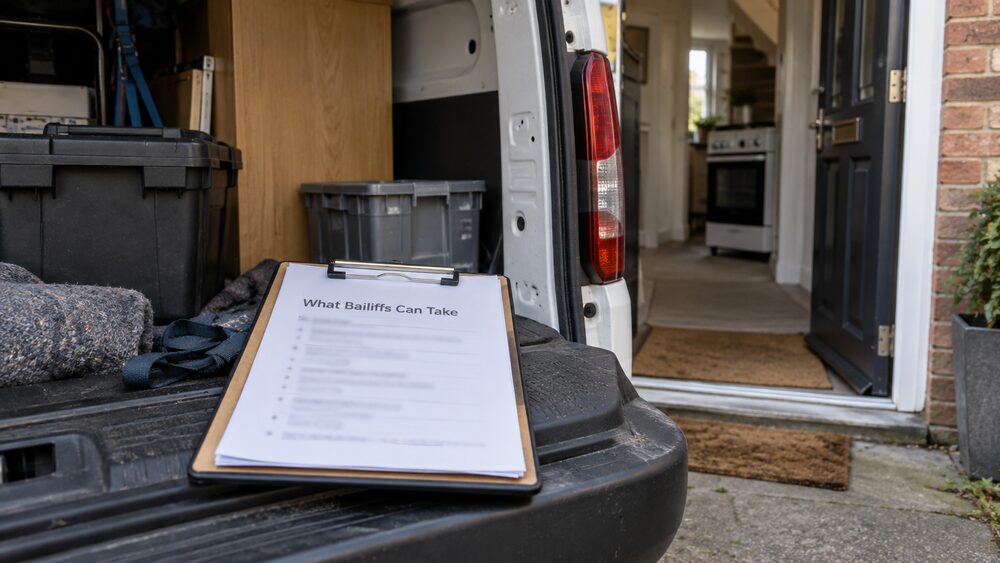
Bailiffs cannot take the things you need to live, such as your clothes, cooker or fridge, and they cannot take work tools and equipment worth less than £1,350. Official guidance sets out that limit for tools and equipment taken together, and the same £1,350 figure appears across county court, High Court, council tax and magistrates' court enforcement1.
Bailiffs cannot take the things you need to live, such as your clothes, cooker or fridge, and they cannot take work tools and equipment worth less than £1,350. Official guidance sets out that limit for tools and equipment taken together, and the same £1,350 figure appears across county court, High Court, council tax and magistrates' court enforcement1.
They also cannot take belongings that are not yours. Things belonging to other people, including the things your children own, are protected, and bailiffs must take reasonable steps to check who owns the things they take4. Only the courts can send bailiffs to visit your home in the first place6.
What follows is what is protected, what happens to other people's belongings in your home, how the rules differ in Scotland, and where to get free advice if a bailiff is already involved.
Goods bailiffs cannot take: essentials, work tools under £1,350 and other people's belongings
The protection list starts with the things a household cannot function without. Official guidance says bailiffs cannot take things you need, such as your clothes, cooker or fridge1. Independent guidance for England and Wales lists cookers, bedding and basic household furniture as items that cannot be taken, and describes the wider rule as covering essential items9. Bailiffs need to leave you with basic household items, and they should only take enough items that will sell to pay off your debt5.
Work tools get a cash limit rather than an outright ban. Tools, books, telephones, computers, vehicles and other equipment necessary for your job, business or education are excluded up to a total value of £1,3502. That same £1,350 limit applies to council tax bailiffs, magistrates' court fines, county court bailiffs and High Court enforcement4. The official wording is that they cannot take "work tools and equipment which together are worth less than £1,350"1. Above that value, the protection does not apply, so a van or set of tools worth more than the limit is not automatically safe.
There is a separate protection for people with health conditions or disabilities. Bailiffs cannot take medical equipment, transport aids and disability equipment such as electric wheelchairs, and they cannot take money from a vulnerable person without giving them the chance for help and advice5. All bailiffs are required to follow The Taking Control Of Goods: National Standards, and must follow codes of conduct14.
Items that belong to someone else in your home
Ownership decides what can be taken, not where an item happens to be sitting. If a bailiff is collecting a debt owed by you personally, they can only take control of goods owned by you16. Things that belong to other people, including the things your children own, cannot be taken4. Bailiffs must take reasonable steps to check who owns the things they take5.
Jointly owned goods sit in the middle. High Court bailiffs can take goods that are jointly owned by you and your partner, but they are only entitled to your share3. In practice that means a bailiff cannot simply treat a jointly owned car or appliance as wholly yours.
The same logic runs through company debts. If a bailiff is collecting a debt owed by a limited company, they can only take goods owned by the limited company16. And enforcement agents or bailiffs may be able to take goods, but only from the person they are court ordered to chase17.
If a debt is not yours at all, that has a direct effect on cost. You cannot be charged fees if you prove the debt is not yours or the bailiffs cannot collect the debt18. Proving ownership usually means paperwork: receipts, bank statements, warranty cards or a hire purchase agreement showing the item belongs to someone else or is still being paid off.
Free debt advice when bailiffs are involved
A bailiff visit is usually the end point of a longer process. A county court judgment lets the creditor ask the court to allow further action to collect the debt, which could include taking money from your wages or sending an enforcement agent to your home19. Council tax works differently: the council can use bailiffs to take your belongings, which will be sold to cover your debt, and the cost of using bailiffs is added to the amount owed20.
That last point matters, because bailiff fees increase what you owe rather than replacing it. Free advice services can help, and there are free advice services available if you are struggling21. In some situations the advice may be to let a bailiff in, for example if they are collecting unpaid magistrates' court fines or debts for HM Revenue & Customs such as income tax debts13. That is a decision to take with an adviser, not on the doorstep.
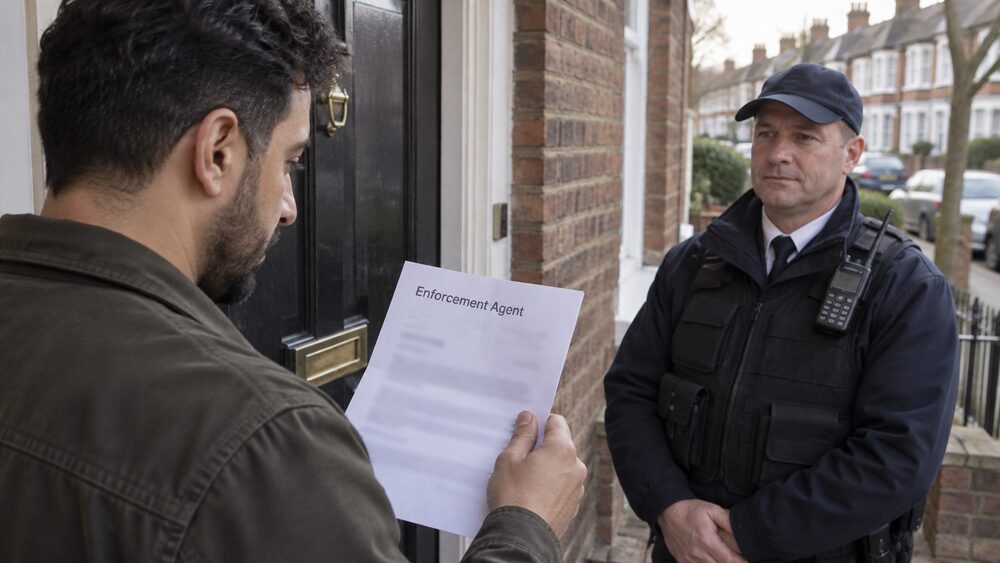
Anyone who claims to be a bailiff when they are not is committing fraud, and pretending to be a bailiff is a criminal offence1. If someone at your door cannot produce ID and a warrant, that is a reason to stop and check before anything else.
National Debtline: phone, webchat and My Money Steps
National Debtline is a free debt advice service that has been helping people in the UK with debt for over 30 years, and it started in 198723. It describes itself as free to use, always, and provides free, impartial debt advice as a registered charity23. It is an independent registered charity, authorised and regulated by the Financial Conduct Authority23.
You can reach it in three ways: call by phone, chat online, or use My Money Steps23. The freephone number is 0808 808 40007. Webchat opening hours are Monday to Friday 9am to 8pm and Saturday 9:30am to 1pm, and My Money Steps is available 24/78. If My Money Steps is not right for you, phone advice and webchat are the alternatives28.
The charity also offers free sample letters you can use to contact creditors in writing, which is useful when a bailiff or creditor needs to be told something in writing rather than by phone29. Its webchat service lets you speak directly to an adviser online if you would rather message than call30.
England and Wales rules differ from Scotland
Bailiffs are court officials in England and Wales, not Scotland, and there is a different process in Scotland32. In Scotland the equivalent role is carried out by sheriff officers, and bailiffs are known as enforcement agents in England and Wales or sheriff officers in Scotland32. The guidance on bailiff complaints covers England and Wales only33.
The ownership rule still applies north of the border: enforcement agents or bailiffs may be able to take goods, but only from the person they are court ordered to chase17. Free advice services exist in Scotland too, and there are free advice services that can help21. The Scottish Welfare Fund and other routes offer more help with money problems34.
Forced entry is tightly limited in England and Wales. County court bailiffs are only allowed to force their way into your home if all three of the following points apply: they have already taken control of goods inside, a controlled goods agreement has been broken by missing at least one payment, and they have given two clear days' notice of inspection or taking12. County Court bailiffs and High Court Enforcement Officers must not use violence or offensive language when evicting you, nor damage your belongings, and they cannot keep belongings to pay for court costs or rent arrears unless a separate court order allows it35.
If a bailiff has already been to your home, or you are dealing with a debt that is not yours, free advice is available before anything is sold. National Debtline can be reached on 0808 808 4000, and its advisers can talk through your options, including free sample letters to send to creditors29.
Sources35 cited
- Your rights when bailiffs visit your home GOV.UK, 2026-09-26
- High Court enforcement in England and Wales Business Debtline, 2026-09-26
- High Court enforcement in England and Wales National Debtline, 2026-09-25
- What can bailiffs take? StepChange, 2026-09-25
- Bailiff complaints StepChange, 2026-09-25
- Debt myths: true or false StepChange, 2026-09-25
- Debt management plans in Scotland National Debtline, 2026-09-25
- How to get debt advice Advicenow, 2026-09-26
- Enforcement action for tax debt TaxAid, 2026-06-19
- County court enforcement TaxAid, 2026-06-19
- Magistrates' court fines in England and Wales Business Debtline, 2026-09-26
- County court bailiffs in England and Wales Business Debtline, 2026-09-26
- Dealing with bailiffs StepChange, 2026-09-25
- Codes of practice and guidelines Mental Health and Money Advice, 2025-09-08
- Regulatory bodies StepChange, 2026-09-25
- Emergency situations in England and Wales Business Debtline, 2026-09-26
- Debts not in my name StepChange, 2026-09-25
- Check bailiffs' fees Citizens Advice, 2026-09-25
- What is unsecured debt? National Debtline, 2026-09-25
- Paying council tax Which?, 2026-04-17
- Debt advice Shelter Scotland, 2026-01-16
- Debt transferred while on a temporary repayment plan StepChange, 2026-09-25
- Worried about someone National Debtline, 2026-09-25
- National Debtline StepChange, 2026-09-25
- How to do budget planning National Debtline, 2026-09-25
- Emergency situations in Scotland National Debtline, 2026-09-25
- How we can help you National Debtline, 2026-09-25
- My Money Steps National Debtline, 2026
- Can debt collectors come to your house? National Debtline, 2026-09-25
- Get help National Debtline, 2026
- Making sure it's us Money Advice Trust, 2026
- Money jargon A to Z: S Citizens Advice Scotland, 2026-09-25
- Bailiff complaints in England and Wales Business Debtline, 2026-09-26
- More help with money problems mygov.scot, 2026-09-25
- Notices of possession served from 1 May 2026 GOV.UK, 2026-04-07








 StepChangeFree debt advice and solutions from a charity
 National DebtlineFree debt advice by phone, webchat and online
 MoneyHelperFree, impartial money and pensions guidance, set up by government
 Citizens AdviceFree advice on money, consumer and legal problems in England and Wales
 Citizens Advice ScotlandFree advice across Scotland