Council tax arrears are treated differently from almost every other household debt. A credit card lender has to go to court and get a judgment before it can take serious enforcement steps, but a council can move from a missed instalment to a demand for your whole year's bill, then to deductions from your wages or benefits, and then to bailiffs, without ever needing a county court judgment. That is why every debt charity classifies council tax as a priority debt: it is not the largest debt for most people, but the consequences of ignoring it arrive fastest1.
The process moves quickly. In England, if you miss a monthly instalment your council sends a reminder giving you 7 days to pay, and if you do not pay within that time you can be asked for the whole year's council tax instead1. You only get two reminder letters in each financial year before the council sends a final notice, and a third missed payment triggers that final notice automatically3. From there the council can apply to the magistrates' court for a liability order, which opens the door to deductions from your wages or benefits, bailiffs and, in England only, in rare cases a prison order2.
The rules are not the same across the UK. Wales changed its missed payment process on 1 April 2026 so households keep the right to pay by instalments for longer2. Scotland uses a different mechanism altogether, the summary warrant, and does not use liability orders or imprisonment4. Northern Ireland has no council tax at all: it has a rates system instead. This page explains each route, what councils can and cannot do at each stage, and where free help fits in.
Council tax arrears are a priority debt
Council tax is a priority debt whether it is your current bill or arrears from earlier years, and the reason is the collection powers attached to it. Councils do not need a county court judgment to take money from your wages or benefits or to send bailiffs: a liability order from the magistrates' court is enough, and the earlier stages of the process happen without any court involvement at all8. Debt advisers put council tax in the same category as court fines, water bills, rent and mortgage payments, ahead of credit cards, loans and overdrafts9.
In practice this affects the order in which you pay things when money is short. If you can only cover some of your bills in a month, the priority debts are the ones where non-payment escalates to enforcement fastest, and council tax is among the fastest of all: a single missed instalment can start a chain that ends with the whole year's bill falling due1. Credit card and loan lenders, by contrast, generally need to issue a claim and obtain a judgment before enforcement, which takes longer and gives more room to negotiate9.
The priority label does not mean the arrears are more important than feeding your household. It means that when a free debt adviser helps you build a budget, council tax arrears sit in the group of bills paid first from the money available, and non-priority creditors get offers from whatever is left. If there is nothing left, there are formal options for those debts, from token payments to insolvency solutions, which the debt solutions guide sets out. The guide to which bills to pay first covers how a adviser sorts a full list of debts.
It also matters that council tax is a household debt. Joint billholders are jointly liable, and a partner living in the house can be liable for arrears even if their name is not on the bill10. If someone named on the bill has died, the council must send a new bill in the surviving partner's name before recovering outstanding amounts. The rules on joint debts explain who owes what when a bill is in more than one name.
What happens when you miss a payment: reminders and final notices
The escalation in England follows a fixed sequence. Your council will send you a reminder notice giving you 7 days to pay if you miss a payment1. The reminder tells you which instalments you have missed and gives you seven days to pay them, plus any other instalment that becomes due during that time2. If you pay within the seven days, nothing else happens and you carry on paying by instalments.
If you do not pay within 7 days, you can lose the right to pay by instalments and be asked to pay the whole year's council tax instead1. You only get two reminder letters in each financial year, which runs from April to March, before the council sends a final notice3. A third missed payment means no further reminder: the council sends a final notice telling you to pay the full remaining balance in one go1. If you pay within seven days of the final notice, you can keep paying in instalments; if not, the council can move to legal action3.
One further trigger catches people out. If you miss a payment after 31 December, you will also get a final notice and must pay the full remaining balance, because there are not enough months left in the financial year to catch up4. The timing of a missed instalment therefore matters as much as how many you have missed.
Bailiffs are not the first step. They usually only appear after a first reminder letter has been ignored, a second reminder letter has been ignored, and payment has still not been made after a final reminder, at which point the council applies for a liability order11. Each stage of that chain is a chance to stop the process, and a payment arrangement agreed with the council at any point before the liability order is usually cheaper than letting it run.
Missed payments in Wales: a longer route to losing instalments
Wales changed its rules on 1 April 2026, and the process there now differs from England's in ways that give households more time. Under the previous law, councils in Wales only needed to send reminder notices for the first two missed payments in a financial year, the household had 7 days to pay the missed amount before losing the right to pay in instalments, and a third missed payment meant the remaining annual balance had to be paid within 1 day12. The Welsh Government described this as a system where people could become liable for the full annual bill if they did not pay within seven days of receiving a reminder6.
From 1 April 2026, councils in Wales send reminder notices that do not end the right to pay by instalments2. A final notice can now only be sent if the debt has been outstanding for at least 41 days from when it was originally due, and at least 14 days have passed since the council sent the latest reminder notice2. The final notice tells you which instalments you have missed and gives you 21 days to pay them2.
The overall effect is a much longer minimum window. The Welsh Government has confirmed that households in Wales will have 63 days to address missed council tax payments before enforcement action can be taken, compared with a minimum of 14 days under the old rules, made up of 7 days from a reminder notice and a further 7 days6. The change was supported after consultation as extending the minimum period to 62 days from one missed instalment to becoming liable for the remaining annual balance6.
England has a parallel reform on the way. Under new rules, councils must wait 63 days, two months, before demanding the full annual amount, instead of a single missed payment triggering a demand within three weeks, and councils must also work with individuals to set up a sustainable repayment plan13. Check the current position with your own council, because the date these changes take effect in England matters to how quickly your bill can escalate.
Liability orders and the court costs they add
A liability order is the court order that unlocks a council's strongest powers. Your council can ask a magistrate for a liability order if you owe them unpaid council tax, and the application is made under Regulation 34(3) of the Council Tax (Administration and Enforcement) Regulations 19921. Magistrates' courts can hear council tax cases and issue liability orders, and the process starts with the council making a complaint to the court, which then issues a summons14.
You do not have to be present for the court to make the order: it is valid as soon as the court makes it and does not need to be entered in any special register to be enforceable14. Attending can still be useful if you want to dispute the amount or explain your circumstances, but the order itself does not depend on your presence.
The order covers your arrears and the court costs for making it8. The council's legal costs may be added to the money you owe, for example the cost of hiring a lawyer1, and StepChange notes that court costs are added on top of the summons for the full amount owed3. These charges have been criticised for deepening the debt, and from the following April they will be capped at £100 when councils take debt to court to obtain a liability order13.
There are limits on how late a council can apply. A council should not go to the magistrates' court and ask for a liability order more than six years after the council tax became due5. This is not the same as a debt becoming statute-barred: council tax arrears are enforced through this special procedure rather than ordinary county court claims, so the six-year rule on liability order applications is the relevant boundary5. The guide to statute-barred debts explains how the ordinary limitation rules work for credit debts.
Once granted, the liability order lets the council involve court-appointed debt collectors and take further legal action3. What that action can be is the next section.
How councils collect arrears: wages, benefits and bailiffs
A liability order is not itself a collection method: it is the permission the council needs to use several. The main routes are deductions from wages, deductions from benefits, bailiffs, and, for larger debts, a charge on your home.
Deductions from wages. The council can apply for an attachment of earnings order, which instructs your employer to take money from your pay and send it to the council. A larger amount might be taken if you have arrears from two years' worth of council tax15. Once an attachment of earnings order for council tax has been sent, it cannot be stopped unless the amount owed is paid in full15, which is why negotiating before this stage matters.
Deductions from benefits. Your council can apply to take money from Employment and Support Allowance, Income Support, Jobseeker's Allowance, Pension Credit and Universal Credit1. The benefits the council can deduct from include income-based and contribution-based variants of those benefits2. For Universal Credit specifically, a maximum of 5% of your standard allowance can be taken for council tax arrears16. The guide to deductions from Universal Credit explains the overall caps that apply when several debts are being deducted at once.
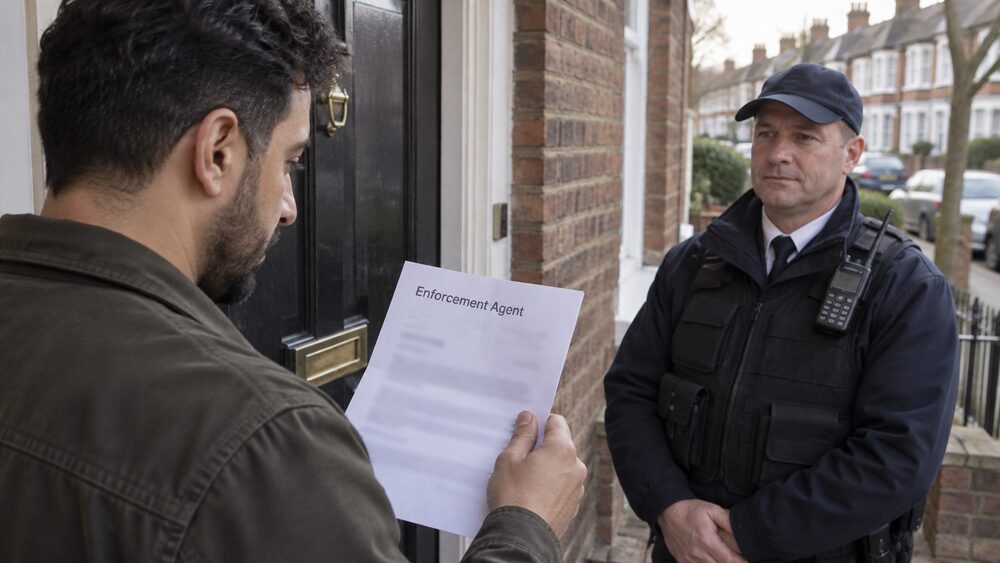
Bailiffs. The council can use bailiffs to take your belongings, which will be sold to cover the debt, and the cost of using bailiffs is added to the amount you owe13. Bailiffs are usually sent only after the reminder letters and final notice have been ignored and a liability order has been granted11. A bailiff cannot force entry to your home for a council tax debt unless they already have a controlled goods agreement in place11. Forced entry is only allowed when all three of the following apply: they have taken control of your goods inside your home, you made a controlled goods agreement and have broken it by missing at least one payment, and they have given you two clear days' notice that they are coming to inspect or take the goods2. The only other time a bailiff can force entry is to collect unpaid magistrates' fines or debts owed to HMRC17, and official guidance confirms bailiffs may force their way in for unpaid criminal fines, Income Tax or Stamp Duty, but only as a last resort18. The guides to bailiffs and your rights, what bailiffs can take and forced entry cover the detail.
A charge on your home. If the debt is for £1,000 or more, the council can apply to the County Court for a legal charge on the home you own2. This secures the debt against the property. The guide to objecting to a charging order covers the deadlines involved.
| Collection method | What it takes | Notes |
|---|---|---|
| Attachment of earnings | Liability order | Taken from wages; larger if two years' arrears; cannot be stopped once sent except by paying in full15 |
| Deduction from benefits | Liability order | ESA, Income Support, JSA, Pension Credit, Universal Credit; up to 5% of the UC standard allowance1 |
| Bailiffs (enforcement agents) | Liability order | Costs added to the debt; forced entry only with a broken controlled goods agreement and two days' notice2 |
| Charging order | Debt of £1,000 or more | Legal charge on a home you own, via the County Court2 |
Can you go to prison for council tax arrears?
In England, yes, in rare cases. You can be sent to prison for up to 3 months if the court decides you do not have a good reason for not paying your council tax and you refuse to do so1. The order is available where the council thinks you have refused to pay, or had the money and neglected to pay7, and StepChange describes it as a last resort and very rare11. Which? likewise notes a sentence of up to three months if the court finds you deliberately refused or neglected to pay13.
The important qualifications are these. First, imprisonment is not a punishment for being unable to pay: it follows a finding that you could pay but refused or neglected to. Second, it is not available across the UK. You cannot go to prison for not paying council tax in Scotland, Wales or Northern Ireland8, and councils in Wales cannot ask the court to send you to prison at all2. Third, the process runs through the magistrates' court after a liability order, so it comes at the end of a long chain of notices, not out of the blue.
The scale of its use has been contested. A StepChange report published in March 2026 found 1,528 prison proceedings over council tax arrears since 2020, based on freedom of information requests to councils in England and Wales, and renewed its call to scrap imprisonment for council tax non-payment19. Whatever the numbers, the practical protection is the same: engage with the council, attend any court hearing, and show what you can afford to pay, because the order targets refusal rather than poverty.
Arrears in Scotland: summary warrants and sheriff officers
Scotland does not use liability orders. Instead, the council may apply to the sheriff court to make a summary warrant for the full amount they say you owe20. The procedure begins with a charge for payment, which asks you to pay the amount due within 14 days16. If the summary warrant is granted, a 10% fee is added: the fee will be 10% of how much you owe to the council, so if you owe £100, the fee would be £1016.
Enforcement in Scotland is carried out by sheriff officers rather than bailiffs, and the methods differ in name and mechanics. Collection can include taking payments from your wages using an earnings arrestment, and taking money from your bank account using a bank arrestment16. The guide to diligence in Scotland explains these measures, and the comparison of bailiffs and sheriff officers sets out how the two systems differ.
There are ways to slow or stop the process. You can ask a sheriff officer to make a payment agreement with you4, and official Scottish guidance says to contact your local council as soon as possible if you have problems paying your council tax21. Council tax is a priority debt in Scotland just as elsewhere, because the council has strong powers to make you pay20. Imprisonment is not among them: you cannot go to prison for not paying council tax in Scotland8.
Formal solutions also differ. You can include council tax arrears in a debt payment programme under the Debt Arrangement Scheme20, which the DAS guide explains. In bankruptcy in Scotland, most unsecured debts such as council tax arrears, overdue utility bills, credit cards and loans will usually be included22, and the sequestration guide covers that route. The Scottish Government pledged in September 2026 to consider changes to make council tax debt recovery processes fairer23, so the detail may continue to evolve.
Getting your bill reduced: discounts, exemptions and Council Tax Reduction
Before arranging to pay arrears, check whether the bill itself is right. Working out what you owe requires three things: the valuation band for your home, how much your local council charges for that band, and whether you can get a discount, reduction or exemption from the full bill24. In Scotland you can challenge your council tax band on the Scottish Assessors website25.
Discounts. You may be able to get a discount if you are the only adult in the property, or you share your house only with people who are not counted for council tax purposes20. If all residents, including yourself, are not counted for council tax purposes, you may get a 50% discount to your bill2. Wales has concluded a review of the 53 categories of council tax discounts and exemptions, with improvements planned by regulation by April 202626.
Council Tax Reduction. You may be able to get Council Tax Reduction, which used to be called Council Tax Benefit, if you are on a low income or get benefits24. You apply to your council: you need to ask your council, as Shelter puts it27. In most cases you will still have to pay something towards your bill28. Pension Credit recipients can also be entitled to a Council Tax Reduction29. In Northern Ireland, Council Tax Reduction does not exist: those renting receive help with their rates through Housing Benefit instead30.
Overpayments. An overpayment of Council Tax Reduction is treated as council tax arrears31, so a mistake in a reduction claim turns into the same debt covered on this page. If you think a decision about your council tax support is wrong, complain to the council first, and if it has not responded to your review request after two months you can appeal straight to the Valuation Tribunal in Wales31.
Discretionary relief. Beyond the standard schemes, you can write to the council asking for discretionary relief, quoting Section 13A of the Local Government Finance Act 1992 and sharing your budget3. Your council may also give you a one-off discount if you still cannot pay what you owe1. These are discretionary, so there is no entitlement, but they exist precisely for situations where the standard schemes leave an unaffordable bill.
Paying off arrears: instalments, payment plans and formal solutions
The cheapest route is always an arrangement made before enforcement starts. Councils can let you pay your council tax in smaller amounts4, and you could agree a repayment plan to reduce the debt, stop the council taking further action and pay off your arrears27. When you contact the council, have a budget ready: advisers use a standard financial statement to set out income, spending and what is affordable, and the guide to budgeting for repayments explains how that works.
On the ongoing bill, you can choose to spread your payments over 12 months instead of the usual 10, which reduces the amount of each instalment1, and some authorities offer alternatives such as 11 or 12 payments a year to help spread the cost13. Carers' guidance likewise notes councils may agree to spread payments over 12 months instead of the usual 10 so the amount of each bill is reduced28. These are arrangements to ask for, not rights, so request them before a missed payment rather than after.
If the arrears are part of a wider debt problem, formal solutions can include council tax:
- An IVA or protected trust deed. You can include council tax arrears in your proposal, but it must be approved by your creditors, including the council3. Your current year's bill is classed as a debt in insolvency solutions only if you are the only person named on the bill, or you and your partner enter the IVA at the same time32. Council tax arrears are among the debts you can include in an IVA33, but the debts you cannot include include magistrates' court fines and maintenance arrears33. The IVA guide covers the process.
- Bankruptcy. Most unsecured debts such as council tax arrears, overdue utility bills, credit cards and loans will usually be included in your bankruptcy22. See bankruptcy in England and Wales and sequestration in Scotland.
- An administration order. Council tax arrears for previous years can be included on the basis of the Preston BC v Riley case from 1995, but the current year's bill cannot normally be included unless you have fallen behind and the council has told you that you have lost your right to pay by instalments34. The administration orders guide explains who qualifies.
- The Debt Arrangement Scheme (Scotland). You include council tax arrears in a debt payment programme, which protects you from diligence while you pay20.
Free debt advice is the place to start before choosing any of these. A adviser will check whether a formal solution is needed at all, or whether an informal payment arrangement with the council and other creditors is enough. The guide to free debt advice lists the charities that provide it at no cost.
Disputing your bill: keep paying while you challenge it
If you think your bill is wrong, the rule that catches most people out is that disputing it does not pause enforcement. The law does not require the council to stop action just because a person disputes the bill14. Official Scottish guidance is explicit that you must keep paying your council tax while you wait for a response25, and Which? advises paying the bill first and appealing afterwards to avoid enforcement measures13.
The reason is mechanical. The reminder, final notice and liability order process runs on missed instalments, and it does not distinguish between a person who cannot pay and a person who will not pay while a dispute is resolved. If you stop paying and lose, you are left with the whole year's bill, court costs and a liability order to unwind. If you keep paying and win, the council refunds or credits whatever you overpaid.
The first step in any challenge is to contact your local council, preferably in writing, explaining why you think the decision is wrong35. That applies to the band as well as the bill: in Scotland, band challenges go through the Scottish Assessors website25. If the council's answer is unsatisfactory, the complaint routes in the next section apply, and for council tax support decisions there is a further appeal to the Valuation Tribunal in some circumstances31.
Complaining about your council and where to get free help
Complaints about council tax handling go through the council first. Allow the council a reasonable amount of time to deal with your complaint: this is usually 16 weeks for a council in England, and 12 weeks for a council in Wales2. If you are unhappy with the response, a complaint about a council in England can go to the Local Government and Social Care Ombudsman7, and for council tax support overpayments you can take your complaint to the Local Government Ombudsman after all stages of the council's complaints process31. You normally need to contact the ombudsman within 12 months of realising the council has done something wrong2.
Free help with the debt itself is available from several directions. You can get free advice from your local council36, and official Scottish guidance directs people with payment problems to contact their local council as soon as possible21. Debt charities provide free advice on council tax arrears specifically, including negotiating with the council3, and the free debt advice guide lists who provides it and what to check so you avoid fee-charging firms posing as charities. If bailiffs are involved, their fees and behaviour can be challenged: the guide to bailiff fees and complaints covers the process.
If the underlying problem is that the bill is unaffordable rather than simply unpaid, combine the two routes: ask the council about Council Tax Reduction and discretionary relief while a debt adviser helps you set a sustainable payment plan. Councils have discretion at several points in this process, at the reminder stage, on repayment plans, and on one-off discounts1, but they can only use it if they hear from you.
Sources36 cited
- Council tax arrears GOV.UK, 2026-09-26
- Council tax arrears (England and Wales) National Debtline, 2026-09-25
- Council tax arrears StepChange, 2026-09-25
- What to do if you cannot pay your council tax mygov.scot, 2026-04-01
- Statute barred debts National Debtline, 2026-09-25
- New rules confirmed for fairer council tax collection Welsh Government, 2026-04-01
- Your priority debts Business Debtline, 2026-09-26
- Liability orders StepChange, 2026-09-25
- What debts to pay first StepChange, 2026-09-25
- Debts after death National Debtline, 2026-09-25
- Bailiff rights and powers StepChange, 2026-09-25
- Improving the administration and enforcement of council tax in Wales Welsh Government, 2025-04-30
- Paying council tax Which?, 2026-04-17
- Council tax and the law Carmarthenshire County Council, 2026-01-19
- Attachment of earnings StepChange, 2026-09-25
- Unpaid council tax debt StepChange, 2026-09-25
- Debt myths: true or false StepChange, 2026-09-25
- Your rights if a bailiff takes your things GOV.UK, 2026-09-26
- Council tax letters press release StepChange, 2026-03-23
- Council tax arrears (Scotland) Business Debtline, 2026-09-25
- Debt and money Scottish Government, 2026-09-25
- Bankruptcy information document Accountant in Bankruptcy, 2026
- Welcome step to make council tax debt recovery fairer Citizens Advice Scotland, 2026-09
- Council tax GOV.UK, 2026-09-26
- Pay your council tax bill mygov.scot, 2026-04-01
- Tax policy report October 2025 Welsh Government, 2025-10
- Help with council tax Shelter England, 2025-07-16
- Help with council tax Carers UK, 2026-09-26
- Pension Credit GOV.UK, 2026-09-26
- Family Resources Survey quality and methodology report NISRA, 2026-05-28
- Council tax support overpayments Turn2us, 2025-12-09
- Council tax debt and an IVA StepChange, 2026-09-25
- Check what an IVA is Citizens Advice, 2026-09-25
- Administration orders National Debtline, 2026-09-25
- Help with council tax (Scotland) Carers UK Scotland, 2026-09-26
- Repossession GOV.UK, 2026-09-26




 StepChangeFree debt advice and solutions from a charity
 National DebtlineFree debt advice by phone, webchat and online
 MoneyHelperFree, impartial money and pensions guidance, set up by government
 Citizens AdviceFree advice on money, consumer and legal problems in England and Wales
 Citizens Advice ScotlandFree advice across Scotland