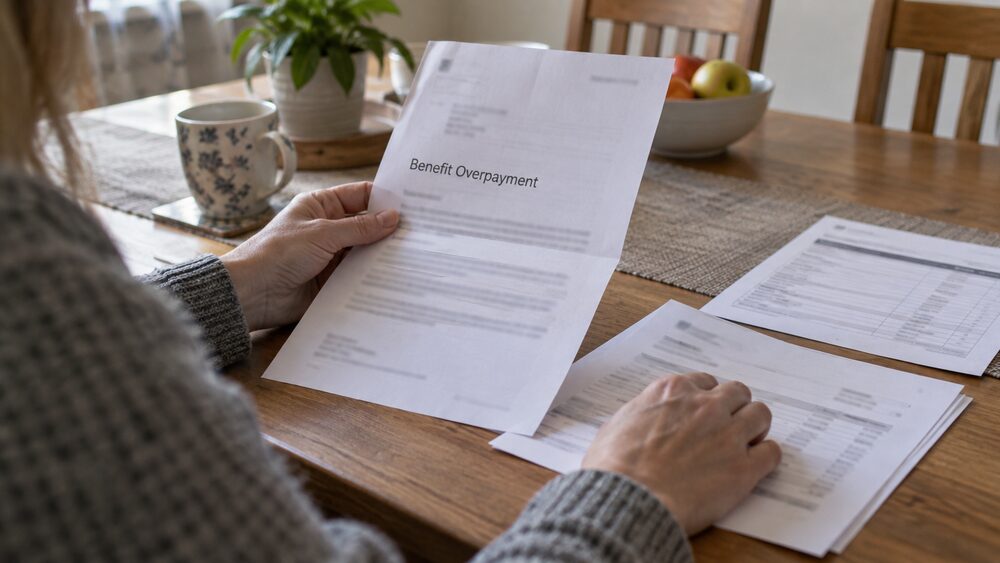
A benefit overpayment is money paid to you that you were not entitled to, and it becomes a debt. The Department for Work and Pensions (DWP) can recover an overpayment regardless of what caused it, including when the mistake was the office's own1. In the financial year ending March 2025, £9.5 billion was overpaid across the benefit system in Great Britain, equal to 3.3% of total benefit expenditure2.
Universal Credit is where overpayments are concentrated. In the financial year ending March 2025, 8.0% of Universal Credit expenditure was overpaid due to fraud, 0.9% due to claimant error and 0.8% due to official error3. Recovery usually happens through deductions from your ongoing payments, normally capped at 15% of your standard allowance4, or through money taken from your wages.
Why benefit overpayments happen: details not kept up to date
Most overpayments begin with details that no longer match your situation. If you do not report a change or a mistake, you might be paid too much, and if you are, you might have to pay some of the money back7. The changes that matter are the ones that affect how much benefit you are entitled to: earnings going up or down, hours of work changing, someone moving in or out of your household, savings rising, or rent changing.
Overpayments are grouped into three causes in the official statistics: fraud, claimant error and official error. Claimant error covers mistakes and unreported changes where there is no dishonesty involved, and official error covers mistakes made by the DWP, HMRC or a council. All three produce a recoverable debt in the same way. Independent guidance is blunt about the practical position: if you have been overpaid, the DWP will be able to recover the overpayment regardless of the cause of the overpayment1.
The scale of the problem has shifted over recent years. In the financial year 2021 to 2022, 4.0% of total benefit expenditure was overpaid due to fraud and error8. The estimate for the financial year 2020 to 2021 was lower, with 1.2% of total benefit expenditure, or £2.5 billion, underpaid due to fraud and error, showing the system both overpays and underpays at the same time9. Underpayments matter here because they show that checking your award works in both directions: a review can find money owed to you as well as money you owe.
If you think you are being paid more benefit than you are entitled to, tell the benefits office that pays your benefit and explain why you think the amount is wrong10. Doing this promptly does not necessarily stop the overpayment being recovered, but it stops it growing.
Universal Credit overpayments: how much is paid in error
Universal Credit has the highest overpayment rate of any benefit in the official statistics. In the financial year ending March 2025, overpayments due to fraud were 8.0% of expenditure (£5,200m), down from 10.8% (£5,620m) in FYE 20243. Overpayments due to claimant error were 0.9% (£610m) in FYE 2025, compared with 0.8% (£410m) in FYE 2024, and overpayments due to official error were 0.8% (£540m) in FYE 2025, compared with 0.7% (£390m) in FYE 20243.
The year before, the fraud figure had been higher still: overpayments due to fraud were 10.9% (£5,660m) in FYE 2024, compared with 11.4% (£4,930m) in FYE 202311. Going further back, fraud overpayments on Universal Credit were 11.5% (£5,010m) in FYE 2023, and 13.0% (£5,250m) in FYE 2022, which was the highest recorded level12. The trend since then has been downward, but the rate remains far above most other benefits.
| Year | Fraud | Claimant error | Official error |
|---|---|---|---|
| FYE 2025 | 8.0% (£5,200m)3 | 0.9% (£610m)3 | 0.8% (£540m)3 |
| FYE 2024 | 10.9% (£5,660m)11 | 0.8% (£410m)11 | 0.7% (£380m)11 |
| FYE 2023 | 11.5% (£5,010m)12 | 0.7% (£290m)12 | 0.6% (£250m)12 |
Not every error is an overpayment. In FYE 2023, the largest estimated cause of Universal Credit underpayments due to claimant error, at 0.4%, was failure to provide evidence of rent or under-declared rent and service charges12. The same year, 3.9% (£330m) of Cost of Living Payments expenditure was overpaid to claimants incorrectly receiving Universal Credit12, a reminder that extra payments bolted onto a benefit inherit its errors.
Paying back when the mistake was not yours
The question most people ask is whether a overpayment caused by the DWP's own mistake has to be repaid. The answer is that it normally does. If you have been overpaid, the DWP will be able to recover the overpayment regardless of the cause of the overpayment1. This includes official error, where the department paid you incorrectly without any action of yours contributing.
The legal basis for recovery is long-standing. Under regulation 4 of the Social Security (General Benefit) Regulations 1982, interim payments made pending determination of a claim are deemed payments of benefit duly made, and overpayments must be repaid unless the person was not informed of the repayment effect and there was no misrepresentation or failure to disclose a material fact; overpayments are recoverable by deduction from benefit13. In practice, the exception is narrow, and most people will not meet it.
Recovery is not limited to deductions from benefits. Benefit overpayments can be taken from your wages by the DWP, and your local council can do the same for the overpayments it administers14. If you no longer receive the benefit the debt came from, recovery continues by other means, such as other benefit payments, your wages or through a debt collection agency15.
What you can do is challenge the decision and the rate of recovery. You can ask for a Universal Credit decision to be reviewed, and if the review finds you were paid too little, your future payments will be changed and you may get an extra payment to make up what you missed out on; if you were paid too much, money will be taken off your payments16. Challenging the overpayment amount itself, and asking for deductions to be reduced because of hardship, are covered later on this page.
How your savings and income can lead to an overpayment
Savings and earnings are the two details most likely to make an award wrong without you noticing. You will get less Universal Credit if you have savings over £6,000 or you earn enough money to cover your basic living costs5. If your savings rise above that level and the DWP is not told, the payments you continue to receive exceed your entitlement and the difference is an overpayment. Housing Benefit has a harder limit: it is usually not paid at all if your savings are over £16,000, unless you get Guarantee Credit of Pension Credit17.
Earnings work through the taper. With Universal Credit you keep 45p of every £1.00 you earn until your earnings are too high to get Universal Credit18. You can earn a certain amount before your payments are reduced, the work allowance, if you or your partner are responsible for a child or young person, or have a disability or health condition that affects your ability to work18. For claimants found to have limited capability for work, the same 45p taper applies over the work allowance19.
Several situations catch people out:
- A final wage. If you have recently stopped working and your employer has paid your final wage in the last few weeks, this may be treated as income and affect your payment18.
- Two paydays in one assessment period. If your earnings are £2,500 or more over the limit, you get no Universal Credit for that period and the amount over £2,500 will be counted as earnings in the next assessment period20.
- Self-employment losses. If you make a loss from self-employment, only your employment earnings will be used to calculate how much Universal Credit you get21.
- Tax credits. Overpayments of Child and Working Tax Credits can range from £10 to over £2,00022, and disputes about them go to HMRC23.
In Scotland, the same principle applies when benefits are devolved. When Carer's Allowance moves over to Carer Support Payment, DWP will arrange with you if you need to repay an overpayment24.
How an overpayment is worked out and what you are told
Once a possible overpayment surfaces, the process follows a set sequence. Your usual benefit office or department will calculate what your correct benefit should be, how much you have been overpaid, whether you have to pay it back, and whether a civil penalty (a fine) applies10. You might get one letter telling you about the overpayment, or you might get separate letters about your new award and the overpayment10.
The timing advice from independent guidance is simple: do not delay, because the longer an incorrect award goes on, the bigger any total overpayment will be10. An overpayment that is spotted in its first month might be a small deduction over a few payment dates; the same unreported change left for a year produces a debt that takes much longer to clear at the 15% cap.
Deductions from Universal Credit: what can be taken from your payment
Deductions are the standard way the DWP recovers overpayments and other debts from people who still receive Universal Credit. Normally the most that can be taken from your payment to repay a debt is 15% of your Universal Credit standard allowance4. The same 15% cap is stated for monthly deductions unless last resort deductions are being taken25, and independent guidance confirms that under the Universal Credit system, deductions tend to be 15% of your standard allowance1. If your household earnings are above a certain level, up to 15% can be taken from your Universal Credit payments15.
The cap applies to the standard allowance, not to your whole payment including housing costs, which is why the cash amount taken can look small against the total you receive. Deductions can cover a range of debts:
- Universal Credit overpayments and advances
- Tax credit overpayments
- Social Fund loans and Universal Credit Advance loans, which you have to pay back from your Universal Credit payments26
- Certain fines, through a Deduction from Benefits Order, which can be made from Universal Credit, Jobseeker's Allowance, Income Support and Pension Credit27
Advance payments are handled separately from the main cap. When you claim Universal Credit you will not receive your first payment for five weeks, and an advance to bridge that wait is repaid from your twice monthly Universal Credit payment15. If you no longer get Universal Credit, repayments will be taken by other means, such as other benefit payments, your wages or through a debt collection agency15.
The narrow guide to how much can be deducted from Universal Credit covers the rates in more detail, and priority and non-priority debts explains why benefit debts behave differently from credit card and loan debts.
Asking for lower deductions: the financial hardship decision
If deductions leave you without enough to live on, there is a formal route to ask for them to be reduced. A financial hardship decision will be considered if deductions are being taken from your Universal Credit payments for repaying tax credit overpayments, paying off benefit debt, or repaying a Social Fund loan25. The same grounds are listed in the official guidance on money taken from Universal Credit15.
The hardship decision is about the rate of recovery, not the debt itself. The overpayment still exists and still has to be repaid eventually, but the monthly amount taken can be reduced so that you can cover essential living costs. To make the case you will normally need to show your income and outgoings, which is where a standard financial statement helps: it sets out what you can afford in the format advice agencies and the DWP recognise.
This is also the point at which free debt advice is worth having. An adviser can check whether the overpayment figure looks right, whether the deductions are within the caps, and whether a hardship application is likely to succeed. The page on free debt advice lists where to get this without paying a fee.
Hardship payments must be repaid on Universal Credit
Hardship payments are a separate kind of debt from overpayments, but they are recovered in the same way and are often confused with them. A hardship payment is money paid when a sanction or fraud penalty has reduced your benefit below what you need to live on. In some circumstances a Hardship Payment will need to be repaid, for example if the applicant is in receipt of Universal Credit28. The same rule appears in the Scottish Welfare Fund statutory guidance: a Hardship Payment will need to be repaid, for example, if the applicant is in receipt of Universal Credit29, and again in the April 2025 version of that guidance30.
The position is different on legacy benefits. If the applicant is in receipt of Jobseeker's Allowance, a hardship payment does not need to be repaid, but applicants may have to wait 15 days before they can reapply29. So the repayment obligation depends on which benefit you receive, and Universal Credit claimants should assume a hardship payment is a debt.
Other advances follow the same pattern. A Universal Credit Advance loan has to be paid back from your Universal Credit payments26, and because advance repayments sit outside the main 15% cap, a household repaying both an advance and an overpayment can see a substantial share of its payment taken before the money arrives.
When hardship repayments can be paused or written off
Hardship repayments are not open-ended. Your hardship repayments can be suspended for any assessment period where your earnings have reached a level at least equal to the Conditionality Earnings Threshold15. In other words, once your earnings recover to the level at which the conditions attached to your claim would expect you to be working, the deductions stop for that month.
There is also a route to having the remainder written off. Universal Credit may not ask you to repay the remaining hardship payment if your earnings, or in the case of a couple both your earnings together, stay at or above the threshold for at least six assessment periods after the last fraud penalty or sanction was applied15. Six consecutive assessment periods, roughly six months, of earnings at or above the threshold is therefore the condition that ends the debt.
This write-off is specific to hardship payments. It does not apply to overpayments generally, to advance loans or to tax credit debts, each of which has its own recovery rules. If you have both a hardship payment and an overpayment being deducted, the hardship element may fall away while the overpayment continues.
Giving false information: penalties and prosecution
The consequences are different, and much more serious, where wrong information was given deliberately. You could be taken to court or have to pay a penalty if you deliberately give wrong information or do not report a change in your circumstances31. The same applies to Child Benefit: you could be prosecuted for benefit fraud if you know you have been overpaid but do not do anything about it, and you could be fined or go to prison if you are convicted32.
Two kinds of penalty sit alongside prosecution:
- Civil penalties. The benefits office may decide you will get a civil penalty (a fine) as part of the overpayment decision10. For a civil penalty to apply, the overpayment must have occurred after 1 October 2012 and be more than £651.
- Administrative penalties. In Northern Ireland, an example given in official guidance is that if you were overpaid by £900 you would have to pay a penalty of £45033, a penalty of half the overpayment.
A penalty for giving inaccurate or prohibited information may not exceed £3,0006. In Wales, civil penalties can be applied to a person who deliberately supplies false information under the Local Government Finance Act 199234, which extends the same principle to council tax matters.
The distinction that matters is intent. Claimant error, where you made a mistake or forgot a change, leads to recovery of the overpayment and possibly a civil penalty. Deliberately giving false information, or knowingly keeping an overpayment, risks prosecution, a fine or imprisonment32. If you realise you have been overpaid, reporting it promptly is what separates the two situations.
Reporting changes and closing a claim to avoid overpayments
Most overpayments are avoidable by reporting changes quickly. Your claim might be reduced or stopped if you do not report a change straight away or you give incorrect information35. The changes to report include starting or leaving a job, changes in earnings or savings, changes to who lives with you, and a child leaving education.
Child Benefit has its own reporting duty with a deadline flavour: parents whose child's plans change, for example if they leave education or start a paid apprenticeship, must tell HMRC straight away to avoid being overpaid36. Tax credit overpayments are disputed by contacting HMRC23.
In Scotland, where some benefits are devolved, the duty is the same in substance: report changes in your circumstances, and when Carer's Allowance moves to Carer Support Payment, DWP will arrange with you if you need to repay an overpayment24.
Closing a claim matters too. If you stop being entitled, for example because your earnings have risen, the claim should be closed rather than left running. The DWP's guidance on managing a Universal Credit claim notes that if the department needs to contact you, it will be in the first few weeks after making your claim, and after the claim is checked you will be given a case manager who will help you to maintain your claim37. Keeping your details current with that case manager is what prevents the silent build-up of an overpayment.
Where to get help with benefit debts and deductions
Universal Credit overpayments are owed to and collected by the DWP1, which makes them a particular kind of debt: the creditor controls the channel through which your income arrives. That does not make them more important than rent or council tax in every case, but it does mean deductions happen automatically unless you act. The page on priority and non-priority debts explains how benefit debts sit alongside others.
Free help is available at every stage:
- Before a debt exists: MoneyHelper and the DWP's own guidance explain what changes to report and when7.
- When an overpayment letter arrives: free debt advice charities can check the figures, help with a hardship application and negotiate repayment. Business Debtline's guidance on Universal Credit overpayments sets out the recovery rules1, and free debt advice lists where to get help without paying.
- When deductions stack up: a financial statement shows what you can afford, and the hardship decision process can reduce the rate25.
- When the debt is part of a wider problem: benefit debts can sit inside debt management plans, debt relief orders and other solutions, though deductions from benefits often continue regardless. The page on debt solutions across the UK sets out the options, including Breathing Space, which pauses most creditor action while you get advice.
If money has run out entirely, emergency grants and loans covers crisis payments and other help, including the Scottish Welfare Fund, whose guidance confirms hardship payment rules for Universal Credit claimants29. Whatever the cause of the overpayment, the practical steps are the same: check the figures, report changes, ask for the hardship decision if deductions are too high, and get free advice before agreeing any repayment plan.
Sources37 cited
- Benefit overpayments under the Universal Credit system Business Debtline, 2026
- Fraud and error in the benefit system: financial year 2024 to 2025 estimates GOV.UK, 2025
- Fraud and error in the benefit system: FYE 2025 GOV.UK, 2025
- Find out about money taken off your Universal Credit payment GOV.UK, 2026
- Who can claim Universal Credit nidirect, 2026
- Penalties for inaccurate or prohibited information Legislation.gov.uk, 2025
- Report a change in your circumstances GOV.UK, 2026
- Fraud and error in the benefit system: financial year 2021 to 2022 estimates GOV.UK, 2021
- Fraud and error in the benefit system: financial year 2020 to 2021 estimates GOV.UK, 2020
- What should I do if I think I have been overpaid Turn2us, 2025
- Fraud and error in the benefit system: FYE 2024 GOV.UK, 2024
- Fraud and error in the benefit system: FYE 2023 GOV.UK, 2023
- Social Security (General Benefit) Regulations 1982 Legislation.gov.uk, 1982
- Debt payments from your wages GOV.UK, 2026
- Money taken from your Universal Credit payments nidirect, 2026
- Universal Credit reviews GOV.UK, 2026
- Housing Benefit GOV.UK, 2026
- Universal Credit if you're employed nidirect, 2026
- Universal Credit if you have a health condition or disability nidirect, 2026
- Claiming Universal Credit when you're self-employed nidirect, 2026
- Self-employment and Universal Credit GOV.UK, 2026
- Child and Working Tax Credits statistics: payments commentary 2024 to 2025 GOV.UK, 2025
- Who to talk to about deductions from your Universal Credit nidirect, 2026
- Carer Support Payment: if your circumstances change mygov.scot, 2025
- How much can be taken from your Universal Credit payments nidirect, 2025
- More financial help if you get Universal Credit nidirect, 2025
- Deductions from Benefits Order Scottish Courts and Tribunals Service, 2026
- Scottish Welfare Fund statutory guidance gov.scot, 2026
- Scottish Welfare Fund statutory guidance, April 2025 gov.scot, 2025
- Scottish Welfare Fund statutory guidance, April 2025 (PDF) gov.scot, 2025
- Universal Credit if you're State Pension age and get a migration notice letter GOV.UK, 2024
- Repay Child Benefit overpayments GOV.UK, 2026
- Benefit fraud nidirect, 2026
- Council tax: empty and second homes in Wales GOV.WALES, 2023
- How benefits and pensions are paid nidirect, 2026
- Extend Child Benefit for your teen before 31 August GOV.UK, 2026
- Manage your Universal Credit claim after you apply GOV.UK, 2025






 StepChangeFree debt advice and solutions from a charity
 National DebtlineFree debt advice by phone, webchat and online
 MoneyHelperFree, impartial money and pensions guidance, set up by government
 Citizens AdviceFree advice on money, consumer and legal problems in England and Wales
 Citizens Advice ScotlandFree advice across Scotland