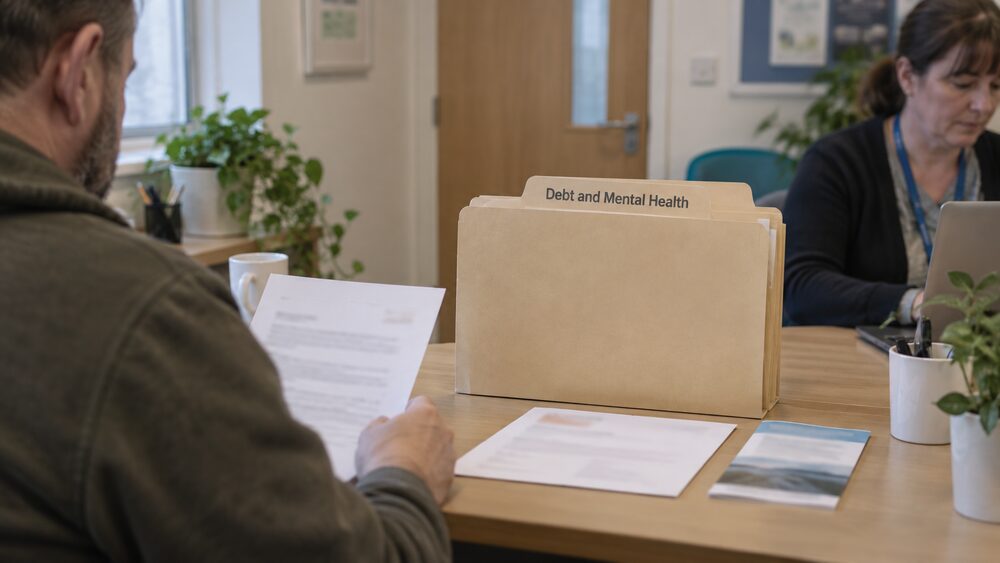
Debt and mental health problems feed each other. Research by the Money and Mental Health Policy Institute shows that 46% of people in problem debt also have a mental health problem, and that almost one in five people with mental health problems (18%) are in problem debt, compared with 5% of people without them1. In England alone, over 1.5 million people are experiencing both problem debt and mental health problems1. Debt advice charities report the same picture from their own clients: half of adults who are struggling with debt also have a mental health issue2.
The law recognises this link. If you are receiving treatment for a mental health crisis, a scheme called the mental health crisis Breathing Space can stop creditors contacting you, charging interest or taking enforcement action for as long as your treatment lasts, plus 30 days3. Outside a crisis, a standard form called the Debt and Mental Health Evidence Form (DMHEF) lets you tell creditors how your mental health affects your money management, and there are guidelines on the extra support they should then give you4.
How debt and mental health affect each other: around 1 in 2 adults with debts has a mental health problem
The relationship runs both ways. A mental health problem can make it harder to open bills, deal with letters from creditors, budget or resist spending during a low or manic period, which pushes people into debt. Debt then adds its own weight: anxiety about money, fear of the phone ringing, and the stress of dealing with creditors can worsen or trigger mental health problems.
The figures bear this out. People experiencing mental health problems are three and a half times more likely to be in problem debt than people without them, according to the Money and Mental Health Policy Institute's statistics1. A Scottish Government review of evidence on the cost of living crisis reported that people with mental health issues are "three or more times more likely to have problem debt"8. Among people in energy debt, 45% report that the debt negatively affects their mental health "a lot"9.
Certain kinds of debt weigh more heavily than others. The Scottish Government's review found a strong association between public and priority debt and poor mental health, particularly council tax debt9. This matters because priority debts such as council tax arrears, rent arrears and energy arrears carry the most serious consequences when they go unpaid, so they are also the debts most likely to cause acute distress. The guide to priority and non-priority debts explains which bills fall into which group.
If money worries are affecting your mental health, or a mental health problem is affecting your money, the practical starting points are the same: build a budget, work out which debts to deal with first, and get free advice rather than facing creditors alone. Charities recommend starting to deal with debts as soon as possible, because the position usually gets harder, and more stressful, the longer it is left10.
Getting help straight away if you are in crisis
If you are thinking about ending your life, or you are in immediate danger, call 999 or go to your nearest accident and emergency department. For confidential emotional support at any time, you can call Samaritans free, 24 hours a day, on 116 1236.
Samaritans provides emotional support, not debt advice. The two kinds of help work alongside each other: emotional support for how you are feeling, and free debt advice for the debts themselves. Free debt help is available online 24/7 from StepChange Debt Charity7, and phone advice lines run during the day. You do not have to be in a formal mental health crisis to use any of these services.
If your mental health is being affected by money worries but you are not in crisis, the earlier you get advice the better. Debt charities recommend building a budget and starting to deal with your debts as soon as possible10, and creditors themselves are expected to offer access to holistic debt advice at the first sign a customer is struggling to pay. Ofwat's Paying Fair guidelines, for example, expect water companies to offer customers access to debt advice to help them maximise their incomes, with the customer's consent11.
You can also tell creditors directly about your mental health, using the evidence form described later on this page, and ask for adjustments to how they deal with you. The guide to how lenders must treat you when you fall behind covers the rules on fair treatment more generally.
Mental health crisis Breathing Space: protection for as long as treatment lasts, plus 30 days
The Debt Respite Scheme, usually called Breathing Space, is a legal scheme that pauses creditor action for people with problem debt. There are two versions. A standard Breathing Space gives 60 days of legal protection from creditors, with most interest and penalty charges frozen and enforcement action paused12. A mental health crisis Breathing Space gives the same protections, but for as long as your mental health crisis treatment lasts, plus 30 days, no matter how long the treatment lasts3.
That difference in length is the whole point. Someone in crisis treatment may need protection for weeks or months, and a 60-day limit would run out long before they were well enough to deal with their debts. The crisis version instead lasts for the full duration of the crisis treatment plus another 30 days13, giving a window after treatment ends in which to get advice and sort out a plan.
The protections themselves are the same as the standard scheme's14:
- Creditors cannot contact you to ask for payment towards a debt included in the breathing space
- Creditors cannot add interest or charges to an included debt
- Creditors must stop most enforcement action, such as court action or the use of bailiffs15
The scheme covers England and Wales, and the Northern Ireland Executive has extended the same scheme to Northern Ireland16. Scotland has its own separate debt solutions, including the Debt Arrangement Scheme, and no Breathing Space scheme; the crisis Breathing Space described here does not apply there. The full guide to Breathing Space: the 60-day protection from creditors covers the standard scheme, and the dedicated page on the mental health crisis Breathing Space goes into more detail.
Who qualifies for a mental health crisis Breathing Space and how to apply
A mental health crisis Breathing Space is only available to someone who is receiving mental health crisis treatment12. StepChange describes the situations that count: being held under the Mental Health Act, being taken to a place of safety under the Mental Health Act, or getting crisis care from a specialist mental health team17.
The key difference from the standard scheme is that you do not have to get debt advice or find a debt solution to enter it3. The legislation instead requires evidence from an Approved Mental Health Professional (AMHP) that you are receiving mental health crisis treatment, including a declaration and a signed statement that the evidence is correct18. You cannot ask a GP, psychiatrist or other doctor to fill in this form: it must be an AMHP19.
An application to a debt advice provider can be submitted by a wide range of people, not just the person with the debts. The regulations allow the debtor, their carer, an AMHP, a care co-ordinator, a mental health nurse, a social worker, an independent mental health advocate, an independent mental capacity advocate, a relevant person's representative, an approved mental capacity professional, or an appropriate person under the Mental Capacity Act 2005 to apply18. This matters in practice: someone who is too unwell to deal with the process themselves can have a carer or professional start it for them.
The debt advice provider then checks the application. It must assess whether the debts included are qualifying debts and obtain information relevant to your financial standing from at least one credit reference agency20. A debt adviser then applies to the Insolvency Service on your behalf21, and the Insolvency Service notifies your nominated point of contact and the creditors whose details have been provided22.
There is no limit to the number of times you can enter a mental health crisis Breathing space, and you can apply even if you have had a standard breathing space in the last 12 months14. You can have one any time you are getting crisis care19.
What a crisis Breathing Space stops creditors doing
Once a crisis Breathing Space starts, creditors who are told a debt is in it must stop all action related to that debt and apply the protections until the breathing space ends23. In practice this means three things, set out in the guidance:
- They cannot contact you to ask for payment towards an included debt
- They cannot add interest or charges to an included debt
- They must stop most enforcement action, such as court action or the use of bailiffs15
For rent or mortgage arrears, this includes pausing enforcement action through the courts, debt collectors or bailiffs13. The breathing space also stops certain deductions from benefits: guidance for creditors and the Department for Work and Pensions explains how deductions under the scheme are stopped and restarted24.
Creditors are not left entirely without options. During the breathing space they can still accept payments from you, ask the debt adviser to cancel the breathing space if they believe you are not eligible, and apply to the court to ask to enforce the debt21. A creditor can only ask for cancellation on limited grounds: that the breathing space is unfair to them, that you do not meet the eligibility criteria, that a debt should be excluded, or that you can afford to pay your debts21.
Only creditors who have a debt included in your breathing space can access the breathing space register, and they can only view their own debt along with your details3. The Insolvency Service tells creditors directly: if you are told a debt owed to you is in a breathing space, you must stop all action related to that debt and apply the protections until it ends23.
Where the protection stops: excluded debts and joint debts
A breathing space does not cover every debt, and it does not write anything off. StepChange lists what the scheme cannot do: it cannot write off debt, cover all debts, stop money being taken from your wages or benefits, cover new debts taken out after it started, or let you stop paying other bills17.
The debts that do not qualify are set out in the guidance25:
- Secured debts, such as mortgages, hire purchase or conditional sale agreements: only the arrears can be included, not the ongoing payments
- Debts incurred after the breathing space started
- Debts obtained through fraud
- Magistrates' court fines
- Child maintenance or money owed under family court orders
- Crisis or budgeting loans from the social fund
- Student loans
- Personal injury damages
This means a breathing space protects you from enforcement over the arrears on your mortgage, but you still have to keep paying the mortgage itself, and you still have to pay ongoing bills like rent, council tax and utilities as they fall due. The guides to council tax arrears and rent arrears cover what happens with those priority debts.
Joint debts work differently again. A joint debt can be included in a breathing space even if only one person enters the scheme, and the protection from enforcement action also applies to the other person who owes that debt23. But the other person is not added to the breathing space register14, and they can still be charged fees and interest on the debt during the breathing space17. So if you go into a crisis breathing space and your partner is named on the same loan, the creditor cannot enforce against either of you, but your partner's share of the debt keeps growing. The page on joint debts and your partner's debts explains how joint liability works.
Guarantor loans raise a similar issue. They can be included in a breathing space, but the creditor can still take action against the guarantor, who can apply for their own breathing space if they are eligible21.
When a crisis Breathing Space ends
The rule is simple but easy to get wrong: the crisis breathing space ends 30 days after you stop receiving crisis treatment, not 30 days after your debt adviser is told21. Shelter Cymru puts the same point plainly: it ends 30 days after your crisis care ends19.
The legislation sets out the ways a crisis breathing space can end26:
- 30 days after you stop receiving mental health crisis treatment
- 30 days after your debt adviser asks your nominated point of contact for confirmation and gets no response
- the day a cancellation takes effect
- the day it ends because of the death of the person in the breathing space
To keep track of whether treatment is continuing, your debt adviser will contact someone from your mental health care team about once a month to check you are still getting crisis treatment19. More precisely, the debt advice provider must request confirmation of whether you are still receiving treatment before the end of the period of 30 days beginning with the day the breathing space started, but not in the first 20 days, and then every 20 to 30 days26. The adviser will end the breathing space if they cannot get confirmation that you are still getting crisis treatment19.
One tell-tale sign of which type of breathing space you are in: the notification creditors receive for a mental health crisis breathing space has no end date, because the end depends on when treatment stops23.
The Debt and Mental Health Evidence Form: telling creditors about your mental health
The Debt and Mental Health Evidence Form (DMHEF) is a standard form that only health and social care professionals can complete27. Its purpose is to give your creditors evidence of your mental health circumstances and how they affect you, so that they can decide what support to offer. It helps your creditors understand any mental health issues you are going through4.
The form has a long pedigree. It was first launched in 2008 by the Money Advice Liaison Group (MALG), a body bringing together creditors and advice organisations27. The current version is the fourth, and it replaces all previous versions27. It was created by the Money Advice Trust and the Money and Mental Health Policy Institute in partnership with the British Medical Association, the Credit Services Association, the Department of Health, the Royal College of Psychiatrists and UK Finance, and it is now hosted online by the Money Advice Trust27. It is recognised by creditors as evidence of your circumstances28, and it is also recognised by the FCA, the organisation that regulates the credit industry4.
The form is not a debt solution and it is not an application for a breathing space. It is a way of explaining your situation. The key question it asks is: "Does the person have a mental health problem that affects their ability to manage their money?"4
"Q4. Does the person have a mental health problem that affects their ability to manage their money?"
Alongside the evidence form sits a consent form. This gives your consent for creditors to get information from your doctor or health professional4. Both forms carry the Plain English Campaign's Crystal Mark, and both are approved by the Information Commissioner's Office, the data protection regulator4.
Getting the evidence form completed and sent to creditors
The form is completed with your health or social care worker29, and only health and social care professionals can complete it27. It cannot be completed without your consent and help, or the help of someone formally authorised to act on your behalf27. Professionals who can complete it include a nurse, psychologist, psychiatrist, GP or social worker4. The form must be stamped by the professional completing it4.
You usually get a copy of the form from a debt adviser or your creditors30. National Debtline asks people to speak to one of its advisers before using its version of the form31. Once it is completed, you send it to the people you owe money to7.
Whether it costs anything depends on where you live. In England, a GP cannot charge you: this would go against a GP's contract with the NHS trust. In Scotland, Wales and Northern Ireland, a GP can ask for payment, but this is rare4. Advice NI's guidance is that there should be no cost for completion of the form28.
A simple process, in order:
- Get the form from a debt adviser, a charity or the Money Advice Trust's website
- Ask your health or social care professional to complete it with you
- Make sure it is stamped by the professional4
- Send it, with the consent form, to each of your creditors
- Ask each creditor what support they will now put in place
It is worth keeping a copy of everything you send, and noting which creditors you sent it to and when, in case a creditor later says it was never told.
What creditors can and cannot do with your health information
Once a creditor knows about your mental health circumstances, there are rules about what it does with that information. The information you give through the DMHEF is not allowed to be shared with other organisations30. Creditors should not use the information you have given to make lending decisions in the future30.
What creditors can do is adjust how they treat you. Guidance on supporting customers with mental health conditions lists the adjustments a creditor may agree to2:
- put collection activity on hold for a short period
- contact you only at set times
- contact you only in certain ways, for example by letter rather than phone
- allow you extra time to gather information
- agree not to pass your debt to a debt collection agency
- use specialist staff to deal with your case
None of these is guaranteed: they are things a creditor may agree to, and you have to ask. A debt adviser can often negotiate them for you, and creditors are more likely to act on evidence from the DMHEF than on a verbal explanation.
If a creditor treats you badly after learning of your mental health circumstances, you can complain to it directly and then to the Financial Ombudsman Service, which handles complaints involving the cost of living, including how firms treat customers in financial difficulty32. The ombudsman is free to use.
Will creditors write off debt because of mental health?
Sometimes, but not usually because of the form alone. It is rare for creditors to write off a debt just because of a DMHEF, though they may write off part of it4.
There is guidance that pushes further. The Money Advice Liaison Group's Good Practice Awareness Guidelines for helping consumers with mental health conditions and debt suggest that creditors should consider writing off unsecured debts when mental health conditions are long term, hold out little likelihood of improvement, and repayment is highly unlikely33. These are guidelines only, not law, and each creditor decides for itself15. A creditor is more likely to consider writing off a debt where the evidence shows a long-term condition with little chance of the debt being repaid, and where a debt adviser has set out the case.
If writing off is refused, the debt still has to be dealt with somehow. The options range from informal payment arrangements and debt management plans to formal solutions such as an IVA, a debt relief order or bankruptcy. Organisations like StepChange Debt Charity offer free debt management plans34, so there is no need to pay a company to set one up. The overview of debt solutions across the UK sets out every option and who each tends to suit.
Free debt and mental health support from charities
Both halves of this problem have free, confidential help available.
For the money side, free advice is available from charities. StepChange Debt Charity offers free, flexible debt advice based on a comprehensive assessment of your situation, with practical help for as long as it is needed32, and free debt help is available online 24/77. Citizens Advice offers free advice on debt and other money problems32. In Northern Ireland, Advice NI provides free and independent advice on debt management plans and other debt problems35. In Scotland, Shelter Scotland advises getting free advice from an approved money adviser at a registered charity36. If you owe money to HMRC, government guidance is that you can get free, confidential and independent advice from a debt adviser37. The guide to free debt advice lists the main services and what happens when you contact them.
For the mental health side, Mind provides confidential advice and support to anyone experiencing a mental health problem, on 0300 123 339328. Samaritans is there round the clock on 116 1236.
You do not have to choose between the two. A common and workable pattern is: emotional support now, a crisis breathing space if you are in crisis treatment, the DMHEF to tell creditors what they are dealing with, and a debt adviser to work through the debts themselves once you are able. All of it is free.
Sources37 cited
- Money and mental health facts Money and Mental Health Policy Institute, 2026-06-29
- Debt and mental health guide, Scotland National Debtline, 2026-09-25
- Breathing Space guidance Business Debtline, 2026-09-26
- Debt and mental health evidence form StepChange Debt Charity, 2026-09-25
- Individual insolvency statistics, August 2026 commentary Insolvency Service (gov.uk), 2026-09-18
- Debt advice for single parent families Gingerbread, 2026-04-13
- Debt stress and mental health StepChange Debt Charity, 2026-09-25
- Review of emerging evidence on the effects of the cost of living crisis on debt in Scotland, page 5 Scottish Government, 2024-12-20
- Review of emerging evidence on the effects of the cost of living crisis on debt in Scotland, page 2 Scottish Government, 2024-12-20
- Unemployment and reduced hours: dealing with debt StepChange Debt Charity, 2026-09-25
- Paying Fair guidelines to support customers in vulnerable circumstances Ofwat, 2026-09-28
- Debt Respite Scheme (Breathing Space) research briefing House of Commons Library, 2026-09-26
- Breathing space from your debts Shelter Cymru, 2026-08-30
- Breathing Space guide, England and Wales National Debtline, 2026-09-25
- Debt and mental health guide, England and Wales National Debtline, 2026-09-25
- Extension of the Debt Respite (Breathing Space) scheme to Northern Ireland Northern Ireland Executive, 2026-04-29
- Breathing Space scheme StepChange Debt Charity, 2026-09-25
- The Debt Respite Scheme (Breathing Space Moratorium) Regulations 2020 legislation.gov.uk, 2020
- Mental health crisis breathing space and rent or mortgage arrears Shelter England, 2026-05-01
- Debt Respite Scheme Regulations 2020, regulation 30 legislation.gov.uk, 2020
- What is a mental health breathing space? Mental Health and Money Advice, 2023-07-09
- Debt Respite Scheme Regulations 2020, regulation 31 legislation.gov.uk, 2020
- Debt respite breathing space scheme: creditors' responsibilities gov.uk, 2021-04-30
- Stop and restart deductions from benefits under the Debt Respite Scheme gov.uk, 2021-05-06
- What is breathing space? Mental Health and Money Advice, 2025-09-08
- Debt Respite Scheme Regulations 2020, Part 3 legislation.gov.uk, 2020
- The Debt and Mental Health Evidence Form Money Advice Trust, 2026
- Debt and mental health Advice NI, 2026
- Your financial situation: health StepChange Debt Charity, 2026-09-25
- Codes of practice and guidelines Mental Health and Money Advice, 2025-09-08
- Debt and mental health evidence form pack, Scotland National Debtline, 2026-09-25
- Complaints involving the cost of living Financial Ombudsman Service, 2026-09-26
- Write off debt guide, Scotland National Debtline, 2026-09-25
- Debt repayment options nidirect (Northern Ireland government), 2025-11-06
- Debt management plans nidirect (Northern Ireland government), 2025-11-06
- Debt advice in Scotland Shelter Scotland, 2026-01-16
- Find out what to do if you owe money to HMRC gov.uk, 2025-08-18





 StepChangeFree debt advice and solutions from a charity
 National DebtlineFree debt advice by phone, webchat and online
 MoneyHelperFree, impartial money and pensions guidance, set up by government
 Citizens AdviceFree advice on money, consumer and legal problems in England and Wales
 Citizens Advice ScotlandFree advice across Scotland