
A mental health crisis breathing space is a legal protection for people in England and Wales who are receiving treatment for a mental health crisis. While it lasts, the people you owe money to cannot contact you to ask for payment, cannot add interest or charges to the debts it covers, and cannot take enforcement action against you such as court action or the use of bailiffs1. It is one of two types of breathing space under the government's Debt Respite Scheme: the standard version, which lasts up to 60 days, and the mental health crisis version, which lasts for as long as your crisis treatment lasts, plus 30 days, no matter how long the treatment goes on1.
The scheme is free3. It exists because someone in a mental health crisis is often in no position to deal with creditors, let alone to work through debt advice and choose a debt solution, so the mental health crisis version does not require either. What it does require is evidence, signed by an approved mental health professional (AMHP), that you are receiving mental health crisis treatment4. A carer, a social worker, a mental health nurse or several other people can apply on your behalf, so you do not have to manage the process yourself5.
What a mental health crisis breathing space is
The Debt Respite Scheme (Breathing Space) is a statutory debt respite scheme operating in England and Wales8. It comes in two types: a standard breathing space and a mental health crisis breathing space9. Both give the same core protections: creditors must stop collecting the debts included in the breathing space, must not contact you about them, and must freeze interest and charges10. Official statistics describe the scheme as giving people legal protections from their creditors, with most interest and penalty charges frozen and enforcement paused2.
The mental health crisis version differs from the standard one in three main ways. First, it lasts as long as your crisis treatment plus 30 days, rather than a fixed 60 days1. Second, you do not need to get debt advice or find a debt solution to enter it6. Third, there is no limit on how many times you can use it, and you can apply for one even if you have had a standard breathing space in the last 12 months11.
One practical difference shows up in how creditors are told. When a creditor is notified that a debtor has entered a breathing space, the notification normally carries an end date. If there is no end date, it is a mental health crisis breathing space, because the end depends on when treatment finishes rather than a fixed clock12. Creditors can check the breathing space register, but only creditors who have had a debt included can access it, and they can only view their own debt with your details10.
Who qualifies: receiving crisis treatment, confirmed by an AMHP
A mental health crisis breathing space is only available to someone who is receiving mental health crisis treatment1. The legislation sets out what counts. It includes being detained in hospital for assessment or treatment under sections 2, 3, 4, 35, 36, 37, 38, 45A, 47 or 48 of the Mental Health Act 1983, being removed to a place of safety under sections 135 or 136, or receiving crisis, emergency or acute care from a specialist mental health service, whether in hospital, in a residential service that gives crisis care, or at home from a specialist mental health team13.
The treatment must be confirmed by an approved mental health professional. An AMHP is a health or social care professional with specialist training in mental health conditions, approved under the Mental Health Act to decide whether someone is in a mental health crisis. They are usually a social worker or psychiatric nurse. Doctors, including a family doctor or a psychiatrist, cannot be AMHPs4. AMHPs are the professional group able to produce the assessment that an individual is receiving mental health crisis treatment14.
There are also a few general conditions. You must not be an undischarged bankrupt, and you must not already be subject to a breathing space moratorium or a mental health crisis moratorium. You must be unable, or unlikely to be able, to repay your debts as they fall due15. An AMHP must have provided evidence that you are receiving mental health crisis treatment16.
How long it lasts: your treatment plus 30 days
The mental health crisis breathing space lasts for as long as your mental health crisis treatment, plus 30 days, no matter how long the treatment lasts1. Official statistics describe the protections as being available for the full duration of a person's crisis treatment plus another 30 days2. Independent guidance puts it the same way: the breathing space can last as long as your treatment, however long that may be, plus 30 days17, and it ends 30 days after your crisis care ends7.
This open-ended length is the scheme's defining feature. A standard breathing space runs for up to 60 days18, but a crisis breathing space has no fixed end date at all: creditors are simply not given one12. If your treatment lasts months, the protections last months. The 30 extra days give a buffer after treatment stops, before creditors can resume enforcement.
The legislation sets the end precisely. A mental health crisis moratorium ends on the earliest of: the end of the 30 days beginning with the day you stop receiving mental health crisis treatment; the end of the 30 days beginning with the day a debt advice provider makes a request to your nominated point of contact and receives no response; the day a cancellation takes effect; or the day it ends because of the death of the debtor20. One point worth knowing: the breathing space ends 30 days after you stopped getting crisis treatment, not 30 days after the debt adviser was told4.
What creditors must stop doing
Once you have entered a mental health crisis breathing space, your creditors cannot charge you further interest, fees or charges on the debts included, cannot take enforcement action, and cannot instruct enforcement agents or bailiffs to recover the debt4. They cannot contact you to ask for payment towards a debt that is included in your breathing space21. Independent guidance summarises the effect: creditors must stop collecting the debts you have with them, must not contact you, and must freeze interest and charges on eligible debts10.
The protections reach into court process. For a mental health crisis breathing space, any scheduled enforcement hearing cannot take place, and any scheduled eviction cannot take place. If a hearing or eviction is adjourned or suspended beyond six months, it will be reviewed by a judge12. In most cases a landlord cannot start court action to evict you for rent arrears, and a mortgage lender cannot start court action to repossess your home10. A creditor cannot start bailiff action while you are in breathing space, and a bailiff cannot take control of your goods, although goods already taken before the breathing space can still be sold10.
There are limits to what stops. Enforcement action may still continue where there is an attachment of earnings, a direct earnings attachment, or other court-ordered enforcement already in place3. And creditors keep certain powers: they can accept payments you choose to make, they can ask the debt advice provider to cancel the breathing space if they believe you are not eligible, and they can apply to the court to ask to enforce the debt22.
Debts it covers and debts it leaves out
The qualifying debts are the same for standard and mental health crisis breathing spaces4. Many common debts qualify, including credit cards, store cards, personal loans, payday loans and overdrafts, arrears on utility bills, mortgage arrears, rent arrears, council tax debts, tax debts, welfare benefit overpayments (unless fraudulent) and penalty charge notices22. Guidance lists the same range: arrears on essential bills such as rent, mortgage, gas and electricity, water, hire purchase, council tax and business rates, income tax and National Insurance arrears, alongside non-priority debts such as credit cards, overdrafts, loans, catalogues and family or personal debts10. All debts should normally be covered by the schemes, including government and local government debts24.
Some debts are left out. The excluded list includes secured debts (you can only include the arrears, not the secured lending itself), debts incurred after the breathing space started, debts incurred through fraud, magistrates' court fines and other court fines, confiscation orders, child maintenance payments and money owed under family court orders, crisis or budgeting loans from the social fund, student loans, and personal injury damages22. Universal Credit Advances and social fund payments cannot be included3.
| Included | Excluded |
|---|---|
| Credit cards, store cards, personal loans, payday loans, overdrafts22 | Secured debts, except the arrears22 |
| Utility bill arrears, rent arrears, council tax, tax debts22 | Debts taken on after the breathing space started22 |
| Mortgage arrears22 | Court and criminal fines, confiscation orders22 |
| Benefit overpayments, unless fraudulent22 | Child maintenance and family court money22 |
| Penalty charge notices22 | Social fund loans, student loans, personal injury damages22 |
Two further points matter. A debt added after the application only receives protections until the end of the breathing space period, not a full run of its own10. And business debts are not eligible if the business is registered for VAT, or if you are in a business partnership and the debt relates solely to the business10.
Joint debts, guarantors, mortgages and rent arrears
Joint debts can be included in a breathing space even if only one person enters it, and the protection from enforcement action also applies to the other people who owe that debt12. The other person named on a joint agreement is protected against enforcement action too, though they are not added to the register themselves10. It is not possible to make a joint breathing space application: one person applies, and the protection follows the debt10.
Guarantors are different. If somebody has given a personal guarantee for a debt you include, they receive no protection, and the creditor can continue collection and enforcement against them10. Guarantor loans can be included in a breathing space, but the creditor can still take action against the guarantor, who can apply for their own breathing space if they are eligible4.
For secured debts such as a mortgage, a secured loan or a hire purchase agreement, you cannot include the secured lending itself, only the arrears, and you must keep up the ongoing payments10. In most cases your energy supplier cannot disconnect your gas or electricity while you are in breathing space, and cannot fit a prepayment meter to take payments towards the debt10. You cannot usually be evicted for rent or mortgage arrears during the breathing space7, but you can still be evicted for other reasons, such as antisocial behaviour26. If you qualify, you cannot be evicted for mortgage arrears during your breathing space, but once it ends your lender can start the repossession process again27.
How to apply and who can apply for you
You do not have to get debt advice to enter a mental health crisis breathing space, but the application still goes through a debt advice provider, which administers the scheme6. You can make a referral yourself, but an evidence form signed by an approved mental health professional must be submitted with your application11. Applications are made on an online portal7. Referrals can be made to We Are Group if you live in England, or Citizens Advice Cardiff and Vale if you live in Wales11.
A wide circle of people can apply on your behalf. The legislation lists: the debtor, the debtor's carer, an approved mental health professional, a care co-ordinator appointed for the debtor, a mental health nurse, a social worker, an independent mental health advocate, an independent mental capacity advocate, a relevant person's representative, an approved mental capacity professional, or an appropriate person under the Mental Capacity Act 200528. Independent guidance gives the practical shortlist: your carer, AMHPs, your care co-ordinator, mental health nurses, social workers, independent mental health advocates (IMHAs) and independent mental capacity advocates (IMCAs)4.
The process in outline:
- An AMHP confirms you are receiving mental health crisis treatment and signs the evidence form11.
- You, or someone acting for you, submit the application with the evidence form to a debt advice provider, through the online portal7.
- The debt advice provider checks the application and, once the information is complete, submits it10.
- Your details are added to the register, and your breathing space usually starts the following day3.
- Creditors who have debts included are notified, with no end date12.
If you receive benefits, deductions work differently depending on the benefit. For Universal Credit, deductions for a debt not owed to the Department for Work and Pensions continue, and new deductions are still possible. For legacy benefits such as Income-based Jobseeker's Allowance, Income-related Employment and Support Allowance, Income Support, Housing Benefit and tax credits, deductions should stop if the debt is eligible for breathing space, and new deductions will not be possible10.
How it ends or can be cancelled
A mental health crisis breathing space ends 30 days after you stop receiving crisis treatment, not 30 days after the debt adviser was told4. The legislation also allows it to end if the debt advice provider makes a request to your nominated point of contact and receives no response within 30 days, if a cancellation takes effect, or on the debtor's death20. The debt adviser will end the breathing space if they cannot get confirmation that you are still getting crisis treatment7.
Creditors have a role too. They can ask the debt advice provider to review the breathing space, and it can be cancelled if the adviser agrees there are sufficient grounds11. Grounds for cancellation include not meeting the eligibility criteria (for example, already being in another formal debt solution such as an IVA, a DRO or bankruptcy), an error in setting it up, not meeting your responsibilities under the scheme, a creditor believing you can afford to pay, incorrect information, or an ineligible debt having been included3.
When it ends, the debts are still there. Once creditors have been told the breathing space has ended, they can add interest, payments, fees and penalties to your debt, start or restart court action to recover it, and contact you about it. They cannot ask for anything that accrued during the breathing space unless a court order allows it29. If you have a debt that was due to become statute-barred during the breathing space, the time limit for the creditor to start a court claim is extended for eight weeks after it finishes10. If you are eligible once your crisis breathing space ends, you may then have access to the standard 60-day breathing space moratorium19.
Where it applies: England and Wales, with Scotland and Northern Ireland different
The Breathing Space Regulations apply to England and Wales only1. The scheme is a statutory debt respite scheme already operating in England and Wales8, and independent guidance is explicit that you will need different advice if you live in Scotland30.
In Scotland, the equivalent protection is called a moratorium, and Scotland has its own debt solutions, including the Debt Arrangement Scheme, protected trust deeds and sequestration31. Northern Ireland has historically been outside the scheme. In April 2026 the Northern Ireland Executive agreed in principle to work with HM Treasury to extend Breathing Space protections to Northern Ireland under a UK statutory instrument, and a separate Northern Ireland Bill was withdrawn from the legislative programme8. Until that extension is in force, people in Northern Ireland need Northern Ireland-specific advice.
Where to get help
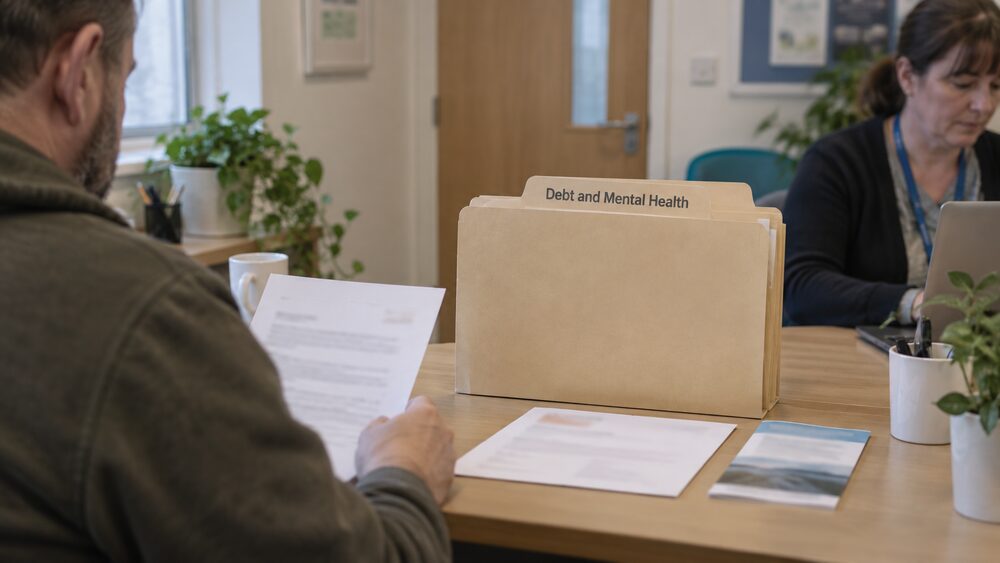
Breathing Space is free, and the debt advice providers that administer it are free to use3. To access Breathing Space you will need to talk to a professional debt adviser32. Free, independent debt advice is available from charities and advice services, and the page on free debt advice explains where to get it and what happens at an appointment. If you are supporting someone through a crisis, the page on debt and mental health covers how creditors must treat people with mental health problems and how evidence of a mental health situation can be shared.
Related options are covered elsewhere on the site: the standard 60-day breathing space, whether breathing space stops bailiffs, court action and eviction, and the full range of debt solutions across the UK. If you are weighing up what to do about arrears while a breathing space runs, priority and non-priority debts explains which bills to keep paying first, and informal payment arrangements explains what creditors may agree once the breathing space ends.
Sources32 cited
- Breathing Space scheme research briefing House of Commons Library, 2026
- Individual insolvency statistics commentary, August 2026 Insolvency Service, 2026-09-18
- Breathing Space: what happens during your breathing space StepChange Debt Charity, 2026-09-25
- What is a mental health breathing space? Mental Health and Money Advice, 2023-07-09
- Stop and restart deductions from benefits under the Debt Respite Scheme GOV.UK, 2021-05-06
- Breathing Space guide, England and Wales Business Debtline, 2026-09-26
- Mental health crisis breathing space: rent and mortgage arrears Shelter England, 2026-05-01
- Extension of the Debt Respite (Breathing Space) Scheme to Northern Ireland Department for Communities, 2026-04-29
- Breathing Space advice for young people Shelter Cymru, 2026-03
- Breathing Space guide, England and Wales National Debtline, 2026-09-25
- Breathing Space scheme guide Mental Health and Money Advice, 2025-09-08
- Debt Respite Scheme: creditors' responsibilities to the court GOV.UK, 2021-04-30
- Mental health crisis moratorium eligibility, Part 3 legislation.gov.uk, 2026
- Explanatory Memorandum to the Debt Respite Scheme Regulations 2020 legislation.gov.uk, 2020
- The Debt Respite Scheme Regulations 2020 legislation.gov.uk, 2026
- Mental health crisis moratorium conditions, regulation 30 legislation.gov.uk, 2026
- Breathing Space from your debts Shelter Cymru, 2026-08-30
- Mortgage arrears and Breathing Space StepChange Debt Charity, 2026-09-25
- Explanatory Memorandum to the Mental Health Crisis Moratorium regulations legislation.gov.uk, 2020
- Mental health crisis moratorium end rule, regulation 32 legislation.gov.uk, 2020
- Debt and mental health guide, England and Wales Business Debtline, 2026-09-26
- Debt and mental health guide, England and Wales National Debtline, 2026-09-25
- The Debt Respite Scheme (England and Wales) Regulations 2020 legislation.gov.uk, 2020-11-17
- Breathing Space consultation response StepChange Debt Charity, 2026-09-25
- Breathing Space scheme: who it is for StepChange Debt Charity, 2026-09-25
- Problems paying your rent Independent Age, 2026-09-26
- Are you worried about your mortgage? Shelter England, 2026-09-26
- The Debt Respite Scheme Regulations 2020, PDF legislation.gov.uk, 2020-11-17
- Breathing Space guidance (Welsh) Mental Health and Money Advice, 2025-09-08
- Costs of living if you can't afford your essential costs Business Debtline, 2026
- Redundancy and what to do StepChange Debt Charity, 2026-09-25
- Get advice about managing credit Welsh Government, 2022-11-18




 StepChangeFree debt advice and solutions from a charity
 National DebtlineFree debt advice by phone, webchat and online
 MoneyHelperFree, impartial money and pensions guidance, set up by government
 Citizens AdviceFree advice on money, consumer and legal problems in England and Wales
 Citizens Advice ScotlandFree advice across Scotland