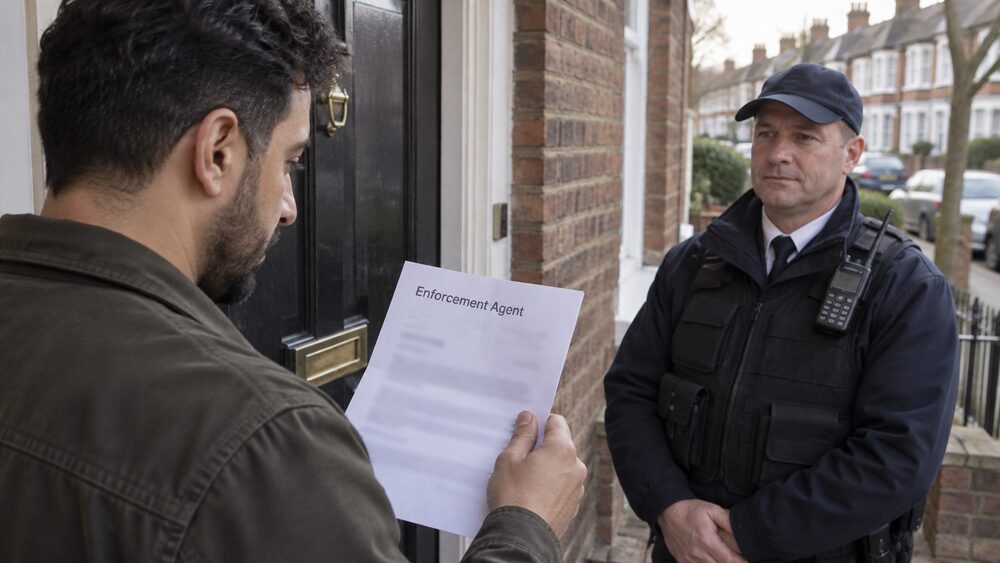
A bailiff, officially called an enforcement agent, is someone with legal powers to take control of your belongings so they can be sold to pay a debt. Those powers are set by law and by national standards, and they stop at clear limits: bailiffs must usually give you at least 14 days' notice of a first visit, you usually do not have to let them in, and they can only force their way into your home in narrow circumstances1. The fees they can charge are fixed at set amounts for each stage of the process, not open-ended2.
Bailiffs are not the same as debt collectors. A debt collector has no special legal powers to collect a debt, but a bailiff does3. Debt collectors cannot enter your home or take anything; bailiffs can, within the rules described on this page4. This page covers England and Wales only. Scotland and Northern Ireland have different systems, explained in the final section.
Bailiffs are normally only involved after court action or a formal order. Private bailiffs can usually only be asked to collect a debt after a creditor has taken court action against you5. The creditors who use bailiffs include landlords, HM Revenue and Customs (HMRC), the Department for Work and Pensions, the Child Maintenance Service, banks and building societies, credit card and catalogue companies, utility companies, and the High Court, County Court and magistrates' courts acting for local authorities6. HMRC is unusual in that it does not need a court order to send bailiffs, though it rarely uses this power7.
What bailiffs are and which debts they can collect
Bailiffs collect unpaid debts by "taking control of goods": listing, securing or removing your belongings so they can be sold towards what you owe. They are used mainly for priority debts, the kind that carry serious consequences if they are not paid, such as council tax arrears, court fines and tax debts2. For council tax, the council can use bailiffs to take belongings which will be sold to cover the debt, and the cost of using bailiffs is added to the amount you owe10.
A bailiff only gets involved late in the process. Councils, for example, can only use bailiffs to collect council tax or business rates arrears after they have got a liability order from the court11. Private bailiffs must be certified and authorised by a court to recover unpaid debts12. Some debts can also be collected by other routes first: your debt may be handled by the original creditor, a debt collection agency acting for them, or a third party who has bought the debt, and only some of those routes lead to bailiffs13.
When a bailiff does arrive, they have information duties. They must show identification, tell you which creditor they are collecting for, show their court warrant and give you a reasonable chance to pay14. They cannot harass you15.
If you are unsure whether the person at your door is a bailiff or a debt collector, the distinction matters practically: a debt collector has no right to enter your home or take anything, and can only come in if you invite them4. Some bailiff firms also work as debt collectors on other debts; when they do, they have only the same powers as any other debt collector and cannot enter your home or take things without permission4.
Notice before a visit: at least 14 clear days
Bailiffs must usually give you at least 14 days' notice of their first visit1. In practice this comes as an enforcement notice, a letter telling you the debt has been passed to bailiffs and when they intend to visit16. The same 14 clear days' notice applies across the different types of bailiff: county court bailiffs, High Court bailiffs, council tax bailiffs and bailiffs collecting magistrates' court fines all have to give it17.
"Clear days" has a specific meaning: the count excludes Sundays, Christmas Day and bank holidays18. So a notice period can stretch over more than two calendar weeks depending on where those days fall.
The 14 days are a window to act, not just to wait. For a warrant of control, the most common enforcement route after a County Court judgment, you have 14 days to respond to the letter before bailiffs can visit, and the count excludes Sundays, bank holidays, Good Friday and Christmas Day20. A debt advice provider such as StepChange can apply to extend that notice period from 14 days to 28 days, giving more time to sort out a plan or get advice20.
You usually do not have to let a bailiff in
You usually do not have to open your door to a bailiff or let them in1. This is the single most important right to understand, because most bailiffs cannot force entry into your home unless you have allowed them inside before and they have taken control of your goods5. Letting a bailiff in once can change what they can do on later visits, so the decision matters.
You can pay the bailiff on the doorstep without letting them into your home1. If you make an offer of weekly or monthly payments, the bailiff does not have to accept it, but bailiff rules mean they must pass your offer to the person you owe money to, and it has to be considered21.
Bailiffs are restricted in how they can approach your door. They cannot break down your door, use a locksmith without a warrant, ask the police to force entry without a warrant, climb through a window, push past you, put their foot in the door, or lie about who they are or why they are there8. They can only enter peacefully through a front or back door, must explain who they are and why they are there, show identification and their warrant, and turn body-worn cameras on8.
The police can sometimes go to a property with a bailiff, but they must not side with or help the bailiff2. Their role is limited, and refusing entry is not an offence: you cannot be arrested for refusing entry to a bailiff2.
One thing to remember: a bailiff does not need to be in your home to start taking control of some goods. They can clamp your car if it is parked on the street or in your driveway8. Keeping the door closed protects what is inside the house, not everything you own.
When bailiffs can force entry
Most bailiffs cannot force entry into your home unless you have allowed them inside before and they have taken control of your goods22. For county court bailiffs, High Court bailiffs, council tax bailiffs and bailiffs collecting parking penalty debts, the rules are the same, and all three of the following points must apply before they can force their way in17:
- They have taken control of your goods inside your home, usually through a controlled goods agreement (CGA) signed on an earlier visit.
- You have broken that agreement by missing at least one payment.
- They have given you two clear days' notice that they are coming to inspect or take the goods.
A bailiff cannot force entry to your home for a council tax debt unless they already have a controlled goods agreement in place8. There are two other situations where force is allowed: to collect a criminal fine or taxes owed to HMRC, and to take goods where a controlled goods agreement was in place and you did not pay what you agreed8.
Bailiffs can apply for a warrant to force entry to your home if you do not let them in. They are not allowed to break down your door and will usually use a locksmith, which adds extra costs21. For a warrant of control, the warrant itself does not let bailiffs force entry; they can apply for a separate warrant to force entry only if the judgment relates to a business address, or you moved your goods elsewhere to stop them being taken20. Some bailiffs are able to force entry into business premises22.
Where a liability order has been granted for council tax, enforcement agents can force entry in two further situations: when re-entering to inspect goods, and when re-entering to remove goods24.
Bailiff fees: set amounts at each stage
There are set fees that bailiffs cannot charge more than, and they can only be charged at certain stages in the collection process21. For most bailiffs, including county court bailiffs and council tax bailiffs, this is a three-stage process: compliance, enforcement and sale9.
The stages work like this. Bailiffs charge a flat fee of £75 at the compliance stage to send a letter notifying people that their debt has been passed to bailiffs25. If they visit your home, the enforcement stage adds a fixed fee of £247, plus 7.5% charged only on the amount of debt over £1,9009. If the process reaches taking and selling your belongings, the sale stage adds a fixed fee of £1169. One policy document gives the sale-stage fee as £11025, so the figures differ slightly between sources; the fee charged on any individual case should be checked against the bailiff's own breakdown.
High Court Enforcement Officers follow a four-stage process and can charge fees at any of those stages, with an extra fee for debts over £1,20021. The first stage, from issuing a writ of control up to before the initial visits, including the enforcement notice, costs £7926. The stage covering attendance to remove goods for sale through to the end of the process costs £55018.
| Stage | Most bailiffs (3-stage) | High Court (4-stage) |
|---|---|---|
| Letter before visiting | £7525 | £7926 |
| Visiting your home | £247, plus 7.5% of the debt over £1,9009 | charged at stages 2 and 321 |
| Removing and selling goods | £1169 | £550 for stage 3 onwards18 |
Fees are added to the debt: for council tax, the bailiffs' costs can be added to the total amount you owe the council27. There are limits on when fees apply. If you made a controlled goods agreement by video call, bailiffs can only charge you for compliance9. You cannot be charged fees if you prove the debt is not yours or the bailiffs cannot collect the debt9. For a warrant of control, the people you owe pay a fee when they apply, and the standard fee of £94 is then added to your debt20.
County court and High Court bailiffs: how each one works
County court bailiffs work for HM Courts and Tribunals Service17. They enforce county court judgments through a warrant of control, which is usually the next step after a County Court judgment (CCJ) where you have missed at least one monthly payment or at least four weekly payments of an instalment order20. A warrant of control is given to County Court bailiffs, and the people you owe have six years from the date of the CCJ to apply for one20. The warrant lasts for one year28. In a county court, enforcement agents can try to get any amount up to £5,000; between £600 and £5,000 the creditor can choose to issue in a county court or in the High Court instead28. County court bailiffs can only enter your premises by a normal method of entry, such as a door17.
High Court Enforcement Officers work under writs of control issued by the High Court. Their process has four stages rather than three, and their fee structure differs as set out above21. High court bailiffs can take goods that are jointly owned by you and your partner, but they are only entitled to your share26.
Both types are bound by conduct rules when carrying out evictions. County Court bailiffs and High Court Enforcement Officers must not use violence or offensive language when evicting you, and must not damage your belongings; they cannot keep your belongings to pay for court costs or rent arrears unless a separate court order allows it29.
Paying, agreeing a plan or putting enforcement on hold
You can deal with a bailiff at any stage, and acting early costs least because each stage adds a fixed fee. You can pay the bailiff on the doorstep, or make an offer of payment. The bailiff does not have to accept your offer, but must pass it to the creditor, and it has to be considered1. If the creditor says no, a free debt adviser can often help negotiate, and the guide to informal payment arrangements explains how these work.
Council tax shows the pattern for how debts reach bailiffs: bailiffs will only usually be sent after a first reminder letter has been ignored, a second reminder letter has been ignored, and payment has still not been made after a final reminder, at which point the council applies for a liability order8. That long run-up means there is usually time to arrange payment before enforcement begins.
If you make a payment arrangement with county court bailiffs after they send the enforcement notice, the 12-month period they have to take control of goods starts from when you broke the terms of that arrangement17. If you made a controlled goods agreement by video call, bailiffs can only charge you for the compliance stage9.
Enforcement can also be paused. In eviction cases, if the court decides to stop the bailiffs you can stay in your home, and if you do not stick to a court-ordered repayment plan your landlord can ask the court to send bailiffs again31. A debt advice provider can apply to extend a warrant of control notice period from 14 days to 28 days20. Breathing Space, a 60-day protection from creditor action, may also stop enforcement; see does Breathing Space stop bailiffs?. If a bailiff visit does not recover a magistrates' court fine, the court can move to other enforcement, including taking money from your wages or benefits32.
What bailiffs can take, and what is protected
Bailiffs cannot take everything. They cannot take things you need, such as your clothes, cooker or fridge; work tools and equipment which together are worth less than £1,350; or belongings that belong to someone else1. They need to leave you with basic household items, and should only take enough items that will sell to pay off your debt14. For a warrant of control, they are only allowed to take things that are at the property when they visit, like cars, electrical items and jewellery20.
Ownership matters. If a bailiff is collecting a debt owed by you personally, the bailiff can only take control of goods owned by you, and they must take reasonable steps to check who owns the things they take14. If a bailiff is collecting a debt owed by a limited company, they can only take goods owned by the company22. High court bailiffs can take goods jointly owned by you and your partner, but are only entitled to your share26.
Cars have their own rules. Bailiffs cannot clamp or remove your car if it is worth less than £1,350 and you need it for work or study and there is no public transport you could use12. They may take a car parked on a public road or on your property, but cannot break into a locked garage or take it from someone else's property4. If a bailiff tries to clamp or take a vehicle you are still paying for on hire purchase, tell them you are still under an agreement and the car is not yours; they should stop8. If a bailiff has already found your car and listed it, hiding it could be a criminal offence33.
In eviction cases the rules are different again: bailiffs will not remove furniture or belongings unless the court has decided they should, and belongings left behind are locked inside and must be collected later by arrangement34. The narrow guide to what bailiffs can take lists the exempt goods in full.
Extra protection if you are vulnerable
Bailiffs have to treat people in vulnerable situations differently. You may be able to get extra time to make a payment or get debt advice if you are a vulnerable person, for example if you have mental health problems or a serious illness1. Bailiffs cannot take medical equipment, transport aids and disability equipment like electric wheelchairs, and cannot take money from a vulnerable person without giving them the chance for help and advice14.
The rules on who counts as a vulnerable person vary between guidance documents. One states that bailiffs should not enter, re-enter, remain in your property or take control of goods if there is only a child (under the age of 16) or a vulnerable person present; another says they should leave without making enquiries if there is only a child (someone under the age of 12) or a vulnerable person present.
Practical protections include:
- A controlled goods agreement must be signed by the bailiff and you, or someone acting for you if you are considered vulnerable8.
- Bailiffs should arrange an interpreter, like a British Sign Language interpreter, where they can, and make communications available in large print, braille and other languages if needed14.
- Most lenders and bailiffs have a policy for supporting vulnerable customers, which may include people who have experienced domestic abuse6.
Free help is available. National Debtline runs a Help with Bailiffs service: if you have extra support needs and an urgent issue involving a bailiff who has not taken into account your extra support needs, they may be able to contact the bailiff firm to try and help35. The Taking Control of Goods National Standards apply to all types of bailiffs and describe how they are expected to behave5. If debt and mental health are connected, see debt and mental health, and for coerced debt see debt and economic abuse.
How to check a bailiff is genuine
All bailiffs must have a certificate unless they are exempt or they are with someone who does have a certificate1. You can check whether a bailiff has a current certificate by searching the Certificated Bailiff Register, entering the enforcement agent's name or employer36. Council tax bailiffs must be certificated, meaning they must have a certificate from the County Court allowing them to act as a bailiff37.
When a bailiff turns up at your home, they must wear a body camera and have it switched on, show their identification, show information about which creditor they are working for, and show copies of their court warrant2. Anyone who claims to be a bailiff when they are not is committing fraud1.
If they say they are an Approved Enforcement Agent, check they are from one of the following companies: Compliant Data-Led Engagements & Resolutions (CDER) Group, Marston Holdings Limited, or Jacobs Enforcement1. An Approved Enforcement Agent can arrest you if there is a warrant for your arrest for breaking a community penalty order1.
If you are struggling with debt more widely, free and impartial advice is available: see free debt advice and how to tell if a debt adviser is legitimate.
Complaining about a bailiff
Complaints can work, and can get fees cancelled or money returned. You can complain by writing to your creditor, the person or organisation you owe the money to, asking them to get the bailiffs to cancel the fees or return your money9. Send the complaint to the bailiff company as well, and send a copy to the creditor14.
If you are not happy with the response, escalate it:
- Report it to a regulator or independent reviewer, like the Enforcement Conduct Board (ECB). If the agency the bailiff works for is registered with them, they will look into your complaint further33.
- For a certificated bailiff, fill in a Complaint against a certificated person form and send it to the County Court hearing centre that granted the bailiff their certificate11. The Certificated Enforcement Agent Register confirms you can complain to the court that issued the agent's certificate36.
- For county court bailiffs, write to the delivery manager of the County Court hearing centre they are working for, and then to the Parliamentary and Health Service Ombudsman after all stages of the court's complaint procedure17.
- You may also be able to complain to the Association of Civil Enforcement Agents if the bailiff is a member34.
The Government has announced increased oversight of the enforcement industry, including consistent professional standards and an independent complaints process for private enforcement agents in England and Wales, so the routes above are likely to carry more weight as regulation tightens. The narrow guide to bailiff fees and complaints covers the detail, and harassment by creditors covers pressure that falls short of bailiff action.
Visiting hours and days
Bailiffs can visit between 6am and 9pm, Monday to Sunday8. They cannot enter between 9pm and 6am1. County court bailiffs can usually act on any day of the week, but only between 6am and 9pm, unless your business is open outside those hours16.
There are no rules about what time during the day they can come, but it will normally be within normal working hours34. The National Standards for Enforcement Agents recommend they avoid certain days, but bailiffs may also visit on public or bank holidays, Good Friday, Christmas Day and other religious holidays2.
Scotland and Northern Ireland have different rules
Bailiffs do not operate across the whole UK. There is a different process in Scotland1. A sheriff officer is different from both the police and a bailiff, and bailiffs do not apply in Scotland38. If you live in Scotland or Northern Ireland, the rules are different, and Scotland has its own guide to sheriff officers8. Private bailiff guidance for England and Wales states plainly that you will need different advice if you live in Scotland5.
For readers in Scotland, the equivalent pages are diligence in Scotland, protected trust deeds, sequestration and the Debt Arrangement Scheme. For a side-by-side comparison of the two systems, see bailiffs, enforcement agents and sheriff officers compared.
Sources38 cited
- Your rights if bailiffs take your things GOV.UK, 2026
- Bailiff help and advice StepChange Debt Charity, 2026
- Can debts be sold on? StepChange Debt Charity, 2026
- Can debt collectors come to your house and take your belongings? National Debtline, 2026
- Bailiff complaints (England and Wales) National Debtline, 2026
- Enforcement agents and bailiffs Surviving Economic Abuse, 2023
- Tax credit overpayments StepChange Debt Charity, 2026
- Bailiff rights and powers StepChange Debt Charity, 2026
- Check bailiffs' fees Citizens Advice, 2026
- Paying council tax Which?, 2026
- Bailiff complaints (England and Wales) Business Debtline, 2026
- Understanding bailiffs National Debtline, 2026
- Harassment by creditors Citizens Advice, 2026
- Bailiff complaints StepChange Debt Charity, 2026
- Cost of living help StepChange Debt Charity, 2026
- County court bailiffs (England and Wales) Business Debtline, 2026
- County court bailiffs (England and Wales) National Debtline, 2026
- High Court enforcement (England and Wales) National Debtline, 2026
- Magistrates' court fines (England and Wales) Business Debtline, 2026
- Warrant of control StepChange Debt Charity, 2026
- Bailiffs' fees and costs StepChange Debt Charity, 2026
- Emergency situations (England and Wales) Business Debtline, 2026
- Council tax arrears (England and Wales) National Debtline, 2026
- Liability orders StepChange Debt Charity, 2026
- Bailiff and court fees research StepChange Debt Charity, 2026
- High Court enforcement (England and Wales) Business Debtline, 2026
- Council tax arrears GOV.UK, 2026
- Apply for a warrant of control GOV.UK, 2026
- Notices of possession served from 1 May 2026 GOV.UK, 2026
- Warning about bailiff email scam GOV.UK, 2021
- What happens next after eviction bailiffs Shelter England, 2025
- Your priority debts (England and Wales) Business Debtline, 2026
- Dealing with bailiffs StepChange Debt Charity, 2026
- Ordered to leave Shelter Cymru, 2026
- How we can help you National Debtline, 2026
- Certificated Enforcement Agent (Bailiff) Register HM Courts and Tribunals Service, 2026
- Council tax arrears (England and Wales) Business Debtline, 2026
- Sheriff officer powers and rights mygov.scot, 2023



 StepChangeFree debt advice and solutions from a charity
 National DebtlineFree debt advice by phone, webchat and online
 MoneyHelperFree, impartial money and pensions guidance, set up by government
 Citizens AdviceFree advice on money, consumer and legal problems in England and Wales
 Citizens Advice ScotlandFree advice across Scotland