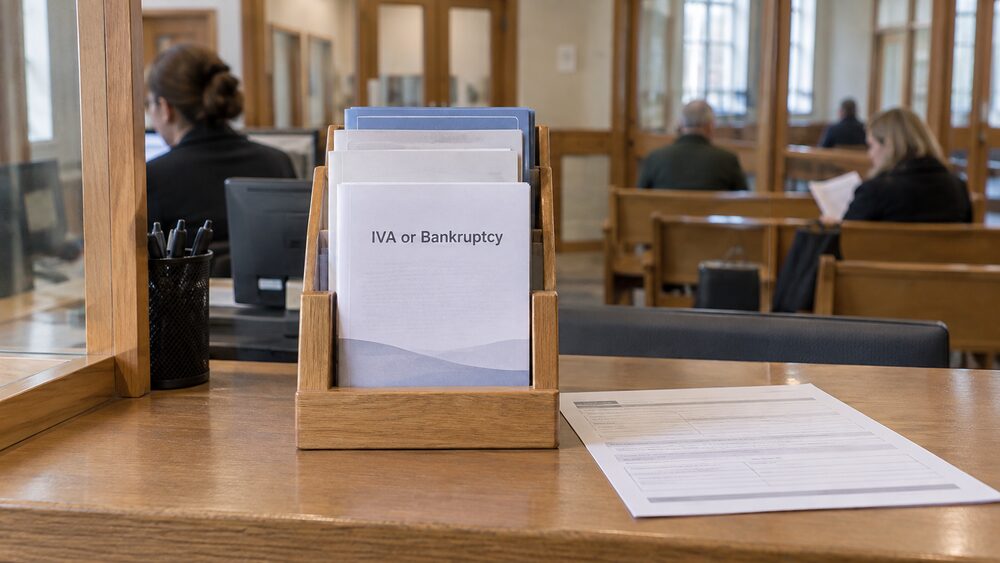
An individual voluntary arrangement (IVA) and bankruptcy are both formal insolvency procedures, and both are recorded on the Individual Insolvency Register1. The difference that matters most to a reader is control: in an IVA you keep control of your assets, while bankruptcy can put them at risk2. An IVA is a legally binding arrangement between you and your creditors, set up through an insolvency practitioner3. Bankruptcy is a court-based process you apply for online, and an adjudicator reviews your application4.
In July 2026, 11,926 people in England and Wales entered insolvency: 664 bankruptcies, 3,820 debt relief orders and 7,442 IVAs5. That is 14% higher than a year earlier5. IVAs are by far the most common of the three, but that does not make one the right answer for everyone. The choice turns on what you own, what you earn, how long you can keep up a payment, and what you do for a living.
This page sets out how each solution works, what it costs, what happens to your home and job, and where to get free advice. Bankruptcy in Scotland works differently, with different fees and processes6. If you live in Scotland, the equivalent options are sequestration and a protected trust deed.
IVA or bankruptcy: the differences side by side
| IVA | Bankruptcy | |
|---|---|---|
| What it is | A legally binding arrangement between you and your creditors, set up through an insolvency practitioner3 | A court-based process you apply for online; an adjudicator reviews the application4 |
| Control of assets | You retain control of your assets2 | Your assets can be used to pay your creditors, and that can include your home6 |
| Typical length | Sixty months7 | Usually ends when you receive your discharge10 |
| Fees | No up-front fees; fees are set out in your proposal and must be approved by creditors8 | Its own eligibility rules and its own fees6 |
| Effect on your job | Less likely to affect your job10 | More likely to affect your job than an IVA10 |
| Public record | Listed on the Individual Insolvency Register1 | Listed on the Individual Insolvency Register1 |
What each solution offers
An IVA is a form of insolvency and a legally binding arrangement between you and your creditors3. You agree to pay an affordable amount each month, usually for five years, and at the end the remaining debt is written off. The write-off happens either when the IVA is completed or when you receive your discharge from bankruptcy10. Unlike bankruptcy, you retain control of your assets during an IVA2.
Bankruptcy is the other main personal insolvency procedure13. You apply online and an adjudicator reviews your application4. The application asks for information about:
- your employment
- your debts and assets
- your income and expenditure
- your bank accounts
- any legal proceedings
- a brief debt history14
After creating an account you are given an application number by email, which lets you log in and save your details as many times as you need14.
The two solutions sit alongside others. Personal insolvency procedures include bankruptcy and IVAs, and the wider set of alternatives includes debt management plans and debt relief orders13. A debt relief order is aimed at people with low income, low assets and debts below a set limit, and a debt management plan is an informal arrangement rather than a formal insolvency. If you are unsure which applies to you, debt solutions across the UK sets out every formal and informal option.
One point that catches people out: an IVA is not a loan or a consolidation product. It is a formal insolvency, and it stays on your record. The same is true of bankruptcy.
Fees, charges and eligibility
IVA fees are based on a standard fee structure that all insolvency practitioners must adhere to8. There are no up-front fees, and debt advice is not charged for. Fees are detailed in your IVA proposal, which an insolvency practitioner helps draft, and any fees have to be approved by your creditors8. Payments go to the insolvency practitioner once the IVA is in progress16. If you do not go ahead with an IVA, you do not pay fees9.
Disbursements are the expenses that arise during an IVA. They include:
- insurance
- system maintenance fees
- registration fees with the Insolvency Service
- legal advice specific to your case
- property valuations or land registry fees9
To see how the numbers work, take an example from the Debt Advice Foundation: if you owe £25,000 and can afford £200 a month, you pay back £12,000 in total over the sixty months, including your insolvency practitioner's fee, and the rest is written off7. That figure is an illustration, not a quote, and your own proposal will differ.
Eligibility for an IVA rests on being insolvent, meaning unable to pay your debts17. The IVA Protocol criteria add that another solution, such as bankruptcy, a debt management plan or a lump-sum settlement, must not provide a better return for your creditors18. You need an insolvency practitioner to set up an IVA19.
Bankruptcy has its own eligibility rules and its own fees, which are set out in the guide to bankruptcy in England and Wales. If you have enough money for a regular payment after paying your living expenses, and can afford it for the next five years, you may be able to agree an IVA instead of bankruptcy20.
What happens to your home and assets
This is where the two solutions diverge most sharply. In an IVA you retain control of your assets2. An IVA can stop creditors taking action that affects your home, such as obtaining a charging order or applying for your bankruptcy21. Once an interim order is in force, it stops your creditors from starting bankruptcy proceedings against you and stops any other enforcement action without the court's permission21.
Bankruptcy works differently. Your assets can be used to pay your creditors, and that can include your home. If you are a homeowner weighing this up, does bankruptcy mean selling your home? covers the detail.
The protection an IVA gives is conditional on keeping up the payments. If you are unable to maintain the payments on your IVA there is a risk that you may be made bankrupt, which could result in you losing your home21. If your IVA fails, the people you owe may ask your IVA supervisor to petition for your bankruptcy, though this is unlikely to happen22.
Windfalls are treated differently too. Redundancy payments and insurance payouts may be kept if unemployment or illness means you have nothing else to live on23. If you receive a windfall during an IVA, the terms of your arrangement govern what happens to it.
If you are already bankrupt and want to annul it, an IVA can be the route. You may be able to agree an IVA instead if you have enough money for a regular payment after paying your living expenses and can afford this for the next five years20. Your insolvency practitioner deals with the annulment for you if you agree an IVA instead20.
How long each one lasts and how it ends
A typical IVA runs for sixty months7. You can pay it off early, and paying off an IVA early explains how that works and what it saves.
Bankruptcy usually ends when you receive your discharge. Your name is removed from the Individual Insolvency Register three months after the solution ends, whether that is the completion of an IVA or your discharge from bankruptcy10. The register is a public record maintained by the Insolvency Service, and it lists bankruptcies, debt relief orders and individual voluntary arrangements24. Your IVA entry shows details such as your name, date of birth and address, though the address may be withheld if you are at risk of violence21.
Ending an IVA early has consequences beyond the register:
- Creditors can restart interest and charges, including for the period the IVA was in place.
- The debt is not reduced by the amount you paid, because some of it covered the insolvency practitioner's fees.
- Creditors can take recovery action, and in rare cases apply to make you bankrupt21.
If you miss payments, the insolvency practitioner may initiate bankruptcy proceedings. You may also be liable for any fees paid by your creditors to your insolvency practitioner up to that point, and your creditors will once again be entitled to pursue you for the outstanding debt23. That is the point at which the choice between the two solutions stops being theoretical.
Banking, credit and your job
It is harder to open new bank accounts, get loans or buy on credit if you have an IVA25. Bankruptcy has a similar effect on your credit file. If you are bankrupt or have a poor credit rating, you may be able to open a basic bank account, though people who are bankrupt or have a record of fraud will not usually be allowed to open a standard account26.
Some savings providers exclude undischarged bankrupts outright. NS&I states that you are not eligible to open a Direct Saver account if you are an undischarged bankrupt or do not have legal capacity, and the same wording appears in its Guaranteed Growth Bonds key features27. That is worth knowing before you assume a savings account is available to you during bankruptcy.
On employment, bankruptcy is more likely to affect your job than an IVA10. Certain roles carry restrictions, and if your job is regulated you may need to tell your employer. Will an IVA affect my job? covers the IVA side, and bankruptcy, jobs and being a company director covers the bankruptcy side.
If you are self-employed, the alternatives to bankruptcy include a debt management plan, an administration order, an IVA or a debt relief order29. Which one fits depends on your income, your assets and how much you owe.
Which debts can go into each solution
An IVA can include a wide range of unsecured debts:
- gas and electricity arrears
- Council Tax arrears
- water arrears
- payday loans
- store cards and catalogues
- personal loans and overdrafts
- credit cards
- income tax and national insurance arrears
- tax credit or benefit overpayments
- debts to family and friends
- other outstanding bills30
Some debts cannot be included in either solution. Court fines, student loans and child maintenance are the usual examples, and debts that cannot go into a debt relief order explains the same principle for that solution. If a debt cannot be included, it survives the insolvency and you remain liable for it.
Secured debts behave differently again. An IVA is a form of insolvency, and assets of value such as a house or a car may be looked at21. If you have a mortgage or a car on finance, the lender's security is not wiped out by an IVA or by bankruptcy.
Where to get free advice
Both solutions are formal, both are recorded publicly, and both have long consequences. Free, impartial advice exists, and it is worth taking before you commit to either.
StepChange Debt Charity offers free, flexible debt advice based on a comprehensive assessment of your situation, with practical help and support for however long it is needed11. Its online advice is available 24 hours a day, and it can refer you to a fellow debt advice charity if face-to-face advice is best12. It has been helping people for over 30 years and has helped more than seven million people31. Getting advice will not affect your credit file or your credit score33.
National Debtline provides free, impartial debt advice to more than 100,000 people each year, and its advisers have been helping people get out of debt for over 30 years34. It is free to use, always, and is an independent registered charity authorised and regulated by the Financial Conduct Authority35. You can reach it by phone, webchat or its My Money Steps tool, and your details will never be shared35.
If you are struggling with priority debts such as rent, Council Tax or energy, which bills to pay first explains the order that matters most. If you want to understand what a debt adviser actually does before you call, what is debt advice sets that out.
Complaints and protection
If something goes wrong with your IVA, there is a route to complain. If you complain to the Insolvency Service, you must include the reply you received from your IVA provider, and you will need as much evidence as possible of the poor practice36. Complaining about an insolvency practitioner sets out the process in full.
The Financial Ombudsman Service can look at some complaints involving debt and cost of living issues37. Its approach to IVAs is that, unlike bankruptcy, the consumer's assets do not pass to the IVA supervisor when the consumer enters the IVA, and the effect on any redress depends on the terms of the IVA38.
"unlike bankruptcy, the consumer's assets do not pass to the IVA supervisor when the consumer enters the IVA"
The Individual Insolvency Register is public, and anyone can search it for people or companies in insolvency proceedings1. That is a fact worth weighing: an IVA is not private.
If you are worried about someone else's debts rather than your own, National Debtline has guidance for that too34. And if your income has dropped or you have lost work, unemployment and reduced hours covers what help is available while you decide.
Sources38 cited
- Search for people or companies in insolvency proceedings GOV.UK, 2020-07-08
- Individual voluntary arrangements R3, 2026-07-20
- IVA companies StepChange Debt Charity, 2026-09-26
- How long will bankruptcy affect me? StepChange Debt Charity, 2026-09-25
- Individual insolvency statistics, July 2026 GOV.UK, 2026-07
- Bankruptcy and your assets StepChange Debt Charity, 2026-09-25
- Straight talking IVAs Debt Advice Foundation, 2026-04-21
- Who pays the IVA fees? Debt Advice Foundation, 2026-04-21
- IVA costs, fees and charges StepChange Debt Charity, 2026-09-25
- IVA or bankruptcy StepChange Debt Charity, 2026-09-25
- Free and face-to-face debt advice StepChange Debt Charity, 2026-09-25
- Pay off or reduce debt StepChange Debt Charity, 2026-09-25
- The insolvency framework R3, 2026-07-23
- What bankruptcy forms do I need to complete? Debt Advice Foundation, 2020-05-12
- Insolvency StepChange Debt Charity, 2026-09-25
- IVA tips StepChange Debt Charity, 2026-09-25
- What am I expected to do when I'm in an IVA? Insolvency Service, 2023-03-23
- Who can enter into an IVA? Debt Advice Foundation, 2026-04-21
- Pay off an IVA early StepChange Debt Charity, 2026-09-25
- Cancelling bankruptcy StepChange Debt Charity, 2026-09-25
- Debt management plans in England and Wales National Debtline, 2026-09-25
- IVA and your credit rating StepChange Debt Charity, 2026-09-25
- What happens if I don't keep up the payments on my IVA? Debt Advice Foundation, 2025-08-15
- What is the IVA register? Debt Advice Foundation, 2020-06-04
- Individual voluntary arrangements Advice NI, 2026
- Getting a bank account Citizens Advice, 2026-09-25
- Direct Saver brochure NS&I, 2024-07-01
- Guaranteed Growth Bonds key features NS&I, 2025-06-30
- Insolvency Trading Standards Wales, 2025-03
- Check what an IVA is Citizens Advice, 2026-09-25
- Individual voluntary arrangement StepChange Debt Charity, 2026-09-25
- What is debt advice? StepChange Debt Charity, 2026-09-25
- Consolidation and bad credit StepChange Debt Charity, 2026-09-25
- How to do budget planning National Debtline, 2026-09-25
- Worried about someone National Debtline, 2026-09-25
- Insolvency Service research into individual voluntary arrangements GOV.UK, 2024-10-17
- Complaints involving cost of living Financial Ombudsman Service, 2026-09-27
- Ombudsman approach to PPI redress Financial Ombudsman Service, 2026-09-27




 StepChangeFree debt advice and solutions from a charity
 National DebtlineFree debt advice by phone, webchat and online
 MoneyHelperFree, impartial money and pensions guidance, set up by government
 Citizens AdviceFree advice on money, consumer and legal problems in England and Wales
 Citizens Advice ScotlandFree advice across Scotland