
When you cannot pay all your bills, the debts with the biggest balances are not necessarily the ones to pay first. What matters is what the creditor can do to you if you do not pay. Priority debts are the ones with serious consequences attached: losing your home, having your gas or electricity cut off, bailiffs taking your belongings, or in rare cases prison. Non-priority debts, such as credit cards, bank loans and overdrafts, carry real consequences too, but nothing as fast or as severe1.
The clearest way to put it comes from debt and mental health guidance:
"A priority debt is a debt that means you would lose something if you did not pay it."
That test decides everything on this page. A £40,000 credit card balance is still a non-priority debt, because the card company cannot take your home, disconnect a service or send you to prison. A £300 Council Tax arrears is a priority debt, because the council can send bailiffs, take money from your benefits or wages, and in England ultimately ask a court to send you to prison3. This page sets out which debts are which, what happens if you fall behind, and how to split whatever money you have between the creditors waiting for it.
Priority debts are judged by what can happen, not by how much you owe
The words "priority" and "non-priority" are not about how urgent a creditor sounds on the phone, or how large the debt is, or how many letters arrive. They describe the legal powers each creditor holds. Priority creditors are the most powerful: if you do not pay what you owe, you may lose an essential service or an essential item, such as your home or your gas or electricity supply8. Non-priority creditors have to follow a collections process before resorting to more serious action, and their debts carry less serious consequences if unpaid9.
This is why the rule for priority debts is inflexible. You must keep paying the debt at the rate the creditor decides, even if you make lower payments to other debts3. A credit card company can ask, chase and eventually sue, but it cannot throw you out of your home. A landlord can, with the right court process. A council can send enforcement agents to your door. An energy supplier can, in the last resort, disconnect you or move you to a more expensive prepayment meter4.
None of this makes non-priority debts safe to ignore. You could still be taken to court for not paying, but it is less likely than for a priority debt9. A non-priority debt that reaches court becomes something more serious, as explained below. The point of the priority test is about order: when there is not enough money to go round, the debts that can take your home, your heating or your freedom are paid first, and the rest are offered whatever is left.
Which debts are priority debts
The lists drawn up by debt charities across the four nations agree on the core. Priority debts include mortgage repayments and loans secured on your home, rent, gas and electricity debts, Council Tax, certain payments ordered by the courts, child support and maintenance payments, and payments for your TV licence4. StepChange describes priority debts and bills as the most important ones to pay, because they are the ones that can impact your home and health, cause legal problems and lead to more debt1. In Scotland the same list appears: mortgage arrears or other loans secured against your home, unpaid income tax or National Insurance, overpaid tax credits, criminal fines, child maintenance arrears, and household bills such as gas or electricity7.
Debts to government bodies are usually priority debts, including Council Tax arrears, rent arrears, TV licence fines, and overpaid benefits or tax credits10. Court fines and child maintenance sit at the top of the list in practice, because the enforcement powers behind them are the sharpest: in England, you can go to prison for non-payment of council tax arrears, criminal fines, and maintenance1.
The common thread is what you lose if you do not pay:
| Priority debt | What can happen if you do not pay |
|---|---|
| Rent or mortgage | You could lose your home11 |
| Gas or electricity | You could be cut off11 |
| Council Tax | Bailiffs could visit your home and take things11 |
| Hire purchase (essential goods, such as a car you need) | The item could be taken away11 |
| Court fines, child maintenance | Court enforcement, and in England potentially prison1 |
Two things need care. Hire purchase appears on both lists depending on the agreement: some hire purchase agreements are non-priority, but where the goods are essential, missing payments can mean losing them4. And water bills are a special case, covered in the next section, because the usual reason for treating a bill as priority, disconnection, is not available to water companies.
Which debts are non-priority debts
Non-priority debts are simply everything else. "A non-priority debt is any debt that is not a priority"2. In practice the list includes credit card debts, some hire purchase agreements, unsecured bank and payday loans, water bills, and loans from friends and family4. Overdrafts, bank loans, credit card or store card bills and money borrowed from friends and family all sit here9. Money you owe to your bank is a non-priority debt12.
The reason each of these is non-priority is the same: the creditor does not have extra powers to make you pay. They cannot take your home13. A payday loan is a non-priority debt because you cannot lose your home, lose an essential service or go to prison for non-payment14. Buy now pay later debts are non-priority debts15. Credit card debts are known as non-priority debts, but as Shelter Cymru points out, this does not mean they are not important16.
Water bills deserve their own explanation, because they confuse people. Water arrears are classed as a non-priority debt because a water company cannot disconnect your domestic water supply if there is still someone living in the property17. That protection is what keeps the debt non-priority, not any kindness on the company's part. The exception matters: where water rates are included in your rent, water arrears can count as rent arrears and could lead to court action to repossess your home, so in that situation they are treated as a priority payment17.
For students, the picture splits the same way. Credit debts, such as bank loans, credit cards and overdrafts, are usually a lower priority than debts to your university or college or Council Tax, because they cannot be enforced by evicting you from your home, sending you to prison or disconnecting an essential service. But accommodation arrears should be treated as a priority, because if you fall behind with rent payments you risk being evicted from the accommodation18.
When a non-priority debt becomes a priority debt
The boundary between the two categories can move. Non-priority debts become priority debts if the creditor is granted a County Court judgment (CCJ) against you19. The reason is enforcement power. Once a creditor has a CCJ and you do not pay, the company can get a charging order, which secures the debt against your home and puts it at risk of repossession20. A debt that started as an ordinary credit card balance has, through court process, acquired the defining feature of a priority debt: you could lose your home.
A few debts move in the other direction, or sit ambiguously. A DWP benefit overpayment is normally pursued hard, but if you are not on any benefits, you can treat the overpayment as a non-priority debt21. Mortgage shortfall debts, the balance left after a repossessed home is sold, can in most cases be treated as non-priority debts, as can claims for repayment of insurance policies22. The logic is the same throughout: the category follows the consequence, not the name of the creditor.
This is also why responding to court papers on time matters so much. A claim you defend or settle by instalments stays an ordinary non-priority debt. A judgment you ignore can turn into a charging order, an attachment of earnings, or worse. The site's guides to county court judgments and how creditors enforce a court judgment cover those stages in detail.
What happens if you fall behind on priority debts
The consequences of missing priority debts are the reason they come first. Not paying these will cause serious problems9. Falling behind can mean losing your home through mortgage or rent arrears, facing action by enforcement agents (previously known as bailiffs), having your gas or electricity supply cut off or being moved to an expensive prepayment meter, or losing belongings on hire purchase such as a car, furniture or other goods4. Common examples include rent arrears, Council Tax arrears and gas or electricity arrears with your current supplier13.
In Scotland the machinery has different names but the same force. Non-payment of priority debts can result in harsh enforcement, such as summary warrants or eviction23. If you do not pay your Council Tax, your council could serve a "Charge for Payment", and if you still do not pay, they could obtain a summary warrant allowing them to freeze your wages or your bank account, and could apply to make you bankrupt depending on how much you owe24.
Falling behind does not mean there are no options. Depending on the debt, you might be able to make lower payments for a short period if money is tight, ask to pay less for a while longer based on what you can afford, or ask for a payment holiday if you cannot afford anything at all11. The crucial step is to contact the priority creditor before the enforcement process starts, not after. A council, landlord or energy supplier asked early can often agree an arrangement; the same creditor with a court order in hand has less reason to negotiate.
Council Tax arrears: from reminder notice to bailiffs
Council Tax is a priority debt, stated plainly in official Scottish guidance24, and the recovery process moves quickly. Your local council will send you a reminder letter 14 days after you miss a payment5. The reminder tells you to bring your payments up to date within 7 days24. If you do not pay within seven days, you may be asked to pay the whole year's Council Tax25. You will only get two reminder letters in each financial year, April to March, before your local council sends a final notice5. Miss a third payment and you will not get another reminder: you get a final notice telling you to pay the full remaining balance in one go24.
If you pay within seven days of getting the final notice, you can keep paying your Council Tax in instalments. If you do not, your local council can ask you to pay your Council Tax for the whole year, and on top of this you will also have to pay the court costs5. In Wales the timings differ: the council can send a final notice if the debt has been outstanding for at least 41 days from when it was originally due and at least 14 days have passed since the latest reminder, and the final notice gives you 21 days to pay the missed instalments26.
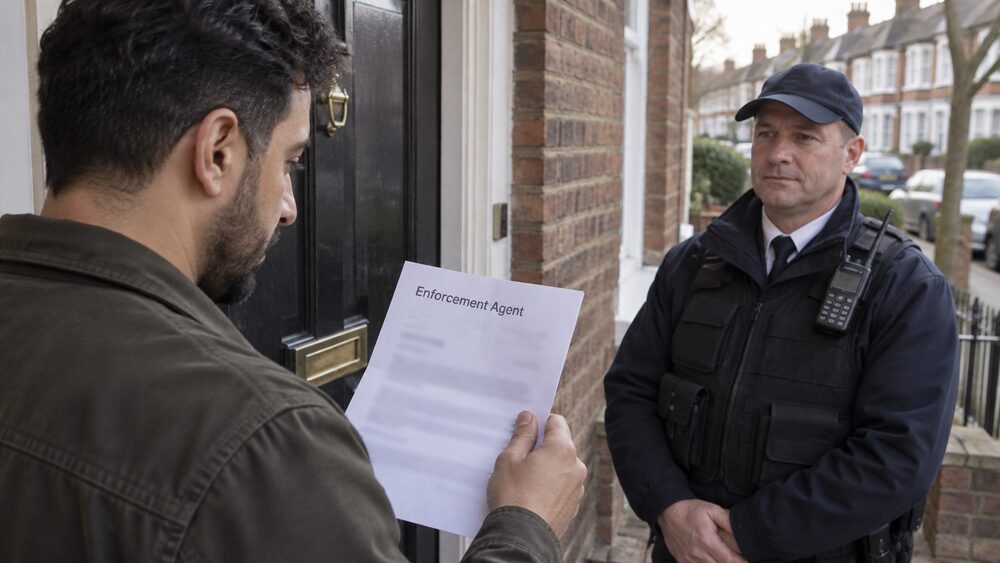
After the final notice, the council applies to the court for a liability order, and bailiffs will only usually be sent after a first reminder letter has been ignored, a second reminder letter has been ignored, and payment has still not been made after a final reminder letter6. Bailiffs could visit your home and take things11. The council can also deduct arrears directly from certain benefits, including Income Support, Pension Credit, income-related or contribution-based Employment and Support Allowance, income-based or contribution-based Jobseeker's Allowance or Universal Credit26. If the debt is for £1,000 or more, the council can apply to the County Court for a legal charge on the home you own, and it can try to make you bankrupt if the debt is £5,000 or more26.
There are softer options at every stage. Councils can let you pay your Council Tax in smaller amounts, and your council may give you a one-off discount if you still cannot pay what you owe27. In Scotland, the council can ask a sheriff officer to make a payment agreement with you24. Where a bill has been wrongly charged, the guidance is to pay it first and appeal afterwards, because enforcement measures can otherwise begin before the dispute is resolved25. Councils can also reduce bills in some circumstances: if all residents, including yourself, are not counted for Council Tax purposes, a 50% discount to the bill may apply26.
The prison question is real but narrow. In England, you could go to prison for up to three months if you do not pay what you have been ordered to pay by the court; this is a last resort and very rare6. You are at risk of going to prison in England, and this does not apply to Wales1. In Wales, official guidance puts the position similarly in general terms: you may have to pay the full amount at once, you might get extra charges, and in very serious long-term cases, not paying could lead to prison28. By contrast, a case for a non-priority debt such as a loan or credit card would be in the County Court and you cannot be sent to prison21.
The site's guide to Council Tax arrears covers the full process, and bailiffs and enforcement agents covers your rights at the door.
Rent and mortgage arrears: the risk to your home
Rent and mortgage arrears are the clearest priority debts, because the consequence of not dealing with them is losing your home. Missed rent payments are known as arrears, and are considered priority debts because they could mean you are at risk of being evicted from your home29. Mortgages are priority debts: your lender could repossess your home and sell it to get their money30. If you fall behind on your mortgage, your lender could take you to court and repossess your home; sheriff officers could evict you from the property and you would become homeless24.
This is not a rare problem. At the end of the first quarter of 2026 there were 88,130 first charge mortgages in arrears, representing over 2.5 per cent of the outstanding balance, and this was down 2.1 per cent compared with the number in December31. Behind each of those cases is a household having to choose between the mortgage and everything else, and the guidance is unambiguous about the choice: keep on top of your mortgage and rent payments when dealing with debts, or you may be in danger of losing your home, and make mortgage and rent the top priority32.
The practical rule for anyone in a debt solution is the same. Rent arrears are a priority payment, and payments towards them sit in your budget before anything goes to non-priority creditors33. If rent arrears have been agreed with your landlord or set by a court, keep paying them and no further action will be taken33. You could lose your home if you pay less to these debts3.
Help exists at every stage, and taking it early changes the outcome. Lenders and landlords are generally more willing to agree reduced payments before court action than after. The site's guides to rent arrears, help for homeowners in arrears and how lenders must treat you when you fall behind set out the options, including schemes such as Mortgage to Rent and Help to Stay.
Dealing with priority creditors first
The order of operations when money is short is fixed by the guidance. Any priority debts are dealt with before decisions are made about other debts34. Offers to priority creditors are worked out first because they have stronger powers to get their money back, and they are dealt with before anything is settled with non-priority creditors34. Once the payments to priority creditors have been worked out, the next step in the process is to contact them to make an arrangement34.
The practical steps, in order:
- Work out your income and outgoings, so you know what you can actually afford. A financial statement is the standard tool for this19.
- List your debts into priority and non-priority, using the test above.
- Work out an offer to each priority creditor, covering the ongoing bill plus something towards the arrears where there are arrears.
- Contact each priority creditor and make the arrangement.
- Only then decide what to do about your non-priority debts34.
If you have no money available to pay your priority debts at all, that is the point to get advice rather than to guess, because the options, from emergency grants and loans to formal solutions, depend on your situation34. Priority debts are things such as rent, mortgage, Council Tax, fuel bills or fines, and the standard offer letters used with non-priority creditors are explicitly not for them35.
Splitting what is left between non-priority creditors
Once your priority creditors have offers they have accepted, whatever money is left goes to the non-priority creditors. Where some money is left, the guidance divides it between non-priority creditors so that each is offered a fair share of the money available. This is worked out on a pro-rata basis, and it is how the court would do it34. The same method applies to a lump sum: where a lump sum of money is being used to reduce non-priority debts, the usual suggestion is to divide the money between the creditors on a pro-rata basis8.
Pro-rata means each creditor gets the same proportion of what they are owed, so a creditor owed twice as much receives twice as much of the available money. This matters because it is defensible: a court dividing your money between creditors would use the same method, and a creditor can see they are being treated no worse than any other34. Citizens Advice publishes template letters for making an offer to non-priority creditors on this basis35.
Where there is nothing left, the options change rather than end. A debt management plan can include non-priority debts such as credit cards, loans and buy now pay later agreements, but priority debts such as mortgage, rent or energy arrears will need to be dealt with separately36. DMP payments are worked out after your priority payments, so rent or mortgage payments are covered in your spending33. Where there is genuinely nothing, token payments, breathing space or a formal insolvency solution such as a debt relief order or bankruptcy may be the route, and advice will tell you which. The site's overview of debt solutions compares them all.
Free debt advice and where to complain
Debt advice from the free sector costs nothing, and there are free advice services that can help7. You can get free and independent advice on debt management plans, or any kind of debt problem, from organisations such as Advice NI37. The Financial Services Compensation Scheme points people struggling with repayments to free debt advice from StepChange, Which? and Citizens Advice38. The FCA's own guidance for consumers in persistent credit card debt directs people to free debt advice39. The site's guide to free debt advice lists the main services and what happens when you contact them.
Where a fee-charging debt adviser is involved, the rules protect the money that should reach creditors. Under the FCA's CONC 8 rules for debt management, firms' fee arrangements must not have the effect that the customer pays all, or substantially all, of those fees in priority to making repayments to lenders in accordance with the debt management plan40. In plain terms, a fee-charging firm cannot take its fees first and leave your creditors unpaid. The site's comparison of free debt charities and fee-charging companies explains the difference.
Complaints have their own routes. For a council, you need to allow the council a reasonable amount of time to deal with your complaint, usually 16 weeks for a council in England and 12 weeks for a council in Wales, and you normally need to contact the ombudsman within 12 months of realising the council has done something wrong26. For creditors and debt advisers, the Financial Ombudsman Service handles complaints, and the site's consumer protection pages explain how it works. For bailiffs, complaints go to the creditor, the bailiff firm and then the enforcement regulator, covered in bailiff fees and how to complain.
One last point on where debt sits among your other worries. Official Scottish analysis found a strong association between public and priority debt and poor mental health, particularly Council Tax debt41. Priority debt is not only a legal category, it is the one whose consequences reach furthest into a household's life, which is the strongest reason for dealing with it first and with free, trained help rather than alone.
Sources41 cited
- What debts to pay first StepChange, 2026-09-25
- Priority and non-priority debts Mental Health and Money Advice, 2021-07-10
- Can I be forced to repay debts? StepChange, 2026-09-25
- Priority and non-priority debts Shelter Cymru, 2026-07-29
- Council tax arrears StepChange, 2026-09-25
- Bailiff rights and powers StepChange, 2026-09-25
- Debt advice Shelter Scotland, 2026-01-16
- Selling assets to clear debt National Debtline, 2026-09-25
- Practical and emotional advice when in debt Scope, 2026-08-05
- Government debts StepChange, 2026-09-26
- Work out your priority debts StepChange, 2026-09-25
- Overdrafts and other bank debts nidirect, 2025-11-07
- Student money and debt Business Debtline, 2026-09-26
- Payday loans National Debtline, 2026-09-25
- Buy now pay later National Debtline, 2026-09-25
- Credit card debt Shelter Cymru, 2026-08-30
- Water arrears National Debtline, 2026-09-25
- Student money and debt Business Debtline, 2026-09-26
- Income and expenditure financial statement StepChange, 2026-09-25
- How to pay off mortgage arrears Shelter England, 2026-08-20
- Your priority debts Business Debtline, 2026-09-26
- Mortgage shortfalls National Debtline, 2026-09-25
- Committee report on debt enforcement Scottish Parliament, 2022-07-02
- If you cannot pay your Council Tax mygov.scot, 2026-04-01
- Paying Council Tax Which?, 2026-04-17
- Council tax arrears National Debtline, 2026-09-25
- Council Tax arrears GOV.UK, 2026-09-26
- Council Tax and the law Carmarthenshire County Council, 2026-01-19
- Problems paying your rent Independent Age, 2026-09-26
- Mortgage arrears or payment difficulties nidirect, 2025-11-07
- Household Finance Review 2026 Q1 UK Finance, 2026-06
- Dealing with debt Shelter Cymru, 2026-07-29
- DMP, mortgage, home and tenancy StepChange, 2026-09-25
- Your business and household budget Business Debtline, 2026-09-26
- Offer to non-priority creditor joint letter Citizens Advice, 2026-09-25
- Debt management plans National Debtline, 2026-09-25
- Debt management plans nidirect, 2025-11-06
- Cost of living crisis debt support FSCS, 2026-09-25
- Help for consumers who are in persistent credit card debt FCA, 2020
- CONC 8: Debt advice FCA Handbook, 2014-04-01
- Review of emerging evidence on the effects of the cost of living crisis on debt in Scotland Scottish Government, 2024-12-20




 StepChangeFree debt advice and solutions from a charity
 National DebtlineFree debt advice by phone, webchat and online
 MoneyHelperFree, impartial money and pensions guidance, set up by government
 Citizens AdviceFree advice on money, consumer and legal problems in England and Wales
 Citizens Advice ScotlandFree advice across Scotland