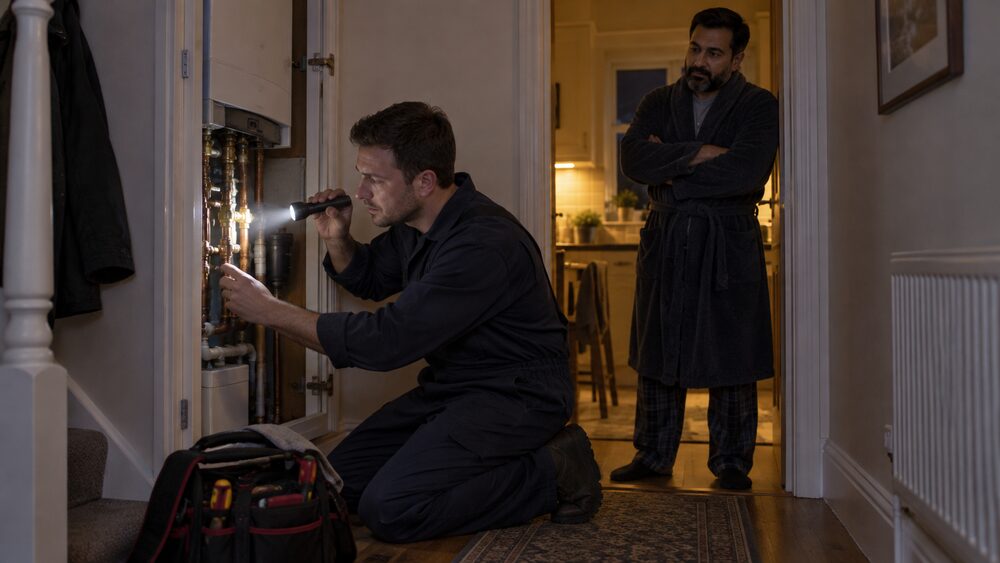
Home emergency cover is an insurance product that sends someone to your door when something in your home fails suddenly: a burst water pipe, a broken boiler, a blocked drain, a faulty lock. It is usually sold as an added extra to a home insurance policy rather than as a stand-alone product, and it typically costs around £50 a year1. When an emergency happens, you call a helpline that most insurers keep open 24 hours a day, 365 days a year, and they arrange and pay for a contractor to make the situation safe3.
The important thing to understand is what the cover is for. The Financial Ombudsman Service, which settles disputes between consumers and insurers, puts it plainly:
"Most home emergency policies are only meant to cover stopping the emergency. They don't usually cover consequential damage."1
So if a pipe bursts, home emergency cover pays for a plumber to stop the leak. The damage the water caused to floors, walls and belongings is a matter for your buildings insurance or contents insurance, not the emergency policy. Claim limits are typically £500 to £1,500 per incident, and the cover stops there.
What home emergency cover is and what it deals with
Home emergency cover exists for the problems that need someone at the door within hours rather than days. Which? describes it as rapid assistance for urgent problems such as a burst water pipe or broken boiler, and says it can help with emergencies ranging from plumbing issues and electrical faults to problems with pests or vermin, with levels varying significantly between insurers2. The Financial Ombudsman lists the kinds of event these policies typically respond to and is equally clear about the boundary: the policy stops the emergency, and consequential damage is not usually covered1.
That boundary is what separates this product from the rest of your home insurance. A burst pipe is really two events: the leak itself, and the water damage that follows. The emergency policy handles the first. The second goes to your buildings or contents insurer, which is why the two covers sit alongside each other rather than replacing each other. A similar line separates home emergency cover from boiler cover, which esure explains is designed to repair the boiler or replace parts after an unexpected breakdown, and which sits inside its Home Emergency Cover optional extra rather than as a stand-alone product6.
What it costs: around £50 a year as an add-on
The headline price is consistent across independent reviews: Which? puts the typical cost of home emergency cover at around £50 a year when added to a home insurance policy2. That makes it one of the cheaper home insurance add-ons, but the price alone does not tell you what you get, because the claim limits attached to that roughly £50 premium vary enormously, from £250 per claim on some bank account versions to £1,500 on some insurer policies8.
A few routes to the cover cost nothing extra at the point of use. Bank of Scotland tells its Premier Account customers they get free access to a 24 hour call-out service to help sort out domestic emergencies10. Halifax lists home emergency cover among the benefits of its Ultimate Reward current account, with an annual average value of £148 across the account's benefits as of June 20268. These are packaged bank accounts, where the cover is paid for through the account's monthly fee rather than as a separate premium, so the cost is less visible but not absent.
When you buy it as an add-on, the premium is usually charged alongside your home insurance premium, and the same rules apply to it as to any insurance product: the price reflects the insurer's view of the risk, and it can change at renewal. If you pay for your home insurance monthly, the add-on is normally spread the same way, and the rules in paying monthly for insurance apply.
Add-on, standard or bank account perk: how you get it
There are three main ways this cover reaches you, and the differences matter for what you end up with.
The most common route is as an optional extra on a home insurance policy. Urban Jungle, which sells policies with a home emergency add-on, notes that home emergency is usually an added extra and is rarely included as standard3. Hiscox tells customers they can choose to add home emergency cover when they take out home insurance with it11. Tesco Insurance lets new customers add Home Emergency Cover when they get a quote and buy a Home Insurance policy, and asks existing customers to call to add it, with no admin fee12.
The second route is a policy where it is simply included. NFU Mutual says home emergency cover is included as standard in its Bespoke Home Insurance, covered up to £1,500 per claim and administered on its behalf by ARAG9. This is the exception rather than the rule, and it tends to appear on higher-spec policies.
The third route is a bank account benefit. Halifax's Ultimate Reward current account includes home emergency cover up to £250 per claim including VAT8, and Bank of Scotland's Premier Account includes access to a 24 hour call-out service for domestic emergencies10. With these, the cover is a perk of the account, its terms are set by the account provider, and it ends if you close or switch the account.
Cover limits per claim: from £250 to £1,500
The limit is the maximum the policy will pay for a single emergency, and it is the figure that varies most between policies. Independent reviews of current policies show the spread clearly:
| Policy or account | Limit per claim |
|---|---|
| Hiscox home emergency cover | up to £1,500, including VAT11 |
| NFU Mutual Bespoke | up to £1,5009 |
| Nationwide Enhanced home insurance | £1,00013 |
| Tesco standard home insurance | £1,000 for home emergency, central heating and boiler repair14 |
| Urban Jungle policies with Home Emergency add-on | up to £1,000 for each covered emergency3 |
| Which? buildings policies (minimum standard) | £500, including the central heating system5 |
| Halifax Ultimate Reward current account | up to £250, including VAT8 |
A limit of £500 is enough for a straightforward call-out, such as stopping a leak or clearing a drain, but a limit at that level can be used up quickly by a heating breakdown that needs parts as well as labour. At the top end, £1,500 gives more room for the labour, parts and materials that Hiscox says its limit is designed to cover11.
One limit deserves separate attention: the boiler. The Financial Ombudsman notes that most home emergency policies offer a cash settlement of around £250 to £500 towards the cost of a new boiler where the old one is beyond economic repair1. That is a contribution, not a replacement, and it is a fraction of what a new boiler costs. The rules on insurance excess also apply: some policies charge no excess on emergency call-outs, as Hiscox states for its cover11, but that is a policy feature, not a given.
Boilers and heating: when a breakdown is covered
Heating is the reason many people buy this cover, and it is also where the restrictions cluster. The Financial Ombudsman lists the common ones: limitations on cover for replacement boilers, restrictions around the age of a boiler, types of property not covered, types of heating systems not covered, specific parts of heating systems not covered such as cylinders or water tanks, limits on how much you can claim, ineligible policyholders such as landlords, and exclusions on shared parts of a building such as external drains1.
What counts as covered varies by policy level. Tesco's Essentials level of Home Emergency Cover excludes heating breakdown altogether, while its higher level includes it12. Bank of Scotland's cover may contribute a maximum of £250 towards replacing a boiler that is beyond economic repair10. Some policies add a benefit that sits outside the emergency itself: the Financial Ombudsman notes that some home emergency policies include an annual boiler service1.
Two boundaries are worth knowing in advance. First, buildings or contents insurance alone will not cover your boiler, as esure confirms; boiler cover comes within the home emergency optional extra6. Second, the emergency policy is about getting heating or hot water working again, not about replacing an appliance: Age UK is blunt that this kind of cover "won't cover the cost of a new boiler"15. If your boiler is old, check the age restriction before you buy, because a policy that excludes your boiler specifically is of limited use for the emergency you are most likely to face.
Pests, drains and locks
Beyond heating and plumbing, the cover extends to several other sudden household failures. esure's Home Emergency Cover includes coverage for plumbing, drainage, security and temporary heating emergencies in addition to boilers6. Bank of Scotland's version covers blockages or damage to drains and waste pipes that cause water leaks or blockages inside the home10.
Pest cover is more common than many people expect. Which? reports that rodent removal is usually included in home emergency cover, and its analysis of policies offering home emergency cover as an optional extra found that 97% include the removal or treatment of vermin16. So a wasps' nest or an infestation of mice is often a valid call-out rather than a pest controller's bill.
Security failures are also typically in scope, meaning a failed lock on an external door that leaves the home insecure can qualify. As with every part of this cover, the levels vary significantly between insurers2, so the policy wording, not the marketing, is what determines whether a particular emergency qualifies and what the limit is for it.
Owners, tenants and landlords: who the cover is for
Who should hold this cover depends on who is responsible for the property. For homeowners, it is straightforward: the owner buys it, usually alongside their buildings and contents policies. For renters, the position is different. Urban Jungle tells renters and tenants they do not need to purchase home emergency cover because it is the landlord's responsibility3, and the Financial Ombudsman says the same: if you are a private tenant and you bought home emergency cover, you may not need it, because it is usually the landlord's responsibility to sort out emergencies1.
Which? summarises the split for renters: your landlord is responsible for buildings insurance, but you need your own cover for personal belongings17. The Royal Institution of Chartered Surveyors advises tenants to insure their own belongings at the property, because the landlord's insurance will not provide cover for them18. A tenant's contents insurance policy can carry its own home emergency add-on, but the emergencies it would respond to, such as a burst pipe, are usually the landlord's to fix in any case.
For landlords, the position reverses: the cover is relevant, but not every policy will have them. The Financial Ombudsman notes that some policies name landlords among the ineligible policyholders1, so a landlord needs a policy that accepts tenanted properties, such as one within landlord insurance, rather than a standard homeowner add-on.
Eligibility also depends on the property itself. Bank of Scotland's cover applies only if the property appears as your account address, is based in the UK, and is owned and occupied as a private residence by you or your family; a second or holiday home must be in the UK, owned and occupied by you or your family, and lived in at the time of an emergency10. That last condition matters: cover for a property you visit occasionally may not respond if nobody is living there when the emergency happens.
How to make a claim
The claim process for a home emergency is faster and simpler than a standard insurance claim, because the point is speed. Most insurers offering home emergency cover have an emergency phone number accessible 24 hours a day, 365 days a year3. Tesco describes its service as 24-hour support, offering a temporary repair for a range of home emergencies12.
Before you call, it helps to have the basics ready. The British Insurance Brokers' Association advises keeping receipts for anything of significant value, photographs of valuable items, serial and model numbers, a note of item ages, and your insurance documents in a safe place, with your broker's or insurer's contact details handy19. For an emergency call-out you will need, at minimum, your policy number, a clear description of the problem, and access to the property.
Keep records as the situation unfolds. The ABI advises keeping records of any damage, including photographs where possible, and retaining receipts for emergency expenses or temporary measures22. BIBA makes the same point for emergency repairs: keep all receipts and, where possible, get an additional quote so you know you are paying a fair price23. Those records matter twice over: once for the emergency claim itself, and again if the damage the emergency caused turns into a buildings or contents claim, where the general guide to making a claim applies.
If you rent, the route is different: nidirect, the Northern Ireland government service, advises tenants to ask their landlord to contact the company that insures the home24.
Call the insurer before you call a tradesperson
This is the rule that decides whether a claim is paid. Urban Jungle states it as an absolute: no claims will be accepted if you arrange your own contractor and try to claim the cost afterwards3. The cover works by sending the insurer's own contractor, so calling a plumber first and expecting reimbursement afterwards is not how the product functions.
The wider claims guidance points the same way. BIBA advises contacting your broker or insurer urgently to discuss any damage, noting they may agree to you carrying out certain emergency repairs before their representative has visited the property23. The ABI recommends getting in touch with your provider as soon as possible, because they can make any emergency payments needed, arrange temporary emergency accommodation and organise necessary repairs25. BIBA also advises notifying your broker, if you have one, as soon as is practically possible if you believe you need to make a claim19.
The practical sequence is therefore: make the home safe if you can do so without risk, call the emergency helpline, and wait for the insurer's contractor unless the helpline tells you otherwise. If the helpline agrees to you arranging a repair yourself, keep every receipt, because a claim submitted without them will be difficult to settle. If a claim is refused and you believe it should not have been, the guide to rejected claims explains the options.
Where home emergency cover does not apply
The exclusions fall into three groups: what the policy was never meant to do, conditions on the property, and limits on what and who is covered.
The first group is the product's design. Home emergency policies are meant to cover stopping the emergency, not consequential damage1. Water damage from the burst pipe, spoilage after a power cut, redecoration after a leak: these belong to buildings or contents insurance. The policy also will not replace a boiler, offering at most a cash settlement of around £250 to £500 towards one1, and Age UK confirms this kind of cover "won't cover the cost of a new boiler"15.
The second group is the condition of the property. Unoccupied homes are the clearest example. Bank of Scotland states that if your home is unoccupied for more than 60 consecutive days, cover does not apply10, and Halifax's Ultimate Reward cover likewise excludes homes left unoccupied for over 60 days8. Urban Jungle puts the typical restriction at around 30 days, varying by insurer3. The guide to how long your home can be empty covers the wider insurance consequences of leaving a property empty.
The third group is the small print the Financial Ombudsman lists: restrictions around the age of a boiler, types of property not covered, types of heating systems not covered, specific parts of heating systems not covered such as cylinders or water tanks, limits on how much you can claim, ineligible policyholders such as landlords, and exclusions on shared parts of a building such as external drains1. Wear and tear is a related boundary: a failure caused by gradual deterioration rather than a sudden event may fall outside the cover, a theme explored in gradual damage and wear and tear claims.
Complaints and where to get help
If a claim is refused, a call-out goes wrong or the repair is poor, the first step is to complain to the insurer or its claims handler. Home emergency insurance generates a steady flow of complaints: the Financial Ombudsman's quarterly complaints data recorded 550 complaints opened about home emergency insurance in Q1 2026/2726.
The ombudsman's own case studies show what can go wrong and how it gets put right. In one case, a couple told their home insurer, who also provided their home emergency cover, about a boiler problem; the engineer sent under the cover wrongly diagnosed the fault, leaving them without hot water, and the complaint reached the ombudsman27. Cases like this are resolved on their facts, but they illustrate that the contractor sent under the policy is the insurer's responsibility, and a botched repair is grounds for complaint.
An unresolved complaint can be taken to the Financial Ombudsman Service free of charge, and the guide to complaining about an insurer sets out the process and the time limits. If the work itself is the problem rather than the claim decision, the guide to poor repairs or unsuitable alternative accommodation is the relevant page. For free, impartial help with any insurance question, MoneyHelper and the British Insurance Brokers' Association's guidance are available, and a broker can help before you buy if you are unsure which policy fits your circumstances19.
Sources27 cited
- Home emergency insurance Financial Ombudsman Service, 2026-09-26
- Do you need home insurance add-ons? Which?, 2026-09-17
- Home emergency cover Urban Jungle, 2026-09-26
- HSBC home insurance review Which?, 2026-09-17
- Santander home insurance review Which?, 2026-09-17
- Boiler cover esure, 2026
- How to claim on your home insurance after a storm Which?, 2022-02-22
- Ultimate Reward current account Halifax, 2026-09-27
- Home insurance NFU Mutual, 2026-09-26
- Home emergency cover Bank of Scotland, 2026-09-27
- Home emergency cover Hiscox, 2026
- Home emergency cover Tesco Insurance, 2026-09-26
- Nationwide home insurance review Which?, 2026
- Tesco home insurance review Which?, 2026-09
- Looking after your boiler Age UK, 2026-09-10
- 5 winter risks your home insurance might not cover Which?, 2026-09-26
- 6 questions to ask before you choose a home insurance policy Which?, 2025-10-15
- Renting a property Royal Institution of Chartered Surveyors, 2026-09-26
- Making a claim British Insurance Brokers' Association, 2026-09-26
- Summer safety guide Halifax, 2026-09-27
- Home emergency cover AXA, 2026-09-26
- The ABI offers advice to anyone affected by wildfires in Suffolk and across the UK Association of British Insurers, 2026-07-31
- Property damage from bad weather British Insurance Brokers' Association, 2022-09-06
- After a flood: making an insurance claim nidirect, 2024-08-29
- Flood disruption and damage: what can your insurance pay for? Which?, 2023-10-31
- Quarterly complaints data Q1 2026/27 Financial Ombudsman Service, 2026
- Couple complain after wrongly diagnosed boiler issue leaves them without hot water Financial Ombudsman Service, 2026-09-27



 MoneyHelperFree, impartial money and pensions guidance, set up by government
 Financial Ombudsman ServiceFree, independent help when a complaint about a firm is not put right
 FSCSProtects your money if a bank, insurer or investment firm fails
 Citizens AdviceFree advice on money, consumer and legal problems in England and Wales
 GOV.UKOfficial information on tax, benefits and government services