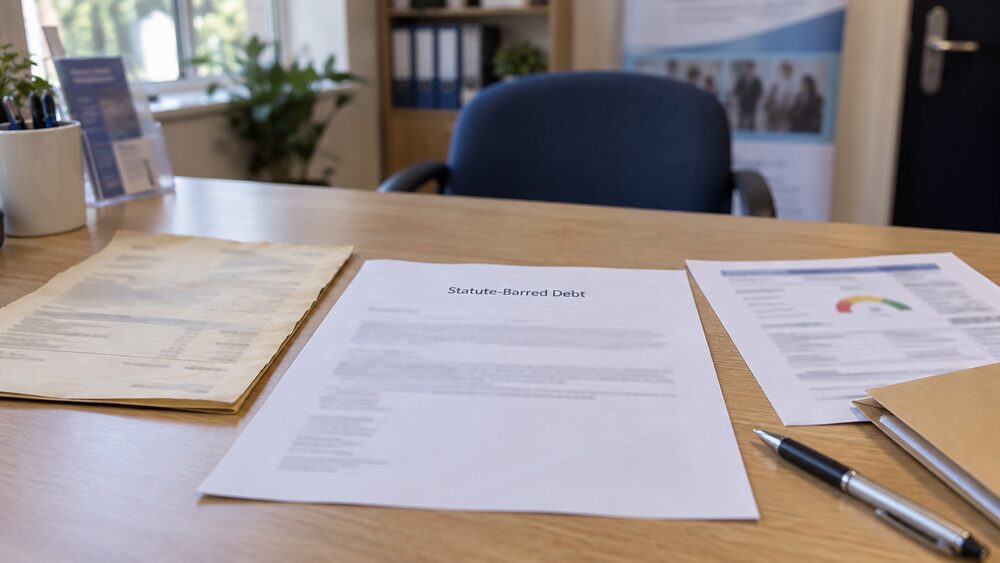
A debt becomes statute barred when enough time has passed that a creditor can no longer take you to court to enforce it. In England, Wales and Northern Ireland that period is six years, and it runs from the last time you made a payment, admitted in writing that you owed the debt, or the creditor took the debt through the county court1. In Scotland the equivalent is called prescription, and it takes five years3.
A debt becomes statute barred when enough time has passed that a creditor can no longer take you to court to enforce it. In England, Wales and Northern Ireland that period is six years, and it runs from the last time you made a payment, admitted in writing that you owed the debt, or the creditor took the debt through the county court1. In Scotland the equivalent is called prescription, and it takes five years3.
Being statute barred does not wipe the debt out. It still exists, and a creditor or debt collector can still ask you to pay it. What changes is that they cannot get a county court judgment, and if they try, you can tell the court the debt is statute barred, at which point it is up to the creditor to prove it is not1.
The clock is fragile. Any payment you make, however small, and any written admission that you owe the money, restarts the six years from the beginning. On a joint debt, a payment by the other borrower restarts the period for both of you4. That is why it is worth understanding the rules before responding to a letter about an old debt.
What a statute-barred debt is: six years in England, Wales and Northern Ireland
A statute-barred debt is one where a creditor cannot take you to court because too much time has passed since the debt was taken out, and the creditor can no longer enforce collection of it7. The rule comes from the Limitation Act, which sets a six-year limitation period for simple contract debts such as credit cards, store cards, personal loans and catalogues8.
The six years is not a single national rule. In England, Wales and Northern Ireland, debts are statute barred after six years, and council tax debts follow the same six-year period3. In Scotland, debts are prescribed after five years, and a prescribed debt ceases to exist and is no longer recoverable if no relevant claim has been made and the debt has not been acknowledged during the limitation period3.
The time limit is usually six years, but it can be between three and 12 years depending on the type of debt5. Mortgage shortfalls are the clearest example of a longer period: the Limitation Act gives a 12-year limit where the claim relates to the capital, and payments within that period restart it4. In Scotland there are different legal views about whether a lender has 5 or 20 years to take court action to recover a mortgage shortfall11.
For most consumer debts, the practical question is simpler: has anything happened in the last six years that counts as an acknowledgement? If nothing has, the debt is likely to be statute barred, and the creditor's main route to enforcement is closed.
When the six years start and what restarts the clock
The clock does not run from the date you took out the borrowing. It runs from the last time one of a small number of things happened. In England, Wales and Northern Ireland, a debt usually becomes statute barred if, during at least the last six years, you have not made any payment, you have not sent a written admission of the debt, and the creditor has not pursued the debt through the county court6.
Two actions restart the period from zero:
- A payment. Any payment you make, or that a joint owner such as your partner makes, within the limitation period causes the time limit to start running again from the beginning4. On a joint mortgage shortfall, a payment by the other borrower restarts the limitation period for both borrowers from the date of that payment12.
- A written acknowledgement. The time limit starts running from the beginning again if you write to the lender admitting or agreeing that you owe the debt4.
There is a trap here that catches people who are trying to do the right thing. Including a debt that is close to being statute barred in a Breathing Space application acknowledges the debt and resets the six-year wait to Day One6. The same logic applies to a debt management plan: a debt might be statute barred if you have not paid in over six years, but paying into a plan keeps it live13.
Debts that can become statute-barred
The debts that can become statute barred in England, Wales and Northern Ireland include credit and store cards, catalogues, overdrafts, personal loans, gas or electric arrears, council tax arrears, benefit overpayments and rent arrears1. For credit card debt and most other credit debts, the limitation period is six years14.
Some debts sit outside the ordinary rules or are treated differently:
- Council tax. Council tax arrears can become statute barred after six years without acknowledgement, but council tax is a priority debt, so it is normally dealt with before non-priority debts9.
- Benefit overpayments. The standard time in which debts should be reclaimed by the Department for Work and Pensions is six years, but it may be longer in some cases17. Recovery of a benefit overpayment must usually begin within six years after the date of the recovery decision18.
- Debts in formal solutions. A statutory debt repayment plan would not accept certain debts, including court fines, student loans, child support and family proceedings obligations, and debts incurred by fraud19. Debts that have reached the legal time limit for creditor action are treated as discretionary non-eligible debts, meaning they may be excluded from a plan21.
If you are working out which of your debts to deal with first, the distinction between priority and non-priority debts matters more than the age of the debt in most cases. Our guide to priority and non-priority debts sets out the order.
A statute-barred debt is not written off
This is the point most people get wrong. The debt is not written off. It still exists but it cannot be enforced by a court order1. A creditor can still contact you, and a debt collection agency can still ask for payment. What the creditor loses is the ability to obtain a county court judgment6.
The rules do place a limit on how far a firm can push. The Financial Conduct Authority's Consumer Credit sourcebook says:
"A firm must not continue to demand payment from a customer after the customer has stated that he will not be paying the debt because it is statute barred."
If a creditor does take court action on a debt you believe is statute barred, they are not allowed to do so, but they sometimes try. You can tell the court the debt is statute barred or prescribed, and the court should cancel the case if you can prove it is true. It is then up to the creditor to prove the debt is not statute barred or prescribed1.
Two further points are worth knowing. First, a statute-barred debt can still appear on your credit file in some cases, which means lenders can see it and it may be harder to get future credit1. Second, being statute barred is not the same as insolvency. Debts written off through bankruptcy or a trust deed have their own exclusions: criminal fines and fraudulent debts still need to be paid after discharge, joint debts are not written off unless the other person is also going bankrupt, and a letter of discharge does not release liabilities arising after the trust deed was granted24.
If you are being contacted about an old debt and the contact feels excessive, our guide to debt collectors and sold debts explains your rights, and National Debtline publishes free sample letters you can use to write to a creditor27.
Is the time limit different in Scotland?
Yes, and the difference is more than a year. In Scotland it takes five years for a debt to become prescribed, and prescription works differently from statute barring in the rest of the UK: a statute barred debt ceases to exist and is no longer recoverable if a relevant claim has not been made and the debt has not been acknowledged during the relevant limitation period3.
Most debts, including those covered by the five-year limit, are also covered by a 20-year limit10. For certain debts there is a five-year limit in some circumstances28. Mortgage shortfalls in Scotland are the least settled area: there are different legal views about whether a lender has 5 or 20 years to take court action to recover a mortgage shortfall11.
Scotland also has its own enforcement route. For most types of debt, as long as applications for time to pay have not already been made, you can apply to court or the First-tier Tribunal (Housing and Property Chamber) for time to pay, which suspends the arrestment procedure29. Free advice services in Scotland can help you work out which limitation period applies to your debt30.
Free help from National Debtline
National Debtline provides free, impartial debt advice, and as a registered charity it does not charge for it31. Its advisers can tell you whether a debt is likely to be statute barred, what to say to a creditor, and what your options are if it is not. The service also publishes free sample letters you can use to contact creditors in writing27.
You can call National Debtline for free debt advice on 0808 808 400032. The same freephone number is used for advice on free debt management plans and on negotiating reduced payments yourself33.
If you are not sure whether a call claiming to be from a debt advice service is genuine, hang up and call the number yourself. Free advice services do not ask you to pay for debt advice, and National Debtline's advice is free, confidential and independent35.
Other free help exists across the UK. Scotland has free advice services that can help with money problems30, and there is free, confidential and independent debt advice available through other routes35. If your situation is urgent, our guide to free debt advice explains where to go and what happens when you get there.
Sources35 cited
- Statute barred debt StepChange, 2026-09-25
- Credit card debt StepChange, 2026-09-25
- Unpaid council tax debt StepChange, 2026-09-25
- Mortgage shortfalls (England and Wales) National Debtline, 2026-09-25
- Glossary StepChange, 2026-09-25
- Whose debt is it? Shelter Cymru, 2026-08-30
- Sample letters StepChange, 2026-09-25
- Statute barred debts (England and Wales) Business Debtline, 2026-09-25
- Bailiff rights and powers StepChange, 2026-09-25
- Statute barred debts (Scotland) National Debtline, 2026-09-25
- Mortgage arrears (Scotland) National Debtline, 2026-09-25
- Mortgage shortfalls (Scotland) Business Debtline, 2026-09-26
- How could my DMP fail? StepChange, 2026-09-25
- Getting credit card debt written off National Debtline, 2026-09-25
- Council tax arrears StepChange, 2026-09-25
- Council tax: if you cannot pay mygov.scot, 2026-04-01
- DWP debt management StepChange, 2026-09-25
- How is an overpayment recovered Turn2us, 2025-12-09
- Statutory Debt Repayment Plan regulations GOV.UK, 2022-05
- Statutory Debt Repayment Plan consultation GOV.UK, 2022-05
- Statutory Debt Repayment Plan consultation published Finance & Leasing Association, 2022-05-17
- Debt Respite Scheme regulations legislation.gov.uk, 2020
- Harassment by creditors National Debtline, 2026-09-25
- How long will bankruptcy affect me? StepChange, 2026-09-25
- Debts included in a bankruptcy StepChange, 2026-09-25
- Discharge from bankruptcy Department for the Economy, 2019-09-11
- Disputing debts with creditors StepChange, 2026-09-25
- Statute barred debts (Scotland) Business Debtline, 2026-09-26
- Creditor takes money from my bank account Citizens Advice Scotland, 2026-09-25
- Debt advice Shelter Scotland, 2026-01-16
- How to do budget planning National Debtline, 2026-09-25
- Emergency situations National Debtline, 2026-09-25
- Can you get a mortgage with a debt management plan? National Debtline, 2026-09-25
- Debt management plans National Debtline, 2026-09-25
- More help with money problems mygov.scot, 2025-06-04









 StepChangeFree debt advice and solutions from a charity
 National DebtlineFree debt advice by phone, webchat and online
 MoneyHelperFree, impartial money and pensions guidance, set up by government
 Citizens AdviceFree advice on money, consumer and legal problems in England and Wales
 Citizens Advice ScotlandFree advice across Scotland