
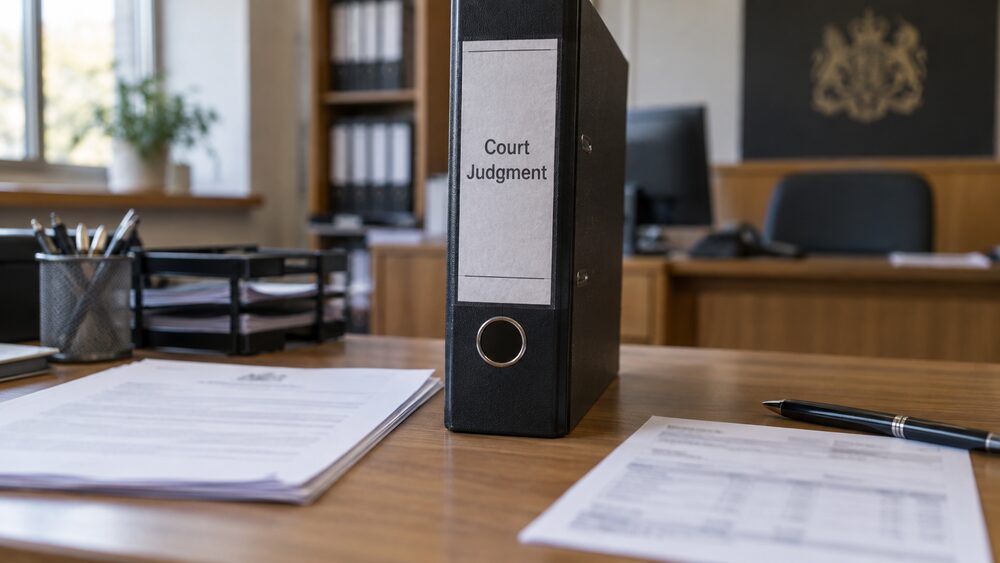
A charging order is a court order that secures a debt against property you own, usually your home, as if it were a mortgage1. It can only be applied for after a county court judgment (CCJ) has already been made against you, and the creditor has to pay a fee to the court for the application, which is then added to your debt2.
A charging order is a court order that secures a debt against property you own, usually your home, as if it were a mortgage1. It can only be applied for after a county court judgment (CCJ) has already been made against you, and the creditor has to pay a fee to the court for the application, which is then added to your debt2.
The deadline that catches most people out is not a date on a form. It is that a creditor may be able to apply for a charging order even if you have kept up to date with the payments you were ordered to make, provided you own property3. Objecting is therefore about the hearing, not about waiting for a letter to expire. If you want to ask the court to set the order aside at a hearing, the application costs £1774.
Free help is available. National Debtline is an independent registered charity, authorised and regulated by the Financial Conduct Authority, and its advisers have been helping people with debt for over 30 years5. Its freephone number is 0808 808 40006.
What a charging order does, and what it does not
A charging order does not take your home away on its own, and it does not force a sale by itself. What it does is turn an unsecured judgment debt into a secured one, so the creditor's claim sits against the property in the same way a mortgage does1. That changes your position in two practical ways: the debt becomes harder to walk away from, and it can be paid off from the proceeds if the property is later sold.
The route to one runs through the county court. A charging order can only happen after a CCJ has already been raised against you2. The creditor must then show one of two things: that the court ordered immediate payment of the judgment debt, or payment in full by a certain date, and you have not paid; or that you have missed a payment on an order to pay by instalments2. For judgments made before 1 October 2012, the position on instalments is different, so the date of your judgment matters2.
Local councils have the same power for council tax. Your local council can apply for a charging order if it gets a liability order for unpaid council tax, and the guidance on this refers to debts of more than £1,0006.
Once a charging order is in place, the way out is straightforward in principle. If you pay off the amount owed, you can apply to the court for the order to be discharged and ask for a certificate of satisfaction on the county court judgment, with evidence of payment3.
Getting free help to object: National Debtline
National Debtline is the main free national service for this kind of problem. It describes itself as an independent registered charity, authorised and regulated by the Financial Conduct Authority, and says it has been helping people in the UK with debt for over 30 years5. Its advisers have been helping people get out of debt for over 30 years, and it provides free, impartial debt advice7.
It is not the only free route. AdviceNow publishes guidance on how to get debt advice, and the Money Advice Trust runs a service to help people check that an advice service is genuine8. If you would rather deal with someone locally, community-based advice services exist alongside the national phone lines.
What National Debtline offers on a charging order is explanation and preparation rather than representation. It provides free debt advice and free sample letters that you can use to contact creditors in writing5. That matters because a letter before a hearing, setting out your circumstances and any offer, is often the practical step a reader needs to take.
"We will always be available to give you free advice to help you overcome any of the debt challenges that you face."
What National Debtline can and cannot do for you
The limits are published plainly, and knowing them saves a wasted call. National Debtline states that it cannot help if you do not have debt, cannot speak to the people you owe money to for you, does not give face-to-face advice, does not give money to pay your debts, and cannot give written information in your language5.
That list is worth reading twice if you are hoping an adviser will ring the creditor or the court on your behalf. They will not. What they will do is work through your budget, explain which options exist, and point you at letters you can send yourself5.
There is a wider point about what creditors can and cannot do while a debt is being dealt with. Debt collectors cannot force you to make a payment11. Where an administration order is in place, the people included in the order cannot contact you for payment or add any more interest or charges to your debts12. Where a debt relief order is in place, creditors cannot demand payment or start court action against you13.
If money is already being taken from your wages through an attachment of earnings order, you can apply to get the deduction amount changed if you cannot afford it14. That is a separate application from objecting to a charging order, but the two often sit alongside each other.
Contacting an adviser: phone, webchat and My Money Steps
National Debtline takes contact by phone, webchat and My Money Steps5. The freephone number is 0808 808 4000, given for free debt advice, for free debt management plans and for negotiating reduced payments yourself6.
The phone lines are open 9am to 8pm, Monday to Friday, and 9:30am to 1pm on Saturday17. Webchat keeps the same hours: Monday to Friday 9am to 8pm and Saturday 9:30am to 1pm18. Business Debtline, which is a separate service for businesses, is open 9am to 8pm, Monday to Friday17.
Before you call, it helps to have your paperwork in front of you: the CCJ, the charging order application, and anything you have already sent the creditor. National Debtline publishes a budget planning guide, and a budget is usually the document that decides whether an objection or a payment offer goes anywhere19.
If you are not ready to speak to anyone, My Money Steps is the self-help route, and it is free like the rest of the service5.
Charging orders in Scotland need different advice
The law diverges, and the guidance says so directly. The Scottish courts and Northern Irish courts have similar orders to a charging order, but they are not the same thing1. National Debtline's own material states that different advice is needed in Scotland, and its guides covering England and Wales say so explicitly20.
In Scotland the enforcement route runs through diligence rather than a charging order. A Charge to Pay or a Charge for Payment is sent before diligence starts8. That document is the Scottish equivalent of the warning stage, and it is the point at which different advice is needed in Scotland.
There is also a twelve-year expiry rule that applies only if you live in Scotland1. If you are in Scotland, the practical step is to use Scottish-specific advice rather than England and Wales material. National Debtline publishes a guide to debt help and advice in Scotland, and there is separate help with money problems through the Scottish Welfare Fund22.
In Northern Ireland the equivalent orders exist too, and there is extra help available to make or maintain a Universal Credit claim24. If you are in Northern Ireland, say so when you make contact, because the advice and the forms differ.
Beware callers pretending to be National Debtline
Debt advice charities are impersonated. Some companies cold call people pretending to be National Debtline, Business Debtline or the Money Advice Trust9. The Debt Advice Foundation reports the same pattern, with criminal organisations and unlicensed debt management companies pretending to be charities and making unsolicited calls to obtain personal details or sell inappropriate debt solutions25.
The tell is the direction of contact. A genuine free advice charity does not cold call you about a debt you have not raised with it. People may also contact you pretending to be a bank or utility company26, and creditors are not allowed to call you at unreasonable times of the day or night27.
HMRC scams follow the same shape: scammers claiming your national insurance number has been used in fraud, and messages offering phoney tax rebates or bogus grants or support28.
Where to get help if you are struggling
Beyond the charging order itself, the underlying debt is what needs dealing with, and there are free routes for that. National Debtline provides free, impartial debt advice as a registered charity19, and it has been helping people for over 30 years22. It also publishes guidance for people worried about someone else, which is the right starting point if you are helping a relative or friend29.
If your mental health is affected, there is specific guidance on debt and mental health30. If you are dealing with a creditor who will not stop contacting you, there is guidance on harassment by creditors31.
For the wider picture, the site's pages on free debt advice and on how creditors enforce a court judgment set out the options and the process in more detail. If you are weighing up formal solutions, debt solutions across the UK compares them, and what debt solutions cost covers the fees.
Sources31 cited
- Charging orders and my home StepChange, 2026-09-25
- Charging orders in England and Wales National Debtline, 2026-09-25
- Charging orders Citizens Advice, 2019-11-25
- Varying a CCJ National Debtline, 2026-09-25
- Support resources National Debtline, 2026-09-25
- Unpaid council tax debt StepChange, 2026-09-25
- How to do budget planning National Debtline, 2026-09-25
- Diligence StepChange, 2026-09-25
- Making sure it's us Money Advice Trust, 2026
- Becoming debt free National Debtline, 2026-09-25
- Bailiff help and advice StepChange, 2026-09-25
- Administration order StepChange, 2026-09-25
- Debt relief order StepChange, 2026-09-25
- Debt payments from your wages GOV.UK, 2026-09-26
- Debt management plans National Debtline, 2026-09-25
- Can you get a mortgage with a debt management plan National Debtline, 2026-09-25
- Free debt advice contacts Which?, 2025-08-26
- How to get debt advice AdviceNow, 2026-09-26
- Emergency situations National Debtline, 2026-09-25
- Debt help and advice in Scotland National Debtline, 2026-09-25
- What is the debt avalanche method National Debtline, 2026-09-25
- More help with money problems mygov.scot, 2026-09-25
- Extra help to make or maintain your Universal Credit claim nidirect, 2026-08-17
- Debt advice fraud alert Debt Advice Foundation, 2026-02-26
- Phone calls about debt StepChange, 2026-09-25
- Harassed by creditors StepChange, 2026-09-25
- HMRC issues scam warning Which?, 2023-06-06
- Worried about someone National Debtline, 2026-09-25
- Debt and mental health National Debtline, 2026-09-25
- What is secured debt National Debtline, 2026-09-25
- Breathing space National Debtline, 2026-09-25







 StepChangeFree debt advice and solutions from a charity
 National DebtlineFree debt advice by phone, webchat and online
 MoneyHelperFree, impartial money and pensions guidance, set up by government
 Citizens AdviceFree advice on money, consumer and legal problems in England and Wales
 Citizens Advice ScotlandFree advice across Scotland