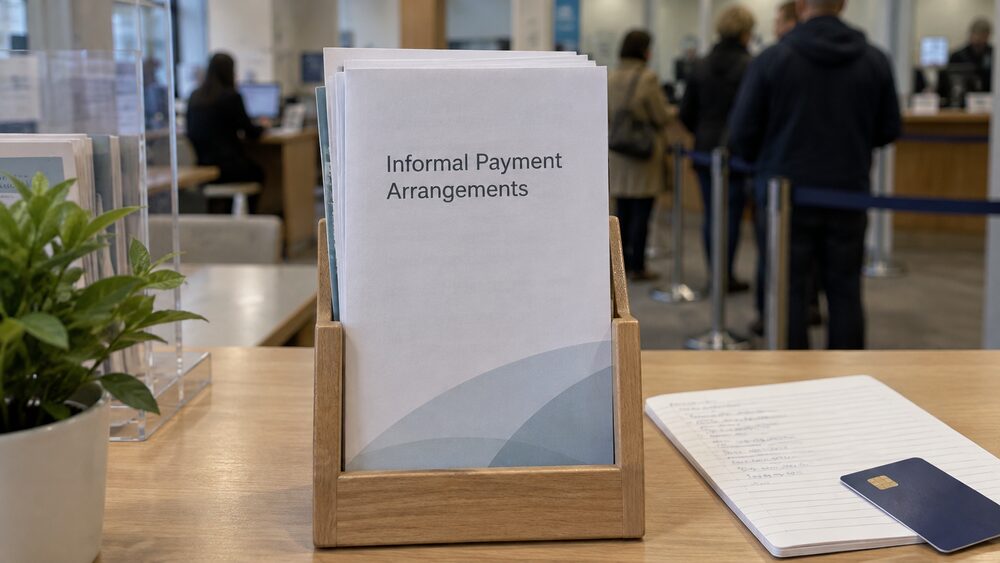
A payment arrangement is a short-term agreement with the people you owe. It helps you catch up on payments you have missed at a rate you can afford, rather than at the rate the original contract demanded1. You set it up yourself: you work out a budget, decide what you can reasonably repay and over what period, and write to each creditor explaining your situation and asking them to accept the arrangement2. Because it is informal, it costs nothing to set up and no court or insolvency process is involved, but that also means creditors can choose whether to agree to it3.
This kind of arrangement is normally used for commercial credit debts: unsecured personal loans, credit cards, store cards, payday loans and overdrafts4. It is not the only way to deal with those debts, and it is not always the right one. A debt management plan is also an informal agreement, run on the same principle of paying what you can afford5, while an individual voluntary arrangement (IVA) is a formal agreement with your creditors to pay all or part of your debts, which must be set up by an authorised debt specialist and involves costs6. The pages on debt solutions across the UK and debt management plans set out the alternatives side by side.
What an informal payment arrangement is, and which debts it covers
An informal arrangement, sometimes called an IA, is an agreement between you and your creditors that you make directly, without a court, an insolvency practitioner or a debt management company in the middle. It is something you can set up yourself, and it is one of several ways of dealing with debts, so it sits alongside other options that a free debt adviser can explain2. It is normally used for commercial credit debts such as unsecured personal loans, credit cards, store cards, payday loans and overdrafts4, which are all non-priority debts: the consequences of falling behind are serious for your credit record and your finances, but they do not put your home or essential services at immediate risk in the way that mortgage, rent or council tax arrears do.
Once the arrangement is running, the responsibility for it sits entirely with you. You are responsible for making all the agreed repayments and keeping your creditors up to date about your finances2. There is no one supervising the arrangement, no certificate recording it, and no legal protection if a creditor changes its mind, which is the main practical difference between this and the formal options such as an IVA, a debt relief order or bankruptcy.
The arrangement can take several shapes. You can try to negotiate a temporary reduction in payments, or a permanent reduction7. Some people offer token payments, sometimes as little as £1 a month to each creditor, when there is nothing meaningful left in the budget. Creditors can also be asked to freeze interest and charges, or to pause collection altogether for a while, though as the next sections explain, none of that is guaranteed.
Priority or non-priority: sort your debts first
Before writing to anyone, sort your debts into priority and non-priority. Priority creditors have stronger powers to get their money back, so you must deal with them first, before working out what to do about non-priority creditors9. Mortgages are priority debts: a lender could repossess your home and sell it to get their money10. Money you owe to your bank, by contrast, is a non-priority debt11, as are credit cards, personal loans and most other credit agreements.
The order matters when money is short. If you have a lump sum, for example from an inheritance or a redundancy payment, you will usually need to use some or all of it to clear your priority debt first12. Only once priority creditors are covered do you divide what is left between the non-priority creditors9. Once you have worked out what to pay your priority creditors, you will need to contact them too, to make an arrangement of their own9, because a payment arrangement with your credit card company does nothing for your rent or your mortgage. The page on priority and non-priority debts goes through the full lists.
Working out what you can afford: the income and expenditure budget
The offer you make has to come from a budget, not from a guess. A budget sets out the money coming in each month, the money going out, any savings you can make, and what is left to pay towards your debts. Creditors will often ask for details of your current income and living costs precisely so they can see what you can afford13, so it is worth having the figures ready before you write.
A household budget works out payments to both priority and non-priority creditors9. List your income, then your essential outgoings: rent or mortgage, council tax, utilities, food, transport and anything else you must pay to keep your home and your job. What remains is the amount available for your non-priority creditors. StepChange gives a worked example: a budget shows £100 left over after paying bills and living costs, and that £100 is what the offers to creditors are calculated from1. If nothing is left, the honest offer is a token payment, and the page on token payments versus Breathing Space compares the two ways of handling a zero budget.
Two points of caution. First, if your creditors do not think the amounts in your budget are reasonable, they are less likely to agree to reduced payment offers9, so keep the outgoings realistic rather than optimistic or padded. Second, some creditors have their own duties on affordability: payday lenders, for example, must satisfy themselves that you can afford the repayments14. If a lender is threatening court action over mortgage arrears, official guidance is to get your adviser's help to prepare a budget of your income and outgoings, to work out whether you can afford to pay the mortgage instalment and the arrears over a period of time15. The page on budgeting for repayments explains the standard formats advisers use.
Making your offer: splitting money pro rata and writing to creditors
Once the budget shows what is left, divide the money between your non-priority creditors so that each is offered a fair share. This is worked out on a pro-rata basis, and it is how the court would do it if the debts ever reached that stage9. The principle is simple: the creditor you owe the most gets the biggest share of the money available.
For monthly offers, you work out your offers of payment based on a pro-rata distribution of your available income17. For a lump sum, the formula is: lump sum available multiplied by each debt, divided by the total amount you owe to your creditors, equals the offer to that creditor12. Where you have a number of creditors you want to settle with using a lump sum, you need to make pro-rata offers to each18. The same fairness rule applies to full and final settlements: offer equal amounts to each creditor, so if your lump sum is 75% of your total debt, you offer each creditor 75% of what you owe them19.
Then put it in writing. Send your offer in writing, ask the creditor to confirm acceptance in writing, and do not send money until you get that confirmation. Keep copies of the letters, negotiate if you need to, make any agreed payments on time and keep proof of payment19. Never make a lump sum payment until the arrangement is accepted and confirmed in writing by your creditor18. Creditors usually review these arrangements every six months, and will want an update on your situation after that7, so keep the budget current.
What creditors can agree to: reduced payments, frozen interest and payment holidays
When you contact a creditor, several things can come out of the conversation. Many creditors agree to temporary payment arrangements that help you pay what you can afford instead of the whole amount20. The reduction can be temporary or permanent7, and some creditors will agree to freeze interest charges only on condition that you make token payments18.
Mortgage lenders have a wider menu when payments become difficult, and which options they offer depends on your payment history and on whether the difficulty is short or long term. They may reduce your payments for a set period, charge interest only for a while on a repayment mortgage, give a payment holiday, or extend the mortgage term to bring the payments down10. Similar forbearance exists on other credit agreements, and the page on how lenders must treat you when you fall behind sets out the rules they work under.
In Scotland, the Debt Arrangement Scheme offers a formal version of the same idea, with stronger guarantees. Once a debt payment plan is applied for, interest and charges are frozen, and they are written off if you keep to the debt payment programme21. The legislation behind the scheme also provides for deemed creditor consent to variation applications, and for automatic approval of variations where all creditors have consented or where the period of the programme will be reduced22. The page on the Debt Arrangement Scheme covers it in full.
Interest and charges are not frozen automatically
This is the biggest weakness of an informal arrangement. Creditors do not legally have to stop interest and charges during an informal arrangement, so your level of debt may not reduce at all over this period4. A monthly payment against a debt that is still gathering interest at a faster rate can mean the balance grows rather than shrinks, and nothing in the arrangement prevents that unless the creditor agrees to freeze the charges.
On a debt management plan, the position is only slightly better: creditors will sometimes agree to freeze interest charges, but they do not have to agree to this, or to the plan at all8. Some creditors may agree to freeze interest only on condition that you make token payments18. Always ask, in writing, for interest and charges to be frozen, and ask again at each review, but treat any freeze as a concession rather than a right. The narrow page on whether creditors have to freeze interest goes deeper.
The contrast with the formal options is stark. Under the Debt Arrangement Scheme, all interest, fees and charges on your debt are frozen from the date you apply23, and the frozen amounts are written off as long as you fully complete the debt payment programme and pay off your debts24. An informal arrangement offers none of that certainty, which is why free debt advice before committing to one matters.
Payment holidays: usually one to six months, and the missed payments still count
A payment holiday is when your creditor agrees to let you miss payments for a short time, usually one to six months3. On credit cards, some lenders offer payment holidays lasting up to three months26. You have to ask for one, and the people you owe do not have to agree to it27. When you apply, expect to give supporting information, including details of your bank, local authority or landlord, and to fill in an income and expenditure form based on your budget27.
The missed payments are not free. Interest and charges may still be added during the holiday27, and the missed payments are likely to be treated as arrears27. You must pay the missed amounts back after the break ends, either by making higher future payments or by paying the agreement back over a longer time27. On a loan, your monthly payment rises to cover the missed payments and the interest charged during the break27; on a mortgage, the monthly payment rises to include the missed payments and the extra interest, with the new amount depending on how long is left on the mortgage term27.
The credit consequences follow the same pattern as any missed payment. Late payments, missed payments and defaults stay on your credit history for six years28, and a missed payment will show on your report for six years, although its impact lessens over time29. If you have missed only one payment, your score could start to recover after around six months and should be fully recovered after a year29. Creditors usually send a default notice after six months of missed or reduced payments, and it gives you at least two weeks to make up the missed payments30. In Scotland, the Debt Arrangement Scheme allows a payment holiday of up to six months if you have a sudden and short-term drop in income of 50% or more17.
How an arrangement affects your credit file
There is no way round this: your credit file will be affected any time you pay less than what you agreed to when you took out the debt1. Creditors may allow you to pay less, but this will be marked on your credit file7. If you get debt help before your accounts have defaulted, creditors will sometimes mark the lower payments as an "arrangement to pay"31, which future lenders can see when they check your file. If payments are missed altogether, your credit file will show that you did not make your agreed payments, which impacts your credit score30.
The records last a long time. Late payments, missed payments and defaults stay on your credit history for six years28, and a single missed payment shows on your report for six years, though its impact lessens29. This matters most when you next need credit: a mortgage lender looking at a file with missed payments and defaults will treat it as a history of payment problems, and the page on getting a mortgage with poor credit explains how lenders read these entries.
Two further points. Any payment missed during forbearance is recorded on your credit file and could make it harder to get credit in the future3. And if you have a joint debt with an ex-partner, your credit files are connected, so how you manage your debts will affect your ex-partner if they apply for credit, and vice versa32; the page on joint debts covers this. Where a debt is later settled with a lump sum, creditors can agree to amend your credit reference file to show the debt is paid off or "satisfied"18.
What creditors can and cannot do while you pay
While an informal arrangement runs, creditors stay within their normal collection rules. They may contact you by letter or phone, and in some cases visit you at home33, and they can contact you by letter, phone call or home visit34. A debt collector can visit you at home, speak to you discreetly about your debt, try to set up a payment arrangement and ask you to make payment to them20. They should always speak to you politely and truthfully, and they must tell you anything important in writing, so read your letters13.
On the phone, the guidance is that one call a week is probably okay, and calling every day is definitely not; calls before 8am are too early and calls after 9pm are too late13. They can call you at work if you gave a work number on the credit application form, but must stop if you tell them to, and you can ask your creditors to remove your number from their records if you do not want calls at all13. If they do not treat you fairly or act outside the law, you can complain34, and the page on when a debt collector calls, visits or threatens you sets out the process.
What an informal arrangement does not do is bind the creditor. It is informal, so your creditors can choose whether to agree to it, and there are no legal protections if the creditor ends it3. Compare the formal options: under a debt payment programme in Scotland, creditors cannot take further action such as diligence or sending sheriff officers, cannot add interest and charges, and cannot take assets while the programme runs31. Under an administration order, creditors must accept the payment they are getting through the court while you keep making the monthly payments35. And under Breathing Space, a creditor can still charge other people on a joint debt interest or fees, because the protection does not affect their debts in their own names36. One further protection exists in law: if you ask a creditor for a copy of your credit agreement and it cannot comply, the creditor cannot make you pay off the debt before you are supposed to, cannot get a county court judgment against you, and cannot take back anything you hired or bought on credit or used as security37.
Where an arrangement does not stop court action
An informal arrangement is not a shield against legal action. Credititors do not have to enter a debt management plan, and may still contact you asking for immediate repayment; if they do not agree, they can continue to contact you, ask for payment or even take you to court8. Creditors might start court action if you owe them a lot of money, or if you have not made an arrangement to pay them back33, so making the arrangement, and keeping to it, is itself the best protection available under this option.
There are rules about how far a creditor may go. The FCA's consumer credit sourcebook provides that a firm must not threaten to commence court action, including an application for a charging order or, in Scotland, an inhibition or order for sale, to pressurise a customer to pay more than they can reasonably afford38. If you receive a statutory demand, a formal demand for payment that can precede a bankruptcy petition, your options include paying the debt or reaching an agreement to pay39. In Scotland, if a sheriff officer comes to take things you own, you may be able to stop further action by contacting the person you owe money and coming to an arrangement, or by making a payment directly to the sheriff officer towards the debt, and you have the right to do this while the officer is there40.
The formal solutions each stop court action in their own way. During the moratorium under a debt relief order, the creditor has no remedy in respect of the debt and may not commence a creditor's petition or other legal proceedings except with the permission of the High Court41. Under an administration order, as long as you make the payments, the creditor cannot take any further action against you35. In most cases, the Debt Arrangement Scheme stops creditors from taking further action against you42. Even HMRC has adopted a similar principle in its own collection process, ensuring that where settlement discussions are ongoing and agreement is imminent, no unnecessary debt collection activity is undertaken43. The FCA's debt advice rules also allow firms to operate a full and final settlement model, in which the firm holds money on behalf of the customer and does not distribute it promptly, pending negotiating a settlement with the customer's lenders44. The pages on county court judgments, statutory demands and court enforcement cover what happens if papers do arrive.
When a creditor refuses your offer
Refusal is not the end of the process. Keep making the payments even if your offer was rejected: the people you owe should still accept the payments and update your account1. Ask the creditor to explain why they have refused, if they have not given reasons45, and look again at your budget, because creditors who do not think the amounts are reasonable are less likely to agree9. Some creditors will only accept partial settlement offers over a certain percentage31, which matters if you are offering a lump sum rather than monthly payments.
If a creditor refuses and keeps pressuring you, the pressure itself has limits. A creditor that cannot produce your credit agreement cannot get a judgment against you, though it can still add interest and charges in line with your terms and conditions, send a default notice, pass your information to a credit reference agency or debt collector, sell your debt, or take your case to court without getting a judgment37. If the treatment becomes unfair, make a complaint34, first to the creditor and then to the Financial Ombudsman Service. The narrow page on what to do when a creditor refuses your repayment offer works through the steps.
There are also circumstances in which a creditor may agree to write the debt off altogether. Creditors may agree to write off a debt if they know you will struggle to repay it and only have assets of limited value, or no assets at all46, for example because of serious illness. They do not have to agree42, and on a joint debt the creditor might agree to write off your liability but will still pursue the other person for the whole amount owed45.
Where to get free help
You do not have to negotiate alone, and free debt advice is available from charities and public bodies across the UK rather than paid services. An adviser can check that an informal arrangement is the right option, help you build the budget, and calculate your payment offers for you9. Advisers can also explain the formal alternatives, such as a debt management plan, and what each one would mean for your debts and your credit file.
Before setting up any arrangement yourself, official guidance is to make sure it is the right way to deal with your debts2, and that check is exactly what a free adviser does. If a lender is already taking action over mortgage arrears, get your adviser's help to prepare a budget of your income and outgoings15. The page on free debt advice lists the main providers, including StepChange, National Debtline, Business Debtline and Advice NI, and the page on how to tell if a debt adviser is legitimate explains how to avoid fee-charging firms that imitate them.
Sources46 cited
- Arranging payments with creditors StepChange, 2026-09-25
- Informal arrangements nidirect, 2025-10-01
- Debt moratorium and forbearance StepChange, 2026-09-25
- Options for dealing with debt Advice NI, 2026
- Debt Arrangement Scheme StepChange, 2026-09-25
- Individual voluntary arrangements (IVAs) nidirect, 2025-09-12
- Negotiating with my creditors StepChange, 2026-09-25
- Debt management plans nidirect, 2025-11-06
- Your business and household budget Business Debtline, 2026-09-26
- Mortgage arrears or payment difficulties nidirect, 2025-11-07
- Overdrafts and other bank debts nidirect, 2025-11-07
- Full and final settlement offers Business Debtline, 2026-09-26
- Phone calls about debt StepChange, 2026-09-25
- Payday loans nidirect, 2026-02-25
- When a lender takes action against you nidirect, 2025-09-05
- Income and expenditure financial statement StepChange, 2026-09-25
- Ways to clear your debt National Debtline, 2026-09-25
- Debt solutions Shelter Cymru, 2026-08-30
- Settlement offers to creditors StepChange, 2026-09-25
- Home visits from debt collectors StepChange, 2026-09-25
- Income tax debt Business Debtline, 2026-09-26
- Debt Arrangement Scheme (Scotland) Regulations 2019, explanatory note legislation.gov.uk, 2026
- Debt Arrangement Scheme guide National Debtline, 2026-09-25
- Debt Arrangement Scheme (DAS) Business Debtline, 2026-09-26
- Mortgage shortfalls Business Debtline, 2026-09-26
- Credit card debt StepChange, 2026-09-25
- Payment holiday for debt repayments StepChange, 2026-09-25
- Getting a mortgage with late payments and defaults Which?, 2025-08-20
- How to improve your credit score Which?, 2025-10-24
- Default notices and missed payments StepChange, 2026-09-25
- Debt Arrangement Scheme or DMP StepChange, 2026-09-25
- Dividing the family home and mortgage during divorce MoneyHelper, 2026-09-25
- What creditors can do StepChange, 2026-09-25
- Harassed by creditors StepChange, 2026-09-25
- Administration order Mental Health and Money Advice, 2025-08-08
- Debt Respite Scheme (Breathing Space): creditors' responsibilities GOV.UK, 2021-04-30
- Credit agreements: getting information Business Debtline, 2026-09-26
- FCA Consumer Credit sourcebook CONC 7 Financial Conduct Authority, 2024-11-04
- Statutory demands GOV.UK, 2026-09-27
- Sheriff officer powers: taking things you own mygov.scot, 2023-11-07
- Debt Relief Orders (Northern Ireland) Order 2010 legislation.gov.uk, 2010-12-15
- Debt help and advice in Scotland: your options explained National Debtline, 2026-09-25
- Independent loan charge review: debt collection process GOV.UK, 2020-04-23
- FCA Consumer Credit sourcebook CONC 8: debt advice Financial Conduct Authority, 2014-04-01
- Debt write-offs Advice NI, 2026
- Getting credit card debt written off: your rights and options National Debtline, 2026-09-25






 StepChangeFree debt advice and solutions from a charity
 National DebtlineFree debt advice by phone, webchat and online
 MoneyHelperFree, impartial money and pensions guidance, set up by government
 Citizens AdviceFree advice on money, consumer and legal problems in England and Wales
 Citizens Advice ScotlandFree advice across Scotland