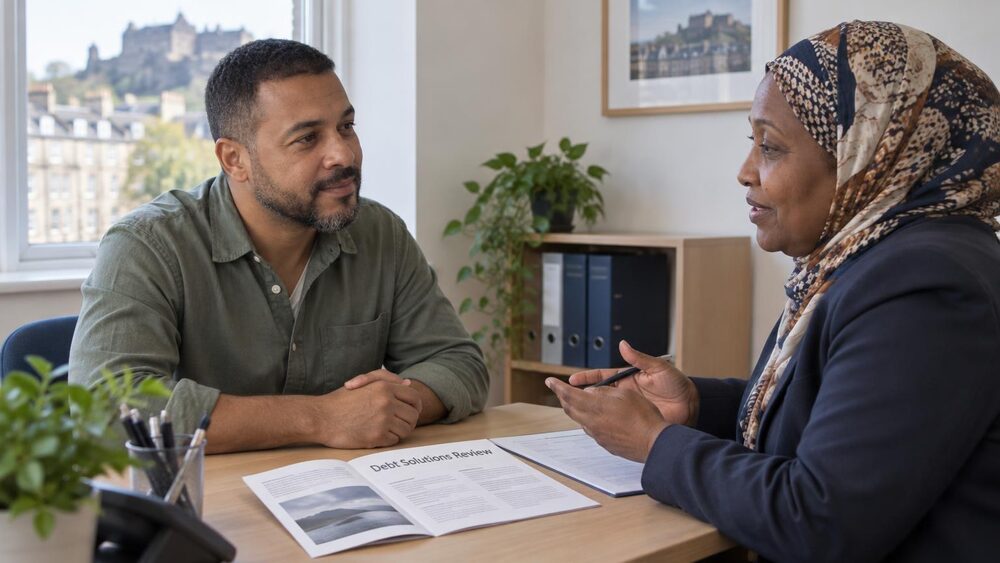
The Debt Arrangement Scheme, usually called DAS, is the Scottish Government's statutory scheme for people who can afford to repay their debts, but not at the rate their creditors are demanding. It works through a debt payment programme, often shortened to DPP: all of your debts are brought together and you make one regular payment, monthly or weekly, based on what you can afford after your essential living costs1. The payment goes to an approved payments distributor, who divides the money between your creditors for you2.
What makes DAS different from an informal repayment arrangement is that the protection is in law, not goodwill. Interest, fees and charges on your debts are frozen from the date you apply, and once your details are on the DAS Register your creditors cannot take enforcement action against you or make you bankrupt4. You keep your assets: your home, your car and your savings are not at risk6. The scheme is run by the Scottish Government and only applies in Scotland7.
How the Debt Arrangement Scheme works: one payment through a debt payment programme
A debt payment programme is an agreement under DAS that lets someone in debt pay off what they owe over an extended period14. Instead of juggling separate demands from each creditor, you make one affordable payment, and the approved payments distributor passes the money on to your creditors in the shares the programme sets out1. The Scottish Government's own guidance describes the scheme as allowing you to repay your debts over an extended period, without the threat of creditor legal action7.
The programme is legally binding on your creditors, not just a request they can ignore. That is the key difference from a debt management plan, which is an informal arrangement where creditors can back out. A DPP is a legally binding agreement to repay debts at a reduced rate, it protects you against enforcement action, and it forces creditors to stop interest and charges for the duration of the programme15.
DAS is a Scottish Government scheme that gives you time to pay off your debts and protection from most creditor action5. Since the scheme was introduced, just over 63,900 debt payment programmes have been approved, and the total debt included in live programmes stood at £447.0 million by 31 March 2026, up from £395.0 million the year before13.
Interest, charges and creditor action stop from the date you apply
The freeze on interest, fees and charges begins from the date you apply for your debt payment programme, not from the date it is approved4. While the programme is in place, all interest, fees and charges on your debts are frozen9. If your application is successful and you keep up the payments, the interest and charges that built up are stopped from the date of application12.
Crucially, the frozen amounts do not come back if you finish the programme. Creditors stop adding interest and charges to the debts included in your programme, and when you complete it, those frozen amounts are written off9. As long as you fully complete the programme and pay off your debts, the frozen interest, fees and charges will be written off9.
Enforcement protection follows a similar pattern. Once your details are placed on the DAS Register, diligence, the Scottish term for enforcement action to recover a debt, is stopped, and creditors cannot start a bankruptcy petition against you5. A debt payment programme will cancel most forms of diligence, such as arrestment of your bank account or an earnings arrestment10. While your application is being prepared, an intimation placed on the register protects you against creditor action for six weeks, giving your adviser time to put the application together10.
Who can use DAS in Scotland
DAS applies in Scotland only: the regulations provide for a scheme for the repayment of debts in Scotland17. Within Scotland, the basic conditions are that you have one or more debts, you live in Scotland, you have a reasonable amount of money left over after essential expenditure or an asset you could pay in, and you have had advice and assistance from an approved money adviser8.
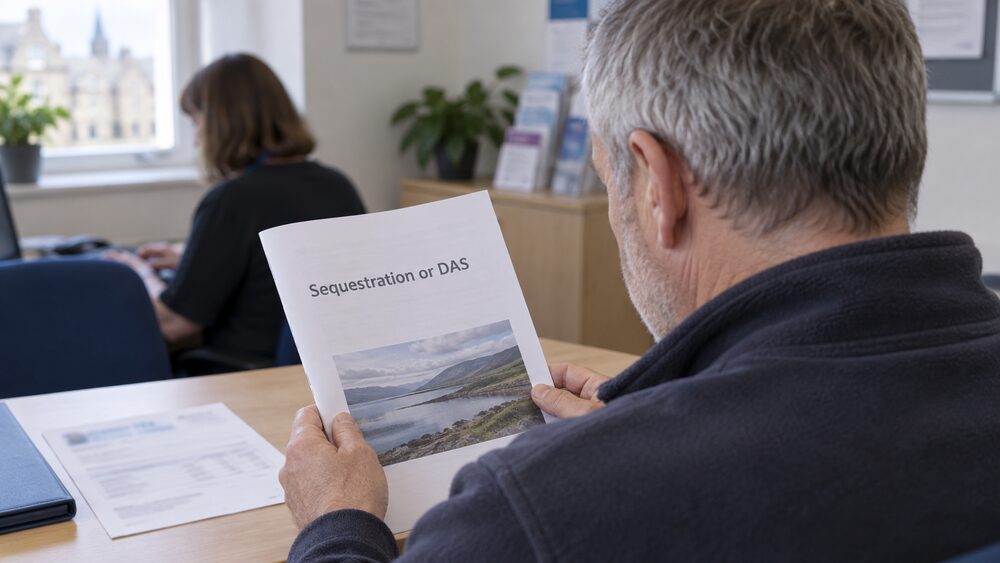
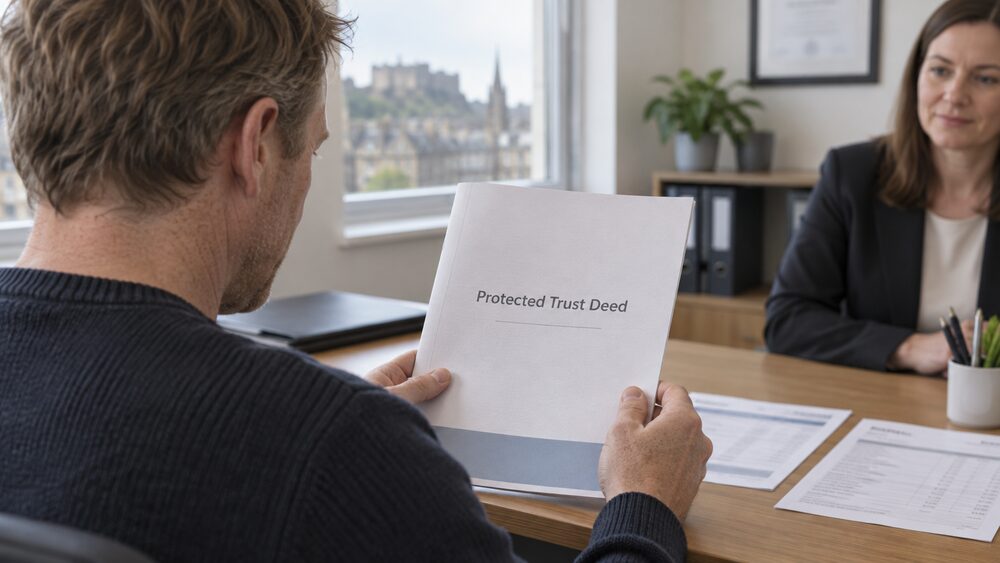
You cannot use DAS if you have no reasonable amount of money or asset available to pay into a programme, if you are in a protected trust deed, if you are bankrupt, if you are subject to a bankruptcy restrictions order or undertaking, or if you are paying debts under a conjoined arrestment order8. If insolvency looks like the better route, the comparison of sequestration or the Debt Arrangement Scheme sets out how they differ.
Couples can apply together. You will be treated as a couple if you are spouses or civil partners of each other, or living together as if spouses of each other9. The official eligibility rules require each client to be liable for a debt which could be paid under the programme and to meet the individual application requirements18. Since 4 November 2019, joint programmes have been extended to cohabitees, including people living together as if they were spouses or civil partners19.
Self-employed people are handled differently from other businesses. A self-employed sole trader applies to DAS as an individual, not to the Business Debt Arrangement Scheme as a business20. The scheme is also open to legal persons and other entities, where it is known as Business DAS17.
Which debts can and cannot be included
All debts can be included: priority debts such as council tax arrears as well as non-priority debts like credit cards21. That breadth is unusual. Most repayment solutions, including debt management plans, are built around non-priority debts, whereas a DPP can bring priority arrears into the same single payment.
There are some practical exclusions and choices to be aware of:
- Secured debts, such as mortgages, secured loans and hire purchase on vehicles, are treated differently6.
- You can exclude rent arrears, mortgage arrears and secured loan arrears from the programme if that is what you want to do20.
- For regular bills, only the arrears go into the programme, not the ongoing charge15.
- If you have hire purchase or conditional sale arrears, only the arrears are included within your debt payment programme9.
Your money adviser will work through your full list of debts when preparing the application, and the application itself must specify, for each debt, the amount outstanding, the creditor and how long the debt has been due22. If you are unsure which of your bills count as priority, the guide to priority and non-priority debts explains the difference.
Fees: paid by your creditors, not by you
The debt payment programme is normally free to the person in it9. There are standardised fees for running a DAS, but these are paid by the creditors and form part of your monthly repayment, so you do not pay them on top9. All DPP fees are paid for by your creditors6.
In practice, when you enter a DPP the costs are covered by the people you owe, within the payments you are already making: you do not make any extra payments16. Fees are included in your plan and paid for by your creditors11.
How to apply through an approved money adviser
You cannot apply directly. You need to find an approved money adviser to act for you12. This is a legal requirement, not an administrative preference: a debtor is not entitled to apply for approval or variation of a debt payment programme unless they have obtained the advice of a money adviser in relation to their financial circumstances, the effect of the proposed programme and the preparation of the application22. The application itself must be made by the money adviser on behalf of the debtor23.
An approved money adviser must meet the criteria set out in Regulation 8 of the Debt Arrangement Scheme (Scotland) Regulations 2011, as amended24. The Scottish Government maintains information on approved money advisers, and guidance and forms are available through the Accountant in Bankruptcy, the body that administers the scheme25. Free advice from an approved money adviser is available through national debt charities and through the Scottish Government's cost of living advice provision27.
Once the application is in, your creditors are asked to agree to it. If a creditor does not respond to the request within 21 days, the DAS Administrator treats them as if they have agreed8. For a debtor who is an individual, creditors representing not less than nine tenths in value of the debts must consent for the programme to be approved automatically by the DAS Administrator17. If your programme is approved, it is effective from midnight on the day before the date the DAS Administrator confirms this on the DAS Register9.
How long a debt payment programme lasts and how it ends early
Programmes can run for any reasonable length of time, but usually within 10 years for individuals, couples and sole traders21. In practice they are shorter: official statistics show a DPP approved in the last three financial years is expected to last between 5.1 and 6.1 years13, and the Accountant in Bankruptcy describes the average duration of a DPP as around six years29. A programme may last up to 20 years, but it is rare for DPPs to last that long6.
A programme ends in one of a small number of ways8:
- You have made all the agreed payments and the debts have been cleared.
- You clear the debts with a lump sum payment.
- All your creditors agree in writing to complete it early.
- All your creditors agree to an offer of composition.
There is also a statutory route to ending a programme early. If you have made payments for 12 years and have paid 70% of your debts, you may be able to end the debt payment programme early8. One guidance source adds that the 12 years does not include any payment breaks21. Once the programme is completed, you cannot be held liable for any further payments towards the debts included in it, or for any further penalties, interest or charges9.
Payment breaks and changing your payments
Circumstances change, and the scheme recognises this. A debtor who is an individual may request a short term financial crisis payment break in the circumstances set out in the regulations17. There is also a longer type of payment break that can last up to six months11. Since 2019, the circumstances in which a payment break can be granted have been extended to cover cohabitees separating in joint programmes17.
Payments themselves can be varied. When you are on a DPP, you can apply for your payment to be varied at any time, to pay more or less depending on what has changed16. Changes can be made to suit your situation, but your creditors and the Accountant in Bankruptcy must agree to any changes put forward6. The regulations also provide for deemed creditor consent to variation applications and automatic approval of variations where all creditors have consented or where the period of the programme will be reduced17.
One time limit is worth knowing: a creditor application to vary a programme because of an omitted or wrongly assessed debt, made more than 120 days after approval, must be accompanied by a statement of reasons17.
Missed payments and revocation: when the protection is lost
The protection DAS gives you depends on keeping up the agreed payments. If you miss payments, or make part payments, so that your arrears add up to the value of two months' payments and another payment is due, this triggers the revocation process9. The legislation puts it in similar terms: revocation can follow where a payment becomes due and there remains unpaid a sum of not less than the aggregate of two payments30.
Before a programme is revoked, the DAS Administrator will contact you and the other parties to tell you they intend to revoke it, and you get at least four weeks to respond9. If you do not respond and the programme is revoked, your creditors cannot take action against you for 14 days from the date of the decision to revoke8. After that short window, creditors can apply interest and charges again and take court enforcement action16.
Revocation can also happen for other reasons: if you make yourself bankrupt, obtain a protected trust deed, breach a condition of the programme, were untruthful in the application, if a creditor petitions for your bankruptcy, if a joint programme ends because the couple separate, or on death8. Where a joint programme is revoked on the grounds of separation, creditors must continue to freeze all interest and charges for six weeks afterwards8.
The DAS Register, credit files and complaints
Your DAS will be recorded on the DAS Register11. The register is an online public register which holds information about those intending to apply for, or applying for, a debt payment programme in DAS26. It records a wide range of statuses: moratorium applications granted, applications awaiting approval, withdrawn applications, consent requests sent, approved programmes, approval or rejection notices, variation applications and variations, corrections of accidental error, compositions not agreed by all creditors, review applications and outcomes, and sheriff appeals and their outcomes31. The legislation establishing it describes a public register of debt payment programmes, maintained by the DAS Administrator23.
The DAS Administrator is responsible for approving debt payment programmes, approving money advisers, approving payments distributors and maintaining the register8. Complaints about the DAS Administrator are handled under the Accountant in Bankruptcy's complaints procedure9.
Complaints about credit records are a live issue for people in debt solutions. The Financial Ombudsman Service's annual complaints data for 2025/26 records 934 complaints opened about credit records32. If a creditor records your account incorrectly while you are in a programme, or chases a debt included in it, you can complain first to the creditor and then to the ombudsman. The guide to how lenders must treat you when you fall behind covers the rules they must follow.
Where to get free help
Advice before you apply is not just sensible, it is a legal requirement, and it does not have to cost anything. The Scottish Government's guidance is that you need to get advice from an approved money adviser first before you can apply27. National debt charities provide DAS advice in Scotland, set up and manage debt payment programmes free of charge, and their DAS services are run with the Scottish Government3. Free advice is also available through the Scottish Government's cost of living support, which covers debt and money27.
If you are not sure whether DAS is the right route, a money adviser will look at your whole situation and compare it with the other options available in Scotland: an informal agreement, DAS, a protected trust deed or sequestration7. The overview of debt solutions across the UK shows how the Scottish options compare with those elsewhere, and the guide to free debt advice lists where to get it.
Sources32 cited
- Time to pay directions and orders in Scotland National Debtline, 2026
- Debt management plans in Scotland National Debtline, 2026
- Debt advice in Scotland StepChange Debt Charity, 2026
- Time to pay directions and orders in Scotland Business Debtline, 2026
- Your non-priority debts in Scotland Business Debtline, 2026
- Debt Arrangement Scheme (DAS) in Scotland StepChange Debt Charity, 2026
- Are you in debt? Accountant in Bankruptcy, 2026
- Debt Arrangement Scheme (DAS) guide for Scotland Business Debtline, 2026
- Debt Arrangement Scheme guide National Debtline, 2026
- Diligence in Scotland National Debtline, 2026
- DAS or DMP? StepChange Debt Charity, 2026
- Ways to clear your debt in Scotland Business Debtline, 2026
- Scottish statutory debt solutions: annual statistics 2024-25 Accountant in Bankruptcy, 2026
- Money jargon A to Z, Scotland Citizens Advice Scotland, 2026
- Debt management plans StepChange Debt Charity, 2026
- Debt Arrangement Scheme StepChange Debt Charity, 2026
- The Debt Arrangement Scheme (Scotland) Amendment Regulations 2019, explanatory note legislation.gov.uk, 2019
- DAS client eligibility, notes for guidance Accountant in Bankruptcy, 2024
- The Debt Arrangement Scheme (Scotland) Amendment Regulations 2019 legislation.gov.uk, 2019
- Debt management plans in Scotland Business Debtline, 2026
- Ways to clear your debt in Scotland National Debtline, 2026
- Debt Arrangement and Attachment (Scotland) Act 2002 legislation.gov.uk, 2002
- The Debt Arrangement Scheme (Scotland) Regulations 2011 legislation.gov.uk, 2011
- DAS notes for guidance for creditors: main parties Accountant in Bankruptcy, 2024
- Money adviser information Accountant in Bankruptcy, 2024
- Debt Arrangement Scheme Accountant in Bankruptcy, 2024
- Debt and money, cost of living support Scottish Government, 2026
- Debt counselling StepChange Debt Charity, 2026
- Scottish statutory debt solutions statistics, April to June 2025 Accountant in Bankruptcy, 2026
- The Debt Arrangement Scheme (Scotland) Regulations 2004 legislation.gov.uk, 2004
- DAS Register, notes for guidance Accountant in Bankruptcy, 2024
- Annual complaints data and insight 2025-26 Financial Ombudsman Service, 2025

 StepChangeFree debt advice and solutions from a charity
 National DebtlineFree debt advice by phone, webchat and online
 MoneyHelperFree, impartial money and pensions guidance, set up by government
 Citizens AdviceFree advice on money, consumer and legal problems in England and Wales
 Citizens Advice ScotlandFree advice across Scotland