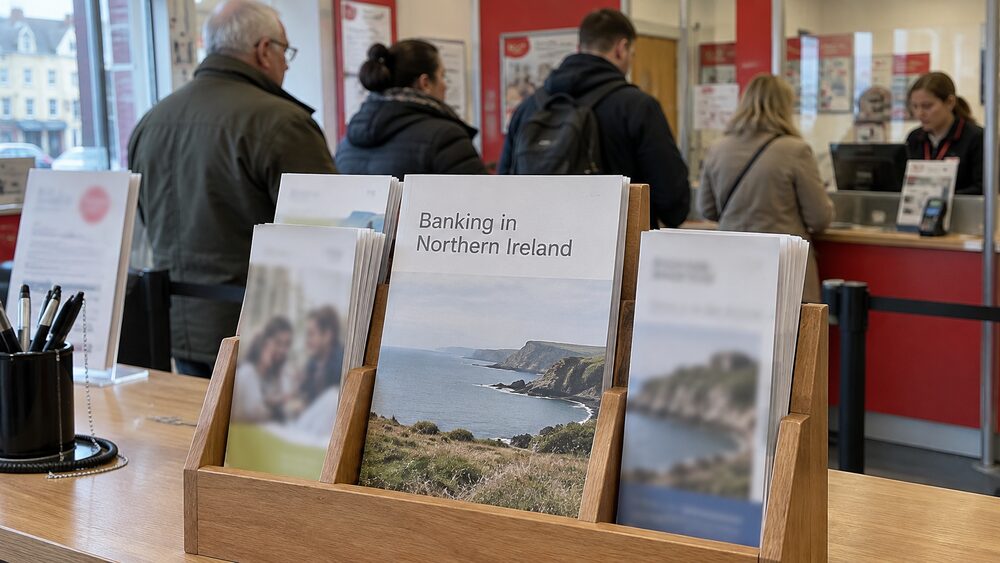
Current accounts in Northern Ireland work under the same broad UK rules as accounts anywhere else in the United Kingdom, but the market is different in ways that matter to someone choosing an account. Around 10% of people in Northern Ireland have no bank account at all, a higher share than elsewhere, and credit unions, which are a major part of financial life there with over 26% of the population in membership, cannot legally offer current accounts1. Bank of Ireland UK, historically one of the biggest names in Northern Ireland banking, no longer offers its Northern Ireland current accounts to new customers3.
That leaves the main high street banks, digital banks and building societies for anyone opening or switching an account. Switching works the same way as in the rest of the UK, through the Current Account Switch Service, which Bank of Ireland UK says completes a switch in just 7 working days3. Switching incentives also appear in the Northern Ireland market, and they carry closing dates: Santander's £240 offer ends on 7 October 2026 and Lloyds' £200 offer ends on 9 December 20264.
Who offers current accounts in Northern Ireland
Current accounts in Northern Ireland are offered by the same kinds of providers as in the rest of the UK: high street banks, building societies and digital or app-only banks. The general guide to current accounts covers how these accounts work, and the directory of banks and building societies lists the providers operating in the UK market.
What makes Northern Ireland different is the shape of the market rather than the accounts themselves. Evidence given to the Northern Ireland Assembly's banking inquiry by Advice NI reports that 10% of people in Northern Ireland have no bank account at all, and it points to a planned mutual bank, Northern Mutual, as a future option: the bank will offer interest-bearing current accounts, overdrafts, unsecured and secured term loans and mortgages, with everyone living in the region eligible for a current account1. Until new entrants like that arrive, the practical choice for most people is between the established banks, digital banks and, for those who struggle to open a standard account, a basic bank account.
MoneyHelper, the free government-backed money guidance service, sets out the conditions that some accounts apply. Beyond the basics, some accounts might also require you to pay in a minimum amount each month, earn a certain salary, pay a monthly fee, have a good credit history, or own a smartphone7. None of these conditions is unique to Northern Ireland, but they matter more in a market where a tenth of adults have no account at all, because an account with a salary condition or a credit check is closed to someone without a steady wage or with a poor credit history. For those people the realistic options are a basic bank account, a credit union current account where credit unions are allowed to offer one (which, as explained below, does not include Northern Ireland), or a prepaid card account, which MoneyHelper notes usually requires no ID but cannot usually be used to set up payments8.
Bankruptcy is a specific circumstance with its own rules in Northern Ireland. The Department for the Economy states that after a bankruptcy order a person may open a new bank or building society account, but the bank must be told about the bankruptcy; the bank decides whether to let the account be opened and may impose conditions and limits9. Existing bank accounts are usually frozen by the bank when it becomes aware of the bankruptcy order, and any money in the account at the date of the order is an asset in the bankruptcy9.
Bank of Ireland UK: accounts closed to new customers
Bank of Ireland UK is one of the historic banking names in Northern Ireland, but its personal current accounts there are no longer open to new business. Its own product page lists its Northern Ireland current accounts under products no longer on sale and states plainly: "These accounts are no longer available to new customers."3
Existing customers keep their accounts, and the provider sets out how they can still access their money day to day. Bank of Ireland UK says customers can take out and lodge money at the Post Office3, which is the standard route for personal banking customers of banks without their own branch network in a given area. The guide to banking at the Post Office covers what you can do there, including cash withdrawals, deposits and balance checks.
Bank of Ireland UK also provides current accounts under the Post Office's own brand. A Parliament report on Post Office banking notes that "The three accounts, which are provided by Bank of Ireland UK, are currently available in 29 branches in East Anglia"10. Those Post Office branded accounts are therefore not a route to a Bank of Ireland UK current account for someone in Northern Ireland: they are sold in a different part of the country.
For anyone who already holds a Bank of Ireland UK Northern Ireland account, the closure to new customers does not close the account. It does mean that anyone wanting a new account with that provider, or a family member wanting to join, cannot get one, and that switching away may be a one-way move. The Current Account Switch Service section explains what happens to payments when you switch.
Credit unions in Northern Ireland cannot offer current accounts
The single biggest difference between banking in Northern Ireland and banking in the rest of the UK is that credit unions there cannot offer current accounts. Research published by the Northern Ireland Assembly in 2025 states it directly: credit unions in Northern Ireland have a remit to offer a range of basic financial services, such as share accounts, loans and life assurance, but current accounts are not among them6. The same research lists current accounts as available to credit unions in Great Britain and in the Republic of Ireland, but not in Northern Ireland6.
The reason is legal. The Assembly research sets out the key legislation governing credit unions in Northern Ireland, including the Credit Unions (Northern Ireland) Order 1985, and notes that credit unions there cannot legally offer hire purchase agreements, conditional sale agreements, insurance, mortgages or loans to other credit unions6. The position is rooted in the devolution settlement: paragraph 23 of Schedule 3 to the Northern Ireland Act 1998 reserves financial services, including investment, business, banking and deposit taking, collective investments and insurances, to Westminster, and credit union law is largely devolved in Northern Ireland, which has left the Northern Ireland credit union regime on a different footing from the rest of the UK6.
The scale of credit unions in Northern Ireland makes this restriction matter. An earlier Assembly research paper records approximately 170 credit unions in Northern Ireland, with over 26% of the population in membership, compared with over 500 credit unions in the Republic of Ireland2. The Irish League of Credit Unions, a trade and representative body, currently covers 92 credit unions in Northern Ireland, which between them provide a range of savings and loan services12. Credit unions in Northern Ireland are regulated by the Registry of Companies, Credit Unions and Industrial and Provident Societies, rather than by the Financial Conduct Authority and Prudential Regulation Authority in the way credit unions in Great Britain are2.
For someone who wants the credit union model and a current account together, the position depends on where the credit union is. MoneyHelper notes that some credit unions offer current accounts, usually with no credit check or overdraft, and that a credit union current account is run by not-for-profit organisations, though you might pay a monthly fee to get one13. Neither of those options exists among Northern Ireland's own credit unions. The realistic alternatives for a Northern Ireland resident are a standard or basic bank account from a bank or building society, or a prepaid card account with its known limits8.
Northern Ireland or Republic of Ireland credit unions: how they differ
Credit unions on the island of Ireland operate under two different regimes, and the difference shows up in what they can sell. The Assembly's comparison puts it in a table: current accounts, loans to other credit unions, insurance and mortgages are all marked "No" for Northern Ireland credit unions and "Yes" for credit unions in the Republic of Ireland and Great Britain6.
| Service | Northern Ireland credit unions | Republic of Ireland credit unions | Great Britain credit unions |
|---|---|---|---|
| Current accounts | No6 | Yes6 | Yes6 |
| Insurance | No6 | Yes6 | Yes6 |
| Mortgages | No6 | Yes6 | Yes6 |
| Loans to other credit unions | No6 | Yes6 | Yes6 |
The House of Commons Library observes that "Credit union use in Northern Ireland is well above that in Great Britain but below that south of the border"11. That pattern reflects both the strength of the credit union movement in Northern Ireland and the wider product range available south of the border, where credit unions have been able to expand into current accounts and other services.
Whether a Northern Ireland resident can use a Republic of Ireland credit union depends on that credit union's own membership rules. Credit unions are founded on a common bond, a defined group of people who may join, and each credit union sets its own. There are over 500 credit unions in the Republic of Ireland2, but joining one from across the border requires meeting its common bond, and the account would be held under Irish regulation rather than UK regulation. That matters for protections: a UK current account carries UK protections such as the Financial Services Compensation Scheme, which the guide to FSCS protection explains, and those protections do not follow an account held with a provider regulated in the Republic of Ireland.
There is also a structural point about how credit union current accounts work where they do exist. The Scottish Government's review of credit unions notes that credit unions that offer the Credit Union Current Account gain access to the payment systems indirectly through The Co-operative Bank, as they do not have direct access14. A credit union current account anywhere in these islands is therefore built on a partner bank's infrastructure, which is part of why the accounts often carry a monthly fee and rarely offer an overdraft13.
Switching incentives and their closing dates
Banks pay cash incentives to people who switch a current account to them, and these offers are available to Northern Ireland customers on the same terms as elsewhere in the UK. Every incentive has a closing date, and the dates below are the ones current at the time of writing.
| Offer | Amount | Conditions | Closes |
|---|---|---|---|
| Santander Everyday Current Account | £240 | Save £200 in a Santander Regular Saver; terms and exclusions apply | 7 October 20264 |
| Lloyds Club Lloyds Silver | £200 | Switch started via the Current Account Switch Service | 9 December 20265 |
| Lloyds Premier | £200 | Switch started via the Current Account Switch Service | 9 December 20265 |
The Santander offer requires more than a switch: the £240 is tied to saving £200 in a Regular Saver, and the offer carries terms and exclusions4. The Lloyds offers require the switch to be started via the Current Account Switch Service by 9 December 2026 to qualify5. The guide to how bank switching offers work explains the usual conditions, including minimum pay-ins and direct debit requirements, and the page on switch bonuses not paid covers what to do if a payment does not arrive.
Missing a closing date means losing the payment, not the switch. The switch itself can still be completed after the offer has ended, but the incentive is not paid on switches that start after the deadline. Anyone planning a switch around an offer should also read the section on how long a bank switch takes, because the seven working day timescale runs from the point the new provider starts the switch, not from the date you first apply.
Student accounts and prize draw offers
Student current accounts in Northern Ireland are offered by the same banks as elsewhere in the UK, and the guide to student bank accounts covers how they work, including their overdraft arrangements. One current offer has a hard entry deadline: the window to open or transfer to a Santander Edge Student current account to enter its £100,000 prize draw closes on 16 October 202615. Opening the account after that date does not enter you into the draw, and there is no later route in.
Student accounts sit alongside student finance, which in Northern Ireland is run separately from England and Wales. Student loans are issued by Student Finance NI, a service managed by the Student Loans Company in partnership with the government16. Applications for full-time undergraduate support for the 2026 to 2027 academic year are open for students from Northern Ireland, and the Student Loans Company encourages students to apply before the deadline of Thursday 30 April 2026 to ensure funding is in place for the start of term17. The deadline for new Student Finance NI students is Friday 30 April 202618.
Postgraduate students in Northern Ireland apply separately. Northern Irish postgraduate loans are available from Student Finance NI to help cover tuition fees, and applications are made by logging in or creating an account at Student Finance NI, sending the requested evidence and signing a declaration; a paper application form is available for anyone who cannot apply online19. Part-time undergraduate applications for 2026 to 2027 are also open, and students can apply online at studentfinanceni.co.uk20. General information is available at www.studentfinanceni.co.uk, and the Student Loans Company publishes guidance on how to contact it21.
The rules behind eligibility are set in legislation. The Education (Student Support) Regulations (Northern Ireland) 2007 allow the Department to renew a period of eligibility where it terminates before the end of the academic year in which the student completes the course, and to re-assess the amount of support payable after a student transfers to another course22. A student who transfers after assessment but before completing the year may not apply for another grant or loan of a kind already applied for in that academic year unless otherwise provided22. Where a relevant event occurs after the first day of the academic year, an application must reach the Department within nine months of the event22. These rules affect when a student can get funding, which in turn affects when a student account and its overdraft can be relied on.
When your current account terms change
Banks change the terms and conditions of their current accounts from time to time, and they give notice before they do. A live example: Royal Bank of Scotland states that its current account terms and conditions are changing from 1 October 202623. The narrow guide to the notice banks must give before changes explains the rules on how much warning a bank must give and when a change lets you close the account without charge.
A change to terms does not force you to stay. If the new terms do not suit you, the remedy is to switch to a different account, using the Current Account Switch Service, which takes seven working days with participating providers3. The switch moves your balance and all incoming and outgoing payments to the new account and closes the old one, so a terms change is a natural moment to compare accounts, including reward and cashback accounts and packaged accounts.
Some changes come from legislation rather than the bank. The Pensions Act (Northern Ireland) 2015, for example, carries provisions that may be brought into force at a future date24, and benefit rules that interact with bank accounts change on their own timetables. The general principle for a consumer is the same in each case: read the notice, check what actually changes, and treat the notice period as the window in which to act if you want to move.
One Northern Ireland specific point on accounts and money: if you fall behind on certain debts, the consequences can reach your bank account. StepChange, the debt charity, notes that for a money judgment in Northern Ireland, money can be taken from your wage and/or bank account, and the same applies to unpaid rates in Northern Ireland, where eviction is also a possibility25. The guide to the bank's right of set-off explains when a bank can take money from your account to cover a debt you owe it.
How to switch your current account
Switching a current account in Northern Ireland works the same way as in the rest of the UK, through the Current Account Switch Service. The process is:
- Choose a new account and open it, checking the eligibility conditions first: some accounts require a minimum monthly pay-in, a certain salary, a monthly fee, a good credit history or a smartphone7.
- Ask the new provider to switch, transferring your balance and all incoming and outgoing payments13.
- The new provider runs the switch, which Bank of Ireland UK states completes in just 7 working days3.
- Your old account closes and payments sent to it are redirected to the new account.
Being overdrawn does not block a switch. MoneyHelper confirms that you can switch using the Current Account Switch Service even if you are overdrawn, though the new account must be able to take the overdraft, or you must repay it26. The guides on switching while overdrawn and overdrafts cover the detail.
Not every switch has to be a full switch. A partial switch moves selected payments to a new account while keeping the old one open, which does not carry the same guarantees as a full switch. Joint accounts have their own process, covered in switching a joint bank account. If you are switching to claim a cash incentive, check the offer's closing date first, as set out above, and make sure the switch is started in time5.
Bankruptcy again has its own rules in Northern Ireland. When a person is made bankrupt, the rules require that they immediately stop using their cheque books and bank cards and hand them over to the Official Receiver as soon as possible9. After the order, a new account may be opened, with the bankruptcy disclosed to the bank, and the bank decides whether to accept the application and on what conditions9.
Where to get free help in Northern Ireland
Free, impartial help with banking and money is available in Northern Ireland from several places. MoneyHelper, the government-backed guidance service, publishes free guidance on opening, switching and closing bank accounts, on basic bank accounts and on overdrafts7. The Consumer Council for Northern Ireland, an independent body, provides consumer help on financial services, including help for people worried about their finances12. Advice NI gave evidence to the Assembly's banking inquiry on access to banking in Northern Ireland and is a source of free advice on the ground1.
For debt problems, StepChange offers free debt advice and sets out which debts to deal with first, including the Northern Ireland specific consequences of unpaid money judgments and rates25. For emergency financial assistance, nidirect government services is the route to apply in Northern Ireland27. The guides to debt and to consumer protection in UK financial services set out the wider options, including the Financial Ombudsman Service for complaints a bank has not resolved.
Sources27 cited
- Advice NI briefing paper on the banking and financial services landscape in Northern Ireland Northern Ireland Assembly, 2025
- Inquiry into credit union regulation, services, funding and recommendations Northern Ireland Assembly, 2007
- Bank of Ireland UK personal current account page Bank of Ireland UK, 2026
- Santander current accounts and switching offer Santander, 2026
- Lloyds Bank switching offers Lloyds Bank, 2026
- Research paper on credit unions and financial services in Northern Ireland Northern Ireland Assembly, 2025
- How to open, switch or close your bank account MoneyHelper, 2026
- Basic bank accounts MoneyHelper, 2026
- The effect of bankruptcy Department for the Economy, 2016
- Post Office banking report Parliament
- Research briefing on credit unions House of Commons Library, 2026
- Help for consumers worried about their finances Consumer Council for Northern Ireland
- Choosing a bank account for your Universal Credit payment MoneyHelper, 2026
- Scotland's credit unions: investing in the future Scottish Government, 2016
- Santander student account prize draw Santander, 2026
- Student loans in Northern Ireland nidirect, 2026
- Full-time undergraduate student finance applications now open for 2026 to 2027 GOV.UK, 2026
- The student finance deadline for new students is approaching GOV.UK, 2026
- Postgraduate loans in Northern Ireland Prospects, 2026
- Part-time undergraduate applications are now open for 2026 to 2027 GOV.UK, 2026
- Guidance on contacting the Student Loans Company GOV.UK, 2020
- The Education (Student Support) Regulations (Northern Ireland) 2007 legislation.gov.uk, 2007
- Royal Bank of Scotland current account terms change Royal Bank of Scotland, 2026
- Pensions Act (Northern Ireland) 2015 legislation.gov.uk, 2026
- What debts to pay first StepChange, 2026
- Overdrafts explained MoneyHelper, 2026
- Support with living costs in Northern Ireland Carers UK, 2026





 MoneyHelperFree, impartial money and pensions guidance, set up by government
 FSCSProtects your money if a bank, insurer or investment firm fails
 Financial Ombudsman ServiceFree, independent help when a complaint about a firm is not put right
 Citizens AdviceFree advice on money, consumer and legal problems in England and Wales