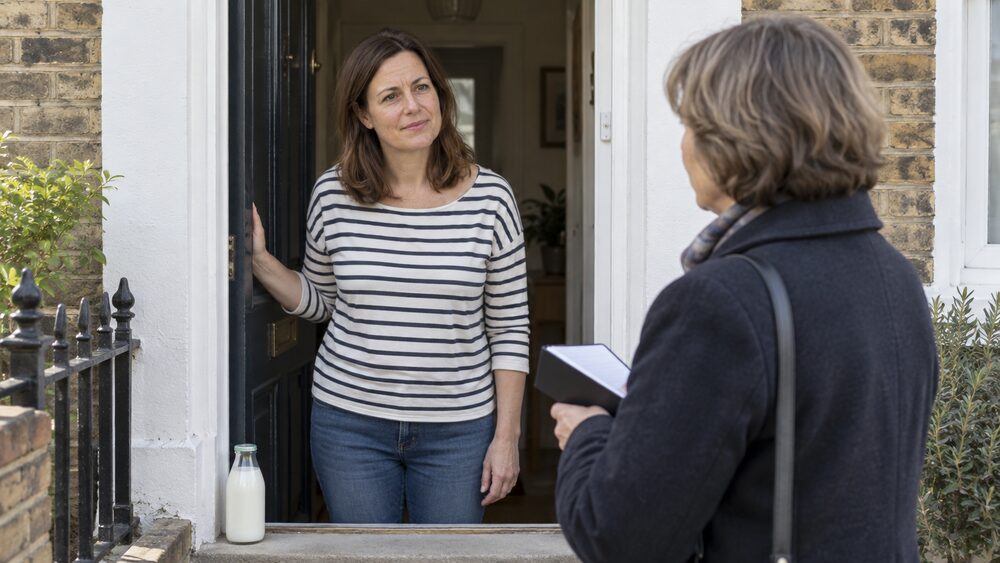
A doorstep loan is a type of personal loan you get from people who visit your home1. It is also called home credit, home-collected credit or a home collection loan, and the idea is simple: an agent from the lender comes to your house, arranges the loan face to face, hands over the money, and then returns, usually every week, to collect the repayments1. The loan is unsecured, which means it is not tied to your home or any possession, and the amounts are small, normally less than £1,0002.
Home credit is high-cost, short-term credit1. The interest is built into the weekly instalments rather than added as a separate charge, and because the amounts are small and the terms short, the total cost of borrowing is high compared with mainstream loans. This page explains how the arrangement works, what it costs, who it tends to suit, the rules that govern agents' visits, how to check a lender is legitimate, and where to get free help if repayments become hard to manage.
How home credit works, from first visit to final collection
Home credit, which can also be called home-collected credit or doorstep lending, is a type of unsecured cash loan arranged at a borrower's home2. The process starts with you: the lender's agent only comes because you have asked, and the loan itself is agreed face to face at your door or in your living room rather than online or in a branch. The money may be handed over as cash, and doorstep loans may also be in the form of vouchers1.
Repayments are usually made weekly, and an agent from the lender usually goes to the borrower's home to collect them2. That weekly rhythm is the defining feature of the product. Rather than a monthly direct debit from a bank account, someone knocks on the door each week and takes the instalment in person. The interest is built into those instalments, so each weekly payment covers part of what you borrowed plus part of the cost of borrowing, and the loan ends when the last instalment is paid.
Because the whole relationship runs through a local agent, the arrangement can feel personal, and many borrowers deal with the same person week after week. That has a practical side: there is no need for a bank account or a direct debit to make the loan work. It also has a downside, explored later on this page, because a collector at your door is harder to keep at arm's length than a letter or an app notification. The general guide to how personal loans work covers the mechanics of instalment lending more broadly.
Loan sizes: smaller than most other borrowing
Home credit loans are small. The amount of credit offered is lower than other forms of lending, and the typical doorstep loan is normally less than £1,0002. That puts home credit at the bottom end of the borrowing scale, and it is worth setting it beside the alternatives to see the gap.
An unsecured personal loan from a mainstream lender usually runs between £1,000 and £25,000, with loans for as much as £50,000 available from some lenders6. A logbook loan, which is secured on your car, is usually £400 to £5,0007. A payday loan is often smaller still, perhaps only a few hundred pounds8. Doorstep loans sit in that small-credit space alongside payday lending, but with longer repayment terms broken into weekly instalments rather than a single repayment on payday.
The small size is not a coincidence. It reflects who the product is designed for: people who need a modest amount quickly, often for household costs, and who want to repay in small weekly amounts rather than one lump sum. It also reflects the cost of the model itself. Sending an agent to a home every week for months is expensive, and lenders can only make that work on small balances where the interest built into the instalments covers the collection cost. The result is a product where the amount borrowed is modest but the proportionate cost is high, which is the subject of the next section.
The cost: high-cost credit with interest built into the repayments
Home credit is a type of high-cost, short-term credit1. High-cost credit covers a wide range of financial products including bank overdrafts, loans, buy-now-pay-later and rent-to-own schemes5, and the Bank of England notes that certain types of borrowing, such as overdrafts, revolving credit on your credit card and payday loans, charge higher interest9. Home credit belongs in this family: the interest rates are high, and the amount of credit offered is lower than other forms of lending3.
The cost is not usually presented as a separate charge. Instead, the interest is built into the weekly instalments, so you are quoted a total amount to repay each week and a number of weeks, rather than a rate you have to work out yourself2. That can make the true cost hard to see. Two independent examples from 2022 illustrate the scale, and they disagree: one puts the cost at £50 on top of every £100 borrowed, the other at £30 on every £100 repaid every two weeks. Both date from March 2022, and the difference between them shows how much the cost varies between loans and how it depends on the term and the instalment pattern.
Because the interest is folded into the instalments, comparing a doorstep loan with other borrowing means looking at the total repayable, not just the weekly figure. The guides to how loan interest is calculated and loan APR, representative APR and personal APR explained set out how to read the numbers, and loan fees and charges covers the other costs that can attach to credit agreements.
Doorstep loans and payday loans are different products
People often mix doorstep loans up with payday loans, but they are different products that work in different ways. A payday loan is a type of cash loan that is normally paid into your bank account; it is intended as a short-term loan, meant to be paid back when you next receive your wages or benefits, and the interest rates are usually very high10. nidirect describes it as a short-term, high interest, unsecured loan8. A same day loan is a type of short-term loan paid into your bank account the same day you apply for it11.
A doorstep loan, by contrast, is arranged in your home and repaid in weekly instalments collected at your door2. Nothing needs to go through a bank account, and the repayment is spread over weeks or months rather than due in one lump on your next payday. Both products sit within high-cost short-term credit, and both carry high interest, but the mechanics, the collection method and the typical term are different.
| Feature | Doorstep loan | Payday loan |
|---|---|---|
| How you get the money | Cash or vouchers, handed over at your home1 | Paid into your bank account10 |
| How you repay | Weekly instalments collected by an agent at your door2 | In one go, when you next receive wages or benefits10 |
| Bank account needed | No | Yes |
| Typical size | Normally less than £1,0002 | Perhaps only a few hundred pounds8 |
| Cost | High, interest built into instalments2 | Usually very high interest rates10 |
If you are weighing the two, the comparison guide to payday lending and high-cost short-term credit covers the payday model in detail, and cheaper alternatives to a payday loan sets out other options for small amounts.
Who borrows: people without a bank account or mainstream credit
Doorstep lending exists for people who are excluded from, or avoid, mainstream credit. Because the loan is arranged and collected in person, with cash or vouchers, no bank account is needed to make it work1. That matters for people who do not have an account, or who do not want repayments leaving their account automatically.
Credit checks are also less of a barrier than with mainstream lending. Some credit unions offer current accounts, usually with no credit check or overdraft, and if you do not meet the opening criteria for a standard account, which might include a credit check, you will usually be offered a basic bank account12. In a similar spirit, doorstep lenders often lend where a mainstream lender would not, though the price of that access is the high cost set out above. The guide to getting a loan with a poor credit history and the page on near-prime and subprime lenders explain this end of the market.
There are alternatives worth knowing about before borrowing at the door. Credit union loans and community lenders (CDFIs) offer small loans at lower cost, and the No Interest Loan Scheme provides small, no-interest loans in the areas where it operates. For people on benefits, Budgeting Loans and Budgeting Advances and the page on getting a loan while on benefits set out what exists. None of these is right for everyone, but each is an option to compare against home credit before signing anything.
A doorstep loan is unsecured and non-priority
A doorstep loan is unsecured, which means it is not secured against your home or any of your possessions3. That has two consequences worth understanding.
First, the lender cannot take your home if you fall behind. This is different from secured borrowing: with a secured loan, your home or business could be at risk if you cannot keep up the payments13, and if you have used your home as security and cannot keep up the payments, your home could be repossessed10. A doorstep loan carries no such risk, because nothing is secured against it.
Second, doorstep lender debt is classed as a non-priority debt14. Priority and non-priority are not about how seriously a debt is taken; they are about the consequences of not paying. Mortgages are priority debts, because the lender could repossess the home and sell it to get their money15. Money owed to a bank, such as a personal loan, is a non-priority debt16. Doorstep debt sits with the non-priority debts, alongside bank loans and credit cards.
| Debt type | Classification | Why |
|---|---|---|
| Mortgage | Priority | The lender could repossess your home15 |
| Secured personal loan | Priority | You could lose whatever is secured, for example your house14 |
| Doorstep lender debt | Non-priority | Unsecured, no asset at risk14 |
| Bank loan | Non-priority | No asset at risk16 |
In practice, this classification matters most when money is short. If you cannot pay everything, priority debts come first, because the consequences of missing them are more severe. That does not mean a doorstep loan can be ignored: the lender is still owed the money and can pursue it, as later sections explain. But it does mean that when a budget cannot stretch to all the debts, the mortgage or rent comes before the weekly collection. The guide to what to do if you can't repay a loan covers this in detail.
Weekly collections and missing a payment
The weekly collection is the engine of home credit. An agent from the lender usually goes to the borrower's home to collect the repayments, which are usually made weekly2. For a borrower, that means a standing appointment at the door, and a relationship with the person collecting the money.
If you miss a payment, the immediate consequences are usually mild. There are usually no charges for missing an occasional repayment3. That is a real difference from some other forms of credit, where missed payments can lead to extra charges and can negatively impact your credit score, making it harder to get credit in the future11.
But "no charge" is not the same as "no consequence". The pattern seen with other instalment lending gives a sense of what follows: a lender will typically contact you after you miss one or two payments, and should discuss ways to catch up and pay the arrears; if you keep missing payments, they may issue a default notice and then take further action to collect the debt, possibly using a debt collection agency or applying for a county court judgment17. A doorstep lender's first step is more likely to be the agent asking at the door, since that is how the relationship works, but the escalation route is the same.
There are rules about how firms behave towards people in arrears. Guidance on lenders' obligations notes that they must treat you fairly, must not charge a higher interest rate because you have missed a payment, must not harass you about money if you are in arrears, and should only contact you between 9am and 8pm18. If a collector's behaviour crosses the line, that is a matter for a complaint, covered by complaining about a lender. And if the problem is not one missed week but a repayment you cannot sustain, the final section of this page sets out where to get free help.
A lender can only visit if you ask, in writing
The rule at the heart of doorstep lending is that the visit must be your idea. Doorstep loan providers are not allowed to call on you uninvited; you must request them to visit you3. Behind that conduct rule sits the law: it is illegal to solicit or canvass to sell credit away from a premises, unless a prior request to borrow money has been made in writing4.
This rule matters because it draws a line between a regulated doorstep lender and something else entirely. A legitimate home credit agent is at your door because you asked, in writing, for a visit. Anyone touting for loan business at your door, on the street or by cold call, without that written request, is breaking the law4.
It also matters for your peace of mind once you have a loan. The weekly collection visits are part of the agreement you asked for, but they do not give the agent rights over your home. You do not have to let a debt collector in, and you do not have to pay someone who comes to your house19. That guidance is about debt collectors generally, and it applies with equal force to collections at your door.
It is worth separating doorstep agents from bailiffs, which people often confuse. Only the courts can send bailiffs to visit your home20, and you can pay a bailiff on the doorstep without letting them into your home21. A doorstep lender's agent is not a bailiff and has no enforcement powers at all: only a court process can turn an unpaid debt into enforcement action. The page on loan sharks and illegal money lending covers the illegal end of the market, where none of these rules apply.
FCA authorisation: how to tell a doorstep lender from a loan shark
Doorstep lenders must be authorised by the Financial Conduct Authority (FCA), and a lender that cannot show proof of FCA authorisation is likely to be a loan shark3. Lenders must be authorised by the FCA or they are lending money illegally13. A loan shark is the common term for an illegal money lender, in effect a money lender who has not been authorised by the FCA22, and licensed moneylenders are regulated by the FCA and must follow their codes of practice23. It is illegal for someone who is not FCA regulated to charge for borrowing money3.
Checking takes a few minutes. The FCA's Firm Checker is a tool to help consumers check whether financial services firms are authorised and have permission to sell products and services24. Search the firm by name, select 'Borrowing money, including credit card lending and credit information', and check the firm is 'Authorised' with permission to 'Lend you money on an unsecured basis'25. You can also check on the FCA register, or telephone the FCA consumer helpline26. The FCA publishes a list of licensed lenders on the FCA register8.
One caution from official scam guidance: check you are using a legitimate loan provider by searching the FCA Firm Checker and using the contact details listed there, not the ones given to you27. A fraudster can quote a real firm's name and give you their own phone number. The narrow guide to upfront fee scams covers the common trick of asking for a fee before a loan is released, which legitimate doorstep lenders do not do.
If you have already borrowed and are worried the lender was never authorised, the position is different from an ordinary debt: an illegal lender has no legal right to collect, and the pages on loan sharks and illegal money lending and debts not in my name explain where you stand and where to report them.
Where doorstep borrowers are less protected
Regulated home credit comes with the standard protections of a consumer credit agreement: FCA authorisation, the right to complain to the Financial Ombudsman Service, and the rights set out in your rights under the Consumer Credit Act, including the 14-day right to withdraw. But there are places where a doorstep borrower is less protected than a mainstream customer.
The first gap is conduct. You may not be fully protected, as some doorstep loan companies do not follow the guidelines for responsible lending1. The FCA's rules exist, but a firm that ignores them leaves the borrower carrying the consequences, and redress comes only after a complaint rather than in advance.
The second gap is the money itself. Cash handed over at the door, and repayments made in cash to an agent, sit outside the protections that bank payments carry. With a bank transfer it is harder to get your money back, and you have much less protection if something goes wrong28. There is no direct debit guarantee, no card dispute route, and no bank statement trail unless you keep your own records. If a dispute arises about what was paid and when, your own note of each weekly payment may be the only evidence.
The third gap is compensation. The Financial Services Compensation Scheme (FSCS) protects deposits, insurance and investments when authorised firms fail, but its cover does not reach lending in the way people often assume. Credit insurance is not eligible for FSCS protection19, and FSCS does not protect money that a debtor pays under an individual voluntary arrangement arranged by insolvency partners, which are not regulated by the FCA, or debt advice29. If a doorstep lender fails, the loan does not disappear: the page on lenders that have closed or stopped lending explains what happens to your debt, and the general guide to consumer protection in UK financial services sets out where the safety nets actually sit.
Getting help if repayments become hard to manage
If the weekly collection has become something you cannot sustain, the first step is to say so rather than avoid the door. Guidance on financial difficulties is consistent across products: contact your lender immediately if you are finding payments difficult18, and you can ask about an affordable repayment plan and other options like reduced repayments30. A lender asked early can often do more than one asked after weeks of missed collections.
Free, independent help is available, and it costs nothing to use:
- StepChange Debt Charity and National Debtline provide free debt advice, including on doorstep loan debt1.
- Citizens Advice can check whether a financial service has followed the rules and help you complain if it has not18.
- MoneyHelper offers free guidance on money troubles and on avoiding scams27.
- In Scotland and Northern Ireland, local advice services cover payday, guarantor and doorstep loans specifically3.
A debt adviser will sort your debts into priority and non-priority, as described earlier, and help you build a budget around what you can actually pay14. Because a doorstep loan is non-priority, an adviser will usually protect your rent, mortgage, council tax and utilities first, then fit the doorstep repayments into what remains. The debt section gathers the full range of options, from repayment plans to formal solutions, and complaining about a lender and complaining about an unaffordable loan cover the route to redress if the loan should never have been made.
Sources30 cited
- Doorstep loan debt StepChange Debt Charity, 2026
- Home credit Financial Ombudsman Service, 2026
- Payday, guarantor and doorstep loans Advice NI, 2026
- Research briefing CDP-2021-0193 House of Commons Library, 2021
- Research briefing CBP-8810 House of Commons Library, 2021
- Remortgaging to release equity and cash from your home Which?, 2026
- Logbook loan debt StepChange Debt Charity, 2026
- Payday loans nidirect, 2026
- What do I need to know about debt? Bank of England, 2025
- Debt consolidation National Debtline, 2026
- Same day loan debt StepChange Debt Charity, 2026
- Choosing a bank account for your Universal Credit payment MoneyHelper, 2026
- Budgeting, saving and borrowing Business Debtline, 2026
- Priority and non-priority debts One Parent Families Scotland, 2026
- Mortgage arrears or payment difficulties nidirect, 2025
- Overdrafts and other bank debts nidirect, 2025
- Car finance debt StepChange Debt Charity, 2026
- Check if a financial service has followed the rules Citizens Advice, 2026
- Debts not in my name StepChange Debt Charity, 2026
- Debt myths: true or false StepChange Debt Charity, 2026
- Your rights and bailiffs GOV.UK, 2026
- Dealing with loan sharks nidirect, 2025
- Loans nidirect, 2025
- Check if a firm is authorised Financial Conduct Authority, 2026
- Buy now pay later Financial Conduct Authority, 2026
- Protect your money Financial Services Compensation Scheme, 2026
- Types of scam MoneyHelper, 2026
- FSCS insurance cover: flood Financial Services Compensation Scheme, 2026
- Shop safely online MoneyHelper, 2026
- Who to talk to about deductions from your Universal Credit nidirect, 2026




 MoneyHelperFree, impartial money and pensions guidance, set up by government
 StepChangeFree debt advice and solutions from a charity
 National DebtlineFree debt advice by phone, webchat and online
 Financial Ombudsman ServiceFree, independent help when a complaint about a firm is not put right
 Citizens AdviceFree advice on money, consumer and legal problems in England and Wales